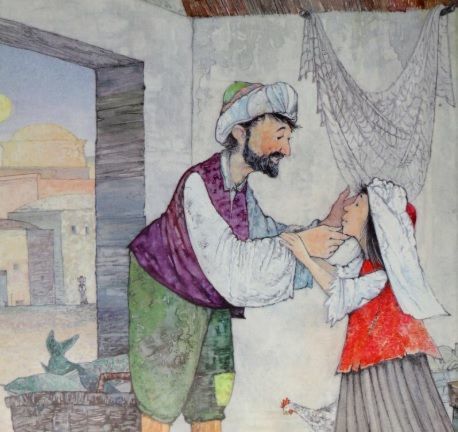
Poor Maha! Her jealous stepmother makes her do all the housework while her selfish stepsister lazes about.
Since Maha's father is away fishing most of the time, there is no one to help or comfort her. All that begins to change when Maha finds a magical red fish. In return for sparing his life, the fish promises to help Maha whenever she calls him. On the night Maha is forbidden to attend a grand henna to celebrate the coming wedding of a wealthy merchant's daughter, the fish is true to his word. His magic sets in motion a chain of events that reward Maha with great happiness, and a dainty golden sandal is the key to it all.
Rebecca Hickox's eloquent retelling and Will Hillenbrand's lush pictures offer a beguiling version of a story well-loved by many cultures the world over.
A pretty standard and bland rendition of an average Middle Eastern version of Cinderella that didn't bring anything new, but I'm not rating it lower because the art isn't that bad.
“Ah little one, I shall never marry, for stepmothers are often too jealous of another’s child” is said by Maha’s father on one of the first few pages of The Golden Sandal. This sentence represents a common theme seen throughout many versions of Cinderella, and The Golden Sandal is no different. This is a Middle Eastern version of this traditional story. Maha’s father marries a women, who is referred to as “the stepmother” throughout the text, and treats Maha poorly throughout the book. One day Maha spares a little red fish’s life, and he tells her, if she is ever in need, to come back to the river to see him. Maha goes to the river throughout the book to seek help when the stepmother treated her poorly, and to have a chance to go to the henna, a large wedding party, being held by a wealthy family. This text includes themes such as the importance of kindness, hard work, and patience.
This text includes many similar events and themes as the traditional Cinderella tale. The author included a note in the back of the text, explaining that his version came from Arabic versions of this story. This text includes information on the Middle Eastern culture, and would give students an opportunity to learn about events, such as hennas. This book would be ideal for younger elementary students, such as 1st and 2nd graders. In addition, the illustrations were done on vellum and copied in a traditional Islamic style. This book could be used to reinforce the importance of hard work and kindness, or to compare and contrast different versions of Cinderella. Students will enjoy the familiar tale, with a few new and exciting differences.
Name: The Golden Sandal Genre: Fairy Tale/Folk Lore Version: Middle Eastern / Islamic culture
Cinderella: Maha Magical element/"fairy godmother": The small red fish Glass Slipper: The golden sandal The ball: The wedding reception Message: The importance of being kind to everyone. Ultimately, good people win.
The daughter of a widowed fisherman, Maha was lonely for a mother's love, and convinced her father to marry their neighbor. Unfortunately for her, her new stepmother was resentful and unkind, and the young girl was made to do all the work, while her stepsister lazed around. After sparing the talking red fish she finds one day, Maha gains a magical ally who helps her throughout her childhood and adolescence. When denied the chance to attend the henna party of a wealthy merchant's daughter, Maha appeals to the fish, and is given enchanted clothing to wear. Returning home at the end of the evening, she loses one of her golden sandals, and it is found by the merchant's son, who is so struck by its dainty beauty, that he decides he must marry its owner...
Adapted from the Iraqi tale of The Little Red Fish and the Clog of Gold, to be found in Inea Bushnaq's 1986 Arab Folktales, this Middle Eastern Cinderella story has many of the elements associated with this tale type, from the unkind stepmother and lazy stepsister, to the magical protector/guide. There is even a party to which the Cinderella figure wishes to go, although here it is a women's only party, rather than the ball of the western tradition. The Golden Sandal: A Middle Eastern Cinderella Story is the second folkloric picture-book I have read from author Rebecca Hickox, following upon her Zorro and Quwi: Tales of a Trickster Guinea Pig, and I enjoyed the narrative, appreciating the mixture of familiar and unfamiliar elements. The accompanying artwork from illustrator Will Hillenbrand, created on velum in a variety of media (he discusses his method in a note at the read), was likewise appealing. The only thing I would criticize is the author's claim, in her afterword, that the Chinese variant of this tale type is the oldest recorded version. This is in fact untrue, as the ancient Egyptian version - see Shirley Climo's The Egyptian Cinderella for a retelling - is the oldest known version. Leaving that aside, this is one I would recommend to young folklore enthusiasts, and to anyone seeking Cinderella variants from around the world.
The Golden Sandal is yet another Cinderella story. This is a Middle Eastern Tale though about a fisherman whose wife had drowned and left him alone with his young daughter, Maha. Eventually Maha's father remarried. His new wife quickly became jealous of her husband's love for Maha. She also noticed how beautiful and clever his daughter was and how her own daughter was quite the opposite. She soon began creating more and more work for Maha to do. One day while carrying a basket full of fish home to her step-mother, Maha heard a voice. The voice was of one red fish in the basket. It begged her to spare its life and set it free. When Maha did this the fish told her to come back anytime and ask for anything she needed. One day many years later, all of the women of the town were gathering for the henna celebration of a bride-to-be. This was where young women could be seen by the mother's of young men. These mother's would choose a wife for their sons. When Maha's step-mother and step-sister headed to the celebration, Maha ran to the river. She asked the fish to help her join in the celebration. The fish gave her everything she needed to go to the henna and told her that she must leave before her step-mother did. At the end of the night when Maha rushed home, she lost her golden sandal behind her. Of course, the bride's brother, Tariq found the sandal and insisted that the girl be his wife. His mother searched long and hard to find the girl who fit that sandal and while Maha's step-mother did everything she could to keep Maha from Traiq's mother, she could not. Eventually, Maha and Tariq were married and lived happily ever after.
Activities: 1. There are so many Cinderella stories but I wonder if there are any where the roles are reversed. The gender-bender activity from Jim Burke's "103 Things to do Before After and During Reading" would be fun for this story. With this activity, students rewrite a scene (or the story) and flip the genders of the main characters. Students then discuss/show how the characters might act differently.
2. Burke's "Open Mind" activity could also be done with this story. With this, students draw an empty head and draw inside, any symbols, words, or images that might be bouncing around in the mind of the character. Next student can share and explain their drawings with the class.
Out of all the Cinderella variation stories this so far is the one that is most interesting since so much of it is quite different from the original and more well-known versions. There is no familiar background, the culture is different and it is the child who ends up begging her wise father to remarry although he refuses at the beginning since he knows what is going on. Culturally-wise I am still trying to figure out why he did continue to marry the neighbor since I thought the man was in charge.
Anyway it takes a bit of adjusting and getting used to the idea when you are reading the book. What makes it easier is that it seems to combine just a bit of the Chinese Cinderella along with its own natural storyline.
The pictures were charming and cute while helping to convey the reader over to the Middle East. The only true complaint that I had about the book was the fact that the stepsister was made not only to look ugly but way older than her years would warrant, which has me wondering why on that front.
This middle eastern version of Cinderella offered an insight into the middle eastern culture with illustrations that represent it. I enjoyed the illustrations more than the story.
Title: The Golden Sandal Author: Rebecca Hickox Illustrator: Will Hellenbrand Genre: Non-European Theme(s): Good things can happen when you least expect it. Nice people always win. Opening line/sentence: There once lived a fisherman whose wife had drowned, leaving him with a small daughter named Maha. Brief Book Summary: Maha, a fisherman’s daughter, is a poor girl that is looking for someone to marry. She lives with her evil stepmother. After talking to a lucky red fish she was privileged enough to go to the merchant’s house and meet a very nice man. They ended up living happily ever after together. Professional Recommendation/Review #1: School Library Journal In this gentle Cinderella variant from Iraq, young Maha begs her widowed father to marry their seemingly kind neighbor, a widow with a daughter of her own. After the marriage, however, the woman grows to loathe her stepdaughter, and she and her daughter treat Maha like a slave. One day, the poor girl rescues a talking red fish that helps her over the years. Finally, it provides her with fine clothes so that she may attend a wealthy young woman's bridal ritual. She stays too long, and in her flight, she loses one of her golden sandals. Tariq, the bride's brother, finds it, and his mother searches the city for the owner of the shoe. Maha's foot is a perfect fit and she and Tariq live happily ever after. In her gracefully written narrative, Hickox effectively blends many familiar touches with elements of the story that will be new to Western audiences. An author's note provides the sources for this well-told tale. Hillenbrand's delicate, textured illustrations have the look of watered silk touched with glowing jewel-toned accents. The paintings integrate well with the text, and the result is a sweet, smooth book with just a hint of spice. Donna L. Scanlon, Lancaster County Library, PA
Professional Recommendation/Review #2: Children's Literature - Joyce Rice Maha's father is a fisherman and must be away for long periods. Maha wishes for a stepmother and stepsister to keep her company and to help her. When Maha's wish comes true, and her father marries again, Maha is delighted. Her delight ends when the stepmother becomes jealous of her and makes her do all the work, and feeds her only dried dates. Maha's unlikely rescuer is the red fish that she throws back into the water. This is another Cinderella tale but with differences that make it unique to the country of Iraq. This is an excellent addition for teaching origin of this genre, as well as teaching about other countries. It is a delightful story just for sharing, but can also be used in instruction during multicultural units.
Response to Two Professional Reviews: The reviews state how this is a well-told tale that has pictures that really integrate with the text. They think that this is an excellent addition for teaching origin of this genre as well as teaching children about other countries. The reviews state how this is entertaining as well as informational when students are learning about other cultures. Evaluation of Literary Elements: Maha is just like Cinderella, she symbolizes her. The setting is in the Middle East. The climax is when she is fed up with living with her evil stepmother and talks to the red fish. Consideration of Instructional Application: Have students get into small groups and make their own twist on the Cinderella story. They must pick a region or culture and make the story be based on this specific culture of way of life. After they pick the culture they must make a story that mirrors Cinderella about that culture.
Kickox, Rebecca. The golden Sandal; A Middle Eastern Cinderella Story. United States of America Library of Congress Cataloging-in-Publication Data, 1998. 32 p. Gr. K-2
A young fisherman’s wife had drowned which left him to care for their daughter, Maha. The daughter loved when the neighbor lady would come over with her own daughter and care for her. Maha begged her father to marry the neighbor. But father told her that stepmothers are too often jealous of another’s child and he will never remarry. But Maha begged and begged until finally Father decided to marry the neighbor lady. After time passed by, the lady realized how much Father loved his daughter. The lady realized how Maha was so much better than her own daughter and she began forcing Maha to do more and more work. One day when Maha was headed home from fishing, she heard a voice. Maha realized it was a little red fish beneath the other. Maha immediately released the fish back into the river. Before the fish was released back into the river, he told Maha that she could come back any time and ask for anything. When Maha got home the step mother was mad that she only brought three fish home, and was sent back to the river to get the little red fish. When she went back to the river, little red fish gave her a gold coin. The stepmother was happy with the gold coin, but did not like Maha any better. Years passed and Maha grew more and more beautiful which made her stepmother very angry. The time came for the girls to go to the bride’s henna to meet their future husbands. The stepmother prepared her own daughter but not Maha. Maha ran to little red fish and told him her wish was to go to the bride’s henna just as all the other young ladies. Maha went but forgot to keep an eye on her stepmother and stepsister. Before she realized it, she needed to run home. On the way home Maha lost one of her golden sandals into the water below the footbridge. Several days later Tariq found the shoe in the water. He thought it was so beautiful and elegant and wanted to find the owner of the shoe. Tariq’s mother spent days searching for the girl who wore the golden shoe. She finally arrived to the fisherman’s hut and was forced to try the shoe on the stepsister. Of course the shoe didn’t fit. She was about to leave the house when she heard a noise coming from the bread oven in the yard. Tariq’s mother ordered her servant to open the oven, where Maha was forced by her stepmother. After trying on the shoe, Tariq’s mother realized she had found her son’s new bride. After the stepmother tried to ruin Maha’s wedding, bad luck fell onto her. Maha and Tariq lived happily ever after, with seven children!
This book can be used in the classroom as a set to compare and contrast different takes on common told stories and tales. Students could use Venn Diagrams to display the information they find. This book could also be used to explore the process of predicting. While students know the original tale, they may think they will know what happens in this Middle Eastern version. As you read the story to them, they could predict what they think will happen next. After you have finished the book and the students have written down all of their predictions, the students can then go back and evaluate their predictions.
Hickox, Rebecca. The Golden Sandal. Holiday House, 1998. 31 p. Gr. K-4 There was a young girl named Maha whose mother had drown and her father was a fisherman. Next door was a lady who had her own daughter but often took care of Maha because she felt bad for her. Maha begged her father to marry their neighbor and after Maha asked her father numerous times they were married. Everything went well at first but then like her father said the neighbor became jealous. One day Maha went out to catch a few fish and she caught three catfish and a red fish that begged to be released. Her father asked her what happened to the redfish the step-mother scolded her. The red fish gave Maha a coin which pleased her step-mother but did not change the fact that she was not liked. Years went by and it was time for the daughter of the master merchant to be married. All the women of the town gathered for the single girls were viewed as mothers of young men. Maha wanted to go desperately so she went to her red fish and he told her she would go. She needed to be home before her step-mother. She had a great time, so great that she forgot to watch for her step-mother to leave. She ran out the door and across the bridge but, she had tripped and lost her shoe. She made it back just in time for when her step-mother returned Maha was on the doorstep sweeping. A few days later the brother of the bride found Maha’s sandal and she needed to find its owner. Going from house to house in search of its owner finally find Maha. Tariq’s mother said that they must be married and then the wedding was planned. Her step mother wanted it ruined and asked for shampoo to rub on Maha head that smelled like dead fish and would rid her of her hair but instead her hair was gorgeous and smelled like roses. The other brother wanted to marry Maha’s step sister and she used the shampoo on her daughter but this time the step-sisters head was covered in blisters and smelled like fish. That wedding was called off but Maha and Tariq had several children and lived happily.
Connecting to this story for some if important. It makes the story more relatable and students understand it better. With this story we can use the relationship of the shampoo and how it is not good to wish something bad upon someone for it could come back and have negative effects on them like it did for the step-mothers daughter. Another way we can connect is the important theme of kindness. We need to teach that when you are kind to others good things happen in return. Maha let the fish back into the water and he remained a friend and helped her all of her life. Her kindness and beauty was seen by Tariq’s mother and wanted the best for her son and wanted them married. Whereas if you are not kind to others, you will not receive kindness in return.
The Golden Sandal: A Middle Eastern Cinderella Story By Rebecca Hickox Illustrated by Will Hillenbrand Published by Holiday House 1998 Picture Book
Rebecca Hickox uses an Iraqi version of the tale of Cinderella to base The Golden Sandal around. The story is structured like Cinderella: father remarries, step mother and sister are evil, Cinderella meets a handsome boy, he finds her and they live happily ever after. This version centers around Maha, a fishermans daughter who encouraged and wanted her father to remarry after her mother drowned. Her new stepmother is mean and only "fed her nothing but a few dried dates." Instead of a fairy godmother, Maha has a talking red fish who she saved from being eaten. The fish helps her through many troubled times and eventually provides the beautiful clothes for her to wear. Maha gets to attend the henna party of a wealthy bride to be. In this version, she never meets her true love until the day of their marriage. Tariq, a wealthy merchant son finds her sandal and wishes to marry the owner. Maha is found, even though her stepmother locked her in the oven and the marriage is arranged by Tariq's mother. They marry and Maha's step sister becomes ugly and cannot make a marriage. Middle Eastern culture is brought to many reader's attention who may have little previous knowledge of Iraqi customs. The main occupations (fisherman and merchant) speak to class differences, while the henna party is illuminated as an important marriage custom. The arranged marriage is also a part of the culture shown through the well-known fairy tale. It is very different in this version that "Cinderella" never meets her prince or falls madly in love at first sight. I really liked the aspect of the fish being the godmother and the rooster giving away the place where the evil stepmother hid Maha. The illustrations were done on vellum paper in pencil and various types of paints. Reading the story, I was fairly indifferent to the illustrations. I liked them and thought they were very pretty, but thought they could have better contributed to the story. I think I would have liked to seen several different scenes illustrated than those chosen, like the moment when Tariq lifts his bride's veil and not the ugly stepsister at the end. After I read the illustrator's note I looked back at the illustrations and saw great technical and artistic skill, which made me want them employed to better use even more.
The Golden Sandal is a Middle Eastern version of Cinderella. The heroine, Maha, begs her widowed father to marry their neighbor, the rival. Her father hesitates, cautioning Maha that a stepmother would be jealous of her. Maha protests and her father finally agrees to marry their neighbor. The stepmother eventually grows jealous of the fisherman’s daughter, who is more beautiful and talented than her own daughter. Out of anger, Maha’s stepmother gives Maha more and more chores. It was through one of her chores that Maha meets a magical little red fish- the helper- that helps Maha in many ways. One way that the red fish helps Maha is by transforming her from riches to rags to attend a henna party to attract a suitor’s mother. The fish warned Maha to leave the party before her stepmother and, in complying with the warning, Maha leaves in a hurry. During the race, Maha loses one of her golden sandals into a body of water, it is discovered by a suitor, and the suitor asks his mother to arrange a marriage with the owner of the slipper. The arrangement is successful despite the stepmother’s attempts to sabotage the arranged marriage.
This folktale has cultural integrity. The author provides a note that she researched a story from Iraq called “The Little Red Fish and the Clog of Gold,” which she used to structure The Golden Sandal with cultural integrity. Her purpose was to diversify picture books set in the Middle East, noting that Arabian Nights was one of the only Middle Eastern texts widely known by children. The illustrator used mixed media, including oil, oil pastel, egg tempera, watercolor, water soluble artist crayons, and a combination of woodless pencils. The illustrations were also based on cultural research, as noted by the author himself. The inclusion of henna and arranged marriages is representative of Middle Eastern culture.
In a second or third grade classroom, students can compare this version of Cinderella to other versions using a Double Bubble Thinking Map. Yeh-Shen: A Cinderella Story from China would pair especially well. In a fourth or fifth grade classroom, students can begin to investigate how culture and time period influenced the folktale.
What do you get when you take Cinderella's glass slipper and transport it to the Middle East? The Golden Sandal! Rebecca Hickox's delightful retelling of an Iraqi folktale "The Little Red Fish and the Clog of Gold" has all the makings of any good Cinderella story- There once lived a fisherman whose wife drowned, leaving him with a young daughter named Maha. Nearby lived a widow with her own young daughter. Each day the widow would come and take care of Maha as the fisherman would go off to work. Maha thought the widow loved her like her own and begged her father to marry her. Reluctantly the two were married and life for Maha had changed. Her chores increased, while her stepsisters decreased. One day while fetching the fish from her father's boat, a little red fish called to her and begged for his freedom. He promised that if she let him go, he would give her anything that she wanted. Years went by and both girls turned into young women. One day, an announcement was made that the daughter of the master merchant was to be married. All the women were to gather for the celebration of the henna painting, which is a wedding tradition. The stepmother scrubbed her daughter and dressed her in her finest clothing, as mothers of young men would be there to choose brides for their sons. Maha was left at home to continue the evening chores. As soon as the others were gone, Maha ran to the river to talk to the fish. The fish dressed her in a silken gown and a pair of golden sandals. He told her to sit in the middle of the hall near the bride herself. He told her she must leave the celebration before her stepmother. This story portrays many middle eastern traditions within a familiar folktale. Students will learn that in the middle east, marriages are arranged, and there are many different traditions that lead up to the wedding ceremony itself. But will Maha live happily ever after? What will come of her evil stepmother and stepsister.
This traditional story will enlighten children from kindergarten through third grade.
Cinderella variations occur in so many different cultures that the story is almost universal. This particular version, which the text notes is based on a story from Iraq, has most of the traditional components: an evil step-mother, a lazy and cruel step-sister, and a magical character who helps the main character, Maha, go to a party. Here, the fairy godmother is a fish who owes Maha his life. The cultural aspects are sharply different in this story, though, from any European version. Maha does not meet or fall in love with her husband-to-be and only lays eyes on him at her wedding. Everything is arranged by the groom's mother via her daughter's wedding party. Marriage is not seen as a love relationship here but a business partnership, with Maha urging her father to marry again so he won't have to do so much work and the groom's mother encouraging him to marry when he finds Maha's sandal, which apparently he finds pretty enough that he wants to marry the owner. The unusual qualities in the story might be enough outside of the experience of most children to need further explanation. The ending, in which the step-mother still tries to ruin Maha's wedding only to ruin her own daughter's and have her sent back in disgrace, does keep some of the feel of the original story in which the stepmother and stepsisters are punished, but it does feel a bit cruel. The illustrations are reverse painted on vellum, giving them a cloudy quality in some cases, but I will admit I sometimes had difficulty telling the stepmother and stepdaughter apart in the drawings as they seemed to be identical in age. The background material at the end explaining some of the history of Cinderella tales and this one in particular was useful, and the artist's process of creating the paintings was informative. On the whole, this was a good story, but it might require further discussion with younger children, particularly any with step-parents as the father says straight out that they are dangerous to their step-children.
The Golden Sandal is a twist on the tale of Cinderella. The young girls name is Maha and she is from the Middle East. Maha wants her father to get married. Her father then passes away and she is left with her stepmother and stepsister. Her stepmother is not very nice to Maha and obviously favors her own daughter. Maha takes care of the family's chores. Instead of a fairy godmother, a fish helps Maha and gives her advice and gifts. She attends a wedding reception like event with her stepmother and stepsister and meets the bride/princess's brother. She loses her golden sandal and he finds it and declares he wants to marry the girl who lost this shoe. He goes to find the girl who lost it. Maha's wicked stepmother locks her in an oven to keep her out of sight. She is still found and marries the Prince. On their wedding night her stepmother tries to put stuff in her hair to make it fall out but it ends up making it shinier. Maha gets her Prince's brother to meet her stepsister who uses the same stuff in her hair only to have it give her blisters on her scalp and scare the other Prince away.
I liked this story because it was a very different spin on Cinderella. This story can teach a lot to children about the importance of being kind to everyone you meet and that ultimately good things happen to good people. This story would be best for children in Kindergarten through fourth grade.
This tale was very telling of Middle Eastern culture and I think children would benefit from this. I think there are too many negative stereotypes of Middle Eastern way of life in America so I loved that the heroine of the story was from this culture. The author did not seem to be Middle Eastern at all but I still felt it enlightened me on aspects of their culture, especially wedding customs.
In the classroom, I could use this book to start a lesson about Middle Eastern culture and different types of customs. I would also like to have my students write an alternate ending for the story if they were not happy with how nice Maha treated her horrible stepsister.
At the end of Hickox’s Cinderella-inspired book, she has an author’s note describing the source of the book. Her inspiration for the book was taken from two different books, one from Iran and one from Iraq. Both stories had the rags-to-riches theme, but Hickox made the story her own. There was an extensive illustrator’s note as well, which described in detail how the illustrations were created. The book is about a girl who gets an evil stepmother, and she ends up marrying the prince. I enjoyed the story, because the traditional Cinderella elements could be found. However, there were new elements found in Hickox’s version, such as a red fish instead of a fairy godmother and a golden sandal instead of a glass slipper. I found the book to be informative about a culture dissimilar to my own. The illustrations were created on vellum, and pastels, paints, and oils were all used. The illustrations were quite unique-looking, and I found myself staring at them multiple times. There was not any white space on the pages; all of the pages were covered with color or illustrations. I gave the book five out of five stars, because it contained traditional Cinderella elements but also had new additions as well. I enjoyed the author/illustrator notes in the back too. The recommended reading level for the book would be between first and third grades. Students at this age could relate to the Cinderella story, and they know what it feels like to be left out. Children will be able to connect with seeking acceptance and approval from family members. Two subject areas into which the book could be integrated could be social studies and language arts. For a language arts lesson, students could read a handful of various Cinderella stories. We could compare and contrast the books to tell how they are alike and different.
The Golden Sandal written by Rebecca Hickox is an Iraqi version of the Cinderella story. This is the story of Maha, a fisherman's daughter, and her experiences with her stepmother and stepsister. Maha finds a small red fish in a basket one day. Releasing it back into the water, she is told that no kindness goes unrewarded. The fish becomes her source of help whenever life becomes too difficult. Maha grows up to be a beautiful young girl but she is forced to serve her stepmother and stepsister like a slave. She hears of a local bride’s henna ceremony, she goes to the fish asking if she can go, the fish tells Maha that she can go, and will not only be dressed in finery, but will sit in the section of the house where the royalty and noble women are seated with the bride…however she must leave before her stepmother does. She finds a beautiful gown, a pearl comb, and golden sandals. She has a wonderful time at the henna ceremony, but she sees her stepmother leave, Maha runs to her home, trips, and loses her sandal. The brother of the bride, named Tariq, finds her sandal, and says he will marry whom ever it fits. Tariq and his mother go all over the land, and eventually find Maha, and her foot that fits the sandal perfectly. Despite many obstacles from her stepmother, eventually Maha and Tariq live happily ever after.
This is an important story to show students because it helps them learn of different cultures, what things are significant to them, all while doing it with a familiar story.
I would invite students to compare and contrast this version with another variant of the tale using the Venn diagram.
Finally, I found a story from the Middle East. The illustrations are wonderful. They depict the food, clothing, and a village that some of my students report as being authentic, including the wild chickens roaming around. The Middle Eastern counterparts to the American Cinderella characters were quite entertaining. In lieu of a fairy godmother, the protagonist, Maha, discovers a talking fish in her basket, whose life she spares. As Maha releases the fish, it casts its spell in a religious context, “Allah says a kindness never goes unrewarded; call for me any time and ask for what you will.” There is a wedding preparation party instead of a ball and the mother of the groom is the one doing the searching for an appropriate match for her son.
Unfortunately, in being a reflection of the culture, this Cinderella story has many stereotypes that we do not want our children internalizing, particularly around gender roles. Maha, the protagonist, pleads with her father saying, “You should marry our good neighbor so you won’t have to cook your own food or mend your own clothes, and then I can have a mother and a sister.” Then, just in case any step parent isn’t already offended, the father replies, “Ah little one, I shall never marry, for stepmothers are too often jealous of another’s child.” This is only the first page of many, which leads me to the second minor criticism. For some reason, this book has no page numbers. Not being able to refer students to specific page numbers would complicate things for me when designing a reading guide
Categories/Genres for this class fulfilled by this book: Traditional (1998)
Copyright date: 1998
Estimate of age level of interest: K - 3
Estimate of reading level: Dewey: 398.2; Int Lvl: K-3; Rd Lvl: 4.4 AR 4.7 LG .5 25866EN; RC 5.9 2; LEX AD870L; GR O
Brief description: This is the age old Cinderella story with several variations.
Identify at least 2 characteristics of this genre and subgenre and discuss how they appear in your book. Fairy tales typically have some royalty in it, and this book is no different. The prince finds the sandal in the river and the mother finds the girl for his wife. Another characteristic is that there is usually a magical element, and this book had the fish which represented Cinderella's fairy godmother as we know it.
In what ways and how well does the book as a whole serve its intended audience? The book is an Iraqi version of the American Cinderella story based on the tale of "the little red fish and the clog of gold." It is a fairy tale with "happily ever after" and the good girl wins, while the evil stepmother gets what she deserves by having her daughter's hair fall out.
Awards: None that I could find.
Reviews: Book Links, 05/01/00 Booklist, 07/01/01 Bulletin of the Center for Children's Books, 06/01/98 Elementary School Library Collection, 06/01/00 Horn Book Magazine, 03/01/98 Kirkus Reviews, 04/15/01 New York Times, 09/20/98 Publishers Weekly, 01/26/98 School Library Journal, 06/01/01 Wilson's Children, 10/01/10
My RIF teacher said her class had just finished Cinderella and asked me to find a parallel story from another culture. This work is from Iraq and my second-graders were astute about finding similar items here and the version they had heard. Instead of a king/princess this is a fisherman whose wife drowned. The fairy godmother is a red fish the father has caught. When our heroine, Maha, is sent to get it from her father's boat she falls for the request from the fish to set him free and is granted numerous wishes, including new clothes to wear to attend the master merchant's henna painting before her wedding. Maha even gets to sit near the bride and he stepmother and stepsister see her but know Maha is home sweeping. Maha has been told to watch the time and leave before they do. Of course she's running, falls, trips, loses the golden slipper in the water. Of course there is a search for her and her stepmother shoves Maha into the bread oven in the yard. A rooster alerts the mother of the brother of the bride Maha is in the oven.
Even tho the unnamed stepmother is given gold and told, "Your stepdaughter is now bethrothed to my eldest son," she goes to the perfumer to get an oil that smells "as foul as rotting fish." When applied to Maha and Tariq lifts the veil "the scent of roses filled the room." When Tariq's brother wishes to wed the stepsister there is a stench and the head is covered with blisters.
The Golden Sandal: A Middle Eastern Cinderella Story was written by Rebecca Hickox and illustrated by Will Illenbrand in 1999. While most people are familiar with the Western version of Cinderella, as popularized by the French author Perault, it is a story that has been told in many cultures. The Golden Sandal is a Middle Eastern version of the classic tale. Instead of a fairy godmother, a magic fish that Maha (this story’s Cinderella) saved becomes a source of comfort and help as she grows up, and provides the gown and slippers to attend a wealthy wedding (this version’s ball). I enjoyed reading this take on the classic story, and while it is well written and engaging, I wished that the illustrations were more in line with the style of Middle Eastern art. The style itself is very Western, and other than the clothing, the characters themselves don’t look Middle Eastern (in fact, they look white). This pulled me out of the setting and made the story feel less authentic. It had me wondering what else was Westernized and/or whitewashed. Illustrations are such an important aspect of picture books, and these missed the mark. I do think it would be great to expose students to several versions of a classic tale so they can examine the similarities and differences, but I wouldn’t recommend this book because there are other examples that do a better job of capturing the culture in which the story is set.
The Golden Sandal by Rebecca Hickox is a Middle Eastern view on Cinderella. Maha is a young girl who lives in the Middle East with her father. She begs her father to marry the neighbor, so she could have a mother, who turns out to be a mean stepmother. Maha befriends a fish who helps her fulfill her stepmothers demanding requests. The daughter of the master merchant is to be married, and every women in town attends her henna ceremony. Maha really wants to go, so the fish sends her a beautiful gown, a pearl comb and a pair of golden sandals. Maha was told to remember to leave before her stepmother so she could get home before her. She ran home to try and beat her stepmother home and tripped, loosing one golden sandal. Tariq, the brother of the bride, found her golden slipper the next day in the stream. Tariq's mother went house to house searching for the owner of the shoe. Maha was shoved in the bread oven hidden from the mother searching for the one person who fit the golden shoe. Maha was ordered to come out of the oven, and the golden shoe perfectly fit her foot. Maha and Tariq were then happily married.
There is little white space in the story, and many traditional words from the middle eastern culture. This story would be great for grade 2-4, due to the story being somewhat lengthy for a picture book.
Kirkus Review: Hickox (Zorro and Quwi, 1997) finds her Cinderella in Maha, a fairy godmother in a red fish that Maha shows mercy to, and the lost slipper in a golden sandal, discovered by Tariq, brother of a rich merchant, who then takes on the search for his bride- to-be. When he arrives at Maha’s house, her stepmother conceals her in an outdoor bread oven, but a happily-ever-after ending is as integral to this Iraqi version of the story as it is to other retellings. An illustrator’s note explains the complex process undertaken for the artwork, done in stages with oils, oil pastel, egg tempera, watercolor, crayon and pencil on vellum, but what readers will come away with is an appreciation for the unusual setting, comic characters, and the age-old emotions and resolutions that rule this story.
Write an Original Recommendation: I would recommend using this book in kindergarten because I feel that children are exposed to many different fairy tales at this time. Cinderella is a story that most children in America are familiar with, and I think it would be great to expose them to different versions of this story from different cultures around the world.
Cinderella has a different name is this tale. Maha is the daughter of a fisherman. After her mother drowned, she begs her father to marry the kind neighbor woman. Despite her fathers warnings, Maha continues to beg.
His wisdom bore truth, and the kind neighbor becomes the jealous and spiteful stepmother.
Maha’s kindness saving the life of a small red fish gives her the gift of friendship and magical wishes are granted too.
Maha must be home from an evening of celebration of the local merchants down before her stepmother. As the story follows suit, Maha loses her golden sandal in the water. It is retrieved by a kind man who loves the delicateness of this tiny shoe. He searches for the shoes owner so he may find his bride.
I rated this book 4/5 stars. Appropriate for grades 3+
A traditional literature story that provides a middle eastern twist to the familiar fairy tale or western told Cinderella story. Through text and illustrations, the reader is swept away into a story about an average girl who has a magic fish that helps her solve her dilemmas and helps her get married. The illustrations compliment the story and provide laughs especially at the end. This story will provide diversity to a library and allow students from the middle eastern culture to relate to a Cinderella story.
Here's a lovely version of Cinderella and one with a shocking little twist at the end. Your princess-loving daughter will enjoy this read!
Ages: 4 - 9
#geography #middleeast #fairytales
**Like my reviews? I also have hundreds of detailed reports that I offer too. These reports give a complete break-down of everything in the book, so you'll know just how clean it is or isn't. I also have Clean Guides (downloadable PDFs) which enable you to clean up your book before reading it! Visit my website: The Book Radar.
The Golden Sandal is another Cinderella story with some cultural twists. In this book, Maha is Middle Eastern and just lost her mother in a tragic drowning incident. Later, Maha's father remarries a woman who seemed kind, but turned out to be a nightmare. Maha eventually gets her happily ever after sparing a fish's, her "fairy godmother's" life. Honestly, I do not care for Cinderella stories, but I did enjoy a new twist on the classic fairy tale. I would introduce this book to a younger audience to expose them to a culture they may or may not know about.