I think I’ve become spoiled by the big trade paperback comics I’ve been buying, and thus have drifted away from short comics. I don’t like reading comics in a single day unless I’ve read them before. I like to savor new reads. I read Sumo in about fifteen minutes, and normally wouldn’t have much to say about something that short. But just commenting on its length and leaving it at that would be doing it a disservice.
Without giving too much away, Sumo follows a young man who leaves America to train as a rikishi in Japan. The comic follows three chronological threads, showing three different stages of this journey: his motivation for going, his doubt and loneliness once he arrives, and his preparation for a pivotal match.
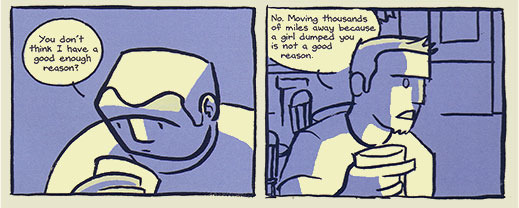
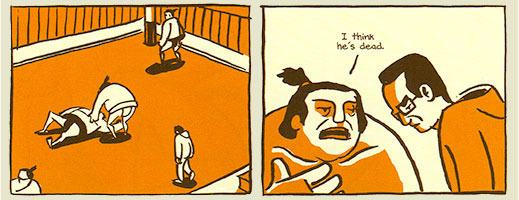
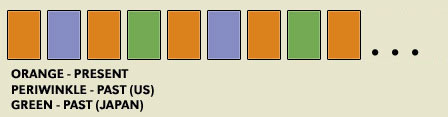
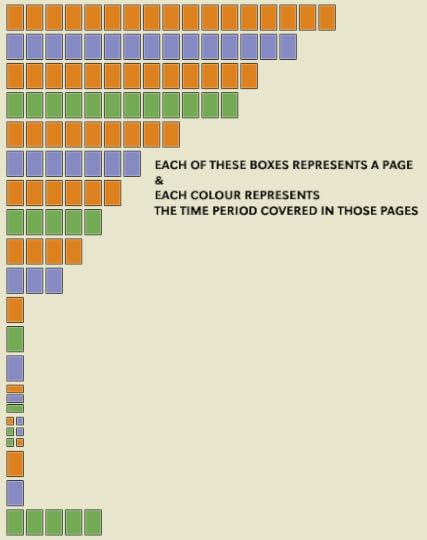
These three sections mix together in a way that can be initially confusing, considering that there are no transitional scenes to demarcate them. However, each is coded by the ink color used in the spartan artwork: blue for when he was preparing to leave, green for the time of his initial arrival, and orange for the main story (such as it is) in Japan. With this in mind, it quickly becomes easy to not only follow what is going on but to get a sense of this short, sweet little comic’s pacing. I recently heard Pham talk about this comic, and he said that he patterned it after the pace of a sumo match: slow in the beginning, with lots of pomp and preparation, leading up to a sudden collision and ending almost before it begins.
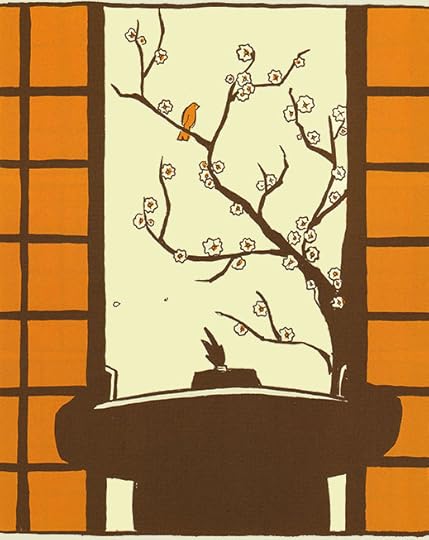
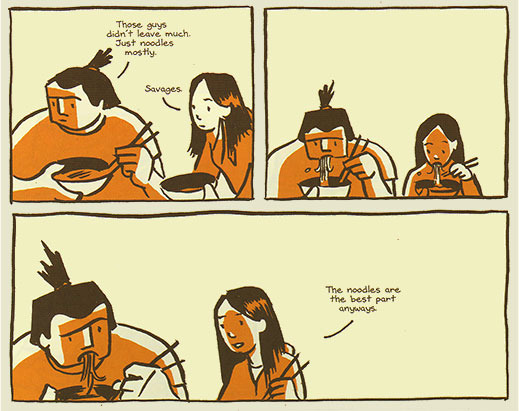
Everything about this comic is in its artwork. There isn’t much dialogue that extends beyond what is literally necessary to move the story. The artwork is simple and largely unadorned, which is a testament to Pham’s skill as an artist, as the momentum of the story is held entirely in the panel design. The emotional states of the characters are clearly evident in their rough-hewn, often interchangeable features. When Pham does indulge his fanciful side, such as when Scott opens his shoji to gaze on the cherry blossom tree outside, the results are breathtaking despite their simplicity.
It’s easy to breeze right through this one and appreciate it for what it is: a quiet little parable illutrated with plain, likeable artwork. It delivers a lot to readers who take their time with it, though, or who go through it a few more times to appreciate what they missed the first time. Between this and Level Up, I think Pham gets a place on my “favorite comic artists” list despite my not usually gravitating to his style of drawing.