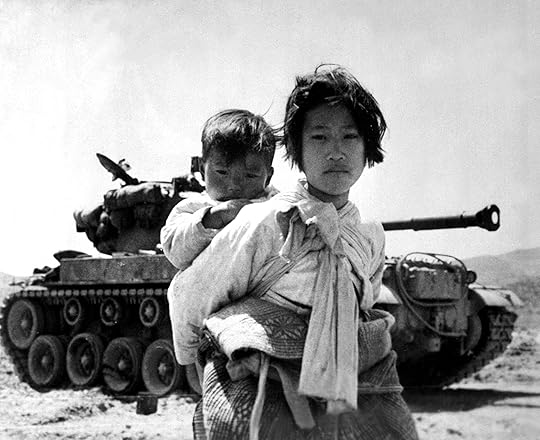
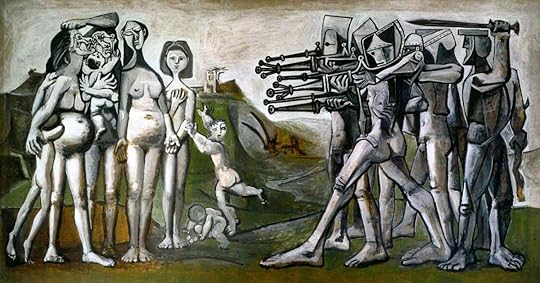
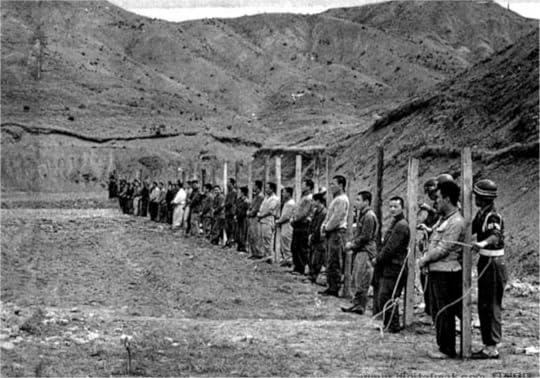
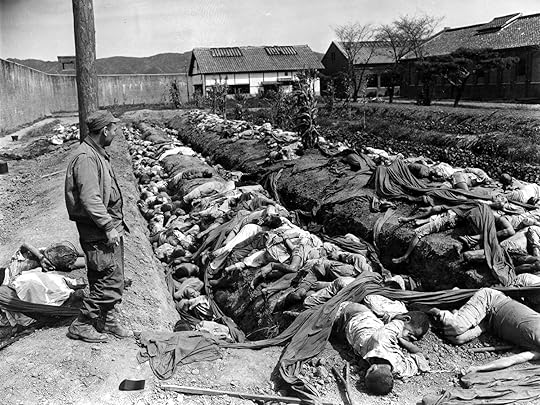
The Korean dimension of the Korean War may have been too long overlooked. We Americans tend to think of Korea as “the forgotten war,” a lacuna to be placed between the great victory of the Second World War and the shocking defeat that was Vietnam; but in his 2010 book The Korean War: A History, University of Chicago historian Bruce Cumings takes pains not only to demonstrate that the “forgotten war” has never been forgotten, in either part of long-divided Korea, but also to place the war of 1950-53 within a larger context of Korean history.
Cumings, whose scholarship has centered mainly around Korean and East Asian history, is not interested in providing a strictly military history of the Korean War – the sort of thing that can be found in books like British historian Max Hastings’s The Korean War (1987). As if to demonstrate, only about 30 pages of a 243-page book – or, to put it another way, part of the book’s opening chapter, “The Course of the War” – actually provides that chronological, events-driven summary of military history that readers might expect. The rest of the book focuses upon how the war is seen and remembered – within the context of Korean history, in both North Korea and South Korea, and in the United States of America.
Generally, modern writing on North Korea has focused on the cruelty and the human-rights abuses carried out by the North Korean regime, or on the way in which the government of contemporary North Korea constructs a bizarre cult of personality around its leaders past and present. Cumings, by contrast, seeks to understand the thinking and motivations of the North Koreans, going all the way back to when North Korea started the war with its June 1950 invasion of South Korea.
For Cumings, the key factor at work here is the North Koreans’ knowledge that a number of South Korea’s post-World War II leaders had collaborated with the Japanese during Japan’s 1910-45 occupation of Korea: “To the North Koreans it is less the Japanese than the Korean quislings that matter: blood enemies. They essentially saw the war in 1950 as a way to settle the hash of the top command of the South Korean army, nearly all of whom had served the Japanese….The Japanese occupation of Korea from 1910 to 1945 is akin to the Nazi occupation of France, in the way it dug in deeply and has gnawed at the Korean national consciousness ever since” (pp. 44-45).
Whatever the validity of Cumings’s points regarding North Korean motivations, however, the fact remains that North Korea started that hideous war, launched the invasion, initiated all that bloodletting. I do think it is important that those facts not be forgotten.
Indeed, one of the salient features of The Korean War is Cumings’s determination to be fair and accurate to the North Koreans. While noting, accurately, that “North Korean political practice is reprehensible,” Cumings denounces “the incessant stereotyping and demonizing of this regime in the United States,” and adds that “After seven decades of confrontation, the dominant American images of North Korea still bear the birthmarks of Orientalist bigotry” (pp. 97, 100).
I appreciate the critical-thinking spirit in which Cumings looks at American media coverage of this important country, but I can’t help pointing out that American media and American organizations are not the only ones denouncing North Korea’s cruelty to its people. International human-rights organizations like Amnesty International, after all, have been diligent in pointing out how the North Korean regime abuses the rights of the North Korean people. When these human-rights groups, including many based in Asia, denounce the behaviour of the North Korean government, would Cumings claim that they too are engaging in Orientalism?
Another of Cumings’s emphases in The Korean War: A History is his wish to deconstruct some of the American myths that have sprung up regarding the conduct of the war. In the traditional Korean War narrative, Americans and their allies fought in the same fundamentally honourable manner in which they fought in the Second World War; only Vietnam, with its numerous and well-documented examples of American atrocities against Vietnamese civilians and enemy prisoners, offers a departure from that paradigm. Au contraire, Cumings might say, pointing to specifics like the American air war against North Korea: “[W]e carpet-bombed the North for three years with next to no concern for civilian casualties….[W]hen foreigners visit North Korea, this is the first thing they hear about the war” (p. 149).
Comparing the Korean War experience with the Allied application of heavy bombing tactics against the Axis powers during the Second World War, Cumings observes somberly that “The United States dropped 635,000 tons of bombs in Korea (not counting 32,557 tons of napalm), compared to 503,000 tons in the entire Pacific theater in World War II” (p. 159). If Korea is, from the American perspective, the “forgotten war,” then perhaps there are some very serious reasons why we are in such a hurry to forget the damned thing.
The picture becomes even more complicated – and, for American readers, potentially even more uncomfortable – when Cumings addresses the issue of atrocities committed against civilians during the war by both the South Korean and North Korean forces. Since 2005, a Korean Truth and Reconciliation Commission has been documenting massacres of civilians; its grim findings are that “South Korean authorities and auxiliary right-wing youth squads executed around 100,000 people”, and that “Communist atrocities constituted about one sixth of the total number of cases” (p. 202). Again, this is not the depiction of the Korean War that Americans conventionally get.
Cumings’s emphasis on cruel actions committed by the South Koreans, and by their American allies, might lead some readers to wonder whether this book constitutes a sort of apologia for the North Koreans. But I do not think so. Rather, Cumings feels that “it is increasingly likely that the ROK’s authority will someday be extended to North Korea” (p. 199). It becomes all the more important, Cumings might argue, that in a future united Korea, Koreans from both north and south look at the difficult and painful history of their country with clear eyes.
Cumings dedicates this book to Kim Dae Jung, the former South Korean dissident. Under the former system, Kim Dae Jung had been jailed and threatened with death for his criticisms of South Korea’s then-authoritarian government; as President of South Korea, he instituted democratic reforms in his country, worked for peace with North Korea, and won the Nobel Peace Prize.
I purchased The Korean War: A History at a bookstore in Seoul’s ultra-modern Incheon Airport, which occupies the site of a major battlefield of that war. Reading it on a flight from Seoul to Washington, I often felt that Cumings was working too hard to provide a revisionist perspective, and in the process was letting the North Korean regime off too easily. At the same time, I read Cumings’s book as an expression of hope that modern South Korea – and, someday, perhaps, a possible united Korea – will move forward in the spirit of peace and democracy that Kim Dae Jung represented.