Many Americans commonly associate evangelical Protestants with the scoldings of the religious right and solicitations of money by televangelists. Whether or not these associations are particularly flattering, it is true that a concern for preserving a moral social order as well as an unrelenting desire to make new converts are traits that have defined evangelicalism throughout American history. In this cogent account, D. G. Hart unpacks evangelicalism's current reputation by tracing its development over the course of the twentieth century. He shows how evangelicals entered the century as full partners in the Protestant denominations and agencies that molded American cultural and intellectual life. Although the fundamentalist controversy of the 1920s marginalized evangelicals in America's largest denominations, their views about the individual, society, and families went virtually unchallenged in American society because of the ongoing dominance of Protestant churches and institutions. After 1960, when the United States entered a period sometimes called “post-Protestant,” evangelicals began to assert themselves more aggressively in politics and culture, seeking to preserve a Christian society. These evangelical responses to Protestantism's waning influence in America reveal a curious feature of twentieth-century despite its conformity to American ideals, since the 1970s evangelical Protestantism has been perceived as alien to other Americans. Mr. Hart's illuminating study offers an explanation for this change in evangelicalism's fortunes by showing the success and limitations of this popular religious movement.
Darryl G. Hart (Ph.D., Johns Hopkins University) directs the honors programs and faculty development at the Intercollegiate Studies Institute and serves Westminster Seminary California as adjunct professor of church history. He has written or edited more than fifteen books, including Defending the Faith, a biography of J. Gresham Machen. He is coeditor of the American Reformed Biographies series.
Appreciated the whole section on Bible Institutes. However, his definition of evangelicalism seems to be tied to dispensationalism specifically without any caveats. That has not been my experience of the term 'evangelical.' Seems to me more broadly pre-millennial, but not excluding the amillenial view of eschatology either.
I picked this book up as another potential window into how a "Reformed two-kingdoms" guy like Hart would evaluate 20th century evangelicalism, including its strengths and faults. First, Hart is a great historian; you realize how well he knows the history and its major players, so that his subsequent analysis stems from thorough knowledge of the subject. Second, he sufficiently demonstrates his conclusion that evangelicalism lives in such tension about how to divide the sacred and the secular that the end result is often pure confusion, which is perhaps the most significant critique found in the book. Great read.
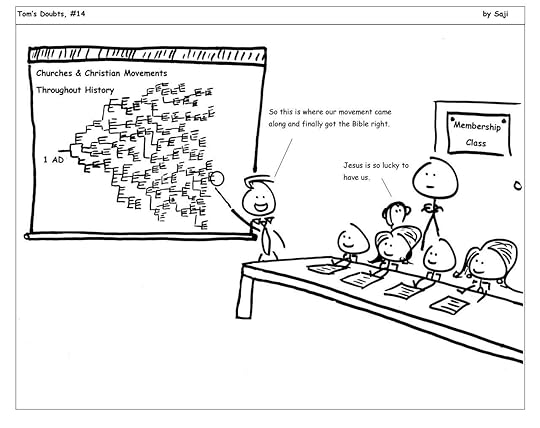
Unsurprisingly, this book is much better than when I read it at light-speed in college. Damning, though-provoking, interesting, and sometimes shocking. A good read for those who find themselves at the end of this cartoon:
I find myself in the interesting position of liking this book better than I did when I first read it even though I dislike the author and his conclusions more than I did last time. He nails the dilemma Evangelicals face between a cultural ghetto centered around cultivation of internal piety and between the desire to apply the Gospel to all of life. That's a tension that we should all think about for a few years. He very much insists that Evangelicals should to the former, and I'm sure it shows here, but that's too easy and not at all in line with what we see in the Gospels.
Older review: Interesting book. Some of it seemed pretty strait-forward (of course we don't section off God from public life), I did find it a great resource. Sometimes surprisingly encouraging to realize that we have developed a distinct part of the culture, even if we do not quite communicate it.
The book brings out the tension within evangelicalism. Evangelicals desire to be distinct from the "secular" world, yet they enjoy success because of their unusual savvy with the modern world's schemes for self-promotion. Aptly titled. I highly recommend it to accompany Ashby's *With Amusement for All*.
Another great feature of this book is its brevity. Great for US surveys, and a very easy read. With this book, many of my students have been able to historically contextualize their own church experience.
Finally, let it be said that D. G. Hart is a swell guy.
Hart is a bit snarky at times, but mostly accurate, and it was good and helpful to read an analysis that contextualizes the elements of evangelicalism I've observed, experienced, or grown up with. Possibly because I was reading it quickly for school, I was often confused by his terminology — "evangelical," "Protestant," "Christian," "conservative" and others became muddled in my mind. But informative and enjoyable nevertheless.
A wonderful overview of evangelical history, our history, really. At parts I was sad, and other parts I was proud. Either way, whether our evangelical leaders made good or damaging decisions, we owe so much to them and I'm thankful.
A great history by a capable historian of this subject. It's always helpful to keep in mind historical context when it comes to American Protestant history. Hart has helped me define and distinguish my own views on evangelical Protestantism with a really good outline of the period.