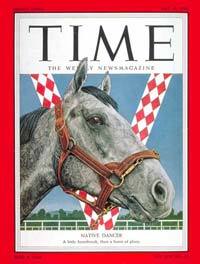
A portrait of celebrated thoroughbred racing horse Native Dancer, nicknamed "The Grey Ghost," relates his competition in the 1953 Kentucky Derby, two-time win of the Horse of the Year title, and induction into the National Museum of Racing's Hall of Fame. 40,000 first printing.
John Eisenberg is one of the country’s most acclaimed sportswriters. A native of Dallas, Texas and graduate of the University of Pennsylvania, he started out covering the “Friday Night Lights” for the now-defunct Dallas Times Herald in 1979. After rising through the ranks to cover pro basketball, he joined the staff of the Baltimore Sun in 1984. For the next 23 years he wrote columns in the Sun about the hometown Orioles, Ravens and Maryland Terrapins, and also covered major events such as the World Series, Super Bowl and Olympics. His honors included several firsts in the prestigious Associated Press Sports Editors’ contest. Since 2012 he has written columns on the Ravens’ website.
John has also authored 10 bestselling sports books, including The Streak: Lou Gehrig, Cal Ripken, Jr. and Baseball’s Most Historic Record. Published in 2017, it was a finalist for the Casey Award, which honors the year’s best baseball book, and was shortlisted for the PEN/ESPN Literary Sportswriting Award, which honors the year’s best sports book. John’s most recent title is The League: How Five Rivals Created the NFL and Launched a Sports Empire. John has also written for Sports Illustrated and Smithsonian Magazine. He lives in Baltimore with his wife of 35years. They have two grown children and a grandson.
I have a love/hate relationship generally with books on horse racing or that focus on a particular horse. I've stopped reading many of them for a variety of sins: being poorly written, anthropomorphizing the horse to a ridiculous extent, being boring (generally too much data with very little story), and/or lacking any kind of emotional tie to the subject and/or bona fides when it came to writing it. Of the ones I've stuck with before picking up this book (well, downloading it, it was my second Kindle read and a much more successful one than the first choice), I really only loved two: Seabiscuit and Ruffian: Burning from the Start. I think those take a pretty distant second to this book, but I caveat that with one thing. I know a lot about horse racing. A lot. I think it's possible this book is for someone like me and that may be why I loved it--it made a lot of assumptions that if you picked this book up, you understood racing in general, so I didn't have to wade through Racing for Dummies stuff like what a furlong is, or the difference between a handicap and a weight-for-age stakes. So it may not work for someone who just, say, likes horses but has never really followed racing.
That said, what this book accomplishes is remarkable. First is the excellent craftsmanship of this--not always evident in non fiction. I had not one single moment where the writing itself made me go "Hmmm?" and that is unusual because I'm really picky (that said, I hope the print version of this book is put together with more care than the Kindle version. End quotes were missing. Periods were missing at the end of sentences. Paragraphs broken strangely (and not due to the font size chosen--I checked for that). If I hadn't loved the book so much I'd have marked it down a star for being so sloppily put together in this digital version. This is the future, publishers. Take some damn care with these eBooks: they are still books and deserve the same editing care as print. )
The second thing that is remarkable is the storytelling. It's not always linear, and there are a ton of tangents, but the amount of restraint is notable and the end result hard to put down (and I don't usually have a hard time putting books down). The tangents add color and background, but they never go on too long and make you wonder when the story is going to get back to the horses. The narrative flow of the horse's career interspersed with comments by an admirable number of people involved in this horse's life was perfectly balanced. You could tell considerable research went into this. The story is also about a rich man as much as it is the horse, but Eisenberg managed to never make Vanderbilt either villain or hero as it details one of the last of the rich breeder/owners that racing doesn't have all that many of anymore.
Which is an interesting thing since Native Dancer was the first real "TV" horse--and there is a lot here about the impact of TV, the way racing did or did not embrace it, and the cost to the sport of that choice. It's a theme that runs throughout and highlights the change in not just racing but all sports. It also probably was one of the things that changed the way horse ownership is handled. This was the last of the days when rich men bred horses for the goal of bettering the species and also controlled the stud farms. You would never see a group of everyday Joes buying a horse (I'm looking at you Funnycide connections) and running him in the Derby (and winning the Derby). But everyday people did follow and love racing--and they adored Native Dancer. At one point, TV Guide named Native Dancer one of America's top three TV stars, along with Ed Sullivan and Arthur Godfrey. Can you imagine that today? Other than the brief moment when people get excited for a possible Triple Crown, racing is ignored by the vast majority of viewers these days.
It's hard not to compare Native Dancer to Zenyatta (and her sire line goes back to him several ways, so maybe that's appropriate). The style of running, the size and power of the horse, the ability to know where the finish line was, the love of the crowds--and the amount of love coming back from the crowds--the tie to one jockey, it all seems very familiar. What's not familiar however is how fragile this horse turned out to be--one person in the book posits that his size and huge stride and power made him simply too large a force for his legs to support and that's why he kept getting foot bruises that would derail his career, eventually permanently (but not fatally). I mention this because it's hard to find a horse racing in the Triple Crown level these days that doesn't have Mr. Prospector, Raise a Native, or Northern Dancer (or two or all three) in their pedigrees--and they are all descended from Native Dancer. Has the rash of injuries and early retirements--in an age where horses are barely raced compared to the fifties and sixties where horses raced between the Triple Crown races and routinely ran back days to weeks from a race instead of months--been partly because of the preponderance of this bloodline? The sheer size and muscle mass and power compared to feet that don't so happily support that? I don't know: that's a question for people who really understand pedigree, but it was impossible to follow The Dancer's career and not see the similarities with horses of today with the constant injuries and early retirements. Which is not usually the case when you're looking at the iron horses of yesteryear.
All in all a wonderful book. I laughed, I cried, and I learned a lot of new things (this is a horse that is routinely ranked in the top ten of greatest racehorses who've ever run in America and I didn't know anything about him). What more can you want from a book about a favorite subject? It almost makes me want to read Eisenberg's book on Lil E. Tee, not a favorite horse of mine but for him I might be willing to risk it.
"Standing in the winner's enclosure, in the shadow of the grandstand, the Dancer was a portrait of power and glory... His moment to make history was at hand."
As you may have guessed from the title, this is the story of racing legend Native Dancer, whose name belongs right up with well known thoroughbreds like Secretariat, War Admiral, and Citation... Native Dancer whose DNA courses through the blood of many modern day Kentucky Derby winners... A touch of irony; though Native Dancer won 21 of 22 starts, he's rarely remembered because he never claimed the Triple Crown. The fan favorite lost by a head at Churchill Downs even though he went on to claim the Preakness and the Belmont.
Born to Alfred Vanderbilt Jr, Sagamore farm in 1950, Native Dancer arrived during an era of change, accompanied by his favorite groom Les Murray, ridden by jockey Eric Guerin, and trained by Bill Winfrey. The Depression and the war were over, and America's love affair with the television (and televised sports) were just beginning. On a black and white tv, it was hard to miss the grey horse surging down the homestretch and into American living rooms.
This book is definitely for the horse racing fan, but nearly missed its 4 star rating. Mostly it was a fun, informative read about The Grey Ghost, but the story drags in some places. The 50s were surely an exciting time and this book contains a lot of information, but its not always compiled in an exciting way. When John Eisenberg writes about the Vanderbilts, Guerin, Winfrey, and the first people to experience television and televised sports, its as if he's a bored reporter assigned a story he doesn't want to cover but feels occupationally obligated to do so. He didn't have fun writing it and it wasn't pleasant to read. But when he talks about the big grey colt he's passionate bordering on poetic; which was the redeeming quality that brought me from 3 stars to 4. He gives play by play accounts of each race which makes the reader feel like a spectator getting caught up in the heat of the moment. By the end of the story he had me choked up and teary eyed. It certainly helped his cause that he'd have to be one helluva bad writer to mess up a story of a powerful horse who couldn't lose...except just that one time.
This was an interesting read, ever since reading Ruffian: Burning from the start, I’ve been interested in all of these racehorse biography books that are floating about and am hoping to get through quite a few of them.
Native Dancer: The Grey Ghost was fine, not as good as the aformentioned Ruffian book but it held my interest to the end with only some minor skipping on my part. I would have preferred a greater focus on Native Dancer himself and his races rather than the many chapters that covered his owner, his trainer, his jockey, his groom, other jockeys, racetracks and the numerous other things it covered that weren’t about Native Dancer.
I understand that a certain amount of context and back history is required but at times it just got a bit dull and wasn’t that interested in the family life of his jockey for example. At times it just seemed like it was there to pad the book out and could have been cut.
I did really enjoy all the parts about Native Dancer though, he seemed very much a larger than life character and it was nice to read about his personality and quirks.
I’d recommend this to anyone looking for books on famous racehorses as it is interesting, it just gets a bit dry at times.
Native Dancer was foaled in 1950. He was bred and owned by Alfred Vanderbilt II. He was a beautiful gray horse, and earned the nickname Gray Ghost. (Side note: I will always support every gray horse, regardless of their record or talent.) Native Dancer won the Preakness and Belmont, but the Triple Crown eluded him. He won a host of other top races, including the Travers and the Wood Memorial. He was awarded Champion Two Year Old, Horse of the Year, and many other awards. He went on to have a very successful career at stud, with 306 live foals. At least 43 of those would go on to be stakes winners, and many had successful stud careers as well. Some of the famous names include Natalma (dam of Native Dancer), Raise A Native (sire of Alydar and Mr. Prospector), and Shenanagins (dam of Ruffian). Native Dancer died at age 17 in 1967.
This book was wonderfully informative. So many horses can be traced back to this incredible horse. I loved learning about this pillar in the pedigree of so many. Learning about his career was really neat as well. This is a great book for any horse racing fan.
After reading a few books in the past few years that delved into the effect of television broadcasting of baseball and football, it was interesting to read a similar perspective on television’s impact on horseracing as a subtopic of this race horse biography. This is the second book I’ve read on Native Dancer, having read Eva Jolene Boyd’s volume in the Thoroughbred Legends series. Boyd was a good short read. Eisenberg’s book is longer, and provides many more side stories. You get more here on the rich race horse owner/breeder Vanderbilt, who comes across as a guy meaning well and generally doing well by his horses as well as the racing industry. A solid work on an outstanding race horse.
The superb story of Native Dancer, and that race-the Kentucky Derby-he was not supposed to and never should have lost. Also the story of Alfred Vanderbilt and a class of sportsman now gone. It is also an interesting cultural history as the grey Dancer was a big early star of television's early black and white days. Highly recommended, but I thought the Derby description in the same author's The Longest Shot, about 1992's Lil' E Tee, was sharper and more exciting. Both are very good reads.
My first horse was a grey off-the-track Thoroughbred who was a Native Dancer descendent. So, I wanted to learn more about the Grey Ghost. John Eisenburg’s book Native Dancer added so much to my understanding of the horse, the people around him, the impact of television, and the racing culture of the time.
The writing is crisp and informative. The use of historic flashbacks is well handled. While this book is now 20 years old, it remains pertinent and informative.
3.25 stars. Well written, and extremely well researched. The author clearly knew a lot about everything involved with the Dancer. At times, it was slow and almost too detailed to keep my interest. I did find it interesting how the introduction to TV made him so popular with the public yet he was doubted by a lot of the experts. He was clearly a horse that had a huge impact on the industry for decades to come.
Literally the only reason this didn't get a five star review is because I would have loved more photos! Beautifully researched & told story of racing's first "heart throb" in the coming of age of TV. The story of this breed shaping big grey horse is a true tribute to the legacy he left behind.
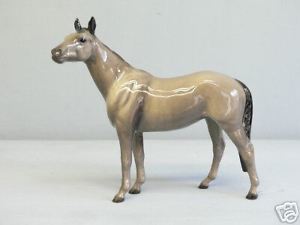
There are not a lot of grey thoroughbreds today. This is mostly due to Italian breeder Frederico Tesio, who claimed that grey horses were diseased and should be culled. Thankfully, Tesio never got his hands on Native Dancer, nicknamed "the Grey Ghost." Native Dancer was not just a promoter of grey racehorses but also one of the most influential American thoroughbred of the twentieth century. His grandson Northern Dancer would be THE most influential American thoroughbred of the twentieth century. An estimated 75% of all thoroughbreds alive today have Northern Dancer somewhere in their pedigrees. And both Breyer and Hagen-Reneker did a model of him:
Anyway, back to Native Dancer. He was a champion who lost only one race in his career (unfortunately, that one race was the Kentucky Derby) and became a TV star in the early days of television. This book not only describes his racing career, but goes into Native Dancer's personality which makes him as three-dimensional a character as any in Shakespeare.
This is one of those books that's so good I may just have to buy my own copy one day. Fortunately, it's not a Seabiscuit clone. This book not only focuses on horse racing in America, or on the Vanderbilts (Native Dancer's owner was a Vanderbilt) but also what life was like in America during the early 1950s. That's the time when my parents grew up so I think I might understand them a little more after reading this book.
Pretty interesting book about one of the all-time great racehorses. The only reason the casual fan might not know him as well as Secretariat or Man O'War is that he didn't win a triple crown; his only career loss happened to come in the Kentucky Derby. The book is written in an anecdotal style, so it makes for a quick read. Might be worth a look if you like horses or racing history.
great read ... an obscure horse, a hold-your-breadth running style ... pops up in the golden age of racing, his gray coat an advantage in the early days of TV (fans could see him better) ... very likeable
Interesting story of the horse and his owner, Vanderbilt. The writing is a bit stiff, and the author sometimes explains the same thing more than once, making me wish for a more observant editor. However, the glimpse of American life in the early and mid 1950s is very interesting.