

What do you think?

Hypnerotomachia Poliphili: The Strife of Love in a Dream
One of the most famous books in the world, the Hypnerotomachia Poliphili, read by every Renaissance intellectual and referred to in studies of art and culture ever since, was first published in English by Thames & Hudson in 1999.
It is a strange, pagan, pedantic, erotic, allegorical, mythological romance relating in highly stylized Italian the quest of Poliphilo for his beloved Polia. The author (presumed to be Francesco Colonna, a friar of dubious reputation) was obsessed by architecture, landscape, and costume—it is not going too far to say sexually obsessed—and its 174 woodcuts are a primary source for Renaissance ideas on both buildings and gardens.
In 1592 an attempt was made to produce an English version but the translator gave up. The task has been triumphantly accomplished by Joscelyn Godwin, who succeeds in reproducing all its wayward charm and arcane learning in language accessible to the modern reader.
It is a strange, pagan, pedantic, erotic, allegorical, mythological romance relating in highly stylized Italian the quest of Poliphilo for his beloved Polia. The author (presumed to be Francesco Colonna, a friar of dubious reputation) was obsessed by architecture, landscape, and costume—it is not going too far to say sexually obsessed—and its 174 woodcuts are a primary source for Renaissance ideas on both buildings and gardens.
In 1592 an attempt was made to produce an English version but the translator gave up. The task has been triumphantly accomplished by Joscelyn Godwin, who succeeds in reproducing all its wayward charm and arcane learning in language accessible to the modern reader.
496 pages, Paperback
First published January 1, 1499
About the author
Francesco Colonna
23 books9 followersFrancesco Colonna (1433/1434 – 1527) was an Italian Dominican priest and monk who was credited with the authorship of the Hypnerotomachia Poliphili by an acrostic in the text.
He lived in Venice, and preached at St. Mark's Cathedral. Besides Hypnerotomachia Poliphili, he definitely wrote an Italian epic poem called Delfili Somnium, the "Dream of Delfilo' which went unpublished in his lifetime and was not published until 1959. Colonna spent part of his life in the monastery of St. John and St. Paul in Venice, but the monastery was apparently not of the strictest observance and Colonna was granted leave to live outside its walls. In Ian Caldwell's and Dustin Thomason's book, The Rule of Four, Francesco Colonna is said to be a Roman, rather than a monk and the true author of the Hypnerotomachia Poliphili.
From Wikipedia
He lived in Venice, and preached at St. Mark's Cathedral. Besides Hypnerotomachia Poliphili, he definitely wrote an Italian epic poem called Delfili Somnium, the "Dream of Delfilo' which went unpublished in his lifetime and was not published until 1959. Colonna spent part of his life in the monastery of St. John and St. Paul in Venice, but the monastery was apparently not of the strictest observance and Colonna was granted leave to live outside its walls. In Ian Caldwell's and Dustin Thomason's book, The Rule of Four, Francesco Colonna is said to be a Roman, rather than a monk and the true author of the Hypnerotomachia Poliphili.
From Wikipedia
Ratings & Reviews
Friends & Following
Create a free account to discover what your friends think of this book!
Community Reviews
Displaying 1 - 30 of 48 reviews

September 21, 2023
Ever since I learnt that the creation of the Park of the Monsters in Bomarzo was inspired by Hypnerotomachia Poliphili – a book written by a Dominican priest and monk Francesco Colonna I had a strong wish to read this exotic tale. The novel is written in the frilly and flowery rococo style so dear to the époque of Renaissance.
Poliphilo is madly in love with Polia and when at last he falls asleep his strife to conquer his love begins… On passing through the woods and dark underground maze he finds himself in the strange antique place full of ancient statures, sculptures, temples and odd edifices…
There he encounters seven nymphs and is commanded by their queen to go the three portals… The first portal opens to the Realm of Earthly Glory, the second – to the Realm of Devine Glory and the third leads to the Kingdom of Love… Entering Kingdom of Love he at last meets his beloved Polia… After some complex and mysterious rites of initiation they together sail to the Isle of Cythera… And on their boat there is a banner of Cupid…
If love can’t surmount all the obstacles then it isn’t true love.
And I, Poliphilo, was lying on my couch, the timely friend of my weary body, with no one with me in my familiar chamber but the dear companion of my sleepless nights, Insomnia. She was consoling me after several conversations in which I had explained to her the cause and origin of my deep sighs; she kindly helped me to calm my uneasiness, then, realizing that the time had come for me to sleep, asked to leave.
Poliphilo is madly in love with Polia and when at last he falls asleep his strife to conquer his love begins… On passing through the woods and dark underground maze he finds himself in the strange antique place full of ancient statures, sculptures, temples and odd edifices…
The pleasure of contemplation exceeded even my great wonder, because, by Jupiter, I thought that its making would not have been difficult for higher beings; and I suspected that no human art or science could have put together such vastness or expressed such grand ideas, invented such novelties, ornamented them with such elegance, arranged them with such extraordinary symmetry, and accomplished the splendid and unimaginable ostentation of this structure without any addition or correction.
There he encounters seven nymphs and is commanded by their queen to go the three portals… The first portal opens to the Realm of Earthly Glory, the second – to the Realm of Devine Glory and the third leads to the Kingdom of Love… Entering Kingdom of Love he at last meets his beloved Polia… After some complex and mysterious rites of initiation they together sail to the Isle of Cythera… And on their boat there is a banner of Cupid…
These depicted many leaves in elaborate decorative shapes and three hieroglyphs: an antique vase, in whose open mouth a flame burned; then the world; and a little branch linking the two together. This banner waved and fluttered in the gentle breath of spring-like and helpful Zephyrus. Thus I interpreted it: Love conquers all.
If love can’t surmount all the obstacles then it isn’t true love.

May 1, 2017
"....he heard a most delightful harmony, which made him forget to drink, and followed after the voice..."

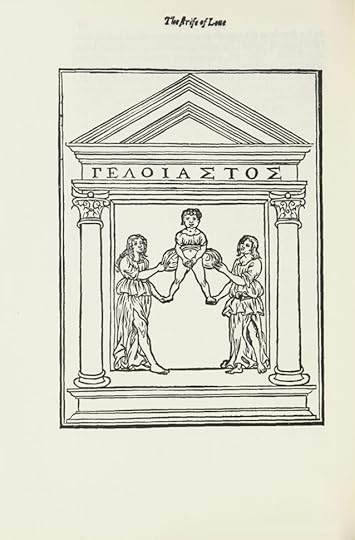

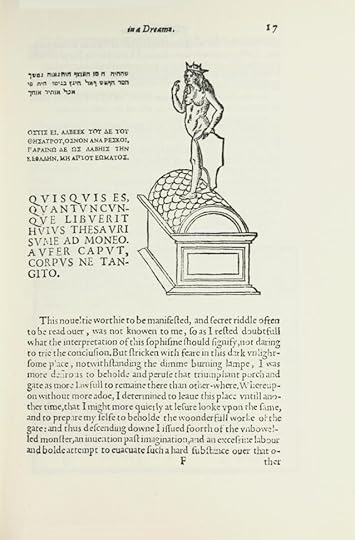
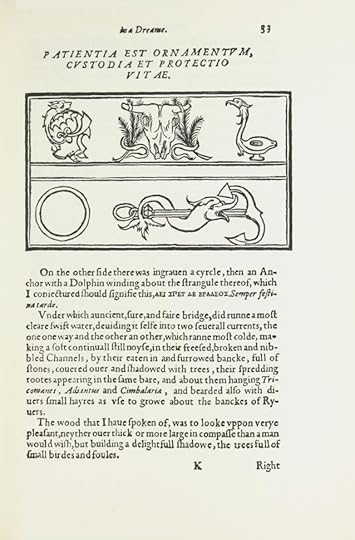

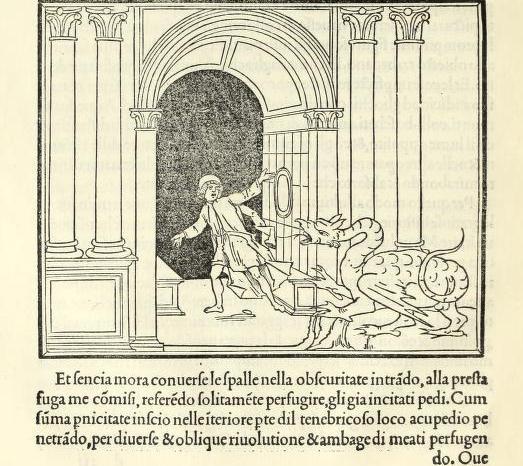
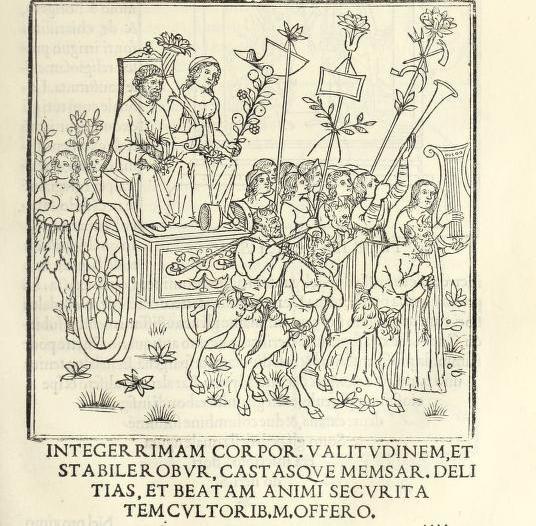
You can easily tell by some of the illustrations that it is, indeed, an enigmatic book. Poliphilus is after [a nymph called] Polia. Through a dream he'll have access to her ...and her magical kiss. But there's a lot happening in between.
Well, there is a lot to tell; the rendezvous with the Gods (Jupiter, Venus, Mercury, Mars), the Cupid, the escaping from a terrible dragon, …and the bats within the darkness; staying at the Queen’s court, and having the chance to choose amongst 3 gates: (1) Gloria Dei (2) Mater Amoris (3) Gloria mundi.
Poliphilus chose the middle-way door. Following the middle door, he’ll soon recognize Polia. They’ll travel to the isle of Citera, whereupon Venus will unite them in marriage.
Poliphilus will learn also, all had been a fantasy. But then we know that after a dream, man wakes up to reality. And we know also that he had had two dreams: a dream, within a dream.
Maybe he’d experienced two realities, after all.
You can easily tell by some of the illustrations that it is, indeed, an enigmatic book. Poliphilus is after [a nymph called] Polia. Through a dream he'll have access to her ...and her magical kiss. But there's a lot happening in between.
Well, there is a lot to tell; the rendezvous with the Gods (Jupiter, Venus, Mercury, Mars), the Cupid, the escaping from a terrible dragon, …and the bats within the darkness; staying at the Queen’s court, and having the chance to choose amongst 3 gates: (1) Gloria Dei (2) Mater Amoris (3) Gloria mundi.
Poliphilus chose the middle-way door. Following the middle door, he’ll soon recognize Polia. They’ll travel to the isle of Citera, whereupon Venus will unite them in marriage.
Poliphilus will learn also, all had been a fantasy. But then we know that after a dream, man wakes up to reality. And we know also that he had had two dreams: a dream, within a dream.
Maybe he’d experienced two realities, after all.

March 23, 2022
I should qualify my 4 star rating. The book itself is easily one of the most boring and insipid I've read in a long time. As an object, though, it's very gratifying to own, and Godwin deserves considerable credit for rendering the text into lucid English. However, he admits that this was at the cost of distorting it, because the original Italian is very bizarre indeed. A more exactingly faithful translation would be virtually impenetrable. He provides an illustration of what one might look like:
"In this horrid and cuspidinous littoral and most miserable site of the argent and fetorific lake stood saevious Tisiphone, efferal and cruel with her viperine capillament, her meschine and miserable soul, implacably furibund."
Ghastly, but fascinating and even perversely entertaining. At very least, the mystery of the book would be better preserved, if at the cost of Godwin's sanity. The trouble is that it's simply a very dull, plodding book. No incident has particular significance and each is quickly forgotten. The pleasure of reading descriptions and inscriptions is diminished by the sheer weight of the contents and by the hint of a plot that does not in fact exist. (Which is not say that there is no pleasure in this aspect of the book, but there are better writers who write more enjoyably in a similar vein - especially Vasari, in his later biographies, those of Francesco Rossi and Taddeo Zucchero in particular.) All the mystery of the HP lies in the very impenetrability this translation dispels, so reading it diminishes it. (If, for some reason, you've convinced yourself that you have to read one novel from 1499, make it the Celestina.)
What's great, though, is simply owning a copy and flipping through it now and then, admiring the strange, hermetic illustrations and fantasizing about possible meanings. It really is better experienced this way, as a sort of literary Bomarzo, a Tarot pack dispersed over the pages of a Voynich Manuscript, etc, etc. My hope is that I'll quickly forget everything I remember about the text and be able to flip through it again in precisely that way. And frankly, there's an excellent chance of that.
"In this horrid and cuspidinous littoral and most miserable site of the argent and fetorific lake stood saevious Tisiphone, efferal and cruel with her viperine capillament, her meschine and miserable soul, implacably furibund."
Ghastly, but fascinating and even perversely entertaining. At very least, the mystery of the book would be better preserved, if at the cost of Godwin's sanity. The trouble is that it's simply a very dull, plodding book. No incident has particular significance and each is quickly forgotten. The pleasure of reading descriptions and inscriptions is diminished by the sheer weight of the contents and by the hint of a plot that does not in fact exist. (Which is not say that there is no pleasure in this aspect of the book, but there are better writers who write more enjoyably in a similar vein - especially Vasari, in his later biographies, those of Francesco Rossi and Taddeo Zucchero in particular.) All the mystery of the HP lies in the very impenetrability this translation dispels, so reading it diminishes it. (If, for some reason, you've convinced yourself that you have to read one novel from 1499, make it the Celestina.)
What's great, though, is simply owning a copy and flipping through it now and then, admiring the strange, hermetic illustrations and fantasizing about possible meanings. It really is better experienced this way, as a sort of literary Bomarzo, a Tarot pack dispersed over the pages of a Voynich Manuscript, etc, etc. My hope is that I'll quickly forget everything I remember about the text and be able to flip through it again in precisely that way. And frankly, there's an excellent chance of that.

September 14, 2012
The Strife of Love in a Dream, or, I Love Cusps
Francesco Colonna was obsessed with architecture, for sure, in a didactically ordered, religiously literate, and, I’ll say it!, fascist kind of way. Yet, the book itself, Hypnerotomachia Poliphili (The Strife of Love in a Dream), is a formally Anti-Fascist exploration of form. It is also a diligent “portal.” To the underworld of other worldly. Into “pleasure” and “unthinkable happiness.” For this, I think it is brilliant!
It was written long ago: 1499. Who doesn’t LOVE cusps?
I love cusps. I also love the pataphysical rendering of dream experience in this book, as the book is clearly a 400-page excuse to deliver the author’s dream, and, by “dream,” I don’t just mean that which might occur when sleeping, but the dream that might be always happening but is not necessarily recognized: the dream we dream awake.
The dream in the book is full of philosophical inscriptions, say, of an architectural wonder displaying the words, “NOTHING FIRM.” This book is translated by Joscelyn Godwin. I will re-translate this architectural portal into the language of poem, as if “NOTHING FIRM” means “OUTSPREAD DRAPERY.”
However, as far as the contemporary reader, dear dream, Poliphilo's pataphysical point of view devolves every time he applauds the architect in his supreme “ordering” as superior to the worker in his mere “ornamentation.” Sure, he might be talking allegorically: the idea is superior to the execution. Or not. This is part of the point. My authorial point. A point is like a period. Impregnated. A point that is like a period that is impregnated is like a period in hyperspace. My point is that reading requires
Dimensionality. However, upon closer scrutiny
The reason why the narrator heralds the sculptor over the worker so much is that, I imagine, the author sees himself as the sculptor of his story.
Who doesn’t, right?
Ask Marjorie Perloff or Kenneth Goldsmith!
Or nearly everyone these days….
A friend once told me that one of the reasons she loved Ed Dorn as a poetry teacher was because he had a point of view. I’m paraphrasing; she probably said something much better. I know she did but can’t reveal what she said. The point of her point of view is that you weren’t supposed to have a point of view—this was the 90s, after all!—so the whole NOTION of a professor having a point of view was very exciting. And she liked his point of view: that’s a big part of the point--my point, which is not really her point. Perhaps she might not have been so happy that he took a point of view if she hated his point of view. I like Kenneth Goldsmith’s point of view because I see it as an overt satire of negative space, a Gestalt image; the genome is already mapped. He's just arranging the chromosomes. With a top hat on. Practically everyone has his point of view, at least many non-poets; who believes in poetry and art? As ANOTHER friend of mine said, more recently, it’s certainly CREATIVE of Kenneth Goldsmith to reject creativity! Obviously. And his work is not just about humor and performance, as one poet I heard lightly tell him after he read at Naropa. The poem becomes redefined as a by-product of the experiment, which is no longer the poem as product but the poem as process. It's reality rather than just the reader that gets mediated. This is subversive.
& who doesn’t like that?
Well, sadly, just about everyone else!
QUANTUM JUMP:
There are such ravishing sculptures in the dreams of Poliphilo that it is said the people who encounter them use them to masturbate. For this, On The Cusp, the book deserves five stars. Yet, I wish the stars of reviewing were more like the stars of outer space, innumerable...
…dwarfs, supernovas, anything goes in my book—
“Even so, I could not satisfy my hungry eyes and my insatiable appetite for looking again and again at the splendid works of antiquity.”
But the larger point of this review is to reveal the terrible injustice and beauty of translation as an art form and as a mediation of reality. In the introduction to this volume, the translator reveals:
“The first principle of this translation is to honor every word of the original, however redundant the style may seem to modern ears. To have done otherwise would have only produced another abridgement. The only general exception to the principle is the omission of Colonna’s constant superlatives and diminutives, which would have become very wearisome in English; and very occasionally the effort to match Aldus’s typography has been made at the cost of a few inessential words. But if one were really to convey the spirit and style of the original language, it would have been necessary to do as Colonna did: to invent English words based on the same Latin and Greek ones, and to embed them into a syntax to match. Thus one might render the description of the fury on page 249 as follows: ‘In this horrid and cuspidisaevious Tisiphone, efferal and cruel with her viperine capillament, her meschine and miserable soul, implacably furibund.’ While most readers will be relieved at the decision not to do so, something has been lost thereby. All the colorful patina, all the grotesque accretions have been stripped away from Colonna’s language, leaving it comprehensible but bland. The only compensation lies in exploiting the rich double vocabulary of Latin and Germanic roots that is unique to English.”
Page 249: “On this horrid and sharp-stoned shore, in this miserable region of the icy and foetid lake, stood fell Tisiphone, wild and cruel with her vipered locks and implacably angry at the wretched and miserable souls who were falling by hordes from the iron bridge on to the eternally frozen lake.”
Page x-xi: “In this horrid and cuspidisaevious Tisiphone, efferal and cruel with her viperine capillament, her meschine and miserable soul, implacably furibund.”
Taken together, these translations form a kind of cusp, a description of between that points beyond the “fury” in which they are describing and into the word itself: the infernal ordinary that comprehensible human language keeps formulaically burying itself in, alive.
This is why we need poems.

July 22, 2008
I first heard of this book when John Crowley mentioned it in his Aegypt cycle, and, as I am prone to do, I bought it solely because it was mentioned in a book I love.
It's been sitting on my shelf for years now, and once I tried to read it through, but got way bogged down. So now I just take it down once in a while and look at. It is one of those books that's nice to just look at, with thick creamy pages, wide margins, and some illustrations.
What I actually read in it reminded me quite a bit of Raymond Roussel's novels (or vice versa), in its rapidly escalating fantasy and dry mouthed recitation of crazy elaborate detail.
There is supposedly an esoteric intent behind the book, and some serious metaphysical investigation, but I haven't gotten deep into it enough to report on that.
It's been sitting on my shelf for years now, and once I tried to read it through, but got way bogged down. So now I just take it down once in a while and look at. It is one of those books that's nice to just look at, with thick creamy pages, wide margins, and some illustrations.
What I actually read in it reminded me quite a bit of Raymond Roussel's novels (or vice versa), in its rapidly escalating fantasy and dry mouthed recitation of crazy elaborate detail.
There is supposedly an esoteric intent behind the book, and some serious metaphysical investigation, but I haven't gotten deep into it enough to report on that.

October 6, 2023
it's disappointing that the translator of this chose to not even try to render the unusual style of italian it's written in(italian syntax with an obscure latin vocabulary) into english, instead rendering it with accuracy but in a plain and uninteresting style. it's particularly insulting that an example is given of what a passage translated true to the original style would have looked like, because this makes me want to read that translation than the one we actually got (the first is the example, the second is the translation actually used for this passage):
"In this horrid and cuspididinous littoral and most miserable site of the algent and fetorific lake stood saevious Tisiphone, efferal and cruel with her viperine capillament, her meschine and miserable soul, implacably furibund"
vs
"On this horrid and sharp-stoned shore, in this miserable region of the icy and foetid lake, stood fell Tisiphone, wild and cruel with her vipered locks and implacably angry"
since the style of the book has basically been gutted, it's hard to evaluate it fairly. most of it is an account of the main character poliphilo's dream in search of his love polia, and what happens when he finally meets up with her in the dream. a lot of the book consists of incredibly specific descriptions of imaginary architecture, or palaces, or processions of nymphs, etc seen in the dream, and i think this would be an exciting read if the original style had been maintained. unfortunately, since it's been rendered in serviceable english, mostly this stuff is pretty interminable and it gets old after a while. it is also full of near constant references to almost every figure from classical mythology that you can think of, which again probably was more impressive in the original style, although the author's erudition still comes through. readers of frances yates may notice that a lot of the obsessive repetition of building dimensions and descriptions of images of mythological figures is extremely reminiscent of a memory system, and in fact ioan culianu explicitly refers to the book as dealing with memnotechnical phantasms in Eros and Magic in the Renaissance. the subject matter of love also makes it very close to some of the other things culianu talks about in that book. one thing that this edition does do pretty well is the illustrations - they're all reproduced in high quality and are unchanged from the originals. what a pity that the style couldn't have been reproduced in english similarly..
"In this horrid and cuspididinous littoral and most miserable site of the algent and fetorific lake stood saevious Tisiphone, efferal and cruel with her viperine capillament, her meschine and miserable soul, implacably furibund"
vs
"On this horrid and sharp-stoned shore, in this miserable region of the icy and foetid lake, stood fell Tisiphone, wild and cruel with her vipered locks and implacably angry"
since the style of the book has basically been gutted, it's hard to evaluate it fairly. most of it is an account of the main character poliphilo's dream in search of his love polia, and what happens when he finally meets up with her in the dream. a lot of the book consists of incredibly specific descriptions of imaginary architecture, or palaces, or processions of nymphs, etc seen in the dream, and i think this would be an exciting read if the original style had been maintained. unfortunately, since it's been rendered in serviceable english, mostly this stuff is pretty interminable and it gets old after a while. it is also full of near constant references to almost every figure from classical mythology that you can think of, which again probably was more impressive in the original style, although the author's erudition still comes through. readers of frances yates may notice that a lot of the obsessive repetition of building dimensions and descriptions of images of mythological figures is extremely reminiscent of a memory system, and in fact ioan culianu explicitly refers to the book as dealing with memnotechnical phantasms in Eros and Magic in the Renaissance. the subject matter of love also makes it very close to some of the other things culianu talks about in that book. one thing that this edition does do pretty well is the illustrations - they're all reproduced in high quality and are unchanged from the originals. what a pity that the style couldn't have been reproduced in english similarly..

April 26, 2023
Vnder her nofe to her lyppes paffed a little valley to her fmall mouth of a moft fweete forme, her lyppes not blabbered o fwelling, but indifferent, & of a rubye collour, couering two vniforme fets of teeth, like yuory, and fmall, not one longer and fharper than an other, but in order euenly difpofed and fet: from betwixt the which, Loue had compofed an euerlafting fweet breathing, fo as I prefumed to thinke.
June 14, 2015
Boring book. So why the 5 stars? Because it has some of the most exciting and unexplained illustrations. Something like participating in a arcade video game of the late 1980s.

October 31, 2018
This book is a bit of an enigma -- but not because of the mystery surrounding its author, conception, intended purpose, or the layers of hidden messages embedded inside it (and these mysteries certainly remain). Instead, I think this book is enigmatic because although the quality of the text itself isn't impressive, there's a strange beauty in the way that these words have been embellished (externally) and turned into something larger and more beautiful than what's contained in the text itself. This book is an example of how the weight of time and many fruitless attempts at interpretation can create a work of beauty that is external to the book itself.

January 10, 2019
This seems to be the story of how an unfortunate woman was harrassed by a deranged lunatic, who dreamt about buildings and temples which he described in tedious detail, and then dreamt up a narrative in which the woman actually loved him. Does for imagined classical Greek architecture what Moby Dick did for whales. On and on.

May 18, 2009
Colonna’s Hypnerotomachia, which can be translated as “Poliphilio’s Strive of Love in a Dream,” tells the author’s tale of love for a girl, Polia. It takes place in two dreams amidst pagan bacchanalia that celebrate Greek and Roman antiquity, especially the architecture, gardens and costuming that the lustful Dominican monk imagined as he wrote in his cell at a Treviso monastery between 1465 and 1467. Based on hints left in the text and what little is known about Colonna during those years, Polia was the daughter of a nobleman, dead in her teens, whom he had loved apparently unrequitedly. The protagonist, Poliphilio (literally “the lover of Polia,” for Colonna was obsessively loving of every detail of the world that revolved around his ingénue) provides exacting descriptions of every lawn, statue, temple, garment and shoe worn by the object of his love and the many sprites, gods and goddesses that surround her. “Although these scenes were small, there was not the least defect in them, not even the smallest detail: everything was perfect and clearly discernible,” Colonna writes, via Godwin’s translation, approximately halfway through a 40-page description of a triumphant parade, not so much as a justification for his exhaustive cataloging of friezes, vases and garlands in the procession of lithe, voluptuous, nubile and hirsute pagan spirits, but simply as a transition to some 15 additional pages on the virtues of details that perpetually “stupefy” Poliphilio as he is led through his dream pursuit of Polia.
“How many bibliophiles have actually read it is another question, for its textual excesses are enough to deter most readers,” wrote Joscelyn Godwin in her introduction to the book. She was the first translator to succeed in making an English version of the book only in 1999, on its 500th anniversary. The book, which is vaguely familiar to modern readers as the source of The Rule of Four, a mystical thriller written in the wake of Dan Brown’s The Da Vinci Code, is often celebrated as a farsighted precursor of James Joyce’s Finnegans Wake, a complex modernist linguistic tour de force published in 1939 that combined many languages in a dream discourse. Colonna’s use of languages, in contrast to Joyce’s, is rather limited, with only a few words of Greek and Hebrew appearing as inscriptions on statuary . His real talent, in addition to that friar’s eye for arcane detail, was in his ability to forge new words from Latin and Italian to create his own vernacular, a lovelorn torrent that, as Godwin points out, if translated literally would include sentences such as “In this horrid and cuspidinous littoral and most miserable site of the algent and fetorific lake stood saevious Tisiphone, efferal and cruel with her viperine capillament, her meschine and miserable soul, implacably furibund.” Nine of those overripe words were neologisms concocted by the writer, none of them has found acceptance in the half millennia since Colonna invented them. His wordplay anticipates the inventive texting of today’s teens and young adults, some of whom have begun writing novels and serial dramas in truncated English, Japanese and Chinese that are delivered to their audiences, mostly friends, by mobile handset. “Viperine,” to be snakelike, doesn’t have the same tone as “LOPSOD,” the texting code for “long on promises, short on delivery,” but both describe a certain danger and untrustworthiness when applied in a narrative.
“How many bibliophiles have actually read it is another question, for its textual excesses are enough to deter most readers,” wrote Joscelyn Godwin in her introduction to the book. She was the first translator to succeed in making an English version of the book only in 1999, on its 500th anniversary. The book, which is vaguely familiar to modern readers as the source of The Rule of Four, a mystical thriller written in the wake of Dan Brown’s The Da Vinci Code, is often celebrated as a farsighted precursor of James Joyce’s Finnegans Wake, a complex modernist linguistic tour de force published in 1939 that combined many languages in a dream discourse. Colonna’s use of languages, in contrast to Joyce’s, is rather limited, with only a few words of Greek and Hebrew appearing as inscriptions on statuary . His real talent, in addition to that friar’s eye for arcane detail, was in his ability to forge new words from Latin and Italian to create his own vernacular, a lovelorn torrent that, as Godwin points out, if translated literally would include sentences such as “In this horrid and cuspidinous littoral and most miserable site of the algent and fetorific lake stood saevious Tisiphone, efferal and cruel with her viperine capillament, her meschine and miserable soul, implacably furibund.” Nine of those overripe words were neologisms concocted by the writer, none of them has found acceptance in the half millennia since Colonna invented them. His wordplay anticipates the inventive texting of today’s teens and young adults, some of whom have begun writing novels and serial dramas in truncated English, Japanese and Chinese that are delivered to their audiences, mostly friends, by mobile handset. “Viperine,” to be snakelike, doesn’t have the same tone as “LOPSOD,” the texting code for “long on promises, short on delivery,” but both describe a certain danger and untrustworthiness when applied in a narrative.

January 6, 2020
Es una historia repleta de conocimiento mitológico y oculto, erudición, desborde de sentimientos, con una conclusión sorprendentemente dolorosa y equitativamente hermosa. En muchos momentos me pareció un texto complicado, en otros momentos me resultaban sumamente pesadas sus ampliamente detalladas descripciones de objetos, lugares y arquitectura, pero conforme pude vislumbrar el tema central y comprender el punto del relato, me fue imposible no conmoverme y sentir el corazón roto al momento de llegar a la conclusión.
El libro más amado de ella que siempre estará en mi corazón, ahora entiendo muchas cosas...
Agradezco que la versión anotada me permitió poder comprender las numerosas referencias a mitología, historia y esoterismo.
El libro más amado de ella que siempre estará en mi corazón, ahora entiendo muchas cosas...
Agradezco que la versión anotada me permitió poder comprender las numerosas referencias a mitología, historia y esoterismo.

September 6, 2007
I will still pick this book up, randomly open to a page and start reading. This helps me go to sleep. An amazing mind wrote it, but it is very easy to get lost in the details.
January 31, 2023
If Beowolf could time travel and have a child with the Decameron, the result would be Hypnerotomachia Poliphili.
I think I may have read this through the lens of a 13-year old boy because this seems like old-timey literary porn. I mean, look at the following quote:
"The beautye of which two [Nymphs] were such, and so fresh, as I looked about mee, whether Apelles had painted them with his Pensill."
Um, what now?
I hesitate to use the term "literary" because it was so devoid of plot that I wanted to pluck my eyes out. What kept me going was simple curiousity--how many ways and for how long can the author tell us he's writing about an orgy without telling us he's writing about an orgy?
Modesty prevents me from including additional excerpts because this is no more than a uncomfortable stretch of thinly veiled sex acts. Yet I've never been so bored. It really goes on and on for so long a time that one really just wants to get it over with.
Summing up, if you're interested in the verbose, inscrutable ramblings of some horny, now long-dead perv, this piece of work--so hard and difficult to grasp--will be sure to hit the spot.
I think I may have read this through the lens of a 13-year old boy because this seems like old-timey literary porn. I mean, look at the following quote:
"The beautye of which two [Nymphs] were such, and so fresh, as I looked about mee, whether Apelles had painted them with his Pensill."
Um, what now?
I hesitate to use the term "literary" because it was so devoid of plot that I wanted to pluck my eyes out. What kept me going was simple curiousity--how many ways and for how long can the author tell us he's writing about an orgy without telling us he's writing about an orgy?
Modesty prevents me from including additional excerpts because this is no more than a uncomfortable stretch of thinly veiled sex acts. Yet I've never been so bored. It really goes on and on for so long a time that one really just wants to get it over with.
Summing up, if you're interested in the verbose, inscrutable ramblings of some horny, now long-dead perv, this piece of work--so hard and difficult to grasp--will be sure to hit the spot.
April 8, 2025
Solo tenía que leer algunos fragmentos para clase, pero no he podido evitar querer conocer cada una de sus palabras. Ha sido una lectura difícil y lenta, de algo más de un mes, pero también la más gratificante en muchísimo tiempo. Es una obra inmensa que me ha hecho sentir muy afortunada de haber decidido dedicar mi vida a la literatura.

Read
April 5, 2013A dreamy read. Difficult, rather challenging, but in a certain and peculiar way more reminiscent of Neil Gaiman's the Sandmand and Alan Moore's Lost Girls rather than contemporary litterature.
Plus there was a special reaosn to read it- and I was overdue.
Not anymore.
Try it, people.
Plus there was a special reaosn to read it- and I was overdue.
Not anymore.
Try it, people.

February 11, 2025
I will have to admit that the illustrations and the endless arcane minutiae about architecture and monument building are the primary interesting things about this book. It feels like a dream, for sure, and it takes a long time to get through. There is also an encyclopedic set of references to the ancient Graeco-Roman myths contained within the pages, though as the book goes on the references and allusions seem to get more and more forced. I figured if every Renaissance scholar had read this book, perhaps I ought to as well. It is quite an experience, but sometimes a slog. That said, it's well worth owning if not just to skim it and then look up and research the myths and architectural structures that are mentioned.
September 6, 2021
This book had a great sense of mystery when I bought it. The title is a combination of "sleep-love-war", was published in 1499, and has a huge number of allegorical wood cuts. I was pretty excited to close out my summer reading with it.
This book has three things:
1. Painfully detailed descriptions of architecture. At first it is pretty exciting when the narrator walks into the organs of a giant detailed human body but descends into countless descriptions of pergolas and fancy vases. I now know what plinths, zophori, and balusters are.
2. Superlative but not very detailed descriptions of nymphs and maidens.
3. The rule of four. The cover said I would learn some illuminati "rule of four", but I didn't. Maybe it was somewhere between the Latin inscriptions in the lovers' graveyard (which was cool) or the description of the massive garden full of nard.
Kudos to the translator but this was a tough read.
This book has three things:
1. Painfully detailed descriptions of architecture. At first it is pretty exciting when the narrator walks into the organs of a giant detailed human body but descends into countless descriptions of pergolas and fancy vases. I now know what plinths, zophori, and balusters are.
2. Superlative but not very detailed descriptions of nymphs and maidens.
3. The rule of four. The cover said I would learn some illuminati "rule of four", but I didn't. Maybe it was somewhere between the Latin inscriptions in the lovers' graveyard (which was cool) or the description of the massive garden full of nard.
Kudos to the translator but this was a tough read.

July 27, 2020
I was about fifty pages away from finishing this in May and it took me almost all of June to finish it. I really enjoyed quite a bit of it, but it does take some effort to get through, especially since I was underlining and making notes extensively.
If you are into Dante-esque architecture fetish vaguely pagan literature, this is the perfect book for you. I honestly do not think this book has gotten the attention it deserves, but I can also understand why it hasn't, considering how difficult it is to translate and how you do need to be dedicated to read through it (in my experience). I think it is worth it, though. There are some really fantastic moments that are quite bizarre.
If you are into Dante-esque architecture fetish vaguely pagan literature, this is the perfect book for you. I honestly do not think this book has gotten the attention it deserves, but I can also understand why it hasn't, considering how difficult it is to translate and how you do need to be dedicated to read through it (in my experience). I think it is worth it, though. There are some really fantastic moments that are quite bizarre.

February 12, 2018
Yes, it's significant, but it also becomes spectacularly tedious as an architectural romance in which plot and character development are replaced by cornicing. It's the Divine Comedy as written by Vitruvius, with input from Jodorowsky (which sounds amazing, but the novelty wears off after 100p).
Golden condiment chariots though, now there's class.
Golden condiment chariots though, now there's class.

May 11, 2007
This is an excellent translation and interpretation of an important work of Renaissance literature that exerted a profound impact on aesthetics, particularly in architecture. Plus the author was a horndog!

January 19, 2008
Perhaps the greatest of incunabula. An expansive polyglot of classical allusions, clever wordplay, and playful typesetting. Further, the book is worth buying if only for the intricate woodcuts throughout.

Want to Read
February 20, 2008Ancient and beautiful text, dense, but written as a key to another story.

October 22, 2008
read a few chapters but not enough to give a cogent or thorough review. the plot is fantastic though.
April 21, 2010
My favorite translation

January 4, 2011
One of those things that I find more inspiring than something to be read for pleasure.
Read
June 29, 2012architettura&arte

August 23, 2012
referred to by Jaron Lanier - sounds very interesting & I'm giving it 5 stars simply because it exists… and hope to read it someday

November 23, 2012
Complicated work. Impressive edition.
I missed the censors' effects, so typical
I missed the censors' effects, so typical

June 17, 2019
The story was good enough, though wasn't prepared for such long descriptions.
Thank you for ruining fountains for me stupid book ;)
Thank you for ruining fountains for me stupid book ;)
Displaying 1 - 30 of 48 reviews