Hailed as a major event (John Carey, Sunday Times), a major anthology: one of the best that Oxford has ever produced (James Fenton, The Times), the most important anthology in recent years (The Economist), and indispensable (Kingsley Amis), Roger Lonsdales The New Oxford Book ofEighteenth-Century Verse is now available in a stylishly redesigned reissue. No previous anthology has succeeded in illustrating so thoroughly the kinds of verse actually written in the eighteenth century. The familiar tradition is fully represented by selections from such poets as Pope, Swift, Gray, Smart, Goldsmith, Cowper, Burns, and Blake. In addition, the anthology includes verse by many forgotten writers, both men and women, from all levels of society. Although they have never figured in conventional literary history, they wrote humorous, idiosyncratic, and graphic verse about their personal experience and the world around them, in a way that should challenge received ideas about the periods restraints and inhibitions.
Tidying up some reviews, I found this. A timely message from my recent past self to my current and future self - and to whoever else reads this. Hoping for happiness in 2020. 🤞
What’s The Recipe for Happiness?
A good question in middle-age. A time of change, uncertainty, and questioning. What have I achieved thus far? What do I want to do with the rest of my life? What are the most basic ingredients for happiness?
There’s no shortage of books, websites, gurus, and groups who’d happily help me answer. And they’re not a new phenomenon.
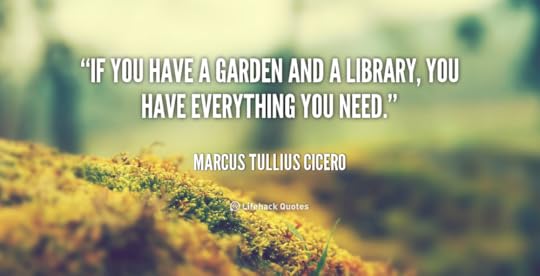
Image: If you have a garden and a library, you have everything you need. - Cicero
Ancient and Modern
I visited my mother recently, to fix her internet. In the gaps between solving twenty first century tech problems, we visited the poetry of the eighteenth century.
In a house full of books, this is not what I’d usually turn to, but my mother’s quiet enthusiasm, especially for the first poem in the anthology, was infectious. I read it twice that night (more, since), but was more fickle with the others. So here it is:
The Choice, by John Pomfret (1667-1702)
You can read it HERE. The language is surprisingly accessible for something likely written in the seventeenth century.
In the poem, Pomfret muses on the sort of life that would make him truly content. His idyll is charming, in part because it is so modest: “frugal plenty”, avoiding “the needless pomp of gaudy furniture”.
He wants a home in the countryside: “A little garden, grateful to the eye, And a cool rivulet run murmuring by, On whose delicious banks a stately row Of shady limes or sycamores should grow.”
It will have a library of “the noblest authors” and “a little vault… with the best wines”. He will have a couple of close (male) friends, and the occasional comfort of female friend. His different requirements for the men and woman are intriguing; he’s certainly not wanting a bimbo.
Part of the appeal of his vision is its achievability. For us. Unfortunately, not for Pomfret, who died, aged 35, a married Anglican priest. Given his vocation, it’s notable that the Church, Bible, and God are not mentioned.
The Answer
Stop buying lottery tickets. Find joy and beauty in the quotidian. Read, and read some more. Cultivate flowers and carefully selected friends. Learn to “live genteelly, but not great”.
“But by a silent and a peaceful death, Without a sigh, resign my aged breath: And when committed to the dust, I'd have Few tears, but friendly, dropp'd into my grave. Then would my exit so propitious be, All men would wish to live and die like me.”
For more of an analytical, pragmatic, self-help approach, see Mark Hebwood's Happiness Rules, which I reviewed HERE.
If you love poetry, or even just like it, you should have this volume in your collection. For a reasonable price and a small footprint, you will have access to a wide swath of poetry from the 18th century that spans from the base to the heights, the profane and the holy, the everyday and the unique. Roger Lonsdale, the editor, has done a great job pulling together such a diverse crowd of people. You’ll find poets you know, but I’d bet there are a bunch of names (not including the various anonymous entries) you’ve never heard of. I didn’t love every poem in this work but am glad to have been exposed to each and every one of them. A fine collection.
In his introduction, Lonsdale writes: “As usual, readers will be struck by apparently inexplicable decisions in my selections from some of the better known poets: I am consoled only by the knowledge that limitations of space were always going to prevent illustration of the full range of, for example, Pope’s achievement. Pope will, however, survive my attentions. I am more haunted by the lingering memory of some of the totally forgotten men and women whose literary bones I disturbed after they had slumbered peacefully for some two hundred years, who had something graphic or individual to say, however modestly, and for whom I had envisaged some kind of minor literary resurrection, but who necessarily fell back into the darkness of the centuries, perhaps irretrievably, at the last stage of my selection” (p. xxxix-xl). Lonsdale may be too harsh on himself here, for he has resurrected or at least brightened the light shining on so many people who wrote poetry that has been forgotten for too long. And, for me and I hope others, we will take this volume as a challenge to continue looking for lost voices across various centuries to listen to what they said about their times and what they can say to us today.
Women’s rights and experiences were nicely featured in this volume. It’s sad that many of these woman I never heard of yet I will be told of Shelley, etc. on the rights of people. Thank you, Mr. Lonsdale, for highlighting them to me. Lady Mary Chudleigh’s “To the Ladies” (#17, 1703) comments on how men treat wives as if they were their servants. Strong words even though couched in a soft tone. Well done. Sarah Fyge Egerton’s “The Emulation” (#18, 1703) is in a similar vain and quite good.
Mary Collier’s excerpt from “The Woman’s Labour. An Epistle to Mr. Stephen Duck” (#218, 1739) was a fantastic piece on class difference and indifference as the lady of the house sleeps in then tells her woman servants to clean up, be very careful, don’t be wasteful, etc. The narrator says “When bright Orion glitters in the skies / In winter nights, then early we must rise” (p. 325). They also continue to work long past dark until their work is done. This excerpt ends “For all our pains, no prospect can we see / Attend us, but old age and poverty” (p. 326). As was, as is, as it always will be?
Lots of poetry from the 18th century, and even among the Romantics in the early 19th, focused on the beauties of rural life. It sometimes went overboard, idealizing a life that existed in their minds and not in reality. George Crabbe wrote a dense piece “The Village, Book I” (#432, 1783) that sharply contrasted this idealized rural life with the lived experience of the poor people working the land. One line that just jumped off the page for me was: “Yes, thus the Muses sing of happy swains / Because the Muses never knew their pains” (p. 670).
On the vices we surround ourselves with, we find Lawrence Spooner (#16, 1703) “On Giving up Smoking”. Still spot on 303 years later, for when I quit in 2006. A hilarious yet also sad piece on the love and horrors of gin was in an anonymous piece “Strip Me Naked, Or Royal Gin For Ever. A Picture” (#299, 1751). Another piece on perils of alcohol was John Wolcot’s “To a Fly, Taken out of a Bowl of Punch” (#488, 1792). It hilariously finds a fly that appears dead in a punchbowl. Fished out, he is shown to be alive, but possibly very drunk. He revives slowly and is eventually able to fly away.
On just the beauty of savoring the moment, there were many pieces. John Gay’s “Trivia: or The Art of Walking the Streets of London, Book II” (#83, 1716) is fun to read about school boys making snowballs to throw at the coaches. I also enjoyed Isaac Hawkins Browne’s (#266, 1746) “The Fire Side. A Pastoral Soliloquy”. One needs not kings and courts, but hearth and home, the scent of flowers, good books, drink and friends. A refuge from the larger world. “Now I pass with old authors an indolent hour / And reclining at ease turn Demosthenes o’er” (p. 404). I really enjoyed Thomas Warton’s (#276, 1747) excerpt on “The Pleasures of Melancholy”.
This collection also covers strong emotional scenes. John Hawthorn wrote a powerful piece on death in an excerpt from “The Journey and Observations of a Countryman” (#421, 1779). It was strong and hard to read for the emotions it conveyed of the death of a father while his wife, daughters and drunken son surround him. For cat owners, Anna Sweard’s “An Old Cat’s Dying Soliloquy” (#498, 1792) is a very sad and touching piece.
We also see many poets calling out social and political problems. The famous Quaker poet John Scott’s anti-war “Ode” (#426, 1782) was fantastic and still valid today. In a perfect riposte to the second Bush years and the 2016 election, we find Josep Mather’s “God Save Great Thomas Paine” (#522, 1792?). “Facts are seditious things / When they touch courts and kings” (p. 791). James Cawthorn wrote a great satire on fine food, stuck-up culture, feigned piety, etc. in an excerpt from his “Of Taste. An Essay” (#324, 1761). Samuel Wesley (#130, 1726) wrote “On the Setting Up of Mr. Butler’s Monument in Westminster Abbey”, calling out those who would memorialize the poet and satirist Samuel Butler in death but ignored him as he died in poverty. “The poet’s fate is here in emblem shown: / He asked for bread, and he received a stone” (p. 178).
Lonsdale is simply one of the finest scholars to ever grace English Literature. Heard many charming anecdotes about him from those who knew him: requiescat!