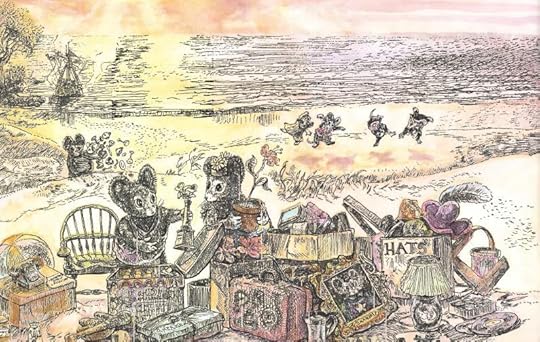
1973 Dial Books for Young Readers/Pied Piper paperback, 9th printing. The color illustrations by master artist Steven Kellogg are true to his form - colorful and detailed. The mice celebrating National Rodent Day are attacked by a cat and decide to sail to a place where mice could live in peace instead of a hole in the ground. Strange adventures and merriment ensues until they discover a "monster" on their new island of the Skog. Very clever tale of learning to live together.
Steven Kellogg is an author and illustrator who has contributed over 90 books for children. He is best known for writing books about animals, for which he credits his grandmother .
Fed up with living in fear of a cat and a German shepherd a group of mice set sail in a boat to find a new place to live. Arriving on an island they find mysterious footprints and seek to capture whatever is making them.
This story had nice detailed drawings, reminiscent of Oakley's Church mice series. When I was very young I used to get this book out of library again and again, although it was before I could read so I didn't know what the story said there was enough in the illustrations that fascinated me and I loved the little creature revealed at the end. Reading as an adult I can see the the mice could have arrived at the island in peace without blazing their canons but I can see that this is a very enjoyable rodent adventure story and it was fun that over 4 decades later I finally got to read the words!
A fine swashbuckler with lots of great details in the illustrations. Stephen Kellogg is a childhood favorite of mine. (I must say, though, I found the depiction of the cats a bit disturbing though this makes sense as it's from the perspective of the mice, but sensitive readers may be upset by how vicious the cats look and how "one got Granny this morning") I do so like that it has a sense of old-fashioned adventure but with a message that is (sadly) still so relevant and needed in our world today. When encountering the new, which can be so often seen as "scary" and "other" what comes when one acts from a place of fear and violence or out of a place of empathy and kindness? Both my boys, despite being beyond the target audience, really liked this book when they saw it recently and I've noticed them looking at the illustrations many times. They both spoke of the approach the mice had when arriving at the island and were able to look at it the scenario as a whole in both a critical and empathetic way. Moments that warm a mama's heart! :-)
This was one of my childhood favorites. It was a solid 5 Stars in my memory. But rereading it with my own child tarnished the memory, and I had to deduct stars. As a child, I sympathized with the mice, but as adult, I sympathize with the Skog.
The mice are fleeing for their lives. They are refugees from a hostile land where they live under constant daily threat. They decide to risk their lives in an ocean crossing, and their voyage brings them to The Island of the Skog, population 1 Skog, where they decide to settle. What do they do? Do they meet with the Skog and request to be allowed to live with him on his island as there is plenty of undeveloped land? No! They feel entitled to claim the entire island for themselves. In an act of might makes right, the mice fire their ship's canons as they approach the island to drive away the Skog.
As the island’s name is the Island of the Skog, there is no question that the island rightfully belongs to him. They are attempting to drive the Skog from his home. This is an act of aggression against the native inhabitant. The mice at colonialists!!! The mice are attacking a sovereign entity without provocation.
The mice also show a complete disregard for the person whose home is already on the island and whose resources they are requisitioning for their own use. They don't apply for asylum. They become conquerors. They just take what they feel they deserve, and they feel entitled because of their own suffering. Because the Skog is other than they are, they feel he has no value and, therefore, does not deserve to be treated as a equal.
Remember, when Aeneas and his small band of survivors reached Italy after the fall of Troy, they immediately asked permission to settle there from the most powerful of the local rulers. The Trojans' arrival was peaceful, and there had been a chance that they could build homesteads and quietly assimilate into the local population. However, the less powerful lords and much of the general population saw them as a threat and unwanted competition for finite resources, which ultimately resulted in violence and bloodshed.
The mice, in contrast to pious Aeneas, never even consider trying to make peaceful contact with the Skog. After firing upon his home, the mice then attempt to trap the Skog who, in turn, attempts to frighten them off. On their second attempt, the mice succeed in capturing the Skog. When he is at their mercy, the mice decide that the island is big enough for all of them and that they can all live together in peace. This is despite the fact that the mice are the ones who should have been asking the Skog’s permission to live on his island to which they have no legitimate claim.
Like all persecuted people throughout history, as soon as they escape to some place else, they immediately being oppressing others and imposing their own culture and values upon them -- when having another group's culture and values forced upon them is exactly what they fled in the first place. That's the horrible irony. The oppressed step into the role of oppressor without the slightest hesitation. Of course, the Abrahamic idea of "right belief" -- as opposed to the pagan tradition of local deities and cultural/familial/ethnic devotion to particular regional gods -- shares a large portion of the blame for this. It's not just that homo Sapiens are hierarchical beings. Anyone who's not a right believer or true [insert type of religious adherent or name of group member] is acceptable collateral damage especially in a land grab.
Oh, this makes me so sad. As an adult, I have a different understanding of the story and its implications. As a young reader, this was a simpler story. Mice decide to set sail in a model ship for a place where they can live without fear of being eaten or exterminated, and just when they think they have reached safety, they are threatened by a monster. But it turns out the monster is a small frightened creature similar to them, so they decide to be friends, and all live happily ever after. The End. Alas, if only that were still so. But at least, illustrations of the Skog in his big black cloak are still wonderful as I recalled.
This is my very favorite Steven Kellogg book. For one thing, it is a timeless adventure that will not go out of fashion. For me, it is the wonderful adventure of the little mice, taking a ship to an unknown destination; and then the having to cope on an island inhabited by an unknown monster. I also loved all the different personalities of the little mice, and the illustrations (I think in watercolor and ink) were so incredibly detailed.
My daughter read The Island of The Skog to me for her school homework assignment and I must say we both tremendously enjoyed this book. Not only was the story about mice trying to find freedom entertaining, the illustrations were quite fine as well. I was certainly surprised to find out who the skog on the island really was and if you and your child like a little bit of mystery you will get this book and find out who the skog is for your selves. As a side note, I was excited to see that this copy borrowed from the school library was autographed by Mr. Kellog and he even drew a little skog holding a heart next to his name.
This is an incredible book. A timeless story of being accepted for who you are and the friends you haven't met, yet. If you don't have this book in your arsenal, you might as well be reading your kids the menu to the local Chinese takeout joint.
Terrorized by the butcher's cat and tired of living in fear, a group of mice decide to "sail away to a peaceful island." When they come upon the island that has one skog (but what is a skog?), Louise wants to offer it a gift so that the skog will let them stay on the island. After all, there's plenty of room. But Bouncer wants to "show him we mean business", in case the skog is dangerous. So they shoot off cannonballs. In turn, someone sets their boat adrift. So, finally the mice set a trap. And when they catch the skog, they realize how silly they've been.
An older book that still has a meaningful message today.
I really liked this book! It was one that I had not read before and I think that this would be a great story for a read aloud. It is a little higher in difficulty regarding vocabulary and amount words so for kids who want to read it on their own, I would recommend grades 2nd and up. The illustrations are intricately detailed and look like they were drawn with pencil and colored with colored pencils. I am not sure how I would use this book for a specific lesson or topic but I would read it to my class or kids just for fun. It also reminds me of the movie The Rescuers because the characters are mice who are voyaging across lands on an adventure,
This story has a lot of silliness and other-worldliness, with everything being from the point of view of mice. The illustrations aren't at all the style that TJ is usually drawn to, which is probably why this one never really grabbed him.
Loved this book as a kid. Steven Kellogg came to my elementary school in the early 80's and told this story while drawing the illustrations live. It was a memorable experience. Then he autographed copies of the books for us. I still have my copy, and treasure it.
This book was my favorite as a kid. The illustrations are so detailed and evoke the exact emotions the author wants you to feel. I love the feeling of camaraderie and fun in this book. Reading it makes me feel like a kid again:)
A group of mice, tired of being harassed by a cat, set sail to find the Island of the Skog. Once they arrive, they try to rid the island of the Skog...only to realize that he is a gentle, scared creature. They learn to live cooperatively, and enjoy a relaxing life on the island.
This is an older picture book, with mice that head off on an adventure to find a deserted island. There's a message about how it is better to lead with kindness, but one character is awfully battle-like.
Delightful illustrations. A group of mice decide to sail away in a toy ship and make their home on a island. However, the island is the home of the Skog. At the end, everyone learns a lesson about friendship and communication.
An oldie but goodie! Love this book and the great conversations that come from sharing it about how easy it is to make judgments of people until we get to know them.
This was a favorite book of mine as a young child that I recently rediscovered. The illustrations are unique and the story is very good for a children’s book.
Naked imperialism as the Rowdies shoot first and ask questions afterwards. But their genocidal campaign against the indigenous population has unexpected consequences.
A family of mice, tired of hiding from their enemies, decided to go find an island to make a new home. It was a long, rough trip on a ship to the Island of Skog. There they made a scary discovery that turned out to be quite surprising. Great story and illustrations.
This was a fun fantasy book. The author does a great job of showing us what happens when we don’t communicate and we make judgments of others without really knowing them first.
This is the first book I remember having read to me at a library storytime and I LOVED it. I made my mother read it again and again and again.
It is a LONG book for a storytime read - at least for how I roll out my storytimes with movement and crafts and such but I still have a lot of nostalgia for this one.