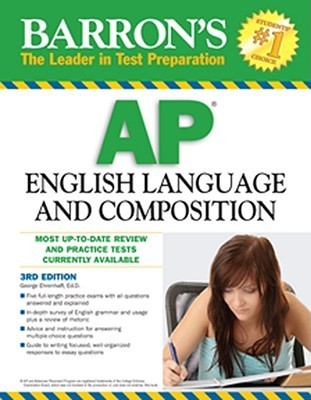
This updated manual presents five full-length practice exams with all questions answered and clearly explained. The book features a complete overview of what students need to know about language and rhetoric to earn top scores on the AP exam. Also included is advice and instruction for answering multiple-choice questions, plus an essential guide to writing focused and well-organized responses to essay questions, including the synthesis essay, which requires students to demonstrate mastery of documentation skills. Sample students' essays are presented with critiques that point out each essay's strengths and weaknesses. A glossary consisting of hundreds of rhetorical terms is also included.
Several people say that you can't study for the AP Lit exam, but I disagree. This review book offers several great strategies to approach the prose and the poetry featured on the exam. Its practice multiple choice questions and exams come with helpful explanations - Lit is pretty similar to Calculus actually, in that you must practice to get better. The most helpful part of this book, at least for me, was its section containing key vocabulary: while I skimmed the majority of it I studied this section in case any vocab came up on the exam. If you want to try and prepare for the Lit exam I'd recommend Barron's all the way. Also, I got a 5 on the exam, just to show that it actually may have helped (though I love literature and it's my passion anyway).
Only going to be helpful for the practice test passages, which were useful - to an extent. Be aware that there's more of a focus on grammar (parallel structure, etc.) than you're probably going to see on the real test. I freaked out when I saw how many questions I missed until I saw which ones I did. I shit on the Princeton review a lot, but this was also not the best prep.
This book teaches how to hone two skills: reading and writing non-fiction.
When writing, check for: 1) good grammar 2) good documentation of materials 3) good use of rhetorical strategies: tone, theme, diction, allusion, paradox, satire, mood, syntax, imagery, irony, point of view... 4) good editing and proofreading. Check for: - misplaced modifiers: words, phrases, clauses that tell something about, or limit meaning of, a word or statement. Modifiers should be placed as close as possible to words they modify. - Dangling modifiers: modifiers that lack the noun or pronoun they modify. Ex: While running to class, the bell rang... - Parallelism: Keep equivalent ideas (in series) in the same grammatical form. Ex: I like skiing, hiking, to take pictures... - Active, animated verbs and active sentences (where performer is emphasized) - No needless words - Use specific language - No fragments (sentences need a subject and a verb) - No run-ons (2 independent clauses with no punctuation between) - No comma splices (2 independent clauses with a comma between)
When reading, be able to identify and describe these elements in a non-fiction text: 1) Thesis: What is the thesis? 2) Documentation: Does the author's documentation of sources qualify him to speak on this topic? 3) Purpose: What is the author's intent/purpose? How does the writer use structure/grammar and rhetorical strategies to convey this? 4) Tone: Tone is the psychological quality of the words. Since we can't hear his "tone of voice," the author must use rhetorical devices and structure/grammar to reveal his tone. What is the author's tone? How does he use structure/grammar and rhetorical strategies to convey this? Tone is largely revealed in these ways: - Sentence forms: - exclamatory, interrogatory, declarative - periodic (most important idea stated at end of sentence) or loose (most important idea stated at beginning of sentence) - Sound of words/sentences: - Onomatopoeia (words that imitate the sounds they describe) - Alliteration: repetition of initial sounds in words and syllables - Rhythm: slow, even, short, choppy sentences... - Vocabulary (Diction: word choice; Connotation of words) - Metaphorical language: figures of speech: metaphor, simile, allusion, analogy, metonymy (substitute concrete for abstract), synecdoche (substitute part for the whole)
Okay, this is an AP prep book. I don't think I need to say much more. Some of the information here is helpful and will be copied, but it's nothing that I probably could have come up on my own... and I'll definitely have to supplement it with my own suggestions. Basically, if you're considering taking AP English Literature and Composition, your money would be far better spent reading real books rather than this. I suggest Ellison's Invisible Man and Gatsby, as they fit almost every free response question ever posed. (Believe me, I've tried.)
Major failures of this book, in my mind:
1. The explanation for the multiple choice questions at the end of the practice tests is rather flimsy. Sometimes it's as important to explain why a detractor is NOT the right answer as it is to explain why the right answer is "more right." If you're going to offer an explanation section, you might as well do it right.
2. The formatting of this book is not very copy friendly. I guess the editors wanted to present the practice tests in a similar format as the real AP test, but I really wish they had made it easier for teachers to copy pages without wasting a lot of paper. Of course, the intention probably isn't to copy. Ha. (Dear publisher, it's for educational purposes! I promise!)
Lots of typos. Lots and lots of them. Or grammatical errors in the grammar section... really?!
Also, I just want to point out that the gaping hole in my "Read" category is due to teaching AP Lang, AP Lit, sophomore English, sponsoring four clubs, and assisting in one sport. Never again. I demand time to read! So, please give me a break. I'll make it up in 2011 and 2012. AP Lang is a fun class, though.
For the little amount of time I used this book, I was not impressed. The multiple choice practice test I took was too difficult and not indicative of the real exam. I got about half of the questions wrong after sitting down and taking it timed, since most of the answer choices were too similar and the questions were all too specific. Usually when I do practice from old AP exams I get most right, so there was something off about the practice section in this book.