Detective Simon Ziele lost his fiancée in the General Slocum ferry disaster―a thousand perished on that summer day in 1904 when an onboard fire burned the boat down in the waters of the East River. Still reeling from the tragedy, Ziele transferred to a police department north of New York, to escape the city and all the memories it conjured.
But only a few months into his new life in a quiet country town, he's faced with the most shocking homicide of his career to date: Young Sarah Wingate has been brutally murdered in her own bedroom in the middle of an otherwise calm and quiet winter afternoon. After just one day of investigation, Simon's contacted by Columbia University's noted criminologist Alistair Sinclair, who offers a startling claim about one of his patients, Michael Fromley―that the facts of the murder bear an uncanny resemblance to Fromley's deranged mutterings.
But what would have led Fromley, with his history of violent behavior and brutal fantasies, to seek out Sarah, a notable mathematics student and a proper young lady who has little in common with his previous targets? Is Fromley really a murderer, or is someone mimicking him?
This is what Simon Ziele must find out, with the help of the brilliant but self-interested Alistair Sinclair―before the killer strikes again.
With this taut, atmospheric, and original story of a haunted man who must search for a killer while on the run from his own demons, Stefanie Pintoff's In the Shadow of Gotham marks the debut of an outstanding new talent, the inaugural winner of the Minotaur Books/Mystery Writers of America Best First Crime Novel Competition.
In the Shadow of Gotham is the winner of the 2010 Edgar Award for Best First Novel.
Stefanie Pintoff is the Edgar® award-winning author of HOSTAGE TAKER and the Simon Ziele historical mysteries. Her writing has also won the Washington Irving Book Prize and earned nominations for the Anthony, Macavity, and Agatha awards. Pintoff's novels have been published around the world, including the United Kingdom, Italy, Croatia, and Japan. She lives on Manhattan's Upper West Side, where she is at work on the next Eve Rossi thriller.
The book is set in 1905, in New York and we are introduced to Detective Simon Ziele who has transferred himself from the main city of New York to a small police department, in the town of Dobson, north of New York, in order to escape from the tragic memories of his fiancee, who died in the Slocum ferry disaster a year earlier. However, only a few months into his new job and he is faced with the task of solving one of the most brutal homicide he has witnessed in his career and what is most shocking is that it has taken place in the small quiet town of Dobson, where such brutal crimes have never been before committed. The victim is Sarah Wingate, a notable student of mathematics, who is found brutally and viciously murdered in her bedroom in her aunt's home. During the investigation Simon is contacted by noted criminologist, Alistair Sinclair, who offers his help to Simon and a clue that one of his patients, Michael Fromley might be behind the murder, as the facts of the murder resemble his deranged patient's murderous fantasies. But Simon has his doubts: is Fromley really the murderer or is it somebody else who is just mimicking Fromley?
This book is not a fast paced thriller and since I like fast paced thrillers, this book should not have worked for me but it does. Why? The answer lies in the strong plot, expertly drawn characters and Stephanie Pintoff's writing style....she gives a lot of information with regards to the political and social background of New York in 1905, the increased interest in the study of criminology as well as the different procedures which were slowly being introduced and accepted in police procedural work, at the turn of the century, in solving crimes...namely the use of photographic evidence, fingerprinting and profiling.... and she manages to merge all this information with the story line in a smooth and fluid manner, making it an interesting book to read.
This is Stephanie Pintoff's debut book... she won the Edgar Award for Best First Novel and the Minotaur Books/ Mystery Writers of America award for Best First Crime Novel...and it is the first book in the Simon Ziele trilogy. This was a random pick by me and I was not at all disappointed by it and I look forward to reading the other books in this trilogy.
First Sentence: The scream that pierced the dull yellow November sky was preternaturally high-pitched.
Simon Ziele left being a policeman in New York City after a personal tragedy and injury. Now in the New York, East River town of Dobson, a young woman has been brutally killed while staying with her aunt. Simon is surprised when noted criminologist, Alistair Sinclair, proclaims he knows the killer. But does he?
I really did want to like this book but there were just too many things wrong with it. I was attracted by the idea of having a book set in a smaller town at the beginning of the 20th century. However neither the location now the period were used to best advantage. Much of the action takes place in New York City, but even then, a strong sense of place is not provided. As to sense of time, we are told about the technological differences but much of the story feels to modern to me. I was particularly stopped when Ziele buys a cup of coffee on his way to work. Coffee to go in 1905? I don’t know.
The characters, in spite of the author’s best efforts, were flat. We were provided factual information regarding Ziele, but I never made an emotional connection to him. Only in one scene where he is frustrated and somewhat angry did he come alive for me.
The plot was based upon one very large coincidence. Although both the character and the reader know the investigation is off in the wrong direction, it takes much too long for the plot to catch up.
My other major issue is that the author adopted the unfortunate style of end-of-chapter foreshadowing way too many times.
The book was not without redeeming elements. The forensic information, as the United States was just beginning to use fingerprinting and study criminal behavior, was fascinating. There was an interesting perspective of the “I know my …..” disbelief of those close to a criminal believing that person could commit such a crime. Unfortunately, these elements were not enough to save the book for me.
The book did win the Mystery Writers of America, First Crime Novel Award, but I’ve disagreed with award winners before. This is one you’ll have to judge for yourself.
IN THE SHADOW OF GOTHAM (Hist. Mys-Simon Ziele-NY-1905) – Okay Pintoff, Stefanie – 1st book Minotaur Books, 2009, US Hardcover, ISBN: 9780312544904
Not very good at all. This book was nominated for the Anthony Award for best first and won the Edgar in the same category which frankly baffles me. The plotting was simplistic (Whodunit was painfully obvious), characters were thin and wooden, and even the historical details were not interesting. This ranks up there as one of the most boring books I have ever finished.
Ah!! A new historical fiction series for me to enjoy. Set in 1905, this first entry involves a brutal murder in a small town just outside New York city and pulls in a former city policeman who now lives in that community. The reader is treated to a picture of the state of crime-fighting at that time, with wonderful visual pictures of the New York and suburban streets. New methods of understanding criminal behavior are being tested during the search for the killer.
Highly recommended for those who liked Carr's The Alienist.
Here's a debut well worth reading. If you like forensics, the workings of the criminal mind or books like Caleb Carr's Alienist, In the Shadow of Gotham should be on your TBR list.
After losing his fiancee in the Slocum Ferry disaster, police detective, Simon Ziele, in hopes of fleeing his memories, escapes New York City and relocates several miles north to Dobson, a quiet village. His quiet is soon interrupted with the brutal stabbing and death of Sarah Wingate. Very early on Ziele is contacted by Alstair Sinclair, a professor and crimonologist of Columbia University. Sinclair has reason to believe, his patient, Michael Fromley is Sarah's killer. Sinclair has been studying Fromley, who exhibits bizarre behaviors and horrible fantasies, in an effort to prove that a criminal mind can be rehabilitated.
This is a superb police procedural with an expertly drawn character in Simon Ziele. 1900's New York comes vividly alive through Pintoff's descriptions. But the strongest part of this Minotaur Books/MWA Best First Crime Novel award winner, is the depictions of the fledging science of criminology. Here is a portrait of the early 20th century that was just seeing the possibilites of fingerprinting, forensics, and profiling. It's slow pacing is appreciated as the story builds to its conclusion.
Definitly looking forward to more from Stefanie Pintoff!
Early 1900s, New York state. Simon Ziele has lost his fiancee and most of the use of one arm to a ferry disaster, his mother to disease, his father to gambling, and his sister to marriage.
I find that last part particularly amusing, because other characters are like, don’t you have any family left? And Ziele is all, naw, everyone’s dead, deserted, or married. Like just because his sister got hitched and left New York City, THEY CAN NEVER WRITE TO EACH OTHER AGAIN.
But I digress.
So Simon’s seriously emo, with good reason, and he leaves his job as a detective in New York City for one as…a detective. But this time in a small town! Where there are no really gross homicides! Because even though his fiancee died in an accident, not through violent crime, he associates the two! Because I guess that makes sense!
Anyway, it sucks to be Simon, because at the very beginning of the book, a young lady comes to visit her wealthy aunt in Simon’s sleepy little town and winds up getting brutally murdered.
See, Simon, here’s your REAL PROBLEM: you shouldn’t have left NYC for upstate New York. You should have left crime fiction for a Nicholas Sparks novel.
So this girl is dead, and almost immediately a professor from Columbia by the name of Alistair Sinclair shows up at Simon’s door and is all, “Hey–so your murder? Sounds like the work of my pet psychopath. I’ve been studying the way this guy’s brain works for a couple of years, and let me tell you, this murder is exactly like the sick shit I’ve been listening to all this time. PS: did I mention that I let him off the leash two weeks ago and haven’t seen him since?”
So then they decide to work together. Shenanigans ensue.
I had several problems with this book: to begin with, I obviously didn’t buy Simon’s PAIN. It’s not that his feelings are totally implausible–many people simply cannot cope with the death of a loved one and switch careers–but they feel…forced. Simon tells us about everything he feels; we never see any indication that he’s experiencing an emotion. This is mostly due to the writing style, which seems to be Pintoff’s attempt to ape the style of the times. But, um, it doesn’t really work. It makes the characters feel flat, and also? She has Simon say things like, “Little did I know then, but everything was about to abruptly go to shit.” DON’T DO THAT, AUTHORS. IT’S A CRIME NOVEL. DO NOT TELEGRAPH PLOT TWISTS LIKE THAT.
And speaking about telegraphing plot twists: I called the murderer from his introduction. Seriously. The minute he showed up, I was like, “BAM! That guy!” And that’s not the end of the world, but Pintoff never managed to shake my conviction about this character. Never. That’s unacceptable. Personally, I don’t read crime novels to feel smart; I read them to feel really, really stupid. I want to be tricked. I want the author to be two steps ahead of me and mooning me at all times. Pintoff never manages that, which is why I can’t forgive her poor characterization or her dreadful period style.
Recommended for: Only if you are deeply, inexplicably, and forever in love with The Alienist.
This entire review has been hidden because of spoilers.
The reason it took me so long to get into this story is that Pintoff failed to create a realistic picture of New York in 1905 for me. She did plenty of research and threw in random facts about the era that distracted from the story, but I needed them to remind me that this was indeed historical fiction. Little things like a telephone in every residence with no mention of switchboard operators and a police photographer excessively snapping shots of a crime scene even though cameras were just recently invented didn't capture the newness of inventions we take for granted. I wanted to hear about buying papers from newsies and horse-drawn carriages and shoe shiners on the street and parasols and all that stuff to give it that turn-of-the-century authenticity.
I could have bought the setting if the characters fit the era. Every single one of them, down the old-money elderly matron, was liberal beyond their times with weak references to the "they" of society that they didn't fit into. You had the outspoken for women's suffrage girl getting her masters when it was unusual enough for a woman to get any college education, the criminologist who had such a grasp of psychopaths when the term was only coined a decade before that he was able to provide accurate profiling when criminal profiling didn't take off for half a century later. Even the lawyer seemed to hint at Miranda rights (1960s) and a prostitute was embarrassed to have taken hush money instead of suing when a prostitute in that day would be happy to get any money and would know her chances in court. I had a hard time believing these characters lived in 1905, maybe if they were mixed with more conservative characters, but the whole lot of them I didn't.
I figured out the culprit pretty early on but then doubted myself so I was curious about the mystery. And despite doubting that the characters would have understood psychology and profiling, I still love that stuff so it was fascinating to me. The writing was a little dry and sometimes awkward, which made the story hard to get into, but once the mystery took over the scene setting , it was easier to read and then I could enjoy the story. It was a struggle to get there though.
I was rather disappointed by this book. It was well-written but the story was pretty pedestrian and the mystery aspect was rather weak. It was obvious from early on who the murderer was and the motive was predictable as well, leading to a boring ending. The lead character was not much of an investigator and did not display impressive police skills. I picked this up due to the comparisons to "The Alienist", which I loved, but this book is not in the same ballpark.
I really liked it but I felt the author used the word 'ascertain' a little too much and was irritating. I will read the rest of the series though. I like the characters!
In the Shadow of Gotham (Minotaur 2009) introduces Simon Ziele, a police detective who lost his fiancee and the full use of his right arm in the 1904 wreck of the steamship General Slocum. Ziele has relocated from New York City to the town of Dobson, hoping for a quieter existence and time to recover from his loss, but the brutal and bloody murder of young mathematics student Sarah Wingate shatters his peaceful retreat. The investigation has barely begun when Ziele receives a communication from Alistair Sinclair, a professor at Columbia University, claiming to know the identity of the killer. Sinclair has created a new department to study the emerging science of criminology based on the controversial theories of Dr. Hans Gross, and fears that Michael Fromley, a former research subject with violent tendencies, may have acted on his fantasies of killing young blond women. Excellent historical details, vivid characters, and a strong plot enliven this combination of police procedural and the beginnings of forensic science. This debut novel is a finalist for both the Agatha and Edgar Awards for Best First Novel, and won the first Minotaur Books/MWA Best First Crime Novel Award. http://www.stopyourekillingme.com/P_A...
A completely enjoyable read by a new author. In the Shadow of Gotham is detective mystery novel that takes place in NYC at the very beginning of the 20th century. Detective Ziele partners up with a professor of criminology to find the person who killed a brilliant female math student. As far as detective novels go, it's not original or innovative, but it's extremely well-written and while I correctly identified the perpetrator near the beginning, Pintoff kept things mysterious enough that I always had two or three other possibilities in my head. I look forward to seeing what the author writes next.
I'm really giving this book 3.5 stars. Many of the plot twists, which are what lead to a surprising denouement in other books, are easily predicted while others jump out at you in surprise right to the very end. For some reason, I don't think that the actual solving of the mystery is what the book is about; rather, it's a look into the investigative process and the beginnings of criminal psychology. I plan on reading the other books in the series
Historical mysteries set in New York City are like catnip to me -- I love NYC history, and I love seeing how the author will play with the conventions. This one, set in 1905, was . . . pretty good. There were some anachronisms and other slips that jarred me: particularly a reference to a man's shirtwaist (wouldn't it be shirtwaists for women and shirts for men at that time?) and a couple of academic specifics about journal publication and "professor emeritus" (a 55 year old man who was still teaching wouldn't be emeritus, unless the term has seriously shifted meaning over the years). The murder victim was working on her Ph.D. at Columbia, a state I can sympathize with, and in fact there were a very few women graduate students there at the time -- Pintoff sets up the difficulties of her position effectively. The mystery -- I kept expecting all kinds of fakeouts and etc. that weren't actually there, but I don't think that's a bad thing -- in this case a more obvious solution was actually less obvious in some ways, unless that was just me.
There were bits and pieces I would have liked to have known more about: the victim's involvement in the women's suffrage movement, the two African-American street musicians who randomly save the detective, Ziele, from a beating, and etc. Ziele's background -- he lost his fiancee in the General Slocum disaster -- was interesting, but I didn't thing as much was done with it as could have been done with it, which leads me to think perhaps this might be the first of a series? I'd definitely read another, for the setting and the mostly-solid sense of history, though I wouldn't rush out to pick it up in hardcover.
This is a very character driven book. That's certainly unusual for a mystery since setting and location often play a huge part in crime fiction. The story is set in the shadow of NY (hence the title) but the setting itself is very vague and not knowing NY very much at all I couldn't orient myself simply by namedropped landmarks and street numbers.
It was rather fascinating to read a historical mystery set at the turn of the century just when criminology and the attempt to understand the criminal and why they commit crime has begun to be developed. How far would someone go for research? Can people who commit horrible crime be understood and do we want to understand them at all? The ethics definitely clash and as do the characters in this book. But intellectual arrogance and pursuit can get in the way of ethics.
What felt strange was that while this was a very character driven novel, I felt very distant from our narrator. I could barely picture him even though we knew his history more or less, his past, his own deficiencies. Still, I felt like I didn't really get to know him.
The mystery was rather well plotted and the crime was fairly horrid. I started getting the hint about who it probably was a bit before everyone else in the book did. Though I did guess that it must be someone connected to the group. One of the other problems was that for a first installment there was a lot of new characters, so I had trouble remembering someone we met briefly when there since everyone was still very new and you don't know who's important or who's not.
I enjoyed the story overall, but I wanted more from it, especially considering this novel won an award.
Very good detective mystery novel with a historical setting of New York in 1905. The author did her homework in the forensics of the era so the authenticity rings true. I am also in awe of any mystery novel in which the identity of the murderer remain unclear to me until the end. The story does offer lots of red herrings. Overall a pleasant mystery worth the time to read.
New York City cop Simon Ziele lost his fiancee and the use of one arm when the General Slocum caught fire and sank in the East River in 1904. Now, a year later, he's policing in the small town of Dobson, not so many miles outside the city. Serious crime is more-or-less unheard-of in Dobson -- that is, until the day Sarah Wingate is brutally murdered.
Simon has hardly begun his investigation when he's contacted by Alistair Sinclair, an academic criminologist working out of Columbia University. Sinclair is pretty certain he knows exactly who the murderer is, and, although Simon is suspicious of these newfangled scientific crime-solving methods, he's forced to admit that Alistair's lead is a strong one, and certainly the only one he's got. Together the two men and Alistair's team (including his widowed daughter-in-law, Isabella, between whom and Simon a bond swiftly establishes itself) comb New York City in search of a ruthless killer . . .
Although I gather there are faults in the historical details of this novel, any such flaws sailed right past me. Much more important, so far as I'm concerned, is that Pintoff has succeeded in creating a novel that splendidly captures the feel of a mystery novel of the period (albeit with rather more of a focus on prostitution than the likes of Ethel Lina White or Mary Roberts Rinehart would have permitted herself). Presumably in keeping with this, the novel is rather slow to get moving: even though the first murder happens in the opening pages, Simon's investigation takes its time to pick up pace. Once the plot does get into gear, however, the novel becomes absolutely gripping -- or at least I found it so, reading way past my lights-out a couple of nights in a row.
The only problem is that the solution to the mystery is a fairly prosaic one -- one that's so obvious you assume the clues have been put there to mislead you. It's as if the country-house murder had indeed been committed by the passing tramp. But I found myself more than prepared to put up with this anticlimax for the sake of all the good stuff that had come before it.
In the Shadow of Gotham by Stefanie Pintoff is the first book of the Simon Ziele mystery series set in 1905 New York. Simon is a a former NYPD homicide detective. To cope with grief over the loss of his fiancee, he fled the constant violent crime of the city to Dobson, 17 miles north. Dobson's former solo detective Joe resents Simon, convinced he will force Joe into retirement. Simon's hopes for peace are shattered by the violent murder of Sarah Wingate, visiting niece of a wealthy resident.
Joe and Simon have scarcely begun their investigation when a stranger contacts them, insisting he knows the culprit. Alistair Sinclair founded a criminology institute to study criminal behavior. Patience is required for the lengthy description of Alistair's theories, his staff, and what he initially discloses about his pet criminal. Hang in there for the first hundred pages. During a hunt for a missing man, interest is provided by fascinating historical details of New York City: Tammany Hall fully controlled elections; growth in the city's neighborhoods stratified by economic status, described as they seek witnesses; Grand Central Depot in the process of being rebuilt as Grand Central Station; Delmonico's already famous for its cuisine as well as illustrious customers.
Simon realizes his investigation must not be swept along strictly on one man's opinion. He recognizes Alistair's values are compromised by his research zeal, whereas Simon strives for objective evidence. Simon continues to conduct comprehensive interviews to learn all the facts. Sarah was a brilliant mathematics graduate student at Columbia, resented by classmates with lower grades. She proposed to solve Riemann's hypothesis (still unsolved), working closely with a professor at Princeton. Simon finds mysterious connections to a successful madam, who will not reveal all she knows. Simon keeps an open mind, dedicated to pursuing evidence diligently - traits which serve him well when the case is turned upside down at book midpoint. The case becomes much more of a puzzle, way more interesting. Clues lead in several directions; suspense begins to build.
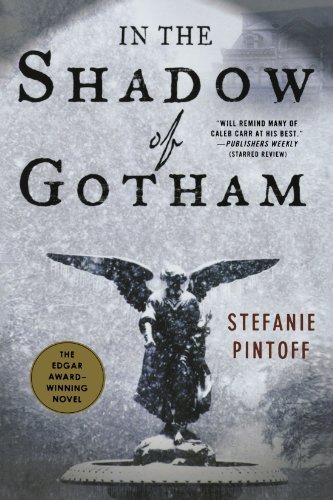
By the time Simon interviews a witness in Central Park at Bethesda Fountain with its statue of the Angel of the Waters (cover photo), it's impossible to put the book down. The complexity of the case, Simon's astute actions, and rich character development completely redeem the glacially paced start. A patient reader will be well rewarded. Simon is an interesting protagonist with a tragic history, well worth following in his next adventure, A Curtain Falls.
The first book of a new-to-me series is set in 1905 in New York City. Lots of historical details including the political climate of the time, specific historical occurrences, physical descriptions of city expansion and how dirty the streets are, as well as the developing social consciousness, help to give an authentic feel to this story. The story is engaging and the characters are well developed. Altogether a satisfying read I recommend to anyone who likes either cozy mysteries or police procedurals.
When I started looking for a final book for the Criminal Plots III Reading Challenge (Read a novel that's been nominated for and Edgar in the last five years), I was relieved to find In the Shadow of Gotham by Stefanie Pintoff sitting on my shelves since I'm trying really hard to read more from my own stacks. I'm not much for reading more recent books, but I had picked this one up last May while browsing in our Friends of the Library used book store. It was purely a whim--based on the cover, the blurb on the back of the book, and the fact that it's a historical mystery set during one of my favorite time periods--early 20th C. Not only was Shadow nominated for an Edgar, but it was the winner of Award for Best First Novel in 2010.
The book introduces us to Detective Simon Ziele, a man trying to recover from the tragedy of losing his fiancée in a terrible disaster aboard the ferry General Slocum. Ziele has left his position in New York City's police force and is now working as a detective in Dobson, New York. He hopes to escape the brutality of the big city, but just months after he begins his new post, he finds himself faced with the horrific murder of a female mathematics graduate student.
Sarah Wingate had come to her aunt's home hoping for a little tranquility of her own--telling her aunt that she needed somewhere quiet to work on her graduate thesis; somewhere removed from Columbia University. What she found instead was an untimely end. Ziele is called to the wealthy home in the middle of the afternoon to investigate a murder that ranks with some of Jack the Ripper's slightly less gruesome efforts. Sarah's throat has been cut and then the killer beat and slashed her repeatedly while taking one of her golden braids as a souvenir.
It looks like the work of a pyschopath...and Columbine University criminologist Alistair Sinclair believes he knows the identity of the murderer. Sinclair has been studying Michael Fromley, younger son of one of New York City's elite families, in the hopes of rehabilitating the man and curing him of his violent behavior. Michael had fantasized about committing such atrocious acts, but now it looked like he had crossed the line from fantasy to make his violent dreams a reality. Sinclair and his team of researches join forces with Ziele to find Michael and try and prevent further deaths.
The investigation takes Ziele from the gambling dens and brothels of the Tenderloin are of the City to the houses of the elite. The more he learns about Michael, the more confused the case becomes. Ziele begins to doubt that Fromley is behind the crime--or if he is that he has acted alone. And somehow the killer manages to stay one step ahead of Ziele and the researchers all along the way. Does this mean that the culprit is really closer to Ziele than he'd like to believe?
In some ways, this is indeed an impressive first novel. The plotting is well-done for the most part and portions of the research are as well. I really like the character of Ziele--although I must agree with another reviewer on GoodReads that despite many utterances of "I don't trust him," Ziele seems to be a very trusting sort. He has never heard of Alistair Sinclair and his researchers before the murder and yet he's willing to bring them all into the investigation as equals and reveal every bit of evidence to them. I, too, was immediately struck by a certain character's behavior (and others' reaction to him/her) upon introduction and was certain that s/he was involved. Kudos to Pintoff for putting a deft spin on that bit of information so I wound up not being completely right....but still the clues were a bit heavy-handed for that early in the book.
The research allowed Pintoff to give us a flavor of turn-of-the-century New York (last century, that is). But it feels like she did the research rather haphazardly. Others have pointed out historical problems--the naming of one of Columbia's halls, for example--and I noted a few blunders with historical word use. The word "overkill" doesn't come into usage until the 1950s and yet Sinclair tells Ziele that the excessive violence of the murder, may be "what you would call over-kill." Actually, no, Ziele wouldn't. Not in 1905.
Despite the sometimes obvious anachronisms, this is a highly enjoyable first novel. It was a quick read and I regretted each time I had to put it down and do such non-essential tasks, such as working and sleeping. I look forward to reading the next two in the series and hope to find out more about Ziele's past and the death of Sinclair's son. Just over three stars.
First posted on my blog My Reader's Block. Please request permission before reposting. Thanks.
I picked up this book - and the sequel to it - just before Christmas because they were remainders and cheap, and the reviews on the covers compared them to Caleb Carr's "The Alienist." And I have to say . . . I really regret buying both of them. Because "In the Shadow of Gotham" is BAD.
The idea - the mystery itself and the plot - are okay, and would have been much more interesting in the hands of a good writer. Sadly, Pintoff is not a good writer. She overwrites extensively - putting information in a character's mouth as dialogue and then immediately explaining what they said in narrative, as if the reader might not be sharp enough to recognize information by themselves. Her characters are badly/incompletely described, so you get to the end of the book and you're not even sure what the main characters actually look like. Another character - who I think is meant to be a main character - is so unattractive and unappealing, you really don't care if you ever see him again.
Things might have been better if she'd had a good editor - but apparently she didn't. Near the beginning of the book, two characters take a ferry from upstate to get to NYC (which is iffy to begin with, especially if they're on the same side of the Hudson, which isn't clear), and for the rest of the book, they use the train to go back and forth. The main character makes a remark about an injury someone has, how it looks worse than it did "yesterday" - and he just met the man that same day. I could go on.
Suffice it to say, I was greatly disappointed in the quality of this book. The story could have been a good one, and she obviously did a lot of research, but her writing is just SO subpar, so poor, so flat, it ruins the book. I can barely give it two stars, and I don't know whether I want to even read the second one. If I could take the books back, I would.
This novel won the author two awards for best first crime novel and I am trying to figure out why. The premise of the novel is good - turn of the (20th) century New York is the location, combined with an insight into the suffragette movement, the emerging sciences of forensics and psychological profiling, a detective who has a decent back-story and a suitably disturbed killer. Sadly, Pintoff failed to deliver.
There was no feeling of place – New York was as flat as a theatre back-drop; the characters suffered the same fate. The detective, Ziele, may have had an interesting back-story but at no point was I able to feel the grief that Ziele was apparently experiencing. The research which Pintoff had evidently carried out was shown in the way of facts scattered throughout the narrative, but the activities of suffragettes, criminologists and the police were not engaging or enlightening. As a result I felt disconnected from characters and storyline alike.
The pace of a thriller is crucial, it needs to keep you engaged and in suspense until the denouement. Pintoff felt the need to explain her character’s emotions and ideas not just in their speeches but repeated in clunky narrative. These repetitions were unnecessary; I felt like a schoolchild being led by the hand. Just when the storyline picked up pace, like the horses drawing Ziele up the hill to the murder scene in Dobson, we stumbled over a loose cobblestone of narrative; momentum was lost. A decent editor could have made this a smoother read. But the most disappointing aspect of the novel was the fact that I was able to work out the identity of the killer 1/3 of the way through; and so should have the supposedly intelligent detective.
In short, ‘In the Shadow of Gotham’ promised much but was a disappointing read.
I think the word "lacking" best describes my feelings about this story. It's lacking in characterization, twists, and the the author's ability to edit unnecessary *stuff*.
Characterization: I really couldn't care about any one character. Everyone is horribly boring and one-dimensional. Even the backstories we're given are weak and predictable.
Twists: Maybe because I've read a lot of Deaver, I've become spoiled and expect great twists in detective fiction. I'm usually pretty bad at figuring out whodunits, but I correctly guessed the who on page 68! So when the reveal came, it was no shock to me.
Stuff: This sentence's redundancy is one of many that made me weary the more I read - "She had recently trained as a nurse at the Bellvue Training School for Nurses". I mean, really. Really!? And there are more like that. It felt like I was reading a draft at times instead of a completed story.
I was most interested in the details about turn of the century New York and the then-new implementation of "CSI" procedures and criminology we know so well today. I'd like to read more on that, but I'm thinking nonfiction would better suit my curiosity.
All that being said, I would recommend this book to someone who is looking for a quick read or would like something a little more involved than an all out beach novel. Not a bad read, but one that I wish weren't so lacking.
so full of anachronisms. It's supposed to be 1905, not 2005. It's also really obviously a first novel, but it's not a bad premise. Just wish the execution had been better.
disability tag - one bad guy uses a cane, but we don't discover this until the scene where we learn he's evil. Another bad guy is apparently grotesque in appearance and has addiction withdrawal symptoms.
gender-politics - all the young pretty women get fridged. All the positively described older/successful women are prostitutes or spinsters. All the hard-working and/or respectable women are coldly unfriendly or overtly neurotic.
I'm annoyed because I really wanted to like this -- it's such a rich setting -- but there's so little characterization that it was hard to get involved with any of the characters. I wanted to worry for them, but they were mostly that unengaging. There are apparently more books in the same 'verse, and I'm curious whether they get better.
This entire review has been hidden because of spoilers.
Historical fiction and murder mystery all rolled into one book. Really loved how the author used the early days of forensics to solve her crimes. This one was a real page turner and while I was able to figure out whodunit, this one still kept me guessing with some of the details up until the end. I can see why Pintoff was a finalist for the Edgar award. I am happy to see there is another book with Detective Simon Ziele.
I picked up this novel because reviewers said it would appeal to fans of The Alienist. I was not disappointed. The lead character was engaging and complex; the depiction of early criminology (e.g. fingerprinting, analyzing criminal behavior) was fascinating; and I enjoyed the turn of the century New York City atmosphere. It was a terrific read and I look forward to more by this author.
In the Shadow of Gotham by Stefanie Pintoff. I was disappointed by this mystery set in New York City in early 1900's.
It was a convoluted, non-page turner and not worthy of more of my time, thus I'm not writing an official review. I finished it because it held my interest, but I cannot recommend it.
So boring and predictable that I wish the killer had just bashed my head in at the beginning too, and saved me a whole lot of trouble. The tone was just dull, almost nothing happened, and when it did, it was just massively underwhelming. The cover is all grey and subdued, and that's what it felt like to read this.
I enjoyed this historical mystery, just not as much as I wanted to. The mystery,, itself, was fine. The narrator, a NYC police detective now working with a police force just north of the big city, catches a case involving a brutal murder of a young woman that brings him back to his old haunting grounds, as well as having him cross paths with a criminologist, Alastair Sinclair, who wants to assist in the investigation.
Det. Simon Ziele lost his fiancee in the 1904 General Slocum ferry disaster and is still dealing with his grief a year later. Sinclair believes the criminal he's been studying with his research staff at Columbia University is the killer Ziele is hunting. Of course, nothing is ever that easy, and this book didn't win its author an Edgar Award for nothing. With Ziele revealing as much of the story as the reader needs to know at any point, the likely culprit seems to change whenever new info is uncovered. I wasn't correct in all my suppositions -- I entertained far more possible resolutions to the killing than the author did -- but the solution to the case wasn't much of a surprise. I also liked the characters. But Pintoff's prose is matter-of-fact simple and doesn't evoke the time and place as well as other historical mystery writers have done. It is a fast read, however, and I have the next two on their way to me.