

What do you think?

The Avignon Quintet #2
Livia or Buried Alive
At the dawn of World War II, Livia and her sister Constance commit themselves to separate sides of a historic struggle in the second volume of the Avignon Quintet
The second book of Durrell’s inventive and inspiring Avignon Quintet, Livia follows the currents of longing and regret, and the shifting illusions of memory, that began in Monsieur. Two sisters, Livia and Constance, have already led remarkable lives as scholars, lovers of artists, and seekers of the forbidden wisdom of Gnostic sages. As Europe is shaken by the rise of fascism, the two sisters find themselves driven apart by shifting alliances. Livia is rich with Durrell’s unmistakable, gorgeous prose and breathtaking insights into love and the idiosyncrasies of the human heart.
The second book of Durrell’s inventive and inspiring Avignon Quintet, Livia follows the currents of longing and regret, and the shifting illusions of memory, that began in Monsieur. Two sisters, Livia and Constance, have already led remarkable lives as scholars, lovers of artists, and seekers of the forbidden wisdom of Gnostic sages. As Europe is shaken by the rise of fascism, the two sisters find themselves driven apart by shifting alliances. Livia is rich with Durrell’s unmistakable, gorgeous prose and breathtaking insights into love and the idiosyncrasies of the human heart.
272 pages, Paperback
First published January 1, 1978
About the author
Lawrence Durrell
327 books925 followersLawrence George Durrell was a critically hailed and beloved novelist, poet, humorist, and travel writer best known for The Alexandria Quartet novels, which were ranked by the Modern Library as among the greatest works of English literature in the twentieth century. A passionate and dedicated writer from an early age, Durrell’s prolific career also included the groundbreaking Avignon Quintet, whose first novel, Monsieur (1974), won the James Tait Black Memorial Prize, and whose third novel, Constance (1982), was nominated for the Booker Prize. He also penned the celebrated travel memoir Bitter Lemons of Cyprus (1957), which won the Duff Cooper Prize. Durrell corresponded with author Henry Miller for forty-five years, and Miller influenced much of his early work, including a provocative and controversial novel, The Black Book (1938). Durrell died in France in 1990.
The time Lawrence spent with his family, mother Louisa, siblings Leslie, Margaret Durrell, and Gerald Durrell, on the island of Corfu were the subject of Gerald's memoirs and have been filmed numerous times for TV.
The time Lawrence spent with his family, mother Louisa, siblings Leslie, Margaret Durrell, and Gerald Durrell, on the island of Corfu were the subject of Gerald's memoirs and have been filmed numerous times for TV.
Ratings & Reviews
Friends & Following
Create a free account to discover what your friends think of this book!
Community Reviews
Displaying 1 - 28 of 28 reviews

December 7, 2020
Livia is a heavily grotesque portrayal of the author’s relations with his own personages.
The writer is so deeply immersed in his writings that he literally becomes an alter ego of his fictitious character…
Not long before the war the young author meets his femme fatale and she becomes his destiny and his ruination…
Soon enough he learns the true self of his beloved and his reality starts deteriorating so he feels buried alive in cosmic sorrow and despair…
Writers always award their characters with the vices of their acquaintances and with their own misfortunes.
The writer is so deeply immersed in his writings that he literally becomes an alter ego of his fictitious character…
All process causes pain, and we are part of process. How chimerical the consolations of art against the central horror of death; being sucked down the great sink like an insect, into the cloaca maxima of death, the anus mundi! Sutcliffe, in writing about him, or rather, he writing about himself in the character of Sutcliffe, under the satirical name of Bloshford in the novel Monsieur had said somewhere: “Women to him were simply a commodity. He was not a fool about them; O no! He knew them inside out, or so he thought. That is to say he was worse than a fool.”
Not long before the war the young author meets his femme fatale and she becomes his destiny and his ruination…
Livia was always looking back over her shoulder to see if she was being followed – clever, slender, nervous, and very caryatid, she had won my heart by her effortless sensuality. What a marvellous death-mask that dark face would make – ascetic, heart-shaped and pale. The way the lips and hands trembled when she became passionate.
Soon enough he learns the true self of his beloved and his reality starts deteriorating so he feels buried alive in cosmic sorrow and despair…
At times when she was drunk her laughter was so extravagant as to be insulting. At times he caught glimpses of unusual expressions on that pale face – hate, malevolence, disdain. It made him feel fearful and sad, as if some vital piece of information was missing – the presence of a shadow which stood forever between them. There was. She had become so much thinner that her looks had changed. The head of the cicada had become narrower, the face an adder’s.
Writers always award their characters with the vices of their acquaintances and with their own misfortunes.

March 8, 2020
”The Livia of that epoch was dark and on the thin side--a contrast to the fairness of her sister. She had beautifully cut cheekbones and eyes of green, while her black soft hair seemed to fly out of the crown of her head and flow down the sides in ringlets reminiscent of Medusa--the snake is quite an appropriate metaphor. Her beauty was not obvious, it came in a sudden kind of revelation. But of course, she slouched, and always had her hands in her pockets, and a cigarette between her lips. We were conventional enough to be shocked by this. But I was dazzled by her brains and her abrasive and articulate way of speech.”
Aubrey Blanford is the protagonist writer of this series and also the alter ego of Lawrence Durrell. Blanford creates a character in his books named Robin Sutcliffe who is his alter ego, and Sutcliffe creates a character in his own writing named Bloshford. This becomes the equivalent of Durrell squishing his face onto the glass plate of a copy machine, making a photocopy of his face, and then making a copy of that copy, and then a copy of that copy. By the time Durrell is Bloshford, he is practically unrecognizable or maybe a truer version of the original. It bares thinking about, but we must move on.
Blanford is friends with a trio of siblings named Constance, Livia, and Hilary. They are introduced towards the end of Monsieur the first novel in this quintet. Durrell explains that the five novels are connected, "roped together like climbers on a rockface, but all independent . . . a series of books through which the same characters move for all the world as if to illustrate the notion of reincarnation." A fanciful thought, but really, for me to catch all the interconnectedness of these novels, I would have to read them back to back and maybe back again. I read Monsieur in November of 2017, so there has been a river of books between Durrell books, a river about 200 books deep.
Despite that, I was able to catch up as much as I needed to catch up. As he said, they are interconnected but independent, so maybe I lost a few nuances, but the fact of the matter is, as I read, I was groping forward in the dim light, trying to find a wall that would guide me to the end of the maze. Once in a while, Durrell’s voice would call out and keep me from becoming snarled in briars or tumbling into a deep dark pit. I make it sound complicated, and it is, and it isn’t.
When Blanford hears of the death of a friend, he first thinks of himself. When we grieve, after all, we are grieving for our loss more than we are grieving for our friend. ”She would miss reading (the selfishness of writers!) all the new material he had added to his book--a novel about another novelist called Sutcliffe, who had become almost as real to him and to Tu as he, Blanford, was to himself.”
Oh, and I liked this as well:
”I know that poets make more boom and slither, but novelists can create personae you loath or adore.”
With his talent for lyrical prose, it is only natural that Durrell also wrote poetry. Really he wrote a bit of everything. His travel books are admired as well, but he is best known for his novels, in particular the brilliant Alexandrian Quartet where I first made his acquaintance.
This series is set in Avignon, and this backdrop for the movements of his characters is beautiful and eerie: ”to walk half the night with this dark girl with her haughty face and bare feet; her thin body was erect as a wand, and she seemed to feel absolutely no fear in the darkest corners of the town--some of which made the flesh creep; like the terrifying rue Londe for example with its one gas lamp set askew in a wall so mossy and so dribbling with damp that it exuded a death-chill.” Scenes like this, sprinkled throughout these novels, is why I also categorize these books as gothic.
Of course, the dark girl is Livia, and unfortunately, Blanford thinks he is in love with her. She seems to prefer the company of gypsies, of which there are many strewn among the ancient ruins of this lovely city. She prefers women, but men are of interest, too, even quite possibly her brother Hilary. Durrell does like to dangle incest, to titillate his readers with suggestions of it, in several of his novels. Livia is a free spirit, a creature of the night, a woman impossible to possess, but so lovely that men must try. Observing her is like having a novel written for him, but of course, the emotional toll of involving himself with such a woman will be gut wrenching. He meets one of her lovers. ”Those little tip-tilted breasts she leaned towards him now in a soft gesture of shy friendship. ‘Take me,’ they said, ‘I am all antelope. I am all musk-melon. I am spice-islander.’” How can Blanford possibly compete with that?
These books are set just before the Second World War, and before the first guns are even fired, the whores of Avignon are already taking German lessons. Practical? Defeatist? Omniscient?
I don’t mind being confused by a writer because I always have confidence that I will catch up or at least see the author’s shadow disappear around a corner just ahead of me. My intention is to read the next book in the series, Constance, fairly soon because I have a feeling that Livia’s sister will add greatly to what I feel I am missing. If you have never read Lawrence Durrell, please do not start with this series. Begin with the first novel in the Alexandrian Quartet, Justine, and hopefully, you will feel the same exhilarating fascination with Durrell’s writing as I do.
”And now the war was coming.
If you wish to see more of my most recent book and movie reviews, visit http://www.jeffreykeeten.com
I also have a Facebook blogger page at:https://www.facebook.com/JeffreyKeeten and an Instagram account https://www.instagram.com/jeffreykeeten/
Aubrey Blanford is the protagonist writer of this series and also the alter ego of Lawrence Durrell. Blanford creates a character in his books named Robin Sutcliffe who is his alter ego, and Sutcliffe creates a character in his own writing named Bloshford. This becomes the equivalent of Durrell squishing his face onto the glass plate of a copy machine, making a photocopy of his face, and then making a copy of that copy, and then a copy of that copy. By the time Durrell is Bloshford, he is practically unrecognizable or maybe a truer version of the original. It bares thinking about, but we must move on.
Blanford is friends with a trio of siblings named Constance, Livia, and Hilary. They are introduced towards the end of Monsieur the first novel in this quintet. Durrell explains that the five novels are connected, "roped together like climbers on a rockface, but all independent . . . a series of books through which the same characters move for all the world as if to illustrate the notion of reincarnation." A fanciful thought, but really, for me to catch all the interconnectedness of these novels, I would have to read them back to back and maybe back again. I read Monsieur in November of 2017, so there has been a river of books between Durrell books, a river about 200 books deep.
Despite that, I was able to catch up as much as I needed to catch up. As he said, they are interconnected but independent, so maybe I lost a few nuances, but the fact of the matter is, as I read, I was groping forward in the dim light, trying to find a wall that would guide me to the end of the maze. Once in a while, Durrell’s voice would call out and keep me from becoming snarled in briars or tumbling into a deep dark pit. I make it sound complicated, and it is, and it isn’t.
When Blanford hears of the death of a friend, he first thinks of himself. When we grieve, after all, we are grieving for our loss more than we are grieving for our friend. ”She would miss reading (the selfishness of writers!) all the new material he had added to his book--a novel about another novelist called Sutcliffe, who had become almost as real to him and to Tu as he, Blanford, was to himself.”
Oh, and I liked this as well:
”I know that poets make more boom and slither, but novelists can create personae you loath or adore.”
With his talent for lyrical prose, it is only natural that Durrell also wrote poetry. Really he wrote a bit of everything. His travel books are admired as well, but he is best known for his novels, in particular the brilliant Alexandrian Quartet where I first made his acquaintance.
This series is set in Avignon, and this backdrop for the movements of his characters is beautiful and eerie: ”to walk half the night with this dark girl with her haughty face and bare feet; her thin body was erect as a wand, and she seemed to feel absolutely no fear in the darkest corners of the town--some of which made the flesh creep; like the terrifying rue Londe for example with its one gas lamp set askew in a wall so mossy and so dribbling with damp that it exuded a death-chill.” Scenes like this, sprinkled throughout these novels, is why I also categorize these books as gothic.
Of course, the dark girl is Livia, and unfortunately, Blanford thinks he is in love with her. She seems to prefer the company of gypsies, of which there are many strewn among the ancient ruins of this lovely city. She prefers women, but men are of interest, too, even quite possibly her brother Hilary. Durrell does like to dangle incest, to titillate his readers with suggestions of it, in several of his novels. Livia is a free spirit, a creature of the night, a woman impossible to possess, but so lovely that men must try. Observing her is like having a novel written for him, but of course, the emotional toll of involving himself with such a woman will be gut wrenching. He meets one of her lovers. ”Those little tip-tilted breasts she leaned towards him now in a soft gesture of shy friendship. ‘Take me,’ they said, ‘I am all antelope. I am all musk-melon. I am spice-islander.’” How can Blanford possibly compete with that?
These books are set just before the Second World War, and before the first guns are even fired, the whores of Avignon are already taking German lessons. Practical? Defeatist? Omniscient?
I don’t mind being confused by a writer because I always have confidence that I will catch up or at least see the author’s shadow disappear around a corner just ahead of me. My intention is to read the next book in the series, Constance, fairly soon because I have a feeling that Livia’s sister will add greatly to what I feel I am missing. If you have never read Lawrence Durrell, please do not start with this series. Begin with the first novel in the Alexandrian Quartet, Justine, and hopefully, you will feel the same exhilarating fascination with Durrell’s writing as I do.
”And now the war was coming.
Once it was Bread and Circuses,
Now it is all Dread and Carcases.”
If you wish to see more of my most recent book and movie reviews, visit http://www.jeffreykeeten.com
I also have a Facebook blogger page at:https://www.facebook.com/JeffreyKeeten and an Instagram account https://www.instagram.com/jeffreykeeten/

March 31, 2023
Avignon seyahatim sürüyor. Beşlinin ikinci kitabı "Livia ya da Diri Diri Gömülmek", ilk kitaptaki bazı soruların yanıtlarını verirken yepyeni de sorular bıraktı kucağıma - Durrell'in bana bunu yapmasına alışkınım gerçi. İlk kitap olan "Monsieur ya da Karanlıklar Prensi"nden çok daha zor, dağınık ve karmaşık bir kitap olduğunu belirterek başlayayım.
İlk kitabın sonunda öğrendiğimiz büyük sırrın detaylarını didikliyoruz. Gerçek olanla kurgu olanın bu biçimde birbirine geçtiği bir metin hiç okumamıştım açıkçası - ne demeli buna, "büyüsüz yalancılık" filan gibi saçma bir isim veresim var. Kim kurgu, kim gerçek, kim yazarın kafasının içinde, kim değil, hatta yazar kim, yazan mı, yazılan mı; işte böyle sorular kalıyor bitirdiğinizde, ona göre okuyunuz. Bu kitapta kurmaca bir yazara dair yazan bir yazarı okuyoruz ama - o gerçek mi acaba? Yoksa asıl yazar olan Durrell'in kurmacasının içindeki kurmacada mı dolanıyor ve aslında Durrell'i mi dinliyoruz? (Yani şöyle desem yeri: Inception filmi bu kitabın yanında halt etmiş.)
İlk kitapta sezdiğimiz karanlık, gotik ve hatta grotesk atmosfer bu kitabı tamamen ele geçirmiş durumda. Arka planda ayak seslerini işittiğimiz, yaklaşmakta olan İkinci Dünya Savaşı da bu tekinsizliği katlıyor.
Kitabın adı her ne kadar Livia olsa da, Livia'yı ele geçirmeyi başaramadığımı hissediyorum. Bu biraz Livia'nın ele avuca sığmazlığından, biraz da Livia'yı anlatan yazarın daha çok kendini anlatmakta olduğunu hissedişimden sanıyorum. Bir de okuduğum bir eleştiride Livia'nın bir karakterden çok "bir fikir, bir konsept" olduğu yazıyordu ki buna çok katılıyorum, böyle okuyunca biraz daha taşlar yerine oturuyor gibi.
Sonuçta şöyle diyebilirim sanırım: Livia tek başına çok iyi bir kitap değil bana kalırsa. Beşlinin bir parçası olarak bir şeyleri tamamladığı şüphesiz ama Monsieur'deki kadar vurup geçmedi beni. Şimdi sırada Constance var, bakalım onunla neler yaşayacağım?
(Durrell'in atmosfer yaratma kabiliyetine duyduğum hayranlığı bininci kez dile getirmeden de bitirmeyeyim: Avignon'un her köşesini iliklerimde hissediyorum ya. Kaldırım taşlarından kilise çanlarına - gittim, gördüm resmen.)
İlk kitabın sonunda öğrendiğimiz büyük sırrın detaylarını didikliyoruz. Gerçek olanla kurgu olanın bu biçimde birbirine geçtiği bir metin hiç okumamıştım açıkçası - ne demeli buna, "büyüsüz yalancılık" filan gibi saçma bir isim veresim var. Kim kurgu, kim gerçek, kim yazarın kafasının içinde, kim değil, hatta yazar kim, yazan mı, yazılan mı; işte böyle sorular kalıyor bitirdiğinizde, ona göre okuyunuz. Bu kitapta kurmaca bir yazara dair yazan bir yazarı okuyoruz ama - o gerçek mi acaba? Yoksa asıl yazar olan Durrell'in kurmacasının içindeki kurmacada mı dolanıyor ve aslında Durrell'i mi dinliyoruz? (Yani şöyle desem yeri: Inception filmi bu kitabın yanında halt etmiş.)
İlk kitapta sezdiğimiz karanlık, gotik ve hatta grotesk atmosfer bu kitabı tamamen ele geçirmiş durumda. Arka planda ayak seslerini işittiğimiz, yaklaşmakta olan İkinci Dünya Savaşı da bu tekinsizliği katlıyor.
Kitabın adı her ne kadar Livia olsa da, Livia'yı ele geçirmeyi başaramadığımı hissediyorum. Bu biraz Livia'nın ele avuca sığmazlığından, biraz da Livia'yı anlatan yazarın daha çok kendini anlatmakta olduğunu hissedişimden sanıyorum. Bir de okuduğum bir eleştiride Livia'nın bir karakterden çok "bir fikir, bir konsept" olduğu yazıyordu ki buna çok katılıyorum, böyle okuyunca biraz daha taşlar yerine oturuyor gibi.
Sonuçta şöyle diyebilirim sanırım: Livia tek başına çok iyi bir kitap değil bana kalırsa. Beşlinin bir parçası olarak bir şeyleri tamamladığı şüphesiz ama Monsieur'deki kadar vurup geçmedi beni. Şimdi sırada Constance var, bakalım onunla neler yaşayacağım?
(Durrell'in atmosfer yaratma kabiliyetine duyduğum hayranlığı bininci kez dile getirmeden de bitirmeyeyim: Avignon'un her köşesini iliklerimde hissediyorum ya. Kaldırım taşlarından kilise çanlarına - gittim, gördüm resmen.)

February 28, 2018
"There were many Livias, some whom I love, and will love until my dying day; others fell off me and dried up like dead leeches."
At this point, I'm almost giving up on long reviews. If you're reading Livia, you've probably already read Durrell's more famous quartet, and you made it through Monsieur, so you're most likely a convert. Yet it would be no fun for me if I couldn't waffle. So, let me waffle.
Monsieur, or the Prince of Darkness ended with the revelation that all of its characters were but confections drawn from the mind of Aubrey Blanford. Livia, or Buried Alive makes good on that revelation by exposing us to the real-life figures who inspired that novel (not, of course, "real" in the sense that we are - as they are still fictional - but that will surely be a matter for the next book). As Blanford and Sutcliffe discuss at one point - crossing the boundaries of reality - "Monsieur would provide simply a cluster of themes to be worked in the others." (Delightfully, we also learn that the single word titles are Blanford's preference; the alternate titles are Sutcliffe's!)
Here, Blanford's mind is cast back to the eerie, unsettled summer of 1939-1940, the Phoney War when for many people there was no chance this could become another Great War, nor - before the advent of mass media - that the evils of Nazism would be quite so dark. Blanford calls this time "a world in awkward transition", and it certainly seems to have many similarities to the 2018 in which I am writing. During his time in Tu Duc (remembered decades later), Blanford falls in love with Livia, while Constance finds her own love in Sam, and the couples - along with the ladies' brother Hilary - encounter the strange world of Lord Galen and his search for the Holy Grail.
As expected, some of the best writing is in Durrell's vivid set pieces, here most often conjured up in characters walking through Avignon and surrounds, especially by night. The fourth chapter, Summer Sunlight, is especially winning with Blanford's remembered love of Livia now turned mournful with her thrall to Nazism now made evident by time. Meanwhile, the novel is far less complex than Monsieur as we spend much of our time interacting with Galen and his broad circle in what amounts to little more than an extended vignette. (Sutcliffe calls Blanford's writings "pornocratic-whimsical" and I think that's a reasonable description of Durrell here!) The sequence in which Prince Hassad remembers wooing Princess Fawzia by taking her to one of the lookouts where Turner painted sunsets, is fantastic.
(I pause momentarily to comment on both Durrell's Freudianism, which is less powerful here but nevertheless makes the commentary on Livia's queer nature a bit unpleasant (even though Blanford has some less than positive things to say about psychology, including call it a "hedgehog"), and his occasional bouts of pure racism - although at the same time, this is Blanford or another narrator speaking, so I can't really jump to any conclusions about a fictional character being written by a man old enough to be my great-grandfather. Nor shall I.)
At one point, Constance surmises that "the great Blanford" might be "simply the fiction of one of his fictions", and occasionally the narrative voice does suggest that someone else is writing this. An unknown narrator? Durrell himself? Another - more real - Blanford conjuring up these versions of himself? Just how many layers are there? I am not sure what layers lie further into the Quintet but this was a most satisfying book in its style, and that ominous atmosphere that gradually descends over Provence as the characters realise that WWII really is upon them. "The whole world was breaking up under them like some raft", and the fact that we know how much the war changed our world provides every line with a neat dose of irony.
And yet Livia herself is primarily an absence in the text - a lacuna, if you will. Rather like Justine in Alexandria, it feels as if Blanford is searching for her not just physically, but psychologically. How could he have fallen for this proto-Fascist (my mind inherently flies to Jerry Seinfeld: "She's a Nazi, George! A Nazi!")? Would things have been different if he could have had Constance? Were their lives defined by war beyond any hope of hope? Whether Livia will be truly important to the outcome is unknown, much as whether Blanford is really real, and whether there really is a grove of olive trees at Avignon that conceals the Templar's secrets. (At one point, Blanford/Durrell references the mysterious labyrinth-cum-quarry at Gortyn, which was considered in the 19th century to be the inspiration of the famed maze of the Minotaur. It was well out of fashion to think so by 1940, and even when this book was published, but 21st century investigators are becoming intrigued by it again.)
But all of this is so much chatter. I do not think Livia stands alone as a great book. It is too unmoored, too old-fashioned (even for Durrell), too deliberately murky, and - in the final chapter at the Prince's pornographic "spree" - a little too Rocky Flintstone. Yet it is still a luscious read, and hopefully will take on much more weight as I continue the Quintet. Even though I yearn to better understand Constance and Livia, who remain at a frustrating distance while we are bloated with the doings of straight men, this book contains many "moments of silk", to quote the Prince - Prince Hassad, that is, I don't assume he is actually any relation to the previous book's eponymous Prince of Darkness.
In closing, my mind lingers in Avignon. It is unsettling to be nostalgic for a world I've never known, but the poignancy of what happened after 1939 does sometimes make me yearn for that allegedly simpler time. Somehow my imagination of the past brings together today's advanced morals and secular views on equality with the freedom that came from having no mobile phone, no television set, and no jumbo jets. Perhaps this is why I yearn for those carefree days at Tu Duc, even though Durrell imbues every moment with a sense of loss. Or perhaps it is because in his characters' diffuse points of view and, for the most part, their unwillingness to be annoyingly certain about anything that make me admire him as a writer. Certainty in characters tends to indicate either certainty in the author or a failed attempt at character. Durrell has neither of those flaws. And perhaps it is because I have read too much Barbara W. Tuchman and know that certainty in men has been at the heart of so many historical follies. From 2018, 1939 seems like only yesterday.
"The real Empire was in the primacy of human imagination and that must always outlast the other kinds, or so he believed."
At this point, I'm almost giving up on long reviews. If you're reading Livia, you've probably already read Durrell's more famous quartet, and you made it through Monsieur, so you're most likely a convert. Yet it would be no fun for me if I couldn't waffle. So, let me waffle.
Monsieur, or the Prince of Darkness ended with the revelation that all of its characters were but confections drawn from the mind of Aubrey Blanford. Livia, or Buried Alive makes good on that revelation by exposing us to the real-life figures who inspired that novel (not, of course, "real" in the sense that we are - as they are still fictional - but that will surely be a matter for the next book). As Blanford and Sutcliffe discuss at one point - crossing the boundaries of reality - "Monsieur would provide simply a cluster of themes to be worked in the others." (Delightfully, we also learn that the single word titles are Blanford's preference; the alternate titles are Sutcliffe's!)
Here, Blanford's mind is cast back to the eerie, unsettled summer of 1939-1940, the Phoney War when for many people there was no chance this could become another Great War, nor - before the advent of mass media - that the evils of Nazism would be quite so dark. Blanford calls this time "a world in awkward transition", and it certainly seems to have many similarities to the 2018 in which I am writing. During his time in Tu Duc (remembered decades later), Blanford falls in love with Livia, while Constance finds her own love in Sam, and the couples - along with the ladies' brother Hilary - encounter the strange world of Lord Galen and his search for the Holy Grail.
As expected, some of the best writing is in Durrell's vivid set pieces, here most often conjured up in characters walking through Avignon and surrounds, especially by night. The fourth chapter, Summer Sunlight, is especially winning with Blanford's remembered love of Livia now turned mournful with her thrall to Nazism now made evident by time. Meanwhile, the novel is far less complex than Monsieur as we spend much of our time interacting with Galen and his broad circle in what amounts to little more than an extended vignette. (Sutcliffe calls Blanford's writings "pornocratic-whimsical" and I think that's a reasonable description of Durrell here!) The sequence in which Prince Hassad remembers wooing Princess Fawzia by taking her to one of the lookouts where Turner painted sunsets, is fantastic.
(I pause momentarily to comment on both Durrell's Freudianism, which is less powerful here but nevertheless makes the commentary on Livia's queer nature a bit unpleasant (even though Blanford has some less than positive things to say about psychology, including call it a "hedgehog"), and his occasional bouts of pure racism - although at the same time, this is Blanford or another narrator speaking, so I can't really jump to any conclusions about a fictional character being written by a man old enough to be my great-grandfather. Nor shall I.)
At one point, Constance surmises that "the great Blanford" might be "simply the fiction of one of his fictions", and occasionally the narrative voice does suggest that someone else is writing this. An unknown narrator? Durrell himself? Another - more real - Blanford conjuring up these versions of himself? Just how many layers are there? I am not sure what layers lie further into the Quintet but this was a most satisfying book in its style, and that ominous atmosphere that gradually descends over Provence as the characters realise that WWII really is upon them. "The whole world was breaking up under them like some raft", and the fact that we know how much the war changed our world provides every line with a neat dose of irony.
And yet Livia herself is primarily an absence in the text - a lacuna, if you will. Rather like Justine in Alexandria, it feels as if Blanford is searching for her not just physically, but psychologically. How could he have fallen for this proto-Fascist (my mind inherently flies to Jerry Seinfeld: "She's a Nazi, George! A Nazi!")? Would things have been different if he could have had Constance? Were their lives defined by war beyond any hope of hope? Whether Livia will be truly important to the outcome is unknown, much as whether Blanford is really real, and whether there really is a grove of olive trees at Avignon that conceals the Templar's secrets. (At one point, Blanford/Durrell references the mysterious labyrinth-cum-quarry at Gortyn, which was considered in the 19th century to be the inspiration of the famed maze of the Minotaur. It was well out of fashion to think so by 1940, and even when this book was published, but 21st century investigators are becoming intrigued by it again.)
But all of this is so much chatter. I do not think Livia stands alone as a great book. It is too unmoored, too old-fashioned (even for Durrell), too deliberately murky, and - in the final chapter at the Prince's pornographic "spree" - a little too Rocky Flintstone. Yet it is still a luscious read, and hopefully will take on much more weight as I continue the Quintet. Even though I yearn to better understand Constance and Livia, who remain at a frustrating distance while we are bloated with the doings of straight men, this book contains many "moments of silk", to quote the Prince - Prince Hassad, that is, I don't assume he is actually any relation to the previous book's eponymous Prince of Darkness.
In closing, my mind lingers in Avignon. It is unsettling to be nostalgic for a world I've never known, but the poignancy of what happened after 1939 does sometimes make me yearn for that allegedly simpler time. Somehow my imagination of the past brings together today's advanced morals and secular views on equality with the freedom that came from having no mobile phone, no television set, and no jumbo jets. Perhaps this is why I yearn for those carefree days at Tu Duc, even though Durrell imbues every moment with a sense of loss. Or perhaps it is because in his characters' diffuse points of view and, for the most part, their unwillingness to be annoyingly certain about anything that make me admire him as a writer. Certainty in characters tends to indicate either certainty in the author or a failed attempt at character. Durrell has neither of those flaws. And perhaps it is because I have read too much Barbara W. Tuchman and know that certainty in men has been at the heart of so many historical follies. From 2018, 1939 seems like only yesterday.
"The real Empire was in the primacy of human imagination and that must always outlast the other kinds, or so he believed."

December 13, 2016
"Ele começava a compreender a diferença entre as duas artes, a pintura e a literatura.
A pintura persuade estimulando a mente e o nervo óptico simultaneamente, ao passo que as palavras implicam, significam qualquer coisa mesmo aproximada e são influenciadas pelo seu valor associativo. O encanto que exercem visa dominar as coisas — são os instrumentos de Merlin ou de Fausto. A pintura é desprovida deste tipo de perfídia — é uma celebração inocente das coisas, procurando apenas inspirar e não coagir."
(Página 237)
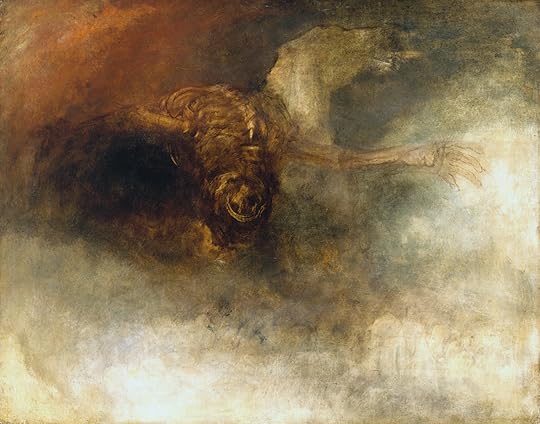
(William Turner, Death on a Pale Horse, 1830)
A pintura persuade estimulando a mente e o nervo óptico simultaneamente, ao passo que as palavras implicam, significam qualquer coisa mesmo aproximada e são influenciadas pelo seu valor associativo. O encanto que exercem visa dominar as coisas — são os instrumentos de Merlin ou de Fausto. A pintura é desprovida deste tipo de perfídia — é uma celebração inocente das coisas, procurando apenas inspirar e não coagir."
(Página 237)
(William Turner, Death on a Pale Horse, 1830)

October 12, 2018
No one warned me that Durrell's other fiction is absolute free association and/or drivel after The Alexandria Quartet.
The writing in Livia is the same amazing prose, but the themes, ideas, and even the characters often feel disjointed. There is no emotional stake for the reader other than a few pages in the middle, which I think are by pure accident. This is a book that feels like Durrel is a saxophonist wandering off into dangerous, cacophony in an attempt to solo, improvise, and impress too many times.
That said, if you are a writer yourself, this may still be worth a read. Treat it like a series of vignettes that are, more often than not, still so abstract as to be about nothing. Especially in the first half, when it's essentially a dialogue between a writer and a character the writer has written to echo himself and his love life.
While "Livia" makes a heroic recovery toward the last third, the final 'climax' as it were fails to really connect the theme in any way but in a flagrant, high school psychology class. Unless you are starved for disaffected wanderings about the countryside of France - in which Durrell's trademark imagery still sings and levitates off the pages - you are better off rereading "Justine" or, better yet, "Balthazar" or "Mountolive."
The writing in Livia is the same amazing prose, but the themes, ideas, and even the characters often feel disjointed. There is no emotional stake for the reader other than a few pages in the middle, which I think are by pure accident. This is a book that feels like Durrel is a saxophonist wandering off into dangerous, cacophony in an attempt to solo, improvise, and impress too many times.
That said, if you are a writer yourself, this may still be worth a read. Treat it like a series of vignettes that are, more often than not, still so abstract as to be about nothing. Especially in the first half, when it's essentially a dialogue between a writer and a character the writer has written to echo himself and his love life.
While "Livia" makes a heroic recovery toward the last third, the final 'climax' as it were fails to really connect the theme in any way but in a flagrant, high school psychology class. Unless you are starved for disaffected wanderings about the countryside of France - in which Durrell's trademark imagery still sings and levitates off the pages - you are better off rereading "Justine" or, better yet, "Balthazar" or "Mountolive."

September 17, 2020
I re-read this in 2020. Basically, if you are a fan of Lawrence Durrell's work, his worst is better than 90% of other writers' best. This is not really intended to be a story, rather a collection of brilliant vignettes loosely connected to a core of characters. Avignon itself in the late 1930s, just before the outbreak of WWII, is as important a character as the humans.
Just like "Sutcliffe", Livia is more a concept than an actual character. Durrell unapologetically disposes of her completely in the last part of the book, the last being heard from her is that --apparently --she has become enamored with National Socialism, and has left for Germany to be part of the movement. Once that is established, she isn't even mentioned any more.
Durrell is little inclined to cater to readers who are not conversant with at least high school French, the geopolitical situation of that era, or obscure literary/mythological/historical references. But the payoff is some breathtaking writing for writing's sake.
Just like "Sutcliffe", Livia is more a concept than an actual character. Durrell unapologetically disposes of her completely in the last part of the book, the last being heard from her is that --apparently --she has become enamored with National Socialism, and has left for Germany to be part of the movement. Once that is established, she isn't even mentioned any more.
Durrell is little inclined to cater to readers who are not conversant with at least high school French, the geopolitical situation of that era, or obscure literary/mythological/historical references. But the payoff is some breathtaking writing for writing's sake.

February 4, 2021
Once more, Durrell outdoes himself in reaching new depths of self-indulgence. However, meta-narrative aside, this is an enjoyable look at Blanford caught in a time of indecision, revelation and impending doom - sumptuously evoked, as always. He said these five novels are freely independent, if connected loosely, like climbers on a rock face. To what extent the stories will connect and the characters corroborate, only perseverance will tell...

March 30, 2026
What are a group of well to do misfits doing on the eve of WWII? Getting together for a final evening of debauchery would work or watching the party from a distance for fun. It's hard to imagine a more unpleasant, unhappy and unproductive existance in Avignon, France, not even the gypsies make life interesting unless you like a wide variety of vice.

July 14, 2026
Durrell’le ilişkimiz aşk nefret karşıtlığında.
Bu neydi şimdi? “Diri diri yakılsa “ bir yerde üzülmem
Bu neydi şimdi? “Diri diri yakılsa “ bir yerde üzülmem

December 16, 2010
There was stuff i liked in here, for certain. Tangled authorship and levels of reality are delicious. A ground-level view of war from the pov of noncombatants, i like, especially in the muddled moral state. The ending is striking. I liked the Hamlet-play he got into early on. But the pervasive Freudianism puts me right off. Ick.

February 17, 2022
Shallow women and men who are certain they’re deep
November 23, 2025
Kitap bir Çin atasözüyle açılıyor: “Beş rengi karıştırırsan, insan kör olur.”
Avignon Beşlisi tam olarak böyle, renklerin, yani anlatı katmanlarının, gerçek ile kurmacanın birbirine karışıp okuru giderek körleştirdiği bir evren. Bir noktadan sonra metin, üst üste yığılan hikâyeler, yankılar, simgeler, gölgeler arasında insanı bildiği dünyadan koparıyor. Okurken beyninin sızladığını hissediyorsun, edebi bir migren. Durrell okumak, hafif mazoşist, hatta yer yer faşizan, bir haz: zorlayan, iten, yorup sınayan bir okuma deneyimi. Kesinlikle her okurun kaldırabileceği bir beşli değil, ama kapısını aralayabilene hem zehirli hem büyüleyici bir güzellik sunuyor.
❤️🔥 SPOILER ALERT!!! 🔥❤️
Livia, anlatıcımız Aubrey Blanford’un, çok sevdiği arkadaşı Constance’ın, Tu’nun, ölüm haberini alması üzerine, Blanford’un kendi yarattığı kahraman Sutcliffe’le yaptığı hayali bir telefon konuşmasıyla başlıyor. Bir şömine başında eski mektupları karıştırırken, Sutcliffe’in ısrarıyla bütün gerçek kişileri, Provence’a uzanan tanışma hikâyelerini anlatmaya başlıyor biz de Proustvari bir geçmiş zaman tünelinde yuvarlanarak okuyoruz kitabı… Bütün kitap boyunca yine B'nin, Blanford’un zihninin içindeyiz, bir bilinç akışı, fakat sıkı sıkıya romanesk öğelerle örülü bir kurmaca.
Oxford’da okuyan üç arkadaş, Hilary, Blanford ve Sam, son sömestr tatillerinde Hilary’nin kız kardeşi Constance’a teyzesinden miras kalan Tu Duc Şatosu’na gitmek üzere yola çıkarlar. O zamanlar bir tıp ögrencisi olan Constance ve çılgın kızkardeşi Livia ile Lyon’da buluşur, oradan tekneyle Rhône üzerinden güneye, Avignon’a inerler. Durrell burada nefis bir edebiyat gösterisi yapıyor, nehir, gölgeler, tarih, ışık, hepsi birer Durrell cümlesine dönüşüyor.
Onları Avignon’da arkadaşları Felix karşılar. Burada olay örgüsüne yeni damarlar eklenir: Felix’in hayli nüfuslu amcası Galen, Quadrefages (Tapınak Şövalyeleri’nin gizemini, kayıp hazineleri ve simya taşını arayan bir meraklı. Galen için çalışır, kâhin gibidir, Galen’in çingenelere katılıp ortadan bir anda kaybolan kızı Sabine’i bulmasına yardım eder) ve elbette Galen’le Avrupa’da iş yapmak için gelen Mısırlı Prens… Merkezinde Livia olsa da bu yan karakterleri de aynı ağırlıkla tanıma fırsatı doğuyor kitapta. Roman ilerledikçe Livia’nın Blanford’la evliliğinin, aslında Constance’ın Blanford’a duyduğu aşkı kıskanıp onun önüne geçme arzusu oldugunu anlıyoruz. Blanford’un Constance’a duyduğu sessiz ve derin sevgiye karşılık, Livia’yla yaşadığı tutkulu, kırılgan, kopuk ve keskin ilişki arasındaki tezat romanın temel eksenlerinden birini oluşturuyor. Annesi tarafından terk edilmişlik, ruhuna yanlış bir açıyla kaynayan Livia’yi anlatırken donemin hayli popüler konusu olan Freud’un Oedipus kompleksine ara ara göndermeler yapar Durrell.
İlginç olan: kitabın başında Aubrey şatoya ilk gelişinde duvarda, ilk kitabın bütün gizlerini taşıyan 3 tablo görür. Bu tablolardan yalnızca bir defa bahsedilir ama Durrell ileride bu detayı yeniden önümüze çıkaracak gibidir. Adı bilinmez bu şatoda duvarda kara çarşaflarla örtülü üç portre asılıdır, birinin altında Piers, diğerinde Sylvie yazılıdır, üçüncünün adı okunmaz ama bunun Constance’a ait olduğunu anlarız.
Sonuç olarak bu ikinci kitapta hâlâ Blanford’un beyninin içindeyiz. İlk kitapta Sutcliffe’in yazdığı Tapınak Şövalyeleri kitabında karşımıza çıkan kahramanların gerçek versiyonlarının Blanford’un hayatına nasıl girdiklerini ve Blanford’un bu karakterlerden neleri ilham aldığını anlıyoruz, bir yazarın karakter yaratma serüvenine tanıklık etme lüksü sunuyor Durrell ki bu essiz bir okuma tecrübesi oldu benin icin. Aşklar, kırılmalar ve Livia’nın kökeni, gemi yolculuğundan Provence’a uzanan anılar çağrışımı, şömine başındaki iç monologlar ve bilinç akışıyla tüm romanesque elementler kullanılarak yazılmış tek kelimeyle mükemmel bir Durrell eseri!
Şimdi sıra üçüncü kitapta, Constance ile devam…

July 15, 2024
Lawrence Durrell (1912-1990) üzerine öyle çok yazasım var ki, bu alana sığar mı bakacağız... 2023'de İskenderiye Dörtlüsü (Justine, Balthazar, Mountolive, Clea) ile başladım okumaya. Her bir kitap "hayat nasıl egzotik yaşanır" ders kitabı gibiydi. Arka planda demek belki haksızlık olur ancak yarattığı her kahramanı öylesine vahşi, hunharca çılgın, ele avuca sığmaz ve hayranlık uyandırıcıydı ki, tüm olayların merkezindeki gelmekte olan II. Dünya Savaşı ve Mısır-İngiltere politikası merkezkaç kuvvetine yakalanmış gibiydiler. Şahaneydi, şahane...
Sonra tüm hızımla Avignon Beşlisi'ne (Monsieur, Livia, Constance, Sebastian, Quinx) başladım. Ancakilk kitap beni tam alamadı içine. Fazlaca, ama çok fazlaca Tapınak Şövalyeleri tarihi doluydu. Boğuldum, sıkıldım. İkinci kitaba başlayamadım. Bodrum'a gelince bir de baktım ki ikinci kitap Livia'yı burada bırakmışım. Veeee döndüm Durrell okumalarıma. Nasıl da özlemişim. Kendisi bir mekan, ortam yaratma uzmanı. Anlattığı yerlere gidiyorsunuz adeta. Bir dünya kuruyor. Bu dünyada pek çok insan var, her birini tanıyorsunuz yavaş yavaş. Birinci kitapta okuduğunuz biri üçüncüde yeniden çıkıyor karşınıza. Bu sebeple çol ara vererek okumamak gerek aslında. Kitabın adı ve ana kişisi kim olursa olsun; Livia ya da Justine, o kitap asla sadece Livia ya da Justine değildir. Bu özellikle Livia için çok geçerli. Hatta Livia neden olmuş adı onu bile anlayamadım. Kitabım yarısında hiç yoktu neredeyse. Varken de çok arka plandaydı, neler yaptığı hep muğlaktı. Yazarın tabiri ile kendisi "sapkınlık biçiminde ortaya çıkan mutlak narsizm" in vücur bulmuş hali...
Kitabım en ilginç tarafı başlangıcıydı. Sürekli eserdeki yazar olan bir karakter ile onun yarattığı bir karakterin öyküleri arasımda bir geçil oluyordu. Her defasımda da birbirlerine laf atıyorlar, sıkıştırıyorlar. Ve yazar mı karakteri yarattı yomsa karakter mi yazarı yarattı tartışmaları çok güzeldi. Ve tabii her ikisini de Lawrence Durrell yarattı. Saygılar üstat #lawrencedurrell #avignonbeşlisi #liviayadadiridirigömülmek #bookworm #okumatutkusu #booknerd #meltemgulsoy #booksbooksbooks #readeveryday #readersdiary #okumahalleri #okumasevdası #kitapgünlüğüm ##bookstgramturkey #kitap
Sonra tüm hızımla Avignon Beşlisi'ne (Monsieur, Livia, Constance, Sebastian, Quinx) başladım. Ancakilk kitap beni tam alamadı içine. Fazlaca, ama çok fazlaca Tapınak Şövalyeleri tarihi doluydu. Boğuldum, sıkıldım. İkinci kitaba başlayamadım. Bodrum'a gelince bir de baktım ki ikinci kitap Livia'yı burada bırakmışım. Veeee döndüm Durrell okumalarıma. Nasıl da özlemişim. Kendisi bir mekan, ortam yaratma uzmanı. Anlattığı yerlere gidiyorsunuz adeta. Bir dünya kuruyor. Bu dünyada pek çok insan var, her birini tanıyorsunuz yavaş yavaş. Birinci kitapta okuduğunuz biri üçüncüde yeniden çıkıyor karşınıza. Bu sebeple çol ara vererek okumamak gerek aslında. Kitabın adı ve ana kişisi kim olursa olsun; Livia ya da Justine, o kitap asla sadece Livia ya da Justine değildir. Bu özellikle Livia için çok geçerli. Hatta Livia neden olmuş adı onu bile anlayamadım. Kitabım yarısında hiç yoktu neredeyse. Varken de çok arka plandaydı, neler yaptığı hep muğlaktı. Yazarın tabiri ile kendisi "sapkınlık biçiminde ortaya çıkan mutlak narsizm" in vücur bulmuş hali...
Kitabım en ilginç tarafı başlangıcıydı. Sürekli eserdeki yazar olan bir karakter ile onun yarattığı bir karakterin öyküleri arasımda bir geçil oluyordu. Her defasımda da birbirlerine laf atıyorlar, sıkıştırıyorlar. Ve yazar mı karakteri yarattı yomsa karakter mi yazarı yarattı tartışmaları çok güzeldi. Ve tabii her ikisini de Lawrence Durrell yarattı. Saygılar üstat #lawrencedurrell #avignonbeşlisi #liviayadadiridirigömülmek #bookworm #okumatutkusu #booknerd #meltemgulsoy #booksbooksbooks #readeveryday #readersdiary #okumahalleri #okumasevdası #kitapgünlüğüm ##bookstgramturkey #kitap

December 3, 2025
3.5 stars. A well written character based novel mainly about novelist Aubrey Blanford. The book also describes the feisty relationship between sisters, Livia, and Constance. Set mainly in France during the years prior to the start of World War II. This novel is the second in the ‘Avignon Quintet’ and tells the story of the first book, ‘Monsieur’, from the perspective of Blanford. Livia is a wild, dark, promiscuous woman, who does her own thing. Constance is a scholar. Blanford is married to Livia but has an affair with Constance that lasts for a long time. Livia embraces German fascism whilst Constance and Blanford oppose it. The three befriend Lord Galen. Lord Galen, a Jewish financier, is involved in the search for the lost treasure of the Knights Templar. Lord Galen, with business partner and friend, Prince Hassad, travel to German and are persuaded by Adolf Hitler to invest in Hitler’s plans.
Blanford’s fictional creation, author Robin Sutciffe, also plays a role in the novel, ‘Livia’.
A book that explores themes of love, memory, and the search for meaning.
Another beautifully written novel with poetic prose and vivid descriptions.
Quotes from the novel:
‘Women to him were simply a commodity. He was no fool about them; Oh no! He knew them inside out, or so he thought. That is to say he was worse than a fool.”
“He felt the lure of language stirring in him…a vomit of words linked by pure association.”
“The Livia of that epoch was dark and on the thin side - a contrast to the fairness of her sister. She had beautifully cut cheekbones and eyes of green, while her black soft hair seemed to fly out of the crown of her head and flow down the sides in ringlets reminiscent of Medusa - the snake is quite an appropriate metaphor. Her beauty was not obvious, it came in a sudden kind of revelation. But of course, she slouched, and always had her hands in her pockets, and a cigarette between her lips. We were conventional enough to be shocked by this. But I was dazzled by her brains and her abrasive and articulate way of speech.”
This book was first published in 1978.
Blanford’s fictional creation, author Robin Sutciffe, also plays a role in the novel, ‘Livia’.
A book that explores themes of love, memory, and the search for meaning.
Another beautifully written novel with poetic prose and vivid descriptions.
Quotes from the novel:
‘Women to him were simply a commodity. He was no fool about them; Oh no! He knew them inside out, or so he thought. That is to say he was worse than a fool.”
“He felt the lure of language stirring in him…a vomit of words linked by pure association.”
“The Livia of that epoch was dark and on the thin side - a contrast to the fairness of her sister. She had beautifully cut cheekbones and eyes of green, while her black soft hair seemed to fly out of the crown of her head and flow down the sides in ringlets reminiscent of Medusa - the snake is quite an appropriate metaphor. Her beauty was not obvious, it came in a sudden kind of revelation. But of course, she slouched, and always had her hands in her pockets, and a cigarette between her lips. We were conventional enough to be shocked by this. But I was dazzled by her brains and her abrasive and articulate way of speech.”
This book was first published in 1978.

September 18, 2024
Durrell beşlinin bu ikinci kitabında edebiyatı ve yaşamı muazzam bir yetenekle karıştırıyor. Yazar ve yarattığı karakter birbirine o kadar yaklaşıyor ki karakteri yazar sanıyor, birini diğeriyle karıştırıyor, bir süreliğine yer değiştirdiklerini anlamıyoruz. Öyle ki bu kadar iyi düşünülmüş ve maharetli bir akışı çok az yazarın yapabileceğini, böyle bir romanla nadiren karşılaşabileceğimi bilerek yavaş yavaş okuyorum. Bu kitaba, genel olarak Avignon Beşlisi’ne İskenderiye Dörtlüsü’ne verilen ihtimam verilmemiş, vallahi üzücü. Şa ha ne!
December 30, 2025
Deeply flawed but brilliant and ultimately a much better read than Monsieur. At times, Durrell rants on like a loud pub bore, but then produces passages of beauty, shocking twists or repulsive depravity. He's halfway over the bridge to post-modernism here, and there are parts almost reminiscent of Pynchon. Behind it all, there's a sub-plot about Gnostics, Templars and treasure, just waiting to become a TV programme, a conspiracy theory book, and another novel...

March 19, 2019
Durrell è strano, e questo romanzo è ancor più strano. A tratti felliniano, e surreale, a tratti allegorico in modo spudorato. Una sorta di rovescio del precedente, Monsieur. Difficile smettere, Una volta cominciato...

February 17, 2021
Lockdown does strange things to person. For instance, I went on to read Livia having struggled through Monsieur. Livia was just as odd. I still don't know what's going on or why. The first two volumes of The Avignon Quintet are behind me, only three more to go. Will lockdown last long enough?

October 25, 2018
yes but

December 2, 2018
Um ode ao cenário natural da Provença e à sua sensualidade.

March 7, 2019
It takes a while to sink into the Durrell's worlds but oh so worth it!

August 10, 2024
В начале стало очень вязко, настолько вязко, что месяц книги не читала. А потом снова пошло, очень бодро и забавно. Однако действительно самоповтор и не хватает глубины, что ли. Очень интеллектуальная и эстетичная мастурбация. Но не могу не согласиться - приятная
January 19, 2026
A prequel that is a sequel. So well-written and deep. A story about a time that the world was in waiting as these characters try to live and enjoy their young lives. But also, is any of this real? What is real and what isn't doesn't seem to matter when these relationships develop

September 29, 2026
Tedious, but worthwhile insights into pre WWII stances, and outlooks.

December 8, 2020
No segundo volume do Quinteto de Avignon começamos por tentar estabelecer qual é o autor que é real. Conseguimos? Logo verão. A verdade é que este livro explora um conjunto diferente de pessoas, que encontram imagens do primeiro volume na sua vida. É um livro sobre paixões, sobre estar "enterrado vivo" debaixo de um amor profundo e não correspondido.
Neste volume o autor faz uma curiosa, embora muito desactualizada, análise sobre a sexualidade feminina, com inspiração freudiana. Diverte-se tanto com isso que nos apresenta uma personagem hilária de uma lésbica nazi, que é fonte dos principais problemas do personagem principal deste volume.
Também é um volume muito mais rico em descrições sexuais, na apresentação de personagens viciadas neste tipo de "patuscada" e nas consequências, quase sempre engraçadas, que estas têm.
Continua a ter passagens de uma beleza estonteante e a revelar uma erudição que eu gostaria de ter. Adorando.
Neste volume o autor faz uma curiosa, embora muito desactualizada, análise sobre a sexualidade feminina, com inspiração freudiana. Diverte-se tanto com isso que nos apresenta uma personagem hilária de uma lésbica nazi, que é fonte dos principais problemas do personagem principal deste volume.
Também é um volume muito mais rico em descrições sexuais, na apresentação de personagens viciadas neste tipo de "patuscada" e nas consequências, quase sempre engraçadas, que estas têm.
Continua a ter passagens de uma beleza estonteante e a revelar uma erudição que eu gostaria de ter. Adorando.

May 2, 2011
On the first couple of pages, the reader learns why he must read all 5 books: LD tells us that Blanford is writing the fictional character Sutcliffe, who, in turn, has written Monsieur, the first book of the 5. If I were a vulgar man, I might think that the scatological aspects of the last page of the book were a fitting reference to the overall worth of the book itself. However, I think the book is more worthy than that. LD is a very talented writer, and some of his phraseology and use of words is beautiful. But, unlike the Alexandria Quarter (AQ), there seems to be no sinister intrigue lurking in the background here, other than just WW2. Also, unlike in AQ, there are no love triangles and conflicts to speak of, other that Constance/Livia and Blanford. Now, maybe all this happens in volumes 3, 4, and 5. But so far, this is inferior to AQ, and written in LD’s obscure prose also. As was the case with Monsieur, I give this only a 4 out of 10.
July 17, 2013
Mesmerizing tale centered around the magical walled city of Avignon. I would have given it 5 stars but it is not as perfect as Monsieur the first book in the quintet. I have been to Avignon and wander the streets looking for the places referred to in these books! And they are still there .. ...
Displaying 1 - 28 of 28 reviews