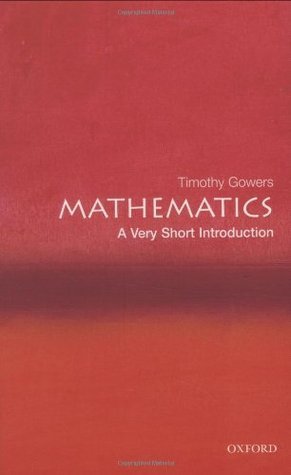
The aim of this book is to explain, carefully but not technically, the differences between advanced, research-level mathematics, and the sort of mathematics we learn at school. The most fundamental differences are philosophical, and readers of this book will emerge with a clearer understanding of paradoxical-sounding concepts such as infinity, curved space, and imaginary numbers. The first few chapters are about general aspects of mathematical thought. These are followed by discussions of more specific topics, and the book closes with a chapter answering common sociological questions about the mathematical community (such as Is it true that mathematicians burn out at the age of 25?) It is the ideal introduction for anyone who wishes to deepen their understanding of mathematics.
About the Series: Combining authority with wit, accessibility, and style, Very Short Introductions offer an introduction to some of life's most interesting topics. Written by experts for the newcomer, they demonstrate the finest contemporary thinking about the central problems and issues in hundreds of key topics, from philosophy to Freud, quantum theory to Islam.
من کلاً اهل کتاب علمی خوندن نیستم و این کتاب رو به پیشنهاد یکی از دوستان خوندم. نمیتونم بگم صددرصد دوسش داشتم ولی کتاب خوبی بود و تاکیدش روی تفکر مجرد واسم جالب بود چون با چنین تفکری در هنر هم مواجه هستیم و من این تفکر را در نقاشی یاد گرفتم. در این کتاب به ارتباط تفکر مجرد و ریاضیات برخوردم که واسم خیلی جالب بود
Absolutely great. Let me explain. Firstly about the level of the book. It is elementary but not basic. There are some concepts and especially some proofs that require some focus to grasp. The amount of equations is minimal, but still some maturity is required to fully appreciate the contents. I would say that the best audience of the book is a beginning undergrad in a stem program, a motivated and mature high school students with a keen interest on maths or a layman with some maturity of mathematical concepts. I was searching for books to recommend to my students and after finishing that i would highly recommend it. What the book does, is to introduce us to the world of mathematics, what it isall about and how mathematicians approach different ideas and the way Timothy does that is by explaining an array of different ideas from model building, basic arithmetic, formal proofs, complex numbers, number theory, coordinate systems, infinity, higher dimensions, non Eucledian geometries, approximations etc. In the final chapter there are some comments on common misconceptions about mathematics. There are so many gems in every chapter and the way they are connected makes you understand why mathematicians treat them in that way. From the geometric(!) proof of the irrationality of φ, to ''visualizing'' objects in higher dimensions and being able to grasp some of their properties, to how the curvature of different geometries affects the shortest path. The reason of 5 stars is all of the above plus finally understanding why airplanes tend to move towards the poles (had to finish my bachelor in physics without ever anyone touching that concept...) plus the 2 most basic ideas of the book, that the meaning of a mathematical object is the rules it obeys and how it is related to other objects and how to extend familiar ideas to unfamiliar territory. These two concepts and how the are used in what Timothy calls the ''abstract method'' are the spine of the book and worth buying just for those two only. True gem.
بسم الله اسم الكتاب الرياضيات مقدمة قصيرة جدا اسم الكاتب تيموثي جاورز فكرة الكتاب تتسم في توضيح سبب تجرد الرياضيات بكونها تتعامل مع اشياء غير ملموسة للاسف قرات ما ترجم منه فقط لأنه لم تترجم جميع فصول الكتاب تطرق الكاتب لاعطاء مفهوم عن التفكير المجرد و ذلك لتبرير التقارير الحسابية كما وضح مبادئ الحساب و اسباب توسيع نظام العد من اكتشاف الصفر بعد الاعداد الطبيعية الى الاعداد السالبة ثم الكسور بعدها الاعداد النسبية الى الاعداد المركبة وضح كذلك منهج دراسة الرياضيات التركيبي بحيث انه لم تكن تفهم الاجزاء التي تعرف الكل سيبقى الكل غامضا لديك و انا اقول من اراد ان يفهم الرياضيات.عليه ان يكثر من التعرض لها لانه ليس هناك بديلا للمارسة حتى تكشف لك اسرارها و تفهمها المحتوى بسيط و جيد لمن اراد ان يتعرف على بعض مبادئ الرياضيات الحقيقية و سبب تجردها
As the name suggests the book tries to tell a non-mathematician but interested person, what is Math about, what is it's goals, how mathematicians think and some techniques and results of modern and classical Math. But for someone who is not very familiar with mathematics, it won't make any sense, for such a person this book can be hard, confusing and boring. Math was never an easy thing to understand. Actually I think the book can be very enlightening for math undergraduate students, especially for math teachers. The book is short, warm, rigid and has good points about how to do Math.
I generally find the "A Very Short Introduction" series to actually be quite good, with most of the volumes accomplishing exactly what they intend to by giving a good overall sense of a field of inquiry and its methods, or of the important elements of a given topic. Unfortunately, this volume did none of this very well. Many of the examples used to introduce to the reader to mathematical thinking are explained more clearly (and in a more engaging fashion) in Fermat's Enigma by Simon Singh. In general, the latter is probably a better overall introduction to the world of mathematics (both the subject as well as the academic practice) than this Very Short Introduction managed to be.
عندي منذ الصغر متلازمة كره الرياضيات ، في أول سنة جامعية لي قررت أن أشتري كتب في مجال الرياضيات في محاولة عبثية لأحبه ، و اشتريت هذا الكتاب من معرض القاهرة الدولي للكتاب 2015 حاولت قراءته عدة مرات و فشلت .
Jedna o knjiga o matematici koju svi mogu čitati i koja opravdava svoj naslov. Neki ce možda biti razočarani jer nije detaljna, a neki što je prenapredna, ali meni se svidjela prvenstveno jer je prepuna činjenica koje do sada nisam čula ili shvatila na način objašnjen u knjizi. Preporučam je posebno onima koji misle da je matematika računanje (da vide da nije :-))
Surprisingly disappointing. I can't imagine who this book is written for. Nothing new to people who knew anything about math, and not terribly interesting to people trying to learn something about math.
El autor (nada menos que medalla Fields en 1998, ojo al dato) se propone algo a priori imposible: una introducción a «las matemáticas», así en general, en menos de 150 páginas. Y lo resuelve con inteligencia, porque no intenta abarcarlo todo, sino enseñar una forma de pensar. En ocho capítulos nos pasea por modelos, abstracción, demostraciones, límites, dimensiones, geometría y aproximaciones, y en cada uno nos da una lección magistral de lo que significa usar las matemáticas para abordar un problema.
Empieza por los modelos. Para aplicar las matemáticas al mundo real primero hay que simplificarlo: la piedra que lanzas se convierte en un punto sin rozamiento y el gas, en bolitas que rebotan. Un modelo no tiene que ser «verdadero», sino útil. Modelar es sobre todo decidir qué ignorar. Un dado obedece a la física, y aun así lo que funciona es tratarlo como seis caras equiprobables.
El segundo capítulo, sobre números y abstracción, es el corazón del libro. Gowers lo resume en una idea: un objeto matemático es lo que hace. Igual que el rey del ajedrez no se define por su forma sino por cómo se mueve, no importa qué «es» el −1 o la raíz de −1, sino qué reglas cumplen. Con eso explica, por ejemplo, por qué menos por menos da más. No hace falta buscarle un sentido físico: es la única opción compatible con las reglas que ya aceptamos. De paso, el número imaginario i deja de ser misterioso.
En el de demostraciones explica qué separa una prueba de una sospecha. Ejemplo: pones puntos en un círculo y los unes todos con cuerdas. Con 1, 2, 3, 4 y 5 puntos salen 1, 2, 4, 8 y 16 regiones. Con 6 salen 31, no 32.
Luego vienen los límites y el infinito. El infinito es imprescindible y a la vez muy difícil de hacer riguroso, así que los matemáticos, básicamente, lo esquivan. Decir que algo «tiende a» un límite es en realidad una afirmación sobre cosas finitas: para cualquier margen de error, a partir de cierto punto siempre estás dentro. Así cobran sentido los decimales infinitos (0,999… = 1) o el área de una figura curva. El infinito acaba siendo una abreviatura.
En el capítulo de dimensión, gracias a las coordenadas, la cuarta dimensión deja de ser algo que haya que imaginar y pasa a ser una lista de cuatro números. No puedes ver un hipercubo, pero sí contarlo. Tiene 16 vértices, que son todas las listas de cuatro ceros y unos. Y tiene 32 aristas, las que unen vértices que difieren en una sola coordenada. También aparecen los fractales y sus dimensiones fraccionarias.
Personalmente siempre he odiado la geometría, así que fue la parte que menos disfruté. Aun así, reconozco que tiene poco que ver con la del colegio. Parte de los axiomas de Euclides y de los siglos de intentos de deducir el de las paralelas a partir de los demás. Al final se descubre que no se puede, porque existen geometrías coherentes donde ese axioma falla: en la esférica los ángulos de un triángulo suman más de 180° y en la hiperbólica, menos. La idea brillante es cómo se demuestra que algo no se puede demostrar: construyendo un mundo donde se cumplen todos los axiomas salvo ese.
En el capítulo de estimaciones y aproximaciones, Gowers explica que muchas veces encontrar una fórmula exacta sería un milagro, y que el trabajo real consiste en estimar bien. No hay fórmula para el primo número n, pero sabemos que cerca de n, más o menos uno de cada ln(n) números es primo. Y aquí consigue algo admirable: explicar la hipótesis de Riemann como lo que es en el fondo, una afirmación sobre lo precisa que es esa estimación.
Cierra con preguntas frecuentes: si los matemáticos están acabados a los 30, por qué hay tan pocas mujeres matemáticas, si las matemáticas y la música van de la mano… El autor da claramente su opinión personalísima, y se ve cómo intenta no mojarse cuando el tema es peliagudo.
En conjunto, el autor consigue que veas que bajo las matemáticas hay algo profundo, algo que permite hacer cosas que a primera vista parecen imposibles. Que las matemáticas son, en el fondo, «domar el pensamiento» para poder hacer cosas con él. Que no son aritmética. Esto ya lo sabemos muchos, pero me ha encantado cómo Gowers lo hace llegar a su público.
-------------------
The author (a Fields Medal winner in 1998, no less, mind you) sets out to do something that seems impossible from the start: an introduction to “mathematics” in under 150 pages. And he pulls it off cleverly, because he doesn’t try to cover everything. Instead he teaches a way of thinking. Over eight chapters he walks us through models, abstraction, proofs, limits, dimensions, geometry and approximations, and in each one he gives a masterclass in what it means to use mathematics to tackle a problem.
He starts with models. To apply mathematics to the real world you first have to simplify it: the stone you throw becomes a point with no air resistance, and a gas becomes tiny balls bouncing around. A model doesn’t have to be “true”, just useful. What stuck with me is that modelling is mostly about deciding what to ignore. A die obeys the laws of physics, and yet what works is treating it as six equally likely faces.
The second chapter, on numbers and abstraction, is the heart of the book. Gowers sums it up in one idea: a mathematical object is what it does. Just as the king in chess is defined not by its shape but by how it moves, it doesn’t matter what −1 or the square root of −1 “is”, only which rules they obey. This lets him explain, for instance, why a negative times a negative is a positive. There’s no need to look for a physical meaning: it’s the only option consistent with the rules we already accept. Along the way, the number i stops being mysterious.
The chapter on proofs explains what separates a proof from a hunch. My favourite example: put points on a circle and join them all with chords. With 1, 2, 3, 4 and 5 points you get 1, 2, 4, 8 and 16 regions. With 6 you get 31, not 32. It’s the best vaccine against “I see a pattern, so it must be true”.
Next come limits and infinity. Infinity is indispensable and at the same time very hard to make rigorous, so mathematicians basically sidestep it. Saying that something “tends to” a limit is really a statement about finite things: for any margin of error, beyond a certain point you are always within it. That’s how infinite decimals (0.999… = 1) or the area of a curved shape come to make sense. Infinity ends up being a kind of shorthand.
In the chapter on dimension, thanks to coordinates, the fourth dimension stops being something you have to imagine and becomes a list of four numbers. You can’t see a hypercube, but you can count it. It has 16 vertices, which are all the lists of four zeros and ones. And it has 32 edges, the ones joining vertices that differ in a single coordinate. Fractals and their fractional dimensions also make an appearance.
Personally, I’ve always hated geometry, so this was the part I enjoyed least. Even so, I admit it has little to do with the geometry we learnt at school. It starts from Euclid’s axioms and the centuries of attempts to derive the parallel postulate from the others. In the end it turns out this can’t be done, because there are consistent geometries in which that axiom fails: in spherical geometry the angles of a triangle add up to more than 180°, and in hyperbolic geometry to less. The brilliant idea is how you prove that something can’t be proved: by building a world in which all the axioms hold except that one.
In estimates and approximations, Gowers explains that finding an exact formula would often be a miracle, and that the real work lies in estimating well. There is no formula for the nth prime, but we know that near n, roughly one in every ln(n) numbers is prime. And here he achieves something remarkable: explaining the Riemann Hypothesis as what it really is at heart, a statement about how accurate that estimate is.
He closes with some frequently asked questions: are mathematicians past it by 30, why are there so few women mathematicians, do mathematics and music go together… The author clearly gives his own very personal opinion, and you can see him trying to sit on the fence whenever the subject gets thorny.
All in all, the author makes you see that there is something deep underneath mathematics, something that lets you do things that at first glance seem impossible. That mathematics is, at its core, about “taming thought” so you can do things with it. That it isn’t arithmetic. Many of us already know this, but I loved the way Gowers gets it across to his readers.
I started this book nearly four days ago, through weekend with dozen amount of coffee and panic attacks (which I usually get.) finally finished this one, and here is my review on it:
Mathematica, the language of nature. wether one thinks of it as a rigid and dry subject or have the other opinion about the subject, it doesn't really matter since it works. it is fascinating when, having thoughts of the debates of wether it was invented or discovered, and thinking about mathematics generally on very basic terms, how the phenomenas of the universe and nature (even in social and economic sciences) are translated from them to us through this language, how we preserve and receive that knowledge through mathematics. it is one of those dazzling and hair itching thoughts that are enchanting and captivating. all this being said, this book is great for someone who has had mathematics in high school and knows what's what. the book is more a descriptive approach for the technical side of mathematics and since it's written by a mathematician, you can sense their handprint on the subject matter, it may seem complex and dry on the surface but when you keep on going it introduces topics which might surprise you in lots of ways. especially in the 3rd part which is titled "Proofs", part 5 with dimensions and part 6 with Geometry. while reading the 6th part I remembered of the phrase that was engraved on the door of plato's academy which goes like this: "LET NO ONE IGNORANT OF GEOMETRY ENTER HERE", I wonder how many people were rejected. this book is great if you want a guide through the mysterious and beautiful path of numbers but for me, it still didn't do justice to mathematics, the way that Roger Penrose does to mathematica.
I enjoyed this book so much, and because of its length, I finished it in one "seating" :-) The most important idea that I learned is to think about what a mathematical object DOES rather what it IS. This is the way mathematicians learn math, do math, and teach math. I plan to do the same in my mathematical endeavors.
این کتاب ریاضی رو جوری متفاوت با آنچه ما میشناسیم به طور معمول معرفی میکنه و باعث نگاه درستی به ریاضیات داشته باشیم. من به شخصه احساس میکردم که از یه زمانی توی مدرسه با ریاضی قهر کردیم یا شاید از همون اول اونجور که باید باهم آشنا نشدیم. خوندن این کتاب تلاشی برای درک و آشتی دوباره با ریاضی بود.
Long story short, I didn't really like this one. Gowers isn't a bad writer, but when all is said and done, this 'Introducution' is rather boring. It doesn't capture the imagination, and as far as math books are concerned, this quite simply isn't allowed. Don't bother with this one; if you want an engaging an accessible overview of mathematics, go pick up the far more interesting 'Language of Mathematics,' by Kieth Devlin.
O ovoj knjizi ne bih puno pisao. Kupio sam je i pročitao iz razloga što sam profesor matematike i uvek tragam za ovakvom literaturom u nadi da ću otkriti neke nove načine kako se matematika može učiniti zanimljivija učenicima. Onom ko matematiku ne voli, ili mu nije jasna, ovaj priručnik neće baš puno pomoći. Iako je autor sve to fino objašnjavao, opet mislim da treba da postoji neka podloga znanja za lakše razumevanje svih ovih stvari koje on spominje.
I usually find these ‘Introduction’ books to be good. But not this one. I wonder who the author thinks he was writing for? If you wanted to be genuinely introduced to the subject of mathematics then this book might as well have been written in Klingon.
Mathematics : A Very Short Introduction (2002) by Timothy Gowers is a good introduction to what Mathematicians actually do and what modern mathematics is really about. Gowers is a professor of Mathematics at Cambridge and College de France.
There are chapters on Models, Numbers and Abstraction, Proofs, Limits and Infinity, Dimension, Geometry, Estimates and Approximations and a list of Frequently Asked Questions.
The first few chapters are very strong, Gowers describes that mental models are, goes on to describing numbers, graphs and abstractions and then goes on to proofs. All are done really well and in a way that elucidates what higher level math is all about. The writing is also nicely clear and the examples are well chosen. Some of the later chapters are not as good but are still clear and give more idea of what math is rally about.
Mathematics : A Very Short Introduction is a really good book for anyone interested in what mathematicians actually do. It’s remarkably good for the length.
A really pleasant read for anyone who enjoys mathematics! (not necessary to have a math background to follow most of it).
Even if you are familiar with the majority of the presented concepts, this (very) short intro, will surely provide you with a fresh and interesting way of viewing them.
Recommendable for anyone who ever considered math beautiful.
هرچند مفاهیم مطرح شده در کتاب قابل فهم برای کسر بزرگی از افراد است و نیاز به دانش ریاضی پیشرفتهای ندارد اما دیدگاههای مطرح شده در کتاب و ایجاد پرسشهای مقدمانی که جواب سادهای برای آنها نمیتوان مطرح کرد از هنرمندیهای ظریف این کتاب است. به نظرم خواندن این کتاب برای هرفرد غیر ریاضیدان علاقهمند به ریاضی و همینطور افرادی که به تدریس ریاضی به کودکان و دانشآموزان مشغول هستند میتواند مفید باشد.
A very lucid and quite fun book for those interested in mathematics. There's a good summary of loads and loads of different bits of maths, and I think the problem-solving and conceptual aspects really strike at the heart of what I and so many others love about it - perhaps the most fun I've had per page!
So exciting, in fact, that I'd finished it in one go over the last few hours...
This book has vividly elaborated how the complex set of theorems or proofs arise from the basics axioms.
The writer starts from the evolution of number system and how the modelling and abstracting plays vital role in developing certain theorem. Concepts of limits and infinity are great. The most impressive thing that the book tells you about is of the concept of infinity. Texts on these book would certainly clear up the concept of infinity in reader's mind. This approach is made by explaining the square root of two(2). Moreover, the text of this evolves from the simple Euclidean geometry, leading up to spherical geometry and then hyperbolic. The author has beautifully explained why latter types are needed. Finally, the author talks about the importance of estimates and approximation and their importance in different fields like A Prime Number theory, Theoretical computer science and several others.
Thing I liked about this book was, superficially, the writers has vividly explained topics. But when he goes little deeper like the concepts of hyperbolic geometry, I found the explanation little hard to comprehend.
کتابی کوچک اما پربار که به شکلی زیرکانه و با بیانی کمیاب جلوههایی از ریاضیات را بدون پرداختن به جزییات پیچیده نمایان نموده است. شاید بهترین توصیف را نویسنده خود در پیشگفتار آورده باشد: «اگر بتوان گفت این کتاب پیامی دارد، آن پیام این است که باید انتزاعی اندیشیدن را یادگرفت، چون با این کار بسیاری از مشکلات فلسفی خودبخخود از میان میروند.»
Has the potential to change how we look at Mathematics, or at least us non-mathematicians, especially in regard to the use of the abstract method and fundamental concepts such as: "A mathematical object is what it does."
This book was simply amazing. For my whole life, I have been HORRIBLE at math (or, at least since the 3rd grade, when fractions were introduced to my life). But this book revealed to me what I've secretly suspected for a long time: that I actually really, really like math, despite being terrible at it (it was actually my favorite subject until the 3rd grade...which was about the age I started bombing tests).
Timothy Gowers, who is himself an award-winning mathematician, has written a book that is easy to understand and is very, very sympathetic to those of us who can't calculate. But despite this, he doesn't shy away from discussing very complicated aspects of mathematics. It's obvious that he's a wonderful teacher. Gowers has written a beautiful book that dabbles in the 'very mathematical', but never actually becomes mathematical. It is always for the uninformed and uninitiated, as these little books always should be. This was a wonderful book and I feel more in touch with math now than I have in many, many years.
people tend to ignore the relationship between math and music (which leads to sound, which leads to the meter in poetry), math and language (linguistics, which structures our LLM and potentially AGI), and math and philosophy (multi-dimensional space - phenomenology, architecture, technology - , symbolic logic - public policy, and so on). i wonder how mathematics can play around with affect theory. few days ago i read this wonderful poetry collection that plays with Fibonacci's sequence by Ingot Christensen.