Jump to ratings and reviews

Loading...

Rate this book

When Prophecy Fails

Rate this book
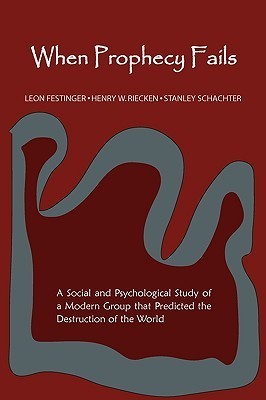
2009 reprint of 1956 First edition. When Prophecy Fails [1956] is a classic text in social psychology authored by Leon Festinger, Henry Riecken, and Stanley Schachter. It chronicles the experience of a UFO cult that believed the end of the world was at hand. In effect, it is a social and psychological study of a modern group that predicted the destruction of the world, and the adjustments made when the prediction failed to materialize. "The authors have done something as laudable as it is unusual for social psychologists. They espied a fleeting social movement important to a line of research they were interested in and took after it. They recruited a team of observers, joined the movement, and watched it from within under great difficulties until its crisis came and went. Their report is of interest as much for the method as for the substance."-Everett C. Hughes, The American Journal of Sociology.

260 pages, Paperback

First published January 1, 1956

Loading...
Loading...

About the author

Leon Festinger

19 books65 followers
Leon Festinger was interested in science at a young age, and decided to pursue a career in psychology. He received his bachelor's degree from City College of New York and went on to Iowa State University for his master's degree and his Ph.D. (which he received in 1942). For the next several years he made his living teaching at different universities until he went to Stanford in 1955.

At Stanford, Festinger began to fully develop the idea he called cognitive dissonance. The original idea stemmed from his observation that people generally liked consistency in their daily lives. For example, some individuals always sit in the same seat on the train or bus when they commute to work, or always eat lunch in the same restaurant. Cognitive dissonance is a part of this need for consistence.

Essentially, Festinger explained, all people hold certain beliefs, and when they are asked to do something that runs counter to their beliefs, conflict arises. Cognitive dissonance comes into play when people try to reconcile the conflicting behaviors or ideas.

Cognitive dissonance soon became an important and much-discussed theory. Over the years it has generated considerable research, in part because it is one of a number of theories based on the idea that consistency of thought is a strong motivating factor in people.

Festinger continued his work at Stanford until 1968 when he returned to New York City to assume the Else and Hans Staudinger professorship at the New School for Social Research. He continued his research on cognitive dissonance as well as other behavioral issues. He was also active in professional organizations including the National Academy of Sciences and the American Academy of Arts and Sciences. He continued to work until his death on February 11, 1989, from liver cancer. He was survived by his wife Trudy and four children.

Taken from the the Encyclopedia of Psychology

Ratings & Reviews

What do you think?
Rate this book

Friends & Following

Create a free account to discover what your friends think of this book!

Community Reviews

5 stars
326 (24%)
4 stars
537 (40%)
3 stars
344 (26%)
2 stars
78 (5%)
1 star
28 (2%)

Loading...

Can't find what you're looking for?

Get help and learn more about the design.