

What do you think?
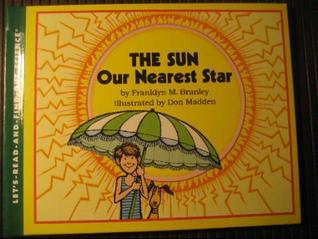
Let's-Read-and-Find-Out Science, Stage 2
The Sun: Our Nearest Star
Describes the sun and how it provides the light and energy which allow plant and animal life to exist on the Earth.
32 pages, Hardcover
First published January 1, 1961
About the author
Franklyn M. Branley
158 books21 followersFranklyn M. Branley was the originator of the Let's-Read-and-Find-Out Science series and the author of close to 150 popular books about scientific topics for young readers of all ages. He was Astronomer Emeritus and former Chairman of the American Museum of Natural History-Hayden Planetarium.
Ratings & Reviews
Friends & Following
Create a free account to discover what your friends think of this book!
Community Reviews
Displaying 1 - 28 of 28 reviews

April 10, 2019
This simple book explains that our sun is a star, that it is far away and hot, and that living things need sunshine to survive. It's just right for a preschooler, as it has visually appealing illustrations and very simple and repetitive text.

February 15, 2011
I already knew all the things about the sun.

August 14, 2017
Oh, you had to take a perfectly good, readable book about the sun and add in stuff about the Earth being millions of years old and dinosaurs turning into coal. Not proven, folks, and there's good science disproving it. By doing so, you portrayed theory as fact, making this a book I can't recommend. Too bad, really, because it really good up until those last few pages!

March 15, 2021
Has some great, however outdated at this point information about the sun. Also, the Dinosaur pages were out of place in a story about the sun. Not because EvOlUtIoN iSn'T ReAl or EaRtH iS oNlY 5000 YeArS old. It's out of place because it tries tying fossil fuels to solar energy in a very bizarre way that isn't needed in a early childhood science book.

February 14, 2021
Not a patch on the old (vintage) Let’s-Read-And-Find-Out-About science texts. Terrible illustrations, bland text - this kind of book says much about how mainstream society views children ie they’re not worth the effort. Definitely not a living book.

June 27, 2023
(2023) Let's Read and Find Out Science books. Stage 2.
The sun and space, stars and where things are and how they work. A lovely story. I'm working on some learning units and reading a range of picture books looking for stories to use.
The sun and space, stars and where things are and how they work. A lovely story. I'm working on some learning units and reading a range of picture books looking for stories to use.
November 28, 2017
Informational Text
This book is cute and the illustrations help students identify with and remember the information. This is a great informational read-aloud book for young children.
This book is cute and the illustrations help students identify with and remember the information. This is a great informational read-aloud book for young children.

December 18, 2018
Informational - Great comparisons to understand how far or hot the sun is. Simple and concise.
April 8, 2019
Nice, short, informative.

April 10, 2019
Interesting illustrations. Very simple text, bordering on See Spot Run. One of the easiest in this series.

November 4, 2019
Has a few pages of evolutionary content.
January 7, 2020
Between 3-4 stars. Decent enough information.

December 12, 2023
“Millions of years”

September 17, 2026
I found a few older versions from this series by chance at a thrift store. They are excellent. Much better than the newer ones - I will be on the hunt for more.

August 14, 2012
45 months - this series is wonderful for introducing small kids to new science concepts in a simple and fun way in picture book format. This one explains how the earth rotates around the sun and how this gives us day and night, seasons, alters the length of the day over the year all using an orange, pencil and flashlight.
April 10, 2013
I really, really liked this book. It's a book about the sun and how the sun is one of our greatest resources. It talks about solar energy, the sun being a star, how we need the sun to live, etc. I would use this book as a science intro to studying about the sun and it's valuable resources to our planet.
September 16, 2008
This is a great informational book for young students. It would be a good book to use to incorporate math lessons with. It discusses time, distances, and compares different sizes. It has a couple of experiments in the back that would be good to use in the classroom.

February 27, 2012
This book is The Sun: Our Nearest Star by Franklyn M. Barnley. This book can be used in Kindergarten to 2 grade classrooms. This book provides facts about the Sun. The book also focuses on the Sun's effects on plant growth.
April 18, 2012
I would use this book when talking about plants and the solar system. It works both ways because this book talks a lot about the effect the sun has on Earth as well as the characteristics it contains.
December 11, 2015
This text is all about the sun! Because it provides so many facts, the main writing trait evident is voice (to inform). This could be used as an authentic text to introduce a science lesson, could be used in a text set about the sun or about planets.

January 27, 2009
Beautifully illustrated and expertly explained. I found this book to be suitable for my 5 1/2 year old....

August 24, 2010
This is a non-fiction book in a picture book format.
I love this book because it would love well for many age groups. I read it during my family storytime and the kids seemed to really like it.
I love this book because it would love well for many age groups. I read it during my family storytime and the kids seemed to really like it.

Read
April 7, 2012K - 2
The Sun - How Large - How Far - How Hot
The Sun - How Large - How Far - How Hot
April 17, 2012
Great book about the sun for grades k-2. Teaches how hot and the distance away. Nice for a mini lesson.

June 25, 2012
This book explains how important the sun is without getting into complicated science terms that kids may not understand.

September 13, 2016
Used with Apologia Astronomy chapter 2 on the sun. The children found the illustrations great, especially drawing showing the distances between the earth, moon and sun.

November 28, 2008
A good learn and find out book.
Read
November 30, 20181) Awards: none
2) Age Range: 5-8
3) Summary: This book gives basic facts about the sun
4) Review: I enjoyed the fact that it read more like a story than just straight facts. I think it would be a good book to incorporate into a science lesson
5) In Class Use: This book can be read during a science lesson about the sun
2) Age Range: 5-8
3) Summary: This book gives basic facts about the sun
4) Review: I enjoyed the fact that it read more like a story than just straight facts. I think it would be a good book to incorporate into a science lesson
5) In Class Use: This book can be read during a science lesson about the sun
Displaying 1 - 28 of 28 reviews