

What do you think?
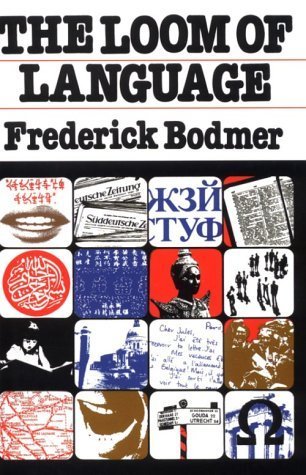
The Loom of Language: A Guide to Foreign Languages for the Home Student
Originally published in 1944 as one of the Primers for the Age along with Mathematics for the Million and Science for the Citizen, this well-loved book has worked its way through many impressions and influenced the whole approach to language teaching.
669 pages, Paperback
First published January 1, 1943
Ratings & Reviews
Friends & Following
Create a free account to discover what your friends think of this book!
Community Reviews
Displaying 1 - 30 of 42 reviews

November 8, 2011
There is so much great information in here that it requires repeat readings over several years, especially Part II. (I'm on my first pass.) Consider this book a meta-manual for learning how to learn languages.
It is divided into four parts. Part I is a "natural history" of language. Part II covers the "hybrid heritage" of English as a language which straddles the Germanic and Romance branches of the Indo-European language tree. Part III covers language problems and planning movements. Part IV is a "language museum" of comparative vocabulary tables.
The most fascinating feature of this book is how it frames being a native English speaker as a positive, not a negative. While speaking English might be a disincentive to learn other languages, it can also be a great base to learn from due to its hybrid Germanic/Romantic vocabulary. As such, the book covers Swedish, Danish, Dutch, and German in the Teutonic track and French, Spanish, Portuguese, and Italian in the Romance track, not to mention plenty of discussion of parent languages like Latin and Old English.
The Loom of Language shares much information and spirit with The Seven Sieves. The latter is also very good, but Loom is more comprehensive and easier to find. There is even a scanned copy available on Archive.org.
As I said above, Part II is a treasure trove. Bodmer distills everything a student needs to know about sound correspondences, etc. to make connections across the outlined languages and accelerate learning. The only annoyance is that the huge tables in Part IV aren't available online somewhere as spreadsheets (the book was written in the '40s) so one could import them into a spaced repetition system like Anki for efficient learning. I'm working on typing these out for my own purposes, but this will take awhile.
UPDATE: Here are spreadsheets of the Romance Word List, Germanic Word List, and the Greek Roots List from the language museum. Importing into Anki or suchlike is pretty easy.
It is divided into four parts. Part I is a "natural history" of language. Part II covers the "hybrid heritage" of English as a language which straddles the Germanic and Romance branches of the Indo-European language tree. Part III covers language problems and planning movements. Part IV is a "language museum" of comparative vocabulary tables.
The most fascinating feature of this book is how it frames being a native English speaker as a positive, not a negative. While speaking English might be a disincentive to learn other languages, it can also be a great base to learn from due to its hybrid Germanic/Romantic vocabulary. As such, the book covers Swedish, Danish, Dutch, and German in the Teutonic track and French, Spanish, Portuguese, and Italian in the Romance track, not to mention plenty of discussion of parent languages like Latin and Old English.
The Loom of Language shares much information and spirit with The Seven Sieves. The latter is also very good, but Loom is more comprehensive and easier to find. There is even a scanned copy available on Archive.org.
As I said above, Part II is a treasure trove. Bodmer distills everything a student needs to know about sound correspondences, etc. to make connections across the outlined languages and accelerate learning. The only annoyance is that the huge tables in Part IV aren't available online somewhere as spreadsheets (the book was written in the '40s) so one could import them into a spaced repetition system like Anki for efficient learning. I'm working on typing these out for my own purposes, but this will take awhile.
UPDATE: Here are spreadsheets of the Romance Word List, Germanic Word List, and the Greek Roots List from the language museum. Importing into Anki or suchlike is pretty easy.

February 8, 2012
This book is a product of its time. The author was multilingual but not a linguist. The book was written right after WWII. The author's purpose was to aid people to be able to communicate with each other so that understanding between people would contribute to the prevention of future wars.
The book contains essays about the Latin and Greek origins of European words. He discusses Romance and Germanic languages. He describes trends in the syntax and semantics of the language families.
Finally, he provides a vocabulary of 500 words for the major Romance languages and for the major Germanic languages. His argument is that if a person learned the Latin and Greek vocabulary lists and all of the 500 word vocabulary lists of all of the languages he provides that a person could understand and make himself understood anywhere in Europe.
There are criticisms of this book by professional linguists. However, as a general reader, I really like it. It is a wonderful Word Hoard. Also, it is an interesting product of its time.
The book contains essays about the Latin and Greek origins of European words. He discusses Romance and Germanic languages. He describes trends in the syntax and semantics of the language families.
Finally, he provides a vocabulary of 500 words for the major Romance languages and for the major Germanic languages. His argument is that if a person learned the Latin and Greek vocabulary lists and all of the 500 word vocabulary lists of all of the languages he provides that a person could understand and make himself understood anywhere in Europe.
There are criticisms of this book by professional linguists. However, as a general reader, I really like it. It is a wonderful Word Hoard. Also, it is an interesting product of its time.

November 3, 2014
If you're interested in a broad overview of languages, not just in studying one of them, then you're going to come across this treasure trove of a book at some stage in your travels.
Despite being a bit dated at this stage, it has a modern feel to it due to its practical, no-nonsense approach - Bodmer constantly encourages you to learn short-cuts or heuristics to capitalise on the family resemblances among the different language groups, which many language books fail to do. In fact they rarely acknowledge other languages, treating their subject as if it was the only language in the world. Which makes no sense whatsoever.
Despite being a bit dated at this stage, it has a modern feel to it due to its practical, no-nonsense approach - Bodmer constantly encourages you to learn short-cuts or heuristics to capitalise on the family resemblances among the different language groups, which many language books fail to do. In fact they rarely acknowledge other languages, treating their subject as if it was the only language in the world. Which makes no sense whatsoever.

January 9, 2023
The Loom was an interesting high-level academic read of the history of many languages. Its primary focus is on Western European languages. It uses written Chinese as a language to use as a grammar syntax benchmark, and takes a shallow look into other languages like Persian, Bantu, Arabic, and others — including some Slavic.
I do not recommend this book at all as a language learning aid. Essentially, the approach to "mastery" is to find the minimum number of vocabulary and grammar to learn (by flipping to the back of the book for the former, and read one of two grammar chapters for the latter), and "do it". It's purely academic in that sense, there's no proper explanation on how to actually go about doing that learning.
At one point, the author mentions that his only suggestion for learning Russian is to have been born in Russia and have grown up there. I laughed out loud when I read that.
It's definitely a book from another era. A comical amount of time is spent complaining about flexion of the various languages, and how English is the saviour for its speakers for removing most of them. For example, in "I eat" "He eats", the "-s" is an unnecessary flexion in the author's eyes (I don't disagree with that). But after pages and pages of hearing the same thing, it felt extremely dogmatic.
There are examples like "I wash" (which means I'm bathing myself in that era) which are used to show how "English has evolved so much further than other European languages" by even being able to remove personal pronouns via the use of context. Given that I would never say "I wash" but instead, "I'm washing myself", I lost trust in a lot of what the book said about the "advanced evolution of Anglo-American".
Given all the above, I will reiterate that I don't recommend this book at all for any language learners. If you want a book that goes into depth of how Teutonic (Germanic) and Romance languages are similar and different to English, this may be the book for you. You will not approach the mastery of any languages with this book, nor have the tools to create a plan to, either.
I do not recommend this book at all as a language learning aid. Essentially, the approach to "mastery" is to find the minimum number of vocabulary and grammar to learn (by flipping to the back of the book for the former, and read one of two grammar chapters for the latter), and "do it". It's purely academic in that sense, there's no proper explanation on how to actually go about doing that learning.
At one point, the author mentions that his only suggestion for learning Russian is to have been born in Russia and have grown up there. I laughed out loud when I read that.
It's definitely a book from another era. A comical amount of time is spent complaining about flexion of the various languages, and how English is the saviour for its speakers for removing most of them. For example, in "I eat" "He eats", the "-s" is an unnecessary flexion in the author's eyes (I don't disagree with that). But after pages and pages of hearing the same thing, it felt extremely dogmatic.
There are examples like "I wash" (which means I'm bathing myself in that era) which are used to show how "English has evolved so much further than other European languages" by even being able to remove personal pronouns via the use of context. Given that I would never say "I wash" but instead, "I'm washing myself", I lost trust in a lot of what the book said about the "advanced evolution of Anglo-American".
Given all the above, I will reiterate that I don't recommend this book at all for any language learners. If you want a book that goes into depth of how Teutonic (Germanic) and Romance languages are similar and different to English, this may be the book for you. You will not approach the mastery of any languages with this book, nor have the tools to create a plan to, either.

March 11, 2024
This is a work of academic scholarship, and it is best suited for linguistics nerds and people enamored by the intricacies of world languages. I am so happy there was a little section on Celtic languages! I'm learning Welsh, so it was good to see it make a mini-appearance here.

October 4, 2020
This book is a combination of a reference book, with parts meant to be consulted as needed, and some chapters meant to be read from beginning to end. The sections of interest to me right now were written for a very specific audience: native English speakers intent on learning Romance and Teutonic languages. There are sections devoted to learning other Romance languages once you know your first one, I hope to make use of this someday! That narrow focus allows a degree of specific insight missing from similar books.
I give it five stars for a very specific reason: the incredible time-saving insights. Here's an example.
The book explains why these shifts happen, why French and English have hundreds of common words like this, and how to learn them without any mental strain.
Other similar books teach you to learn any language, including those outside the Indo-European language family that share literally nothing with your native tongue, English. The Loom of Language starts with multiple chapters about linguistics. (contra Benny the Polyglot, Fluent in 3 Months: How Anyone at Any Age Can Learn to Speak Any Language from Anywhere in the World who counsels speaking on Day 1, and Kaufmann, The Way of the Linguist: A Language Learning Odyssey who would have me reading text with native speaker audio on Day 1).
The Loom of Language helps learners avoid wasted time by explaining how things normally go for the various languages. For example, French is (relatively. I said relatively.) easy to read for us English speakers, relative to the other languages. But it is relatively difficult to pick out individual words when listening to someone speak. Whereas for German, the grammar is insanely difficult to get right, but once you know a word in German, you will be able to understand it when you hear it right away. So if, like me, you've had the experience of learning both, these statements will ring true and you can trust the other tips and ideas.
Why learn linguistics? We learn how older languages like Old English forked into German and English, and that there are a few common changes to know. e.g. in Wasser and “water”, W in Old English has not changed over time and remains the same in English. In German it sounds like V. The Old English word wæter had a hard T consonant that survived to English, but evolved to “ss” and softened in German. The point of learning this is that there are a handful of these changes you can learn and then you will automatically know hundreds of words without effort.
These linguistic learning shortcuts are language specific. The English language is a mongrel, consisting of 29% Norman French vocab grafted onto German grammar, with an incredible 9% of our vocab coming from Greek as well. Native English speakers have a head start learning a bunch of vocab if you only know This One Weird Trick of how your common ancestor language usually diverged.
Sidenote: In linguistic circles people love to dig into exceptions and point out when rules break down, which can make learners abandon something incredibly useful for fear of making mistakes. But you should not be discouraged by ivory-tower elitism. You are going to make mistakes and fall into traps no matter what, so don’t get discouraged by exceptions.
I’m looking forward to someday using the section about working within the Romance and Teutonic languages. e.g. if you know the German or Dutch word, you can deduce the meaning of Swedish or Danish words. Here's an example from the Lord's Prayer that many English speakers could probably read already.
If you dream of learning more than one language from the following list, read/skim this book and use the tips. It will save you time and effort overall. The list: French, Italian, Spanish, Portuguese, plus the languages in the above quote. The ideas will also work for languages like Catalan and Romanian, but you will have to find the relative shifts somewhere else, which won't be hard to do once you understand how they usually work.
Some other reviews I've seen make a big deal out of the book being written in 1944, and using words like talkies and gramophone. That didn't bother me at all. As for calling some groups of people "backwards" and other outdated terms, it's a fallacy to believe ourselves morally superior to those in the past simply because we were born in a later decade. If the authors wrote the book today, they would use modern terms and a modern level of sensitivity. Or at the very least, conceal their feelings in the manner that authors do today.
I give The Loom of Language five stars overall, not weighted based on its age. It still stands out today.
I give it five stars for a very specific reason: the incredible time-saving insights. Here's an example.
When an accented é precedes t, p, or c at the beginning of a modern French word it often takes the place of the Latin s in English words of Romance origin. Thus état (state), étranger (stranger, foreigner), étoffe (stuff), éponge (sponge), épouse (spouse, wife), épicier (grocer—man who sells spices), and école (school) come to life if we know this.
The book explains why these shifts happen, why French and English have hundreds of common words like this, and how to learn them without any mental strain.
Other similar books teach you to learn any language, including those outside the Indo-European language family that share literally nothing with your native tongue, English. The Loom of Language starts with multiple chapters about linguistics. (contra Benny the Polyglot, Fluent in 3 Months: How Anyone at Any Age Can Learn to Speak Any Language from Anywhere in the World who counsels speaking on Day 1, and Kaufmann, The Way of the Linguist: A Language Learning Odyssey who would have me reading text with native speaker audio on Day 1).
The Loom of Language helps learners avoid wasted time by explaining how things normally go for the various languages. For example, French is (relatively. I said relatively.) easy to read for us English speakers, relative to the other languages. But it is relatively difficult to pick out individual words when listening to someone speak. Whereas for German, the grammar is insanely difficult to get right, but once you know a word in German, you will be able to understand it when you hear it right away. So if, like me, you've had the experience of learning both, these statements will ring true and you can trust the other tips and ideas.
Why learn linguistics? We learn how older languages like Old English forked into German and English, and that there are a few common changes to know. e.g. in Wasser and “water”, W in Old English has not changed over time and remains the same in English. In German it sounds like V. The Old English word wæter had a hard T consonant that survived to English, but evolved to “ss” and softened in German. The point of learning this is that there are a handful of these changes you can learn and then you will automatically know hundreds of words without effort.
These linguistic learning shortcuts are language specific. The English language is a mongrel, consisting of 29% Norman French vocab grafted onto German grammar, with an incredible 9% of our vocab coming from Greek as well. Native English speakers have a head start learning a bunch of vocab if you only know This One Weird Trick of how your common ancestor language usually diverged.
Sidenote: In linguistic circles people love to dig into exceptions and point out when rules break down, which can make learners abandon something incredibly useful for fear of making mistakes. But you should not be discouraged by ivory-tower elitism. You are going to make mistakes and fall into traps no matter what, so don’t get discouraged by exceptions.
I’m looking forward to someday using the section about working within the Romance and Teutonic languages. e.g. if you know the German or Dutch word, you can deduce the meaning of Swedish or Danish words. Here's an example from the Lord's Prayer that many English speakers could probably read already.
Gib uns heute unser täglich Brot (German)
Geef ons heden ons dagelijksch brood (Dutch)
Giv os i Dag vort daglige Brød (Danish)
Giv oss i dag vårt dagliga bröd (Swedish)
Gef oss i dag vort daglegt brauð (Icelandic)
If you dream of learning more than one language from the following list, read/skim this book and use the tips. It will save you time and effort overall. The list: French, Italian, Spanish, Portuguese, plus the languages in the above quote. The ideas will also work for languages like Catalan and Romanian, but you will have to find the relative shifts somewhere else, which won't be hard to do once you understand how they usually work.
Some other reviews I've seen make a big deal out of the book being written in 1944, and using words like talkies and gramophone. That didn't bother me at all. As for calling some groups of people "backwards" and other outdated terms, it's a fallacy to believe ourselves morally superior to those in the past simply because we were born in a later decade. If the authors wrote the book today, they would use modern terms and a modern level of sensitivity. Or at the very least, conceal their feelings in the manner that authors do today.
I give The Loom of Language five stars overall, not weighted based on its age. It still stands out today.

June 30, 2022
Em mais de uma ocasião, ao ser questionado sobre dicas para aprender mais de um idioma, o professor Olavo de Carvalho recomendou este livro: The Loom of Language: A guide to foreign languages for the home student. O livro foi publicado no Brasil, nos anos 60, com o título de O homem e as línguas: guia para o estudioso de idiomas, traduzido e adaptado pelo filólogo brasileiro Aires da Mata Machado Filho, em conjunto com Paulo Rónai e Marcello Marques Magalhães. Ano passado, 2021, a obra foi novamente publicada pela Editora Kírion.
O livro é dividido em quatro partes. A primeira trata da história natural da linguagem e traz um panorama da história do alfabeto, do uso das flexões e como elas vão decaindo conforme a língua evolui, da sintaxe e da classificação das línguas. A segunda parte faz uma análise comparativa das línguas dentro das famílias teutônicas e latinas. A terceira parte comenta os projetos de línguas artificiais e a última traz lista de palavras para estudo.
Os trechos mais divertidos são as tabelas comparativas em que podemos perceber padrões de semelhanças e diferenças nas línguas que evoluíram de uma língua comum. Nas fotos (link abaixo) coloquei dois exemplos: a semelhança do verbo ter nas línguas teutônicas e as mudanças fonéticas nas línguas românicas.
Não é um livro para todos, mas para o autodidata interessado em aprender vários idiomas. Não é um livro para ser ‹‹lido››, mas estudado — é um livro de referência, porém a leitura é acessível aos leigos. O livro tem alguns dados desatualizados, mas contém muitas dicas valiosas.
A dica mais importante, que perpassa o livro todo, é que, para aprender um idioma com menor esforço, é muito útil adquirir uma consciência linguística. Essa consciência é obtida através do estudo da evolução das línguas e da análise das peculiaridades do nosso próprio idioma.
Friedrich Bodmer (1894-1960) nasceu na Suíça. Lecionou na Universidade da Cidade do Cabo, na África do Sul e no Departamento de Línguas Modernas do Instituto de Tecnologia de Massachusetts (MIT). The Loom of Language foi publicado em 1943 sob a orientação de Lancelot Hogben.
https://www.instagram.com/p/CfcDZU-JSEU/
O livro é dividido em quatro partes. A primeira trata da história natural da linguagem e traz um panorama da história do alfabeto, do uso das flexões e como elas vão decaindo conforme a língua evolui, da sintaxe e da classificação das línguas. A segunda parte faz uma análise comparativa das línguas dentro das famílias teutônicas e latinas. A terceira parte comenta os projetos de línguas artificiais e a última traz lista de palavras para estudo.
Os trechos mais divertidos são as tabelas comparativas em que podemos perceber padrões de semelhanças e diferenças nas línguas que evoluíram de uma língua comum. Nas fotos (link abaixo) coloquei dois exemplos: a semelhança do verbo ter nas línguas teutônicas e as mudanças fonéticas nas línguas românicas.
Não é um livro para todos, mas para o autodidata interessado em aprender vários idiomas. Não é um livro para ser ‹‹lido››, mas estudado — é um livro de referência, porém a leitura é acessível aos leigos. O livro tem alguns dados desatualizados, mas contém muitas dicas valiosas.
A dica mais importante, que perpassa o livro todo, é que, para aprender um idioma com menor esforço, é muito útil adquirir uma consciência linguística. Essa consciência é obtida através do estudo da evolução das línguas e da análise das peculiaridades do nosso próprio idioma.
Friedrich Bodmer (1894-1960) nasceu na Suíça. Lecionou na Universidade da Cidade do Cabo, na África do Sul e no Departamento de Línguas Modernas do Instituto de Tecnologia de Massachusetts (MIT). The Loom of Language foi publicado em 1943 sob a orientação de Lancelot Hogben.
https://www.instagram.com/p/CfcDZU-JSEU/

October 15, 2020
The Loom of Language is about languages.
I have been interested in languages since my big sister started learning her first foreign language and I realized there is such a thing... I was 5. So I know a lot of the things in this book.
Not all, though :-D
He has a very interesting way of presenting things, and drawing conclusions, and associating thing. Well... to me, at least.
It might not be a very... scientifically sound book, I can understand the linguistic objections, but the purpose of it is to make it easier for English speakers to dare to speak or try to understand other languages, and that it does well, I think.
I have been interested in languages since my big sister started learning her first foreign language and I realized there is such a thing... I was 5. So I know a lot of the things in this book.
Not all, though :-D
He has a very interesting way of presenting things, and drawing conclusions, and associating thing. Well... to me, at least.
It might not be a very... scientifically sound book, I can understand the linguistic objections, but the purpose of it is to make it easier for English speakers to dare to speak or try to understand other languages, and that it does well, I think.

December 5, 2007
Well suited for older people and laymen who are interested in languages and linguistics, but certainly not very technical or scientific. So for me it was nice to have some looks in, but it's not too useful, I'd say.
October 17, 2024
The book was an engaging read, offering some valuable insights, though certain sections felt dated, which is understandable given that it was written in the early 20th century. Frederick Boomer places a strong emphasis on learning languages primarily through reading and writing, with the goal of enabling the reader to become proficient in multiple languages. This approach makes sense within the context of the time, as people can only be the best within the limits of their era. One quote that stood out to me was: "Syntax is the most important part of grammar." I found that this statement alerted me to ideas I hadn’t previously considered, which will prompt me to explore other works that delve into these aspects in greater detail in my linguistic journey.
One of the standout explanations in the book was Boomer’s discussion of agglutination versus amalgamation in languages, using analogies that made these concepts clearer.
Boomer’s primary focus is grammar, and he argues that "many people do not get as much benefit from reading as they would if they first got a bird's eye view of grammar in order to recognise rules which are not essential for self-expression." This approach suggests that understanding the structure of a language allows for more freedom in communication, which I found to be a useful insight.
One particularly interesting observation was on page 303, where Boomer discusses the German language. He notes that, unlike in many other countries, where educated people speak a unified dialect, even educated Germans often reveal their regional origins through their speech. According to Boomer, this lack of a unified dialect in Germany persists, with local accents and dialects seeping into the way educated Germans speak, betraying the region they come from.
On page 361, Boomer claims: "Canadian French has archaic and dialect peculiarities due to long linguistic isolation." This caught my attention, as it mirrors examples from other former colonial nations such as the United States, India, Anglo Africa, and the West Indies. In these regions, one can still find archaic forms of English, if we consider Great Britain to be the linguistic 'host.' However, the English spoken in these countries isn't so archaic as to be unintelligible to contemporary speakers.
Further on, page 365 presents Boomer’s argument that Anglophones find Spanish easier to learn than French, with Italian being the easiest of the three. He attributes this to the fact that the sounds in Spanish and Italian are closer to those used in English, and the spelling conventions are more consistent. By contrast, French words are harder to recognise, making the language more challenging to learn. I haven’t studied Italian myself, but I agree that reading in Spanish can be rewarding, as the language's stable pronunciation makes learning smoother. French, on the other hand, offers fewer such rewards and is, in many ways, as complex and unpredictable as English.
In Chapter 8, Boomer explains that Latin was never forced upon its subjects; instead, it was a language of administration, and knowledge of it was essential for social distinction. This reminded me of a similar observation someone made about French—that its difficulty was intentional, designed to distinguish the educated from the hoi polloi.
On page 454, Boomer argues for the reform of the Chinese writing system, claiming that the traditional script impedes literacy. He explains that Chinese people often assimilate 20th-century scientific concepts using a 17th-century method of discourse. Advocates of reform argue that a new script would accelerate literacy, as demonstrated by a test script called Chu-Yin-Tzu-Mu, which enabled previously illiterate Chinese people to read and write their names after just 3-6 weeks of tuition. Some critics fear that reforming the Chinese script would sever ties with the country’s literary past, but Boomer counters that the masses cannot lose what they have never had, as literacy was historically reserved for a small, privileged class.
On page 479, Boomer addresses the challenge of selecting a neutral language to serve as a lingua franca. He argues that English is not politically neutral, and making it the official language of international communication would perpetuate inequalities, as native English speakers would enjoy a privileged status. The only way to ensure true equality, Boomer suggests, is for everyone to become bilingual, as "world citizenship must be the birthright of everyone."
Other notable insights from the book include:
- Page 518: "The difficulty of fishing out an appropriate definition may be much greater than the effort of memorising an extra word." This suggests that building a broad vocabulary can sometimes be more efficient than labouring over specific definitions.
- Page 523: Many foreigners say that "English is simple at the start but...," noting that as learners progress, they find that English, in its linguistic expression of concepts and relations, is as chaotic as any other language.
- Page 525: "The more familiar we are with a language, the smaller the fraction of its sounds we require to catch in order to understand what is being said." This highlights the intuitive nature of language comprehension once a certain level of fluency is achieved.
In conclusion, while I found the book valuable, it was somewhat tedious to read at times, perhaps due to the quality of the print or simply the writing style typical of its era. Although it contains insights that remain relevant as long as human language exists, I believe the advent of modern technology and the widespread availability of multimedia make it essential to focus on building both listening and speaking skills when learning a new language. Relying solely on reading and writing, as Boomer suggests, overlooks the importance of mastering a language’s auditory and spoken dimensions in today’s world.
One of the standout explanations in the book was Boomer’s discussion of agglutination versus amalgamation in languages, using analogies that made these concepts clearer.
Boomer’s primary focus is grammar, and he argues that "many people do not get as much benefit from reading as they would if they first got a bird's eye view of grammar in order to recognise rules which are not essential for self-expression." This approach suggests that understanding the structure of a language allows for more freedom in communication, which I found to be a useful insight.
One particularly interesting observation was on page 303, where Boomer discusses the German language. He notes that, unlike in many other countries, where educated people speak a unified dialect, even educated Germans often reveal their regional origins through their speech. According to Boomer, this lack of a unified dialect in Germany persists, with local accents and dialects seeping into the way educated Germans speak, betraying the region they come from.
On page 361, Boomer claims: "Canadian French has archaic and dialect peculiarities due to long linguistic isolation." This caught my attention, as it mirrors examples from other former colonial nations such as the United States, India, Anglo Africa, and the West Indies. In these regions, one can still find archaic forms of English, if we consider Great Britain to be the linguistic 'host.' However, the English spoken in these countries isn't so archaic as to be unintelligible to contemporary speakers.
Further on, page 365 presents Boomer’s argument that Anglophones find Spanish easier to learn than French, with Italian being the easiest of the three. He attributes this to the fact that the sounds in Spanish and Italian are closer to those used in English, and the spelling conventions are more consistent. By contrast, French words are harder to recognise, making the language more challenging to learn. I haven’t studied Italian myself, but I agree that reading in Spanish can be rewarding, as the language's stable pronunciation makes learning smoother. French, on the other hand, offers fewer such rewards and is, in many ways, as complex and unpredictable as English.
In Chapter 8, Boomer explains that Latin was never forced upon its subjects; instead, it was a language of administration, and knowledge of it was essential for social distinction. This reminded me of a similar observation someone made about French—that its difficulty was intentional, designed to distinguish the educated from the hoi polloi.
On page 454, Boomer argues for the reform of the Chinese writing system, claiming that the traditional script impedes literacy. He explains that Chinese people often assimilate 20th-century scientific concepts using a 17th-century method of discourse. Advocates of reform argue that a new script would accelerate literacy, as demonstrated by a test script called Chu-Yin-Tzu-Mu, which enabled previously illiterate Chinese people to read and write their names after just 3-6 weeks of tuition. Some critics fear that reforming the Chinese script would sever ties with the country’s literary past, but Boomer counters that the masses cannot lose what they have never had, as literacy was historically reserved for a small, privileged class.
On page 479, Boomer addresses the challenge of selecting a neutral language to serve as a lingua franca. He argues that English is not politically neutral, and making it the official language of international communication would perpetuate inequalities, as native English speakers would enjoy a privileged status. The only way to ensure true equality, Boomer suggests, is for everyone to become bilingual, as "world citizenship must be the birthright of everyone."
Other notable insights from the book include:
- Page 518: "The difficulty of fishing out an appropriate definition may be much greater than the effort of memorising an extra word." This suggests that building a broad vocabulary can sometimes be more efficient than labouring over specific definitions.
- Page 523: Many foreigners say that "English is simple at the start but...," noting that as learners progress, they find that English, in its linguistic expression of concepts and relations, is as chaotic as any other language.
- Page 525: "The more familiar we are with a language, the smaller the fraction of its sounds we require to catch in order to understand what is being said." This highlights the intuitive nature of language comprehension once a certain level of fluency is achieved.
In conclusion, while I found the book valuable, it was somewhat tedious to read at times, perhaps due to the quality of the print or simply the writing style typical of its era. Although it contains insights that remain relevant as long as human language exists, I believe the advent of modern technology and the widespread availability of multimedia make it essential to focus on building both listening and speaking skills when learning a new language. Relying solely on reading and writing, as Boomer suggests, overlooks the importance of mastering a language’s auditory and spoken dimensions in today’s world.

June 12, 2025
A little choppy at times, definitely written in the 40s.
Loved it nonetheless.
Loved it nonetheless.

March 9, 2022
This book is simply awesome in documenting the history and evolution of Teutonic and Latin languages and tracing parallels of language evolution. This was certainly the most fascinating part for me!
The grammar differences explained in detail are super useful to get a grasp of multiple languages. Understanding the core concepts allows you to broaden your view and get an understanding in a better way. Despite learning a language being much more than mastering the grammar, understanding better the grammar also helps, and tracing similarities makes it easier.
The book seems outdated in some parts. As languages are living organisms you will find some words here and there in German, English, Portuguese, etc, which are different nowadays, but by no means turns it into a bad reading experience, on the contrary, we see how the languages are still evolving. Just be aware.
The last part about language planning might be boring if you're not a linguist or don't share a curiosity for the subject.
The grammar differences explained in detail are super useful to get a grasp of multiple languages. Understanding the core concepts allows you to broaden your view and get an understanding in a better way. Despite learning a language being much more than mastering the grammar, understanding better the grammar also helps, and tracing similarities makes it easier.
The book seems outdated in some parts. As languages are living organisms you will find some words here and there in German, English, Portuguese, etc, which are different nowadays, but by no means turns it into a bad reading experience, on the contrary, we see how the languages are still evolving. Just be aware.
The last part about language planning might be boring if you're not a linguist or don't share a curiosity for the subject.

December 1, 2024
A sort of vintage knock off swiss army knife of linguistic fare. Idk enough to be swinging my balls around but I sense that a decent amount of what Bodmer prescribes in language learning and in method of conversation is old news at best and deleterious to a new learner at worst. I wasn't seeking to learn much from this but historical value and I think that's the best way to utilize this text, that is, appreciation for the humanist movements sway in all aspects of culture. It's a tremendous achievement of intellect that has been surpassed thanks to great insights from the burgeoning cognitive sciences yet retains a passion for unity and a callousness towards the shallow and self-interested anchors of nationalisms that warms any attentive reader to a mood for productive study.
November 26, 2021
Super complicated grammarian view of key European languages and compared to English. A book that i had on my shelf for about 30 years. I can see why i have attempted but failed to finish this a few times. I love the word dictionary at the back, and i would love to have the same but for phrases for select languages. I won't be reading the majority of this again.
October 19, 2020
Exceptional, fascinating book - cannot let go of my old yellowed copy published in 1946? If you love language and literature or are learning language, this is a phenomenal overview and history of languages and how they developed

Currently Reading
June 12, 2009Wow! This book is a fascinating exploration into the history of language and speech. I bought it only yesterday and I am halfway through this 692 page tome.

April 10, 2019
sui generis.

March 26, 2020
Good book comparing the different languages and showing the similarities.
Although written in a language style that is for the arrogant at heart.
Although written in a language style that is for the arrogant at heart.

September 6, 2026
The Loom of Language (1943), by Frederick Bodmer.
Bodmer was a philologist – someone who studies the history of languages through their texts and traces how words, grammar, and meaning evolve over time. This differs from linguists in the modern, technical sense of the term. Linguistics studies the structure of language itself, including its sounds, grammar, meaning, acquisition and cognitive processing, often independent of any particular text or historical period. If you are expecting a formal linguistics manual, this is not that. However, what Bodmer does offer is a fascinating, accessible exploration of the relationships among the world’s major languages, how they developed, and how ordinary learners can use those connections to make language learning more intuitive. It’s part history, part comparative grammar, part practical guide.
Bodmer was writing during World War II. He published The Loom of Language in hopes that learning one another’s languages could help bridge ethnic divides, reduce mutual suspicion, and cultivate a sense of shared cultural inheritance. There is a humanistic idealism that runs throughout the book, as well as an entire section where he spells out his arguments based on this motivation. In a world that seems so heavily divided today, I found that refreshing (though my cynicism says, perhaps a bit naive).
Language geeks should find something of interest here.
Bodmer was a philologist – someone who studies the history of languages through their texts and traces how words, grammar, and meaning evolve over time. This differs from linguists in the modern, technical sense of the term. Linguistics studies the structure of language itself, including its sounds, grammar, meaning, acquisition and cognitive processing, often independent of any particular text or historical period. If you are expecting a formal linguistics manual, this is not that. However, what Bodmer does offer is a fascinating, accessible exploration of the relationships among the world’s major languages, how they developed, and how ordinary learners can use those connections to make language learning more intuitive. It’s part history, part comparative grammar, part practical guide.
Bodmer was writing during World War II. He published The Loom of Language in hopes that learning one another’s languages could help bridge ethnic divides, reduce mutual suspicion, and cultivate a sense of shared cultural inheritance. There is a humanistic idealism that runs throughout the book, as well as an entire section where he spells out his arguments based on this motivation. In a world that seems so heavily divided today, I found that refreshing (though my cynicism says, perhaps a bit naive).
Language geeks should find something of interest here.

July 11, 2023
An absolutely wild ride. The first two-thirds of the book was an incredibly in-depth analysis of the syntax of Romance and Germanic languages, especially as they apply to English. The last third was grandpa going on a rant, mischaracterizing several international languages, and dreaming up an international auxiliary language that would be more efficient than any other invented before. This last point really shows the assumptions made but not clarified in the first part, namely that learning a language is about memorizing a list of words and "redundancies" in language must be bad. I disagree with both of these points deeply, but the writing itself was so fun (you don't often have someone use terms like gewgaws and folderals) and pushed me to several clarifications of my own thought that I continued reading to the end.

September 23, 2019
I read the first three chapters of the book. Published during World War II (1943), this book is slightly dated. The author's treatise on the development of various Western languages from their Latin and Teutonic roots, however, was engaging. Taking advantage of the Latin and Teutonic roots would greatly aid learning the Romance and Germanic languages, respectively. Also, I had never read a book that dealt with the history of the alphabet in this much detail.
I believe that the appendices (dubbed The Language Museum), in which the author gives 500 basic vocabularies for the Teutonic and Romance languages, along with the common Greek roots for the technical terminology, would alone be a worthy collection.
I believe that the appendices (dubbed The Language Museum), in which the author gives 500 basic vocabularies for the Teutonic and Romance languages, along with the common Greek roots for the technical terminology, would alone be a worthy collection.

January 30, 2024
Frederick Bodmer wrote The Loom of Language in 1944. It is a language guide and how to learn more than one. It focuses on other European languages rather than any language. It came about due to curiosity and the influence of World War II.
Most of the book focuses on verb conjugation and vocabulary.
The writing is tiny, and the book is an odd shape. It's too fat to fit in a pocket. However, despite these flaws, the book is fascinating.
I enjoyed the book. Thanks for reading my review, and see you next time.
Most of the book focuses on verb conjugation and vocabulary.
The writing is tiny, and the book is an odd shape. It's too fat to fit in a pocket. However, despite these flaws, the book is fascinating.
I enjoyed the book. Thanks for reading my review, and see you next time.
May 3, 2020
This book - not overly dated despite its appearance in 1943 - is refreshingly un-tiresome, as opposed to the myriad of general-readership books on linguistics that strain the readers' patience with pseudo-scientific wordiness. You want a closer, albeit time-consuming, look at the languages surrounding you (and they'll always be "Euro-centric" wherever you live)? Then this is a highly recommendable starting point.

December 30, 2020
i would be lying if i said that ive read this whole thing. but im three books behind my gr challenge. (and my god u would think i wouldve read more this year but no. so im adding this idc🥴) ive read MOST pages tho and the sections I was really interested in (ie its part 2 and the part 4 when needed) besides some ppl even treat this book like dictionary and not to be read from page to page. so whatevs. and yeah im reading nonfiction now. who wouldve thought. it’s v 2020 yknow.

December 28, 2024
Author hilariously biased against classical grammar, Latin & Greek study, & pro language planning (think newspeak). Besides these cringeworthy opinions, the book is a good reference for modern European languages. (Provided you are aware of its biases.)

March 2, 2025
A great introduction to linguistics. While dated in many aspects, it serves as a very intriguing time capsule. What's most striking is when it shows itself to be very forward-thinking. I thank Malcolm X for mentioning this book.
May 15, 2026
This was such an interesting read. Felt a lot like a textbook at times which I guess it kinda is, but I found the history of word study and stuff so much more compelling than case study and verbs and tense and whatever. But still a super cool book for anyone interested in words and linguistics.
January 17, 2023
learning European languages made much easier

November 22, 2024
I’m done w this. It is good and I give it credit for rekindling my language practice, it did broaden my horizons and make it all seem much easier but it is rather exhausting reading this shift
June 21, 2026
Top notch if you enjoy language studies
Displaying 1 - 30 of 42 reviews