

What do you think?

Wild Comfort: The Solace of Nature
In an effort to make sense of the deaths in quick succession of several loved ones, Kathleen Dean Moore turned to the comfort of the wild, making a series of solitary excursions into ancient forests, wild rivers, remote deserts, and windswept islands to learn what the environment could teach her in her time of pain. This book is the record of her experiences. It’s a stunning collection of carefully observed accounts of her life—tracking otters on the beach, cooking breakfast in the desert, canoeing in a snow squall, wading among migrating salmon in the dark—but it is also a profound meditation on the healing power of nature.
208 pages, Paperback
First published January 1, 2010
About the author
Kathleen Dean Moore
44 books167 followersEnvironmental philosopher Kathleen Dean Moore writes about moral, spiritual, and cultural relationships to the natural world. In 2000 she founded the Spring Creek Project at Oregon State, which brings together the practical wisdom of the environmental sciences, the clarity of philosophy, and the emotive power of the written word to re-imagine humankind’s relation to the natural world. In addition to her philosophical writing for professional journals, Moore is the author of several books of nature essays, including Wild Comfort: The Solace of Nature; Riverwalking; and The Pine Island Paradox, winner of the Oregon Book Award.
A graduate of Wooster College (1969), Moore earned her M.A. (1972) and Ph.D. (1977) from the University of Colorado, Boulder, in the philosophy of law, with a focus on the nature of forgiveness and reconciliation. At Oregon State, she teaches environmental ethics, the philosophy of nature, and a variety of courses for OSU’s new master’s program in environmental leadership. She is also co-author of a new Environmental Humanities Initiative, which integrates science and humanities to provide leadership for complex times.
A graduate of Wooster College (1969), Moore earned her M.A. (1972) and Ph.D. (1977) from the University of Colorado, Boulder, in the philosophy of law, with a focus on the nature of forgiveness and reconciliation. At Oregon State, she teaches environmental ethics, the philosophy of nature, and a variety of courses for OSU’s new master’s program in environmental leadership. She is also co-author of a new Environmental Humanities Initiative, which integrates science and humanities to provide leadership for complex times.
Ratings & Reviews
Friends & Following
Create a free account to discover what your friends think of this book!
Community Reviews
Displaying 1 - 30 of 125 reviews

August 27, 2010
I have to confess up front: I was afraid to read this book. Not because I don't know and love Moore's thinking and writing; I do. Her essay "Testimony of the Marsh," from her book Holdfast is one of my favorites ever. I teach it in my creative writing workshops as an example of how to use lyrical nature writing to reveal truths at the heart of life. So I picked up Wild Comfort in delighted anticipation, until I read in the "Introduction,"
"I had set out to write a different book. I had begun to write about happiness. ... But events overtook me. I guess that's how I'll say it. That autumn, events overtook me, death after death, and my life became an experiment in sadness."
I couldn't read more. I closed the book. For the past eight months since my husband began seeing birds and was eventually diagnosed with brain cancer, my life has been an experiment in sustaining courage and balance. I didn't want to read about grief, sadness or any of their relatives. I wanted that book on what makes a person happy.
A few days later, I picked up Wild Comfort again. And reading on, drank it in like a healing draught, like the smell of rain bringing life to my drought-stricken desert valley. This slender collection of essays moves as powerfully and inevitably as a tide, inching in, rising ever-so-slowly under the reader, until we are buoyed by the strength and truth that flow through Moore's words. It is like the sun shining through a gap in the clouds, spotlighting the exact place that makes us stop and stare, overcome with awe at how beautiful life is. Wild Comfort may be rooted in grief, in loss, in darkness, but Moore's words carry us inexorably toward light and hope.
I could quote an insightful passage from every essay, but here's the paragraph from the beginning of the book that hooked me:
"Late on the night when I finished this book, I felt my way to the edge of the Pacific Ocean. Clouds obscured the moon. I could hear the shifting of the dark sea but could only imagine the surge and ebb of its rim on the sand. Then the clouds slid out from under the moon. The advancing edge of waves gathered moonlight and pushed it toward land. The line of light wavered there, shaking in the wind, then slid out to sea. And so it was, up and down the beach, a rim of light riding in on the swash and slipping back into the night. I was happy then, standing in the surge with lines of moonlight catching on my rubber boots. This is something that needs explaining, how light emerges from darkness, how comfort wells up from sorrow. The Earth holds every possibility inside it, and the mystery of transformation, one thing into another. This is the wildest comfort."
Amen.
This review first appeared on Story Circle Book Reviews at http://storycirclebookreviews.org/rev...
"I had set out to write a different book. I had begun to write about happiness. ... But events overtook me. I guess that's how I'll say it. That autumn, events overtook me, death after death, and my life became an experiment in sadness."
I couldn't read more. I closed the book. For the past eight months since my husband began seeing birds and was eventually diagnosed with brain cancer, my life has been an experiment in sustaining courage and balance. I didn't want to read about grief, sadness or any of their relatives. I wanted that book on what makes a person happy.
A few days later, I picked up Wild Comfort again. And reading on, drank it in like a healing draught, like the smell of rain bringing life to my drought-stricken desert valley. This slender collection of essays moves as powerfully and inevitably as a tide, inching in, rising ever-so-slowly under the reader, until we are buoyed by the strength and truth that flow through Moore's words. It is like the sun shining through a gap in the clouds, spotlighting the exact place that makes us stop and stare, overcome with awe at how beautiful life is. Wild Comfort may be rooted in grief, in loss, in darkness, but Moore's words carry us inexorably toward light and hope.
I could quote an insightful passage from every essay, but here's the paragraph from the beginning of the book that hooked me:
"Late on the night when I finished this book, I felt my way to the edge of the Pacific Ocean. Clouds obscured the moon. I could hear the shifting of the dark sea but could only imagine the surge and ebb of its rim on the sand. Then the clouds slid out from under the moon. The advancing edge of waves gathered moonlight and pushed it toward land. The line of light wavered there, shaking in the wind, then slid out to sea. And so it was, up and down the beach, a rim of light riding in on the swash and slipping back into the night. I was happy then, standing in the surge with lines of moonlight catching on my rubber boots. This is something that needs explaining, how light emerges from darkness, how comfort wells up from sorrow. The Earth holds every possibility inside it, and the mystery of transformation, one thing into another. This is the wildest comfort."
Amen.
This review first appeared on Story Circle Book Reviews at http://storycirclebookreviews.org/rev...

March 22, 2014
Moore's first essay about snakes really grabbed me and raised my expectations, but the rest of the book was a long, rocky climb to see a view that wasn't worth the effort.
These observations on nature were strangely lifeless and there was a weird, unpleasant tale about a child clutching a dead bird until its head popped off that was somehow supposed to be inspiring.
The best lines in the book came from someone other than the author - Rachel Carson, Camus, Sartre, Chet Raymo, and this lovely sentiment from the author's friend, Hank:
"Pay attention to the present moment," he said. "Every moment we are wondering at the path of the wind across the water or smiling to see a dog rest in the sun, we are not rehearsing our misfortunes. Every moment we are glad for the twilight of morning, we are not vexed. It is impossible to be at the same time grateful and spiteful."
Maybe her next effort should be a book of quotations...
These observations on nature were strangely lifeless and there was a weird, unpleasant tale about a child clutching a dead bird until its head popped off that was somehow supposed to be inspiring.
The best lines in the book came from someone other than the author - Rachel Carson, Camus, Sartre, Chet Raymo, and this lovely sentiment from the author's friend, Hank:
"Pay attention to the present moment," he said. "Every moment we are wondering at the path of the wind across the water or smiling to see a dog rest in the sun, we are not rehearsing our misfortunes. Every moment we are glad for the twilight of morning, we are not vexed. It is impossible to be at the same time grateful and spiteful."
Maybe her next effort should be a book of quotations...
February 28, 2017
The Earth offers gift after gift—life and the living of it, light and the return of it, the growing things, the roaring things, fire and nightmares, falling water and the wisdom of friends, forgiveness. My god, the gift of forgiveness, time and the scouring tides. How does one accepts gifts as great as these and hold them in the mind?
Seeking to make sense out of a series of personal tragedies, professor of philosophy, writer, and social activist Kathleen Dean Moore turned away from the social world and toward the natural.
Turning over rocks, literally, and scrap metal (oh the snakes! I never knew!), hiking in rain forests and through deserts, tracking migrating salmon and prowling cougar, chasing sunsets and becoming lost then found on trails covered by snowfall, Moore finds gladness amidst sorrow.
This is a collection of essays and meditations that have appeared over the years in various publications, so they are loosely knit by the theme of finding redemption in the natural world. Moore's style is poetic and thoughtful, gentle and open- in direct contrast with the often abrupt and heartless way that nature has of carrying on with the business of life and death. But each essay is intimate and poignant, full of gratitude and hope.
Of particular pleasure for this reader were the moments spent in her home of Corvallis, OR, where she teaches at Oregon State. I spent part of my childhood here and her memories mingled with my own, comfort leading to comfort.
At this time, when the personal and political are so fraught with change and uncertainty, Wild Comfort brought respite from the anxiety. It was a reminder that life cycles endlessly, that sorrow and joy can coexist, that
The earth holds every possibility inside it, and the mystery of transformation, one thing into another. This is the wildest comfort.
I ached while reading this, ache now while writing this review, to set out-drop out, more precisely-into the world and reconnect with the essential. To unpack my grief and lay it out to dry on a bush while I set up camp in silence, a silence absent of the voices of men but filled with the sounds of the Earth shifting and breathing and changing all around me.
I don’t know what despair is, if it’s something or nothing, a kind of filling up or an emptying out. I don’t know what sorrow does to the world, what it adds or takes away. What I think I do know now is that sorrow is part of the Earth’s great cycles, flowing into the night like cool air sinking down a river course. To feel sorrow is to float on the pulse of the Earth, the surge from living to dying, from coming into being to ceasing to exist. Maybe this is why the Earth has the power over time to wash sorrow into a deeper pool, cold and shadowed. And maybe this is why, even though sorrow never disappears, it can make a deeper connection to the currents of life and so connect, somehow, to sources of wonder and solace.

August 22, 2022
I don’t know why, but so many books about nature have a depth of beauty to the writing that astounds, in this case so much so that I read through the first chapter on snakes and thought it was beautiful. Her prose reminded of me of Mary Oliver’s poems in its spareness and, like poetry, I had to read it little by little so that I could savor it.
She wrote this book because several friends of hers had died over the prior year and this was how she moved through that grief. There are chapters on various topics (gladness, for instance) and the entire work is a reflection or prayer on nature as solace to sorrow.
-Marjorie
She wrote this book because several friends of hers had died over the prior year and this was how she moved through that grief. There are chapters on various topics (gladness, for instance) and the entire work is a reflection or prayer on nature as solace to sorrow.
-Marjorie

August 4, 2011
An uneven and contradictory meander through confused philosophy written by a Depressive academic.
July 15, 2012
Damn amazing prose......this is a stunning book. Not just for the grieving, but for the living who love Nature and its many solaces, lovers who know how to just spend time together, for that is, ultimately, her message to everyone who peruses these pages--be a lover of Nature and what it can teach us about our place in the beauty. Do read her intro first--it is the opening premise and an important one. Really a beautiful find.

April 1, 2010
Wonderful book! I will be buying a personal copy so I can hi-lite all the passages I want to remember rather than transcribing so much of the book into my reading journal. Love the authors views on nature, loss, happiness, spirituality, philosophy.

December 3, 2010
Beautifully written book. Every time I had to put the book down to come back to reality, I was disappointed. I'm going to check out the author's other writings to see if they measure up.
October 9, 2017
Humans still have rudimentary sensing organs tucked into their brains, Jacobson’s organ. But they are withered and useless, the remains of the vomeronasal system that still sends messages from the snake’s tongue to its brain - withered and useless, like two rudimentary leg bones tucked under a boa’s skin, left over from the time when its ancestors scuttled like lizards. Now humans can no more sense the full meaning of the air than snakes can walk. If I were to sit in damp grass in the dark, I could only listen, mourn this terrible loss, and breathe deeply of what is left to me of the world.
Failing to notice a gift dishonors it, and deflects the love of the giver. That’s what’s wrong with living a careless life, storing up sorrow, waking up regretful, walking unaware. But to turn the gift in your hands, to say, this is wonderful and beautiful, this is a great gift - this honors the gift and the giver of it.
Is candlelight caught in a beer bottle any less the star-rimmed edge of an angel’s wing? The glass in the bottle is sand, fused by fire into something that still glitters. And what is sand? - black urchin spines, fallen stars, unimaginable time.
Now, back home in my ordinary little house, roof ticking under the usual spring rain, I’m thinking about sardines. To see the blue flashes of sardines for the first time, to see it with new eyes - there is no escaping the wonder of it. But what if I could see the familiar world as if I had never seen it before, even if I see it every day - with that wonderment and surprise? Or see it as if I would never see it again? Then imagine the glory. I’m thinking it’s a paltry sense of wonder that requires something new every day. I confess: Wonder is easy when you travel to desert islands in search of experiences you have never imagined, in search of something you have never seen before, in search of wonder, the shock of surprise. It’s easy, and maybe it’s cheap. It’s not what the world asks of us.
To be worthy of the astonishing world, a sense of wonder will be a way of life, in every place and time, no matter how familiar: to listen in the dark of every night, to praise the mystery of every returning day, to be astonished again and again, to be grateful with an intensity that cannot be distinguished from joy.
“Those who dwell... among the beauties and mysteries of the earth,” Rachel Carson believed, “are never alone or weary of life.”
When I was a graduate student in philosophy, I pinned my hopes on Thomas Hobbes. He laid the truth out brick by brick in numbered propositions, a deductive system, from the nature of mathematics to the necessity of kinds. The system was a city of stacked bricks so perfect it needed no mortar. Back then, I sat in brick use and took each tower apart and put it back together again, astounded at the genius of the design, moved by its beauty. But now that I am older, my bricks all seem to be birds. No starlings that might be persuaded to line up shoulder to shoulder on a telephone wire, but geese on a day too close to spring. I can scare my stories into startled flight and watch impatiently for a pattern to emerge. But if I wanted to stack these birds like bricks, I would have to kill them first.
“Things fall apart; the center cannot hold.” And not just geese. The whole damn universe might have been a single point at first, something whole and dense and utterly dark. At least that’s what they say, and I haven no reason to doubt it. Then all hell broke loose. Why, they do not say. Everything blew apart spraying out, but not regularly as one might hope, or by the rules. Energy stampeded and tripped, trampling substances underfoot, then spinning and spewing, organizing into us, this moment that is us! Until we dissolve and go spinning into whatever oblivion awaits. We look for patterns, and maybe that is commendable. We tell stories. Orion. The swan. Cassiopeia. But when I look at the sky, I don’t see a beautiful woman hung upside down in a market basket, as if that made any sense anyway. I see everything and nothing, and it is all spinning apart.
What is a person to do? How are we to make sense out of anything? Is this what it means to be human - to search and search for meaning in a world that has none? To sit in damp grass day after day, waiting for geese to somehow organize themselves into one great true sentence written in the sky. It’s absurd.
I could do it. It’s a tricky river, a technical river, but I could get a boat through. I walked along, smiling until the whole river fell off a cliff.
This happens. A person can be walking along a river, la de da, listening for wrens. The river has its share of bumps along the way, but then suddenly it’s just plain gone. It drops away, leaving salal branches bobbing in the stunned air.
I hurried downstream and cast my eyes over the wreckage of the river. The falling water smacked against a rock ledge, turned white, roared, and toppled. The terrible force of its falling thundered in my spine and shook the alders. When the torrent his the black pool, it shot out in four directions. The rock face seemed to sail up like an elevator. No wonder I reached out for the steadiness of a tree.
I should be careful about looking for lessons in rivers. Rivers fall because the rock has disappeared out from under them - that’s why. The force of water falling grinds a deep place out of rock and shoves up a weir of stone - and would do, and will do whether we live or die. Rivers flow downhill. Rivers fall off cliffs. You cannot trust them. This is the way the world is. Life is a joke - exactly that joke, all of us falling to our deaths from the moment we are born. Where is meaning to be found in such a world - this world, this black rock, rock wren, heartrending world?
The French existentialist Albert Camus compared hope to the painted screen that executioners once held in front of the faces of prisoners to hide their view of the scaffold as they climbed the stairs. Instead of black crows hunched on the gallows pole, prisoners saw lively swallows darting over Italian hills arrayed with vineyards and poplar trees. If hope is this delusion, I have no use for it. But I believe hope is not a gallows screen. Hope is what keeps us climbing toward a gallows we know full well await us, which is what we do so nobly and what has become our art, our beauty, our cause for celebration.
Plato, a smart but deluded man, believed that the universe was so small that if all the people in the world shouted at the same time, they could hear their voices echo back from the dome of the universe. But I know that if I shouted, the vibration of my voice would sail into the dark night, fading until it ran out of air or by some chance bumped into a cloud and snuffed out.
“Help!” I shout.
Nothing.
See?
I am one unfolding among other interfoldings and enfoldings, the wrinkled lap and pucker of life in Earth, the vulture and the possum and the dew on the plums.
For how smart we think we are, how facile with words, we don’t have a word for this feeling, the feeling of being blessed by belonging. If the universe is an unfolding bud, then I am a part of its creative surge, along with the flowing of water and the growing of pines. I can find a kind of camaraderie in this universe, once I recover from the astonishment of it. Or maybe not camaraderie exactly. What is the opposite of loneliness?
I don’t know why we live or die, whether that’s necessary or contingent. But I will tell my students this: life and death are all or nothing. When you die, it’s done, the chance is gone. So when you live? When you live, make it all. Don’t wait for the rain to stop. Climb out of your tent with your mind engaged and your senses ablaze and let rain pour into you. Remember: you are not who you think you are. You are what you do. Be the kindness of soft rain. Be the beauty of light behind a fall fir. Be gratitude. Be gladness.
I thought I would learn peace from this mountain. Acceptance. I thought I would find comfort in the tenacity of life precariously rooted in constant change. I would learn grace, which I thought was only this: balance as the world slides away under my feet. Instead, I learned how different I am from a mountain, which is not afraid to fall.
Tumbling rocks shake me, body and soul. Falling of rimrock, filling the valleys, the steam of peoples shakes the belief that human lives are the measure of time. They undercut the conceit that humans are the center of creation, our hopes and sorrows a special concern of the Earth’s. And what do they say about human pride, the confidence that global events are under human control, that we might understand the Earth and triumph over death? Ha. The mountain laughs. Ha, a great explosion of ash and steam, jolted by lightning.
But then there is this: Would we fear loss so desperately if we didn’t have such a love for the earth and its life, for our own lives in the midst of indifferent laughter? Would we be afraid of the silence of a robin if a robin’s song didn’t mean so much to us? Would we be so afraid of our own deaths if we didn’t love life so urgently? If there were no love, there would be no loss. I am quite sure about this. But I wonder if it has to work the other way too. If we did not fear or suffer loss, could we claim to feel love? Maybe grace is a kind of balance after all - love and loss creating each other, sorrow defining gladness, gladness giving shape to sorrow, the way the fog lifts from the valleys between mountains outlines each ridge line, each silhouette of reaching firs and silvery pumice plains.
How should a person live in a world that erupts catastrophically, sliding down and down? Here’s what I will try to do. Especially when I’m grieving, to listen for wrens. When I listen to wrens, to accept that death has shaped their song. To know both the inevitability of change and the urgency of continued life, the power of the Earth that flows out from its center and gathers all life back into its fold. And especially when I’m caught in my human-scaled sense of time and significance, to know that my life is part of the endless flow of fiery rock.
My life flows in an endless song. How can I keep from singing?
Failing to notice a gift dishonors it, and deflects the love of the giver. That’s what’s wrong with living a careless life, storing up sorrow, waking up regretful, walking unaware. But to turn the gift in your hands, to say, this is wonderful and beautiful, this is a great gift - this honors the gift and the giver of it.
Is candlelight caught in a beer bottle any less the star-rimmed edge of an angel’s wing? The glass in the bottle is sand, fused by fire into something that still glitters. And what is sand? - black urchin spines, fallen stars, unimaginable time.
Now, back home in my ordinary little house, roof ticking under the usual spring rain, I’m thinking about sardines. To see the blue flashes of sardines for the first time, to see it with new eyes - there is no escaping the wonder of it. But what if I could see the familiar world as if I had never seen it before, even if I see it every day - with that wonderment and surprise? Or see it as if I would never see it again? Then imagine the glory. I’m thinking it’s a paltry sense of wonder that requires something new every day. I confess: Wonder is easy when you travel to desert islands in search of experiences you have never imagined, in search of something you have never seen before, in search of wonder, the shock of surprise. It’s easy, and maybe it’s cheap. It’s not what the world asks of us.
To be worthy of the astonishing world, a sense of wonder will be a way of life, in every place and time, no matter how familiar: to listen in the dark of every night, to praise the mystery of every returning day, to be astonished again and again, to be grateful with an intensity that cannot be distinguished from joy.
“Those who dwell... among the beauties and mysteries of the earth,” Rachel Carson believed, “are never alone or weary of life.”
When I was a graduate student in philosophy, I pinned my hopes on Thomas Hobbes. He laid the truth out brick by brick in numbered propositions, a deductive system, from the nature of mathematics to the necessity of kinds. The system was a city of stacked bricks so perfect it needed no mortar. Back then, I sat in brick use and took each tower apart and put it back together again, astounded at the genius of the design, moved by its beauty. But now that I am older, my bricks all seem to be birds. No starlings that might be persuaded to line up shoulder to shoulder on a telephone wire, but geese on a day too close to spring. I can scare my stories into startled flight and watch impatiently for a pattern to emerge. But if I wanted to stack these birds like bricks, I would have to kill them first.
“Things fall apart; the center cannot hold.” And not just geese. The whole damn universe might have been a single point at first, something whole and dense and utterly dark. At least that’s what they say, and I haven no reason to doubt it. Then all hell broke loose. Why, they do not say. Everything blew apart spraying out, but not regularly as one might hope, or by the rules. Energy stampeded and tripped, trampling substances underfoot, then spinning and spewing, organizing into us, this moment that is us! Until we dissolve and go spinning into whatever oblivion awaits. We look for patterns, and maybe that is commendable. We tell stories. Orion. The swan. Cassiopeia. But when I look at the sky, I don’t see a beautiful woman hung upside down in a market basket, as if that made any sense anyway. I see everything and nothing, and it is all spinning apart.
What is a person to do? How are we to make sense out of anything? Is this what it means to be human - to search and search for meaning in a world that has none? To sit in damp grass day after day, waiting for geese to somehow organize themselves into one great true sentence written in the sky. It’s absurd.
I could do it. It’s a tricky river, a technical river, but I could get a boat through. I walked along, smiling until the whole river fell off a cliff.
This happens. A person can be walking along a river, la de da, listening for wrens. The river has its share of bumps along the way, but then suddenly it’s just plain gone. It drops away, leaving salal branches bobbing in the stunned air.
I hurried downstream and cast my eyes over the wreckage of the river. The falling water smacked against a rock ledge, turned white, roared, and toppled. The terrible force of its falling thundered in my spine and shook the alders. When the torrent his the black pool, it shot out in four directions. The rock face seemed to sail up like an elevator. No wonder I reached out for the steadiness of a tree.
I should be careful about looking for lessons in rivers. Rivers fall because the rock has disappeared out from under them - that’s why. The force of water falling grinds a deep place out of rock and shoves up a weir of stone - and would do, and will do whether we live or die. Rivers flow downhill. Rivers fall off cliffs. You cannot trust them. This is the way the world is. Life is a joke - exactly that joke, all of us falling to our deaths from the moment we are born. Where is meaning to be found in such a world - this world, this black rock, rock wren, heartrending world?
The French existentialist Albert Camus compared hope to the painted screen that executioners once held in front of the faces of prisoners to hide their view of the scaffold as they climbed the stairs. Instead of black crows hunched on the gallows pole, prisoners saw lively swallows darting over Italian hills arrayed with vineyards and poplar trees. If hope is this delusion, I have no use for it. But I believe hope is not a gallows screen. Hope is what keeps us climbing toward a gallows we know full well await us, which is what we do so nobly and what has become our art, our beauty, our cause for celebration.
Plato, a smart but deluded man, believed that the universe was so small that if all the people in the world shouted at the same time, they could hear their voices echo back from the dome of the universe. But I know that if I shouted, the vibration of my voice would sail into the dark night, fading until it ran out of air or by some chance bumped into a cloud and snuffed out.
“Help!” I shout.
Nothing.
See?
I am one unfolding among other interfoldings and enfoldings, the wrinkled lap and pucker of life in Earth, the vulture and the possum and the dew on the plums.
For how smart we think we are, how facile with words, we don’t have a word for this feeling, the feeling of being blessed by belonging. If the universe is an unfolding bud, then I am a part of its creative surge, along with the flowing of water and the growing of pines. I can find a kind of camaraderie in this universe, once I recover from the astonishment of it. Or maybe not camaraderie exactly. What is the opposite of loneliness?
I don’t know why we live or die, whether that’s necessary or contingent. But I will tell my students this: life and death are all or nothing. When you die, it’s done, the chance is gone. So when you live? When you live, make it all. Don’t wait for the rain to stop. Climb out of your tent with your mind engaged and your senses ablaze and let rain pour into you. Remember: you are not who you think you are. You are what you do. Be the kindness of soft rain. Be the beauty of light behind a fall fir. Be gratitude. Be gladness.
I thought I would learn peace from this mountain. Acceptance. I thought I would find comfort in the tenacity of life precariously rooted in constant change. I would learn grace, which I thought was only this: balance as the world slides away under my feet. Instead, I learned how different I am from a mountain, which is not afraid to fall.
Tumbling rocks shake me, body and soul. Falling of rimrock, filling the valleys, the steam of peoples shakes the belief that human lives are the measure of time. They undercut the conceit that humans are the center of creation, our hopes and sorrows a special concern of the Earth’s. And what do they say about human pride, the confidence that global events are under human control, that we might understand the Earth and triumph over death? Ha. The mountain laughs. Ha, a great explosion of ash and steam, jolted by lightning.
But then there is this: Would we fear loss so desperately if we didn’t have such a love for the earth and its life, for our own lives in the midst of indifferent laughter? Would we be afraid of the silence of a robin if a robin’s song didn’t mean so much to us? Would we be so afraid of our own deaths if we didn’t love life so urgently? If there were no love, there would be no loss. I am quite sure about this. But I wonder if it has to work the other way too. If we did not fear or suffer loss, could we claim to feel love? Maybe grace is a kind of balance after all - love and loss creating each other, sorrow defining gladness, gladness giving shape to sorrow, the way the fog lifts from the valleys between mountains outlines each ridge line, each silhouette of reaching firs and silvery pumice plains.
How should a person live in a world that erupts catastrophically, sliding down and down? Here’s what I will try to do. Especially when I’m grieving, to listen for wrens. When I listen to wrens, to accept that death has shaped their song. To know both the inevitability of change and the urgency of continued life, the power of the Earth that flows out from its center and gathers all life back into its fold. And especially when I’m caught in my human-scaled sense of time and significance, to know that my life is part of the endless flow of fiery rock.
My life flows in an endless song. How can I keep from singing?

February 8, 2021
A wildly comforting book (literally). As Moore notes, "There is wild comfort in the cycles and the intersecting circles, the rotations and revolutions, the growing and ebbing of this beautiful and strangely trustworthy world." Now more than ever, I am finding such comfort in nature. This book does a brilliant job of articulating why.

March 28, 2021
This book is filled with glimmering descriptions of so many things... so many passages which brought me to tears of joy.. when overflowing with emotion I write... I’ve included my written responses that I entered in the book before I could turn the page. I didn’t want to lose my thoughts. It was a profoundly beautiful book. My digital highlighter did not rest very much during the course of my reading! If you love nature and poetic writing, I highly encourage you to treat yourself to this amazing read.

June 28, 2022
I especially loved the introduction to this book. It is poetic in its beautiful lyricism. The book is indeed comforting. Nature lovers in particular will find it uplifting.

February 18, 2023
So then this is our work in the world: to pull on rubber boots and stand in this lively, dangerous water, bracing against the slapping waves, one foot on stone, another on sand. When one foot slips and the other sinks, to hop awkwardly to keep from filling our boots. To laugh, to point, and sometimes to let this surging, light-flecked mystery wash into us and knock us to our knees, while we sing songs of celebration through our own three short nights, our voices thin in the darkness.
It took me a while to grow into some skill and art as a photographer, and I think the same with my affinity for the world or landscape outside. My initial hikes were filled with beauty and appreciation for the beauty, the sunshine, the sky, the exercise and heartbeat and they became more of an emotional, spiritual experience over time. There was a time when even just walking on greenways or around a lake nearby were as important as hikes in the mountains, and that is when it came together that the land was healing me and lifting me. I can look at a photo I have taken and feel the echo of the thrill or the peace I felt taking it.
A lot of her words around despair and sorrow ring true for me, so I do think her goal, wild comfort, is part of the entire book, and she has a gift for description of the world around her that makes you feel you are there. I haven’t had some of the experiences she has had, such as being on a kayak on a lake as the snow falls or kayaking through ocean bioluminescence, but I know what it is like to feel wonder, so these activated my awe instinct and I can dream of those experiences; hoping to have them one day, yes, but also like I already did.
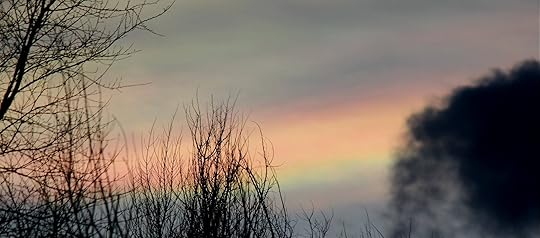
She addresses this, but there is value in seeking wonder in the everyday spaces around you, something I have cultivated, living in a fast growing city. It does not have to be Alaska or the Caribbean. I see reflected colors of the rainbow on snow on city streets and mountain hikes. It is always available, it is just a practice to see it, and then going further, to know it is always there, or possibly there, even if not seen.
I have been thinking of awe deeply lately, as I am not sure the message is reaching the masses, and sharing mine is all I can do. Which is what is asked of us. Grateful for this book and the chance to share.

I don't know what despair is, if it's something or nothing, a kind of filling up or an emptying out. I don't know what sorrow does to the world, what it adds or takes away. What I think I do know now is that sorrow is part of the Earth's great cycles, flowing into the night like cool air sinking down a river course. To feel sorrow is to float on the pulse of the Earth, the surge from living to dying, from coming into being to ceasing to exist.
Maybe this is why the Earth has the power over time to wash sorrow into a deeper pool, cold and shadowed. And maybe this is why, even though sorrow never disappears, it can make a deeper connection to the currents of life and so connect, somehow, to sources of wonder and solace. I don't know.
And I don't know what gladness is or where it comes from that feels like a splitting open of the self. It takes me by surprise.
I felt my way to the edge of the Pacific Ocean. Clouds obscured the moon. I could hear the shifting of the dark sea but could only imagine the surge and ebb of its rim on the sand. Then the clouds slid out from under the moon. The advancing edge of waves gathered moonlight and pushed it toward land. The line of light wavered there, shaking in the wind, then slid out to sea. And so it was, up and down the beach, a rim of light riding in on the swash and slipping back into the night. I was happy then, standing in the surge with lines of moonlight catching on my rubber boots. This is something that needs explaining, how light emerges from darkness, how comfort wells up from sorrow. The Earth holds every possibility inside it, and the mystery of transformation, one thing into another. This is the wildest comfort.
This Oregon morning, steam rises from the creek. Blackberry shoots thrust through the soil. Barn swallows arc into warm air above the railroad, chasing midges. Rain that fell like dead weight all winter long defies gravity in the spring. Mist floats over the river and drifts away east. Even my own spirits are lifting, as if heavy snow has melted off my shoulders and I am light again.
When the time comes, I want to be the woman Hank wrote about. She was a regular old plaid-jacketed Alaskan until she began losing her capacities. She lost the ability to balance. She lost access to her memories. One by one, the capacities that we think are essential dropped away, until she was stripped of all conscious thought and intention, leaving only the transparency of her inner mind. But what she had stored there, through all a lifetime, was radiant. Hank says that when they sat together, watching rain roll down the window, what ballooned from her was glass-clear gladness.
That's what she had left. That's what she had become.
I can't accept any more of these beautiful gifts. I have no way to give them back." He addressed me quite sternly. "Then you will have to learn to accept gifts," he said, "and a good way to learn is to practice." And now this moonlight, and this trembling path across the water. The Earth offers gift after gift-life and the living of it, light and the return of it, the growing things, the roaring things, fire and nightmares, falling water and the wisdom of friends, forgiveness. My god, the gift of forgiveness, time, and the scouring tides. How does one accept gifts as great as these and hold them in the mind?
Failing to notice a gift dishonors it, and deflects the love of the giver. That's what's wrong with living a careless life, storing up sorrow, waking up regretful, walking unaware. But to turn the gift in your hands, to say, this is wonderful and beautiful, this is a great gift-this honors the gift and the giver of it. Maybe this is what Hank has been trying to make me understand: Notice the gift. Be astonished at it. Be glad for it, care about it. Keep it in mind. This is the greatest gift a person can give in return.
"This is your work," my friend told me, "which is work of substance and prayer and mad attentiveness, which is the real deal, which is why we are here."
I embarked on an experiment this year. On January 1, I put a basket on my desk, and every time I found myself really happy-happy in that deep-down, exhaling, head-back way I jotted down on a little slip of paper what I was doing at that time and threw the paper into the basket. My plan was that at the end of the year (I pictured myself home alone, maybe on a cloudy winter day with the lamps on and the furnace sighing), I would spread the papers across the dining room table and study them. I imagined what that would be, to read them all, remembering.
-Went with Frank to a program on Lou Gehrig's disease. Allen was there, in a wheelchair. The woman said that of all the things that Lou Gehrig's disease brings, the most striking is the outpouring of love. At that, Allen started to sob. The woman explained that too, telling us that people who lose control of their muscles will cry often, to think of all the muscle effort to keep your crying inside, every muscle tensed to hold in your sorrow. I had never thought of that. People pulled their chairs closer to Allen, and his friend stroked his back, and there wasn't anybody muscular enough to hold in their sadness, and that was important.
- When the chorus kicked in at the last movement, the "Ode to Joy," and the trumpets started to sing, Marlan leaning in, and the music marching up and down again, and the sopranos impossibly high and clear and triumphant, all I could think was what a glory. If humans can do this, can do this TOGETHER, then they can do anything. You know that point in the "Ode to Joy" when you think there will be a rest and there ISN'T? It's about going on and not stopping. Thrilled by the music, thrilled by the hope, the conviction that if we can go on, can just hold on long enough to get past this point in his-tory, just keep singing joy, just hold things together through this time, then maybe there is hope for the human race. If we can't, then the world can go on without us, but that would be a shame, because it would have to go on without the "Ode to Joy."
A swell lifts and drops us. The bow slaps the water. Sparks scatter and drown. The bow sparkles again on the next swell. "Bio-luminescent algae," Frank whispers. "Pyrrophyta, the fire plants." It’s the first either of us has spoken. I nod invisibly, then smack my paddle, raising an angel's wing of sparks. We have seen this on other beaches, the light from millions of one-celled dinoflagellates. When they are disturbed, a chemical called luciferin and the enzyme luciferase pulse from their separate pockets, mix together with oxygen, and release a blue-white flash. We are quiet again, wondering, listening, rising and falling on the azure-lightning illumination of the face of a wave and the bending reflections of countless stars. We hear it then, the breathing, approaching off the starboard bow.
Suddenly, streaks of light splatter toward our boat. They leap from the sea and patter against the swell, thousands of them flying clear of the water. They hit the boat like pebbles, clunking and bouncing off the hull, sparking back into the sea. I duck reflexively and brace my paddle for balance, but the lights strike the paddle blade too. The sea is alive with them, plunging toward our boat. They dive and flash. In the midst of the melee, a large blur of blue light surges toward our bow. Sparks glint to the heavens. Starlight plummets onto the sea, the fallen stars, the Lucifers. Their spread wings blaze one last time, then slide under the dark waves.
But what if I could see the familiar world as if I had never seen it before, even if I see it every day--with that wonderment and surprise? Or see it as if I would never see it again? Then imagine the glory. I'm thinking it's a paltry sense of wonder that requires something new every day. I confess: Wonder is easy when you travel to desert islands in search of experiences you have never imagined, in search of something you have never seen before, in search of wonder, the shock of surprise. It's easy, and maybe it's cheap. It's not what the world asks of us.
To be worthy of the astonishing world, a sense of wonder will be a way of life, in every place and time, no matter how familiar: to listen in the dark of every night, to praise the mystery of every returning day, to be astonished again and again, to be grateful with an intensity that cannot be distinguished from joy.
That's what the silence meant: you're not alone.
The whole wild world pours down.
- WILLIAM STAFFORD, "ASSURANCE"
Maybe the forest is a prayer tonight, bent under the weight of all that winter, the whole world on its knees. Or maybe the prayer is the hush. Could I pray this way, letting the night settle onto my thoughts like snow on my shoulders, that gently? Hush. My snowshoes shuffle through the drifts. Hush: one snowshoe, then another. There is no other sound.
As evening came slowly on, I floated in my kayak on a small lake. The water was cold, but the air was colder; mist rose in streamers and drifted downwind.
When the fog floated over me, color faded from the forest that shouldered into the lake, and I could no longer make out each pine and hemlock. Then the cattails along the shore disappeared. The silver world wrapped itself around me like a scarf suffused with light, and snow began to fall. For some time, I could follow individual snowflakes -wet, floppy rags as they tumbled onto the glaze of the lake and disappeared. Some flakes landed on my kayak, shone there, then melted into beads that runneled off the chine. Then the snow was shawling down, thick and heavy and obscuring. My kayak disappeared under snow, and I could feel myself disappearing too as snow built upon my shoulders, the whole white sky fluttering down. I floated quietly. But what I want to tell you about is the brightness. The water shone like plate silver, and the fog seemed to brighten in a globe around me as I drifted downwind.
"Those who dwell . .. among the beauties and mysteries of the earth," Rachel Carson believed, are never alone or weary of life." I believe this too. Far away and hidden from people on shore, I could feel myself part of that evening, floating like duckweed on reflected storm light, floating among the memories of what I could no longer see, the lakeside meadows of corn lilies, corrugated leaves spiraling up and up, the muddy slough where we had watched a bear sway by, the lake bent under my boat.
There are no edges in this world. The water, the snow, the bear, the memory of the blackbird, the urgent growth of the lily are all one beautiful, mysterious thing, and we are part of that one thing. How, then, can we ever be alone?
As long as frogs sing, I will not be lost in a squall. The song tells me where the cattails are, and the cattails mark the shore. I am sure of this much, that Earth lights these small signal fires-not for us, but among us and we can find them if we look. If we are not afraid, if we keep our balance, if we let our anxious selves dissolve into the beauties and mysteries of the night, we will find a way to peace and assurance. Signal fires burn all over the land.
May the light that reflects on water be this wild prayer. May water lift us with its unexpected strength. May we find comfort in the "repeated refrains of nature," the softly sheeting snow, the changing seasons, the return of blackbirds to the marsh. May we find strength in light that pours in under snow and laughter that breaks through tears. May we go out into the light-filled snow, among meadows in bloom, with a gratitude for life that is deep and alive. May Earth's fire burn in our hearts, and may we know ourselves part of this flame, one thing, never alone, never weary of life.
Armando calls out the names of what he sees. Tiger heron. Elegant quail. Squirrel cuckoo. They come as utter astonishments, bursts of color against the gray bajada. I didn't know the world held such birds. I didn't know the world held such colors.I didn't know that happiness and beauty are so much the same thing.
The blue in a bird comes from the reflective qualities of its feathers, not from pigments. The microstructure of the blue bird's feathers- a sort of tight ribbing or corduroy - absorbs all light except blue, and this reflects back to our eyes. That's why the blue of a jay changes when the angle of light changes, why the color is fleeting and shiny. If the feather's structure were different, the bird we see would be green or black or pastel as an oyster shell. If you ground up blue feathers, the color would disappear.
This is something to think about, the unreal blue of the magpie-jay's wings. This small fact knocks me sideways and makes me think about things a little differently. Is it a mistake to look to the world to tell us the meaning of our plummeting lives? Maybe we all have the power to shape our own structure, the structure of our metaphoric wings, what lifts us our character maybe, call it our spirit. We all in our own ways catch the light of the world and reflect it back, and this is what is bright and surprising about a person, this rainbow shimmer created from colorless structure. Maybe there is no meaning in the world itself -no sorrow. In fact, no good or bad, beginning or end. Maybe what there is, is the individual way each of us has of transforming the world, ways to refract it, to create of it something that shimmers from our spread wings. This is our work, creating these wings and giving them color.
The magpie-jays remind me of Epictetus, the Greek Stoic philosopher. "There is nothing good or evil, save in the will," he wrote. What comes at us is what it is. How we feel about events, how we respond to them, how we transform them and judge them -these are our own decisions, Epictetus believed. Or maybe I would say it's a little more complicated: How we feel about events, respond to them, transform them and judge them, is a matter of the shape of our spirit, the corrugation of the feathers in our wings. And this, the shape of our spirit, our way of reflecting the world, is something we must work to create and tend, day after day after day.
To see to the depth of a river, wade into still water. In the silent space under the slick of the world, the river clears. If you stand still too, so as not to wrinkle the water, you will see the shadows of minnows. You will smell sage and melting snow and you will notice, incised into the topography of the silt, little river channels pointing to the sea. And isn't this what you had hoped to find? A quiet place where everything comes clear and the Earth itself shows the way to the one thing.
While fields and floods, rocks, hills, and plains
Repeat the sounding joy,
Repeat the sounding joy,
Repeat, repeat the sounding joy.
ISAAC WATTS
It took me a while to grow into some skill and art as a photographer, and I think the same with my affinity for the world or landscape outside. My initial hikes were filled with beauty and appreciation for the beauty, the sunshine, the sky, the exercise and heartbeat and they became more of an emotional, spiritual experience over time. There was a time when even just walking on greenways or around a lake nearby were as important as hikes in the mountains, and that is when it came together that the land was healing me and lifting me. I can look at a photo I have taken and feel the echo of the thrill or the peace I felt taking it.
A lot of her words around despair and sorrow ring true for me, so I do think her goal, wild comfort, is part of the entire book, and she has a gift for description of the world around her that makes you feel you are there. I haven’t had some of the experiences she has had, such as being on a kayak on a lake as the snow falls or kayaking through ocean bioluminescence, but I know what it is like to feel wonder, so these activated my awe instinct and I can dream of those experiences; hoping to have them one day, yes, but also like I already did.
She addresses this, but there is value in seeking wonder in the everyday spaces around you, something I have cultivated, living in a fast growing city. It does not have to be Alaska or the Caribbean. I see reflected colors of the rainbow on snow on city streets and mountain hikes. It is always available, it is just a practice to see it, and then going further, to know it is always there, or possibly there, even if not seen.
I have been thinking of awe deeply lately, as I am not sure the message is reaching the masses, and sharing mine is all I can do. Which is what is asked of us. Grateful for this book and the chance to share.
I don't know what despair is, if it's something or nothing, a kind of filling up or an emptying out. I don't know what sorrow does to the world, what it adds or takes away. What I think I do know now is that sorrow is part of the Earth's great cycles, flowing into the night like cool air sinking down a river course. To feel sorrow is to float on the pulse of the Earth, the surge from living to dying, from coming into being to ceasing to exist.
Maybe this is why the Earth has the power over time to wash sorrow into a deeper pool, cold and shadowed. And maybe this is why, even though sorrow never disappears, it can make a deeper connection to the currents of life and so connect, somehow, to sources of wonder and solace. I don't know.
And I don't know what gladness is or where it comes from that feels like a splitting open of the self. It takes me by surprise.
I felt my way to the edge of the Pacific Ocean. Clouds obscured the moon. I could hear the shifting of the dark sea but could only imagine the surge and ebb of its rim on the sand. Then the clouds slid out from under the moon. The advancing edge of waves gathered moonlight and pushed it toward land. The line of light wavered there, shaking in the wind, then slid out to sea. And so it was, up and down the beach, a rim of light riding in on the swash and slipping back into the night. I was happy then, standing in the surge with lines of moonlight catching on my rubber boots. This is something that needs explaining, how light emerges from darkness, how comfort wells up from sorrow. The Earth holds every possibility inside it, and the mystery of transformation, one thing into another. This is the wildest comfort.
This Oregon morning, steam rises from the creek. Blackberry shoots thrust through the soil. Barn swallows arc into warm air above the railroad, chasing midges. Rain that fell like dead weight all winter long defies gravity in the spring. Mist floats over the river and drifts away east. Even my own spirits are lifting, as if heavy snow has melted off my shoulders and I am light again.
When the time comes, I want to be the woman Hank wrote about. She was a regular old plaid-jacketed Alaskan until she began losing her capacities. She lost the ability to balance. She lost access to her memories. One by one, the capacities that we think are essential dropped away, until she was stripped of all conscious thought and intention, leaving only the transparency of her inner mind. But what she had stored there, through all a lifetime, was radiant. Hank says that when they sat together, watching rain roll down the window, what ballooned from her was glass-clear gladness.
That's what she had left. That's what she had become.
I can't accept any more of these beautiful gifts. I have no way to give them back." He addressed me quite sternly. "Then you will have to learn to accept gifts," he said, "and a good way to learn is to practice." And now this moonlight, and this trembling path across the water. The Earth offers gift after gift-life and the living of it, light and the return of it, the growing things, the roaring things, fire and nightmares, falling water and the wisdom of friends, forgiveness. My god, the gift of forgiveness, time, and the scouring tides. How does one accept gifts as great as these and hold them in the mind?
Failing to notice a gift dishonors it, and deflects the love of the giver. That's what's wrong with living a careless life, storing up sorrow, waking up regretful, walking unaware. But to turn the gift in your hands, to say, this is wonderful and beautiful, this is a great gift-this honors the gift and the giver of it. Maybe this is what Hank has been trying to make me understand: Notice the gift. Be astonished at it. Be glad for it, care about it. Keep it in mind. This is the greatest gift a person can give in return.
"This is your work," my friend told me, "which is work of substance and prayer and mad attentiveness, which is the real deal, which is why we are here."
I embarked on an experiment this year. On January 1, I put a basket on my desk, and every time I found myself really happy-happy in that deep-down, exhaling, head-back way I jotted down on a little slip of paper what I was doing at that time and threw the paper into the basket. My plan was that at the end of the year (I pictured myself home alone, maybe on a cloudy winter day with the lamps on and the furnace sighing), I would spread the papers across the dining room table and study them. I imagined what that would be, to read them all, remembering.
-Went with Frank to a program on Lou Gehrig's disease. Allen was there, in a wheelchair. The woman said that of all the things that Lou Gehrig's disease brings, the most striking is the outpouring of love. At that, Allen started to sob. The woman explained that too, telling us that people who lose control of their muscles will cry often, to think of all the muscle effort to keep your crying inside, every muscle tensed to hold in your sorrow. I had never thought of that. People pulled their chairs closer to Allen, and his friend stroked his back, and there wasn't anybody muscular enough to hold in their sadness, and that was important.
- When the chorus kicked in at the last movement, the "Ode to Joy," and the trumpets started to sing, Marlan leaning in, and the music marching up and down again, and the sopranos impossibly high and clear and triumphant, all I could think was what a glory. If humans can do this, can do this TOGETHER, then they can do anything. You know that point in the "Ode to Joy" when you think there will be a rest and there ISN'T? It's about going on and not stopping. Thrilled by the music, thrilled by the hope, the conviction that if we can go on, can just hold on long enough to get past this point in his-tory, just keep singing joy, just hold things together through this time, then maybe there is hope for the human race. If we can't, then the world can go on without us, but that would be a shame, because it would have to go on without the "Ode to Joy."
A swell lifts and drops us. The bow slaps the water. Sparks scatter and drown. The bow sparkles again on the next swell. "Bio-luminescent algae," Frank whispers. "Pyrrophyta, the fire plants." It’s the first either of us has spoken. I nod invisibly, then smack my paddle, raising an angel's wing of sparks. We have seen this on other beaches, the light from millions of one-celled dinoflagellates. When they are disturbed, a chemical called luciferin and the enzyme luciferase pulse from their separate pockets, mix together with oxygen, and release a blue-white flash. We are quiet again, wondering, listening, rising and falling on the azure-lightning illumination of the face of a wave and the bending reflections of countless stars. We hear it then, the breathing, approaching off the starboard bow.
Suddenly, streaks of light splatter toward our boat. They leap from the sea and patter against the swell, thousands of them flying clear of the water. They hit the boat like pebbles, clunking and bouncing off the hull, sparking back into the sea. I duck reflexively and brace my paddle for balance, but the lights strike the paddle blade too. The sea is alive with them, plunging toward our boat. They dive and flash. In the midst of the melee, a large blur of blue light surges toward our bow. Sparks glint to the heavens. Starlight plummets onto the sea, the fallen stars, the Lucifers. Their spread wings blaze one last time, then slide under the dark waves.
But what if I could see the familiar world as if I had never seen it before, even if I see it every day--with that wonderment and surprise? Or see it as if I would never see it again? Then imagine the glory. I'm thinking it's a paltry sense of wonder that requires something new every day. I confess: Wonder is easy when you travel to desert islands in search of experiences you have never imagined, in search of something you have never seen before, in search of wonder, the shock of surprise. It's easy, and maybe it's cheap. It's not what the world asks of us.
To be worthy of the astonishing world, a sense of wonder will be a way of life, in every place and time, no matter how familiar: to listen in the dark of every night, to praise the mystery of every returning day, to be astonished again and again, to be grateful with an intensity that cannot be distinguished from joy.
That's what the silence meant: you're not alone.
The whole wild world pours down.
- WILLIAM STAFFORD, "ASSURANCE"
Maybe the forest is a prayer tonight, bent under the weight of all that winter, the whole world on its knees. Or maybe the prayer is the hush. Could I pray this way, letting the night settle onto my thoughts like snow on my shoulders, that gently? Hush. My snowshoes shuffle through the drifts. Hush: one snowshoe, then another. There is no other sound.
As evening came slowly on, I floated in my kayak on a small lake. The water was cold, but the air was colder; mist rose in streamers and drifted downwind.
When the fog floated over me, color faded from the forest that shouldered into the lake, and I could no longer make out each pine and hemlock. Then the cattails along the shore disappeared. The silver world wrapped itself around me like a scarf suffused with light, and snow began to fall. For some time, I could follow individual snowflakes -wet, floppy rags as they tumbled onto the glaze of the lake and disappeared. Some flakes landed on my kayak, shone there, then melted into beads that runneled off the chine. Then the snow was shawling down, thick and heavy and obscuring. My kayak disappeared under snow, and I could feel myself disappearing too as snow built upon my shoulders, the whole white sky fluttering down. I floated quietly. But what I want to tell you about is the brightness. The water shone like plate silver, and the fog seemed to brighten in a globe around me as I drifted downwind.
"Those who dwell . .. among the beauties and mysteries of the earth," Rachel Carson believed, are never alone or weary of life." I believe this too. Far away and hidden from people on shore, I could feel myself part of that evening, floating like duckweed on reflected storm light, floating among the memories of what I could no longer see, the lakeside meadows of corn lilies, corrugated leaves spiraling up and up, the muddy slough where we had watched a bear sway by, the lake bent under my boat.
There are no edges in this world. The water, the snow, the bear, the memory of the blackbird, the urgent growth of the lily are all one beautiful, mysterious thing, and we are part of that one thing. How, then, can we ever be alone?
As long as frogs sing, I will not be lost in a squall. The song tells me where the cattails are, and the cattails mark the shore. I am sure of this much, that Earth lights these small signal fires-not for us, but among us and we can find them if we look. If we are not afraid, if we keep our balance, if we let our anxious selves dissolve into the beauties and mysteries of the night, we will find a way to peace and assurance. Signal fires burn all over the land.
May the light that reflects on water be this wild prayer. May water lift us with its unexpected strength. May we find comfort in the "repeated refrains of nature," the softly sheeting snow, the changing seasons, the return of blackbirds to the marsh. May we find strength in light that pours in under snow and laughter that breaks through tears. May we go out into the light-filled snow, among meadows in bloom, with a gratitude for life that is deep and alive. May Earth's fire burn in our hearts, and may we know ourselves part of this flame, one thing, never alone, never weary of life.
Armando calls out the names of what he sees. Tiger heron. Elegant quail. Squirrel cuckoo. They come as utter astonishments, bursts of color against the gray bajada. I didn't know the world held such birds. I didn't know the world held such colors.I didn't know that happiness and beauty are so much the same thing.
The blue in a bird comes from the reflective qualities of its feathers, not from pigments. The microstructure of the blue bird's feathers- a sort of tight ribbing or corduroy - absorbs all light except blue, and this reflects back to our eyes. That's why the blue of a jay changes when the angle of light changes, why the color is fleeting and shiny. If the feather's structure were different, the bird we see would be green or black or pastel as an oyster shell. If you ground up blue feathers, the color would disappear.
This is something to think about, the unreal blue of the magpie-jay's wings. This small fact knocks me sideways and makes me think about things a little differently. Is it a mistake to look to the world to tell us the meaning of our plummeting lives? Maybe we all have the power to shape our own structure, the structure of our metaphoric wings, what lifts us our character maybe, call it our spirit. We all in our own ways catch the light of the world and reflect it back, and this is what is bright and surprising about a person, this rainbow shimmer created from colorless structure. Maybe there is no meaning in the world itself -no sorrow. In fact, no good or bad, beginning or end. Maybe what there is, is the individual way each of us has of transforming the world, ways to refract it, to create of it something that shimmers from our spread wings. This is our work, creating these wings and giving them color.
The magpie-jays remind me of Epictetus, the Greek Stoic philosopher. "There is nothing good or evil, save in the will," he wrote. What comes at us is what it is. How we feel about events, how we respond to them, how we transform them and judge them -these are our own decisions, Epictetus believed. Or maybe I would say it's a little more complicated: How we feel about events, respond to them, transform them and judge them, is a matter of the shape of our spirit, the corrugation of the feathers in our wings. And this, the shape of our spirit, our way of reflecting the world, is something we must work to create and tend, day after day after day.
To see to the depth of a river, wade into still water. In the silent space under the slick of the world, the river clears. If you stand still too, so as not to wrinkle the water, you will see the shadows of minnows. You will smell sage and melting snow and you will notice, incised into the topography of the silt, little river channels pointing to the sea. And isn't this what you had hoped to find? A quiet place where everything comes clear and the Earth itself shows the way to the one thing.
While fields and floods, rocks, hills, and plains
Repeat the sounding joy,
Repeat the sounding joy,
Repeat, repeat the sounding joy.
ISAAC WATTS

October 29, 2025
Once I got past the first story about snakes, I enjoyed the earthy stories about nature.
"There is meaning in the natural rhythms of dying and living, winter and spring, bones and leaves. Even in times of bewilderment or despair, there is the steadfast ground underfoot - pine duff, baked clay, stone turned red in the rain."
"We don't really need to know where we're going to keep moving ahead."
"There is meaning in the natural rhythms of dying and living, winter and spring, bones and leaves. Even in times of bewilderment or despair, there is the steadfast ground underfoot - pine duff, baked clay, stone turned red in the rain."
"We don't really need to know where we're going to keep moving ahead."

March 27, 2011
Excellent series of essays about the solace to be found in nature. Great read for springtime.
Passages I liked:
"I don't know what despair is, if it's something or nothing, a kind of filling up or an emptying out. I don't know what sorrow does to the world, what it adds or takes away. What I think I do know now is that sorrow is part of the Earth's great cycles..."
"This is something that needs explaining, how light emerges from darkness, how comfort wells up from sorrow. The Earth holds every possiblity inside it, the mystery of transformation, one thing into another. This it the wildest comfort."
"Do not be surprised that the return of the light lifts your spirits. Do not be surprised that warmth on your back calms you and makes you glad. Feel your spirits lift as the sun rises higher in the sky: this is part of you, this snaky gladness, part of who you have been for a million years. Find the warm places; do not expect them to come to you. When you find them, stay there and be still. Be still and watchful. In this quiet, taste the air. Lick up the taste of it. Listen. Listen with the full length of your body against the ground."
"May the light that reflects on water be this wild prayer. May water lift us with its unexpected strength. May we find comfort in the 'repeated refrains of nature,' the softly sheeting snow, the changing seasons, the return of blackbirds to the marsh. May we find strength in light that pours in under snow and laughter that breaks through tears. May we go out into the light-filled snow, among meadows in bloom, with a gratitude for life that is deep and alive."
Passages I liked:
"I don't know what despair is, if it's something or nothing, a kind of filling up or an emptying out. I don't know what sorrow does to the world, what it adds or takes away. What I think I do know now is that sorrow is part of the Earth's great cycles..."
"This is something that needs explaining, how light emerges from darkness, how comfort wells up from sorrow. The Earth holds every possiblity inside it, the mystery of transformation, one thing into another. This it the wildest comfort."
"Do not be surprised that the return of the light lifts your spirits. Do not be surprised that warmth on your back calms you and makes you glad. Feel your spirits lift as the sun rises higher in the sky: this is part of you, this snaky gladness, part of who you have been for a million years. Find the warm places; do not expect them to come to you. When you find them, stay there and be still. Be still and watchful. In this quiet, taste the air. Lick up the taste of it. Listen. Listen with the full length of your body against the ground."
"May the light that reflects on water be this wild prayer. May water lift us with its unexpected strength. May we find comfort in the 'repeated refrains of nature,' the softly sheeting snow, the changing seasons, the return of blackbirds to the marsh. May we find strength in light that pours in under snow and laughter that breaks through tears. May we go out into the light-filled snow, among meadows in bloom, with a gratitude for life that is deep and alive."

January 28, 2017
This book consists of a series of essays about the author's musings on her experiences in nature. As she explains in the introduction, she had recently lost several people who were close to her, and so the tone of the book tends to be rather melancholy and bittersweet. Overall, I enjoyed the book but I didn't love it.
What I liked:
The writing is very dense, poetic and lyrical.
What I didn't like:
The writing is very dense, poetic and lyrical.
To be honest, this is not my favorite writing style. I prefer a more direct and down to earth approach, and a bit of narrative and/or humor is always welcome. Although I do enjoy a beautiful turn of phrase or an image that continues to resonate with me after I have stopped reading, (and this book has both of those in spades), this sort of writing can also seem a bit pretentious and overly self-aware. Some of the essays in particular felt a bit overly polished and forced. I loved some of her images, such as the description of kayaking in a snow squall or a young heron learning how to be patient enough to catch a fish. Other essays fell flat for me--like the overly-long description of geese flying over a winter field, and the author's extended discussion of how she was trying to impose the order of her own world view on their movements.
What I liked:
The writing is very dense, poetic and lyrical.
What I didn't like:
The writing is very dense, poetic and lyrical.
To be honest, this is not my favorite writing style. I prefer a more direct and down to earth approach, and a bit of narrative and/or humor is always welcome. Although I do enjoy a beautiful turn of phrase or an image that continues to resonate with me after I have stopped reading, (and this book has both of those in spades), this sort of writing can also seem a bit pretentious and overly self-aware. Some of the essays in particular felt a bit overly polished and forced. I loved some of her images, such as the description of kayaking in a snow squall or a young heron learning how to be patient enough to catch a fish. Other essays fell flat for me--like the overly-long description of geese flying over a winter field, and the author's extended discussion of how she was trying to impose the order of her own world view on their movements.

August 17, 2018
So I had high expectations but this book was definitely not my cup of tea. Each chapter is fairly autonomous so it can be read in stages without sacrificing any sort of continuity but overall it is a fairly short book. I could have read it faster but I really did not enjoy it. It read more like prose or poetry than a work of nonfiction and that is what I found bothersome. It is not as if Moore does not create wonderful images from her interactions with nature in a variety of settings - she does have a wonderful ability to capture the beauty in the simplest of things found out in the wild. However, it moved along at a rather slow pace and I don't think I had the right mindset to truly enjoy the work for what it was. Perhaps reading a chapter while actually in nature would have been a better choice. In that respect, taking this rather lightweight volume camping and breezing through a chapter while relaxing under the stars in one's tent would have maximized the experience. For me, reading it in an air-conditioned room is about as far from Moore's intended message as one could get and that probably contributed to my dissatisfaction. Hopefully other readers will not get discouraged by this review and attempt to sample it in a different context, perhaps thereby finding it more inspirational then I.

April 12, 2012
I know/know of Kathleen Dean Moore (she was on the board of an organization I worked for) and she is a lovely person and writer. Her gentle yet fierce spirit just exudes from this book, which I started eagerly and initially could not put down. I yearned, though, for change in the speaker, a narrative arc, such as you might find in a memoir or novel or even a book of linked essays: the writer's growth from gladness to sorrow. We learn on the book jacket, no spoiler, that she has written Wild Comfort in response to the deaths of several friends. Yet those deaths are mentioned in one or two lines, and then we move on, no mention, no rumination, no marked change. So, for me, while the writing was beautiful and extremely poetic (does she write poetry? She should) on the subjects of nature and its rhythms, about halfway through I started to feel it was just that: beautiful writing. No sense of rumination or growth, just observation. Maybe this indicates above all that I'm a writer and not a philosopher? Maybe not a generous enough reader. I don't know.
May 9, 2014
There is nothing like nature to soothe the soul and if you can't get out into it the way this author does then it sure helps to read her essays. I remember most her kayaking alone on a lake when it was snowing. I could feel the flakes melt into the water. Just the visual of that relaxes me and makes me happy. Her writing is lovely, her thoughts profound and more than once I stopped and reread many inspiring paragraphs. I stumbled over this book in the nature section in a local bookstore. I'm glad I did.

April 2, 2019
Talks about humans not being the center of the universe while she acts like she's the center of the universe. Came off as entitled to me. The only feeling this book provoked was anger at her anecdotes of natural destruction passed off as appreciation. Skip it and read Gifts from the Sea or anything else.

July 21, 2010
This book spoke to the way that I look at nature around me. I felt a connection to the authors zeal for nature, she paints for all of my senses with the simple arrangement of her words on the page.

January 24, 2012
A series of absolutely gorgeous musings and meditations on what it means to be human in the natural world.

October 2, 2015
It's a meditation, a spiritual reflection. If that's your thing, I think you'll like it. If I owned a hard copy, I'd shelf it next to Pilgrim at Tinker Creek, if I owned a hard copy of that.

June 12, 2021
A collection of short stories and musings, Moore weaves natural observation with philosophy and wonder. Some stories strike me to the core, like "the Patience of Herons", "A Joke my Father Liked to Tell", and "How Can I Keep from Singing". I will read these stories over and over.
"So I don't know what to think about people who tell their grieving friends to be patient. "Be patient. Time is the great healer. Give it time." Have these people ever watched a heron hunt, ever heard one die in the dark? What are they thinking? There are many kinds of patience, and maybe they work against each other. Patience is active and passive. I would call patience a paradox, except that's too simple. Here is the work of patience: to die to the world of acting, the world of hoping, and so to open oneself to the suffering of the whole world. This is true passion, taking in the suffering of all together. This patience is the birth of compassion. And here is the work of patience: to become brave and fierce, set like a spring to size whatever life puts in the way of our stiletto beaks... This patience is the birth of joy. And here is the work of patience: to be ready fo the world to slit us, the full length of us, opening our hearts with the pellucid attention that is the watchfulness of the heron in the cove at the end of the day, when wood smoke slides onto the rising tide and slanting rain pocks the water. This patience is the birth of gratitude." pg 108
"So I don't know what to think about people who tell their grieving friends to be patient. "Be patient. Time is the great healer. Give it time." Have these people ever watched a heron hunt, ever heard one die in the dark? What are they thinking? There are many kinds of patience, and maybe they work against each other. Patience is active and passive. I would call patience a paradox, except that's too simple. Here is the work of patience: to die to the world of acting, the world of hoping, and so to open oneself to the suffering of the whole world. This is true passion, taking in the suffering of all together. This patience is the birth of compassion. And here is the work of patience: to become brave and fierce, set like a spring to size whatever life puts in the way of our stiletto beaks... This patience is the birth of joy. And here is the work of patience: to be ready fo the world to slit us, the full length of us, opening our hearts with the pellucid attention that is the watchfulness of the heron in the cove at the end of the day, when wood smoke slides onto the rising tide and slanting rain pocks the water. This patience is the birth of gratitude." pg 108

November 5, 2022
I really, really wanted to love this book. I always turn to the wild comfort of nature for solace when life is hard and filled with pain. And there were some evocative, soothing essays. But then I came to "Things With Feathers." I'm not sure what the author was trying to express here, but it was a story about a two year old child who accidentally kills a wounded bird after insisting on picking it up, then carries the body around all day, squeezing it so tightly it's head eventually pops off. The only message I got from this disturbing story was that the little girl's parents were totally negligent.
Every story I read after that had a bad taste to me. I think that the author was horribly scarred by the four deaths she struggled with. When describing the lovely serenity of a mountain lake at dawn, she wrote "The lake lies as still as the silence after a car wreck." I felt the pain she suffered after losing a friend in a car accident. But I had completely lost the solace of nature.
If you read this collection, maybe skip "Things With Feathers," maybe read it last. If at all. It might make the other essays more enjoyable. Maybe.
Every story I read after that had a bad taste to me. I think that the author was horribly scarred by the four deaths she struggled with. When describing the lovely serenity of a mountain lake at dawn, she wrote "The lake lies as still as the silence after a car wreck." I felt the pain she suffered after losing a friend in a car accident. But I had completely lost the solace of nature.
If you read this collection, maybe skip "Things With Feathers," maybe read it last. If at all. It might make the other essays more enjoyable. Maybe.
September 1, 2019
I was about 70 pages in before I started loving this book. Perhaps that's fitting. Perhaps Moore was using the essays to process several griefs and what I was experiencing in the first 70 pages was a lot of unprocessed "stuff." After 70 pages, I found one essay after another that left me calm, open and in a respectful silence at her skill in evoking the fierce beauty of her western habitat. I live in the midwest and her nature experiences are different from mine - but we share the sense of being embedded in the natural world and in awe of it at the same time. So for me, bearing with her during the grittiness of the those first 70 pages was well worth it. I'll re-read in 6 months or so and enjoy it all over again.

August 22, 2022
I don’t know why, but so many books about nature have a depth of beauty to the writing that astounds, in this case so much so that I read through the first chapter on snakes and thought it was beautiful. Her prose reminded of me of Mary Oliver’s poems in its spareness and, like poetry, I had to read it little by little so that I could savor it.
She wrote this book because several friends of hers had died over the prior year and this was how she moved through that grief. There are chapters on various topics (gladness, for instance) and the entire work is a reflection or prayer on nature as solace to sorrow.
She wrote this book because several friends of hers had died over the prior year and this was how she moved through that grief. There are chapters on various topics (gladness, for instance) and the entire work is a reflection or prayer on nature as solace to sorrow.

July 19, 2020
"Every moment we are wondering at the path of wind across the water or smiling to see a dog rest in the sun, we are not rehearsing our misfortunes. Every moment we are glad for the twilight of morning, we are not vexed."
"Destruction, creation, catastrophe, renewal, sorrow, and joy are merely human ways of seeing, human projections onto the landscape, the ecologists say. What is real, they say, is change. What is necessary, they say, is change."
"Destruction, creation, catastrophe, renewal, sorrow, and joy are merely human ways of seeing, human projections onto the landscape, the ecologists say. What is real, they say, is change. What is necessary, they say, is change."

July 22, 2017
To be worthy of the astonishing world, a sense of wonder will be a way of life, in every place and time, no matter how familiar: to listen in the dark of every night, to praise the mystery of every returning day, to be astonished again and again, to be grateful with an intensity that cannot be distinguished from joy.

December 16, 2019
I love nature, so I loved this book. I found it very comforting to hear her reflections about nature and have them translated into the subject of existence. I enjoy the metaphor of the forest, the trees, and the stream that flows to the sea. I found this book spoke my language of comfort. I am comforted by the order of the universe and all of its sacred chaos.
Displaying 1 - 30 of 125 reviews