Jump to ratings and reviews
Rate this book

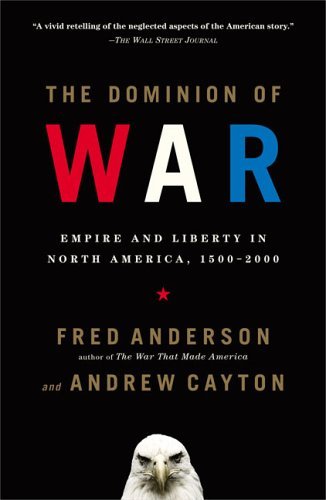
The Dominion of War: Empire and Liberty in North America, 1500-2000

Rate this book
Americans often think of their nation’s history as a movement toward ever-greater democracy, equality, and freedom. Wars in this story are understood both as necessary to defend those values and as exceptions to the rule of peaceful progress. In The Dominion of War , historians Fred Anderson and Andrew Cayton boldly reinterpret the development of the United States, arguing instead that war has played a leading role in shaping North America from the sixteenth century to the present. Anderson and Cayton bring their sweeping narrative to life by structuring it around the lives of eight men—Samuel de Champlain, William Penn, George Washington, Andrew Jackson, Antonio Lopez de Santa Anna, Ulysses S. Grant, Douglas MacArthur, and Colin Powell. This approach enables them to describe great events in concrete terms and to illuminate critical connections between often-forgotten imperial conflicts, such as the Seven Years’ War and the Mexican-American War, and better-known events such as the War of Independence and the Civil War. The result is a provocative, highly readable account of the ways in which republic and empire have coexisted in American history as two faces of the same coin. The Dominion of War recasts familiar triumphs as tragedies, proposes an unconventional set of turning points, and depicts imperialism and republicanism as inseparable influences in a pattern of development in which war and freedom have long been intertwined.   It offers a new perspective on America’s attempts to define its role in the world at the dawn of the twenty-first century.

544 pages, Paperback

First published November 29, 2004

23 people are currently reading
399 people want to read

About the author

Fred Anderson

16 books62 followers
Fred Anderson is an American historian specializing in early North American history, particularly the colonial and revolutionary periods. He earned his B.A. from Colorado State University and his Ph.D. from Harvard, later teaching at both institutions. Now Professor Emeritus at the University of Colorado Boulder, he has held fellowships from the NEH, Guggenheim Foundation, and others. His acclaimed book Crucible of War received the Francis Parkman and Mark Lynton History Prizes. He co-authored The Dominion of War with Andrew Cayton and wrote The War That Made America, companion to the PBS series. Anderson is also a contributor to the Oxford History of the United States.

Ratings & Reviews

What do you think?
Rate this book

Friends & Following

Create a free account to discover what your friends think of this book!

Community Reviews

5 stars
48 (31%)
4 stars
69 (45%)
3 stars
29 (19%)
2 stars
4 (2%)
1 star
1 (<1%)
Displaying 1 - 30 of 31 reviews
Profile Image for Brennan.
34 reviews2 followers
February 12, 2009
This was fantastic - it looks at the gaps between the military endeavours that form our national myth at other events and people that lead to US expansion over the continent and beyond. I was taught about the Revolutionary War, the Civil War, World Wars 1 and 2, and the rest was glossed over. The stories of how we as a nation invaded Mexico unprovoked and annexed half their territory, and how we dismantled the Spanish Empire for our own ends and annexed Cuba, Puerto Rico, Guam and the Philippines, to name two, aren't as prominent in our national hagiography because they go against the myth of being provoked into wars in self defense or for just cause. This is very accessible and anyone who is interested in US history and wants to learn the back story of Empire might enjoy this.
Profile Image for Joseph Stieb.
Author 1 book239 followers
November 15, 2014
Cayton and Anderson’s The Dominion of War begins with a fascinating image. Americans have memorialized five conflicts on the National Mall: the Revolution, the Civil War, World War II, Korea, and Vietnam. Missing from the Mall are a series conflicts that are no less crucial to understanding American history: a host of Indian Wars, the War of 1812, the Mexican-American War, the Spanish-American War, World War I, and numerous interventions in the Caribbean. With the exception of Vietnam, Americans have viewed the first set of conflicts as campaigns to establish, protect, and/or expand the sphere of liberty and democracy. In turn, Americans have tended to view the latter group, which expanded and consolidated an American empire, as “unfortunate exceptions to the antimilitarist rule of republicanism” (xi). Americans chose not to commemorate these conflicts because as wars for empire they have a tainted and “un-American” quality.
Cayton and Anderson do not tear down either narrative about why America has fought its wars. Rather, Cayton and Anderson’s achievement in this magisterial book is to synthesize these narratives by breaking down the distinctions between America’s wars for liberty and wars for empire by showing that “the values of republicanism and empire have consistently complemented one another” (424). To a greater extent that most Americans would admit, the protection of American liberty depended upon the expansion of its empire, at least in the eyes of historical actors such as Washington, Jackson, and MacArthur. This expansion was not always by force, as their chapter on William Penn’s largely peaceful, cooperative expansion into Indian territory demonstrates. Nevertheless, the authors show that Americans since before the Revolution have been willing to use force to establish, defend, and expand the empire of liberty.
In fact, one of the authors’ most insightful points is that Americans have often conflated expanding the sphere of liberty to other peoples with defending our liberty at home. One could argue that the more democracies there are in the world, the safer American democracy will be. However, Cayton and Anderson show that racism, a patronizing cultural superiority complex, and a messianic self-image have severely complicated the superficially benign goal of making the world safe for democracy. Their strongest illustration of this dynamic is the guerrilla fighting in the Spanish American War.
The US took the Philippines from Spain in 1898 with the intention of instituting a “benevolent assimilation” with Filipinos in which the Americans would selflessly tutor the oppressed and immature native in democracy, liberty, and modernization in exchange for a strategic foothold in Asia. When Filipino nationalists launched a guerrilla war against the US, it was almost impossible for most Americans to understand why such a benighted people would reject American enlightenment. As the Cayton and Anderson succinctly put it: “Liberation as defined by Americans was conquest as understood by some Filipinos” (336). Motivated by racism and resentment at ostensible Filipino ingratitude, the US launched a successful but brutal counterinsurgency campaign that strongly reduced American eagerness for imperialist reform. Instead, the US became interventionists for the remainder of the twentieth century who were willing to use force to defend democracy and American allies as far afield as Europe (twice), the South Pacific, Korea, and Vietnam. Nevertheless, American interventionists like Douglas MacArthur never lost the sense that they were acting on behalf of liberty and humanity and that they knew what was best for their conquered foes.
The Spanish-American War and its Filipino corollary may be too morally murky for a memorial on the Mall, but Cayton and Anderson strongly argue that this ambiguity does not mean Americans should treat the empire-expanding wars as the aberrations in American history. Rather, they show that the memorialized wars were still about empire building. For instance, the Revolutionary War was largely about the terms of British citizenship within an expanding empire that constantly pushed into Indian territory. No person embodied the union of empire and liberty better than George Washington, who led the Continental Army to victory and was personally invested in an orderly western expansion. Furthermore, the authors show that the memorialized “good” wars cannot be historically understood without reference to imperialist wars of expansion. For instance, the acquisition of huge western territories in the nakedly aggressive Mexican War triggered a sectional crisis over the place of slavery in those territories that greatly contributed to the Civil War.
Overall, Cayton and Anderson show that the motivations of empire and liberty were mixed into every American war and that the more morally ambiguous wars deserve a prominent place in our national historical narrative even if they do not make for inspiring memorials. This narrative is especially valuable in the midst of twenty-first century wars in which America continues to spend blood and treasure to expand the empire of liberty with decidedly mixed results. Those seeking to understand why we continue to fight for these reasons and often with the same inability to consider the history and wishes of the “natives” will find much illumination in this book. A book such as this that helps Americans understand why we are so often seen as conquerors when we imagine ourselves as liberators truly deserves the widest possible readership.
Profile Image for Peter Corrigan.
814 reviews19 followers
October 18, 2023
An explanation of America viewed through the lens of the many wars in our history (and pre-history) from 1600-2000. The overall story is told through nine biographies - Samuel de Champlain, William Penn, George Washington, Andrew Jackson, Antonio Lopez de Santa Anna, U.S. Grant, Douglas MacArthur (and his father Arthur), and Colin Powell. The most interesting chapters to me were the first three, on Champlain, Penn and Washington. Of course Champlain was French but his interactions with native Americans (aka Indians) created one template for how the colonial interlopers might interact with these incredibly varied tribal people. The authors contrast the French approach in native relations to the English methods with several interesting observations (p 43-44) and how the Anglo model used in the brutal colonization of Ireland in the 1600s also informed their approach to the natives in North America. Something I never considered before. Fred Anderson is an eminent historian and an expert on the Seven Years War (aka the French and Indian War), his book 'Crucible of War' was outstanding. So you might expect more insight and detail out of this early portion of the book and you do. There is a lot (almost too much) to unpack in every chapter however and it is a well referenced and heavily footnoted work. One minor quibble is that there is no single listing of references or recommended reading. The overall theme of 'Dominion' is to refocus the lens of history on the imperialistic and frankly racial basis of America's wars, especially early in our history and this argument is repeated throughout. Perhaps not '1619 Project' level historical revision (although I have not read a thing from that so really can't say) but a distinct shift in the way our military history may be viewed. And it is a generally well supported and convincing argument. It barely touches on our more recent forays into the 'Dominion' but there is little doubt that the forces, if not the motivations, of American militarism and economic imperialism remain well in control. 3.5 stars rounded up.
78 reviews6 followers
February 26, 2011
Very highly recommended. This book has just the right pace for a broad-sweeping history book. The authors manage to tell a compelling story of America from the perspective of warfare, and it's a very unique take, at least for me.

They also do an excellent job of actually laying out their thesis in the introduction in a nice, concise manner. Essentially, they're saying that the typical way of looking at America's wars over-emphasizes the big three (American Revolution, Civil War, and World War Two). Instead, they claim, the development of our nation depended just as much, if not more, on the less popular, more conquest-y wars, like the War of 1812, the Mexican-American War, the Spanish-American War, the countless Indian conquests, etc.

They tell the story through nine biographies - Champlain, William Penn, George Washington, Andrew Jackson, Santa Anna, Ulysses S. Grant, Douglas MacArthur (and his father), and Colin Powell. This makes the book much more concrete and personal. The only bad side effect is the long chapters (chapters should be around 15 pages long, never longer than 20).

Two complaints, and they're both very minor. First, they're writing is generally smooth and very accessible, but they do have a weakness for melodrama at times. That gets a bit aggravating. Second, I want more on the parallels between America and Mexico, and, if possible, the parallels between American and Canada. They did a bit on America and Mexico with a chapter on Santa Anna, which offered an interesting look at the Mexican-American war, but it mainly left me wanting more, especially when they offered unsatisfyingly tiny bits in later chapters.
289 reviews6 followers
December 15, 2010
Anderson claims that Americans are raised to beleive that three wars matter- The Revolutionary War, that made America, the Civil War, that saved America, and WWII, where America saved the world. We are conditioned to believe that the other wars (banana republics, spanish American, etc) were irregularities. Anderson's major thesis is that this is exactly wrong- that the 'little wars' are the ones that show the true character of America, and those three major 'moral imperative' wars are the aberration. He tells the story through biographies of powerful cators, actors that overlap, moving from de Champlaign, to Penn to Franklin, Washington, etc (Jackson was probably my favorite. But I kind of enjoy the idea of electing lunatics, so there's that). He finishes with Colin Powell. All in all, a well-crafted piece of history that should be included with Zinn's People's History. The more I think about this book, the more impressed I am about it.
102 reviews3 followers
November 1, 2008
I might have rated this book 4.5 stars, but decided to go the whole hog and ratchet it up to the five star club. Some people say that Anderson is one of the best historians of 18th-century America around. For example, I say that.

At any rate, this book is a highly readable re-interpretation of American/US history from the early 1600s through the Second Gulf War. It focuses on the importance of war and conquest in American history from the Champlain's alliance with the Algonguian peoples through the continuing compromises and conflicts expressed in the biographies of Penn, Washington, Jackson, Santa Ana, Grant, McCarthur and Colin Powell.

I'm not sure that I agree with all of Anderson and Clayton's arguments, but this book is an exciting and thought-provoking read.


67 reviews
Read
July 28, 2011
Like it so well I have used it as a text for two different semesters in my History of American Diplomacy course. Does an excellent job of relationg the zeitgeist of American leaders to the policy they follow when they run or direct the country. Washington trying to add the Ohio River Valley to the 13 colonies as a Virginia militia officer and sending Mad Anthony Wayne to secure the Ohio River Valley to the United States when he was President. Or relating Colin Powell's Vietnam trauma as a junior officer to his actions in 1991 and in 2002 as Bush's Secretary of State.
Profile Image for liv.
27 reviews
January 3, 2024
I was waffling between 2.5 stars and 3 stars for this book. I decided on 3 stars simply because at its core, the book contains incredibly interesting information that provides a view of war in North America that usually isn’t expounded upon this extensively. The thesis is beyond important, this disproving of the US as a nation that only engages in war as a defensive measure and prefers to use consent rather coercion when moving in on foreign land, when in reality, the country rarely, if ever, operated in this manner. Instead, violence, racism, and a bloodthirsty desire for expansion motivated military and overall government effort.

However, while the book is informative and exciting at best, at worst it is exhausting and borderline punishing. When I reached the end of the first Washington chapter, I was so disappointed to find a second Washington chapter because the first had been so tiring. Maybe it’s because I’ve read so many books on Washington before and it is hard to write about him in a unique matter at this point, but the two chapters felt endless. I considered skipping to the next chapter or even not finishing the book. I’m glad I plowed ahead because the next few chapters were great, specifically Grant through the first MacArthur chapter. But by the time I reached the second MacArthur chapter, I experienced the same frustration I had had with the Washington chapters.

The book is sometimes so dense that you don’t understand why they’re including certain details and by the time you reach the end of the section, you’ve fought so hard just to get through it that you can’t figure out how to analyze it and how it was important to the overall message of the book. I’m not saying they should have walked us to the reason for the inclusion, but in certain scenarios, like Washington’s desire for land, they didn’t close the loop until quite a bit later, at which point the payoff was disappointing because you had endured all that detail for one sentence. At several points they presented one view of a historical situation, and then the opposing view, and then the first view without adding anything significant and just restating the exact same points, and then the opposing view once again with the same structure.

I’m glad I read it because I learned so much about wars that aren’t taught enough and received very important information and perspectives on often neglected parts of history, and I will be diving into the notes for further reading recommendations, but by the time I got to the final 50 pages I was so ready for the book to be over.

If you decide to read this, and I don’t at all discourage anyone with an interest in this topic from doing so, don’t be afraid to skim certain sections instead of giving it your full attention. That may sound disrespectful to the authors and I truly don’t mean it that way, but the truth is that they often seem to pack as much information in there as possible without considering what is actual important and what is less important and ends up being redundant, and it can get frustrating to read a dense section only to discover that you read pretty much the exact same thing two paragraphs above without any added value.
Profile Image for Josh.
396 reviews5 followers
January 30, 2015
In The Dominion of War: Empire and Liberty in North America, 1500-2000, historians Fred Anderson and Andrew Cayton present a synthetic narrative of North American conflicts during the colonial period and after American Independence that illustrates how war functioned as the primary motor for social and political change. The authors assert that all North American conflicts ranging from Samuel de Champlain’s Indian alliances to Colin Powell’s direction of the First Persian Gulf War were motivated either by imperial ambition or were the direct consequence of a prior imperial war.
Anderson and Cayton demonstrate the imperial origins of memorialized wars, like the American Revolution, that are typically associated with defending liberty and promoting freedom. They also call attention to the forgotten wars for territorial expansion, such as the Spanish-American War. The volume challenges the “grand narrative” of United States history wherein Americans believe historical conflicts were “thrust upon” the nation and jingoistic pursuits of self-interest were an unfortunate aberration (xii-xiii). The Dominion of War is a story of growing American dominion on the world stage and casts the nation as an empire often cloaked in the rhetoric of consensual expansion and the defender of global democracy.
Anderson and Cayton conceptually organize North American history into four periods: the Age of Contact (1500s), the Age of Colonization and Conflict (1600-1750), the Age of Empires and Revolutions (1750-1900), and the Age of Intervention (1900 to the present). Throughout the volume the authors remain sensitive to varied imperial strategies—conquest, trading posts, economic liberalism, alliance, or consent (purchase)—but primarily address the vacillation between an ethos of consent and conquest—consent meaning an empire by invitation or territorial expansion through peaceful purchase.
Most empires during the Age of Contact expanded through consent. Indian-Indian and Indian-European alliances, middle grounds, and sporadic open warfare marked an age where no single group or empire acquired hegemony. Samuel de Champlain fostered broad alliances among Indians and illustrated that not all empires expanded through warfare alone, despite his participation in small Indian-Indian conflicts. Likewise, William Penn promised land and liberty for settlers and peaceful relations with Native Americans in Pennsylvania. Penn made efforts to learn Indian languages and acquired land by purchase rather than force of arms. Gradually Penn’s ideal harmony of Anglo-Indian interests broke down as burgeoning populations coveted, squatted on, and seized Indian lands and culminated most infamously in the Walking Purchase of 1737. Given that William Penn premised colonial expansion on consent, the later Pennsylvanian conflicts marked the broader shift toward overt conquest during the Age of Colonization and Conflict. After 1600 North America became embroiled in a three-way contest between Spanish, French, and British ambitions while Native Americans occupied liminal spaces between the empires and sustained their independence by playing one empire against another.
While the French and Indian War (1754-1763) signaled the Age of Empires and Revolutions, Anderson and Cayton are primarily concerned with how the “Revolutionary Settlement” reached between Federalists and anti-Federalists in 1787 articulated an empire of consent that transitioned toward an empire of intervention through the nineteenth century (188-189). The Settlement promulgated two central tenets of American imperialism: the Bill of Rights elevated state militias over a national army, and the Northwest Ordinance confined territorial acquisition to only voluntary cessions according to popular sovereignty. This curtailed vision of empire unraveled after the War of 1812 primarily because pundits could couch American aggression as necessary measures to promote liberty. Subsequent conflicts predicated on preserving or promoting liberty included Andrew Jackson’s illegal military campaigns through the Old Southwest and Florida, the Mexican-American War, and the massive expansion of federal authority during the Civil War to emancipate slaves and occupy the South. The evolving rhetoric and expansionist conflicts abrogated the Revolutionary Settlement as federal power increasingly relied on standing armies to subordinate foreign and domestic enemies.
This trend intensified during the twentieth century as an ethos of liberty, democracy, and freedom coalesced into a pervasive ideal of the burgeoning United States being antithetical to “empire” despite clear historical precedents of national expansion through consent and conquest. Americans arrived at this point by first supplementing the Revolutionary Settlement with an addendum during the early twentieth century that indicated United States’ disinterest in foreign affairs unless forced to “protect liberty from tyranny” by military force (356). Various amateur historians—called “debunkers”—arose during the 1930s and recast the American Revolution, Civil War, and First World War (and later World War II and the Korean War) as examples where the nation exercised power to defend liberty at home and abroad. With overtly imperial wars against Native Americans, Mexico, and the Philippines either re-interpreted as aberrations or ignored entirely, Americans understood American intervention and hegemony as necessary instruments for the preservation of liberty and democracy.
Anderson and Cayton demonstrate how imperial ideologies fostered North American conflicts and, in turn, how those conflicts conditioned and modified those ideologies through lived experience and collective memory. Their approach to war and society illuminates matters at the heart of American expansion, identity, and ideals. And by doing so the authors confront the United States as an empire during a time when Americans too often conflate consent and conquest into a narrative that presents foreign countries inviting American intervention on the behalf of protecting liberty. This work deserves wide recognition and the authors have written an incredibly well-written narrative that should engage both historians and educated readers alike.


Profile Image for Oscar Lilley.
357 reviews2 followers
February 25, 2020
This is a wonderful book. Well researched with a solid thesis: namely, that we are and have been from the beginning, an imperial republic. I believe that their analysis is generally objective, but they quite easily overlook what the alternatives were to the decisions made. Also, the case studies chosen seemed at times forced or arbitrary. Like choosing Champlain but not Pitt, Santa Anna and Grant but not Winfield Scott who actually spanned generations of conflict from the War of 1812 to the Civil War in the same way the MacArthurs did who were chosen. Overall. It is excellent. I still stand by the saying by an early American patriot: "Our Country, Right or Wrong" and still generally believe in our goodness and that despite all our many faults we are a growing franchise and have done so many great things for the world that we have unquestionably been a net positive for Mankind. This book highlights the faults and minimizes our goodness. But for a free people we must face our own negatives and learn from it, not hide from it.
Profile Image for Dave.
366 reviews2 followers
September 2, 2017
Offering a critical look at US history by focusing on America (and Britain) as an expansive, imperial nation, Dominion of War provides a strong narrative with a necessary perspective. The authors really base their argument on the colonial period through the War of 1812 and the 20th century shift from territorial expansion to using intervention to control other countries. And, they take a biographical approach, telling their story through the examples of key figures like William Penn, George Washington, and Douglas MacArthur which adds a personal touch. I do wish, though, they had spent more time on the 18th century. The lighter touch actually made the book sag a bit.
Profile Image for Ron Nurmi.
564 reviews5 followers
August 10, 2025
To quote from the book, "It was, therefore, a profoundly ironic accident of the revolutionary origins of the United States that the power-abhorring ideology of resistance, republicanism, formed the basis of political culture in what soon proved one of the most dynamically expansionist territorial empires in world history."
Profile Image for James S. .
1,431 reviews16 followers
August 16, 2019
Interesting thesis, but tries to do too much and gets lost in the details.
22 reviews
November 20, 2021
Tougher read, but great book and perspective on how war (besides the World Wars, Korea, and Vietnam) have shaped what we now know as America...
Profile Image for John Boretti.
12 reviews
July 25, 2024
I really loved reading this book sophomore Bryant history class. The professor was a great educator and he knew his subject extremely well.
I would not give this book 5 starts if it was not a very good book.
This US history book, from a military perspective, is a detailed look of the struggles, tactics, and eventual dominance of the US Army. (1500-1950)
Profile Image for Chandra Powers Wersch.
177 reviews8 followers
February 24, 2017
This book is massive in its scope, but very well done. I use this book in the classes I teach, especially in my colonial America section where I utilize their comparison approach and arguments about how the French & English mentalities and ways of interacting with the natives differed, in turn shaping American and native relations post Revolutionary War. Despite the long span of time they cover, the chapters still seem succinct, and the book is definitely effective and thought provoking for their overall argument.
Profile Image for Douglas.
Author 7 books4 followers
June 27, 2010
An exceptionally well-written overview of the role played by warfare in the evolution of post-contact North America and, primarily, of the United States. In fact, the only chapter to consider the northern half of North America is the first, called “Champlain’s Legacy: The Transformation of Seventeenth Century North America.” But this chapter is, in my view, one of the best in the book, charting the career of Samuel de Champlain in the context of his personal commercial vision of the French empire along and west of the St Lawrence River, but also in terms of his almost inadvertent establishment of battle lines for the next two centuries. This happened mainly through his agreement to participate in war parties of the Montagnais, Algonquins and Huron against the Six Nations Iroquois in 1609-10, and the book is valuable in tracing the alignments and developments that came out of these initial contacts, including the devastating Beaver Wars of the mid-seventeenth century: profoundly influential decades of violence that are now almost completely forgotten.

Equally valuable are chapters on William Penn and “Peaceable Imperialism,” the ambiguity of George Washington’s roles as a land speculator and first President; Andrew Jackson’s style of decisive “populist” displacement of aboriginal peoples east of the Mississippi, and the achievement of Ulysses S. Grant in suppressing Confederate secessionism. What the book conveys especially well is the extent to which the concept of “Liberty,” so central to the Declaration of Independence, was interwoven historically with Manifest Destiny imperialism and – as this policy’s frequent instrument – aggressive warfare. In chapters on Douglas MacArthur and Colin Powell, the authors also examine both the historical continuity of this paradoxical relationship, and the odds that the United States as a nation will ever be able to escape it. As published in 2005, two years after the almost unilateral invasion of Iraq by the United States, and Powell’s concomitant humiliation before the United Nations as a sort of dupe of the Bush war agenda, the book does not pretend to optimism that the two can be separated.
Profile Image for Helen.
735 reviews106 followers
May 24, 2013
This was an enlightening and thought-provoking volume on US expansionism from the pre-Revolutionary period to the Gulf War. The authors examine the topic by means of focusing on the choices and stories of individual historical actors in some key moments in our history, such as Gen. Washington, Wm. Penn, Andrew Jackson, Grant, MacArthur, and Colin Powell. The recurring theme of the conquest of N. America so as to bring the Anglo-American concept of "order" to what was regarded as a chaotic, disorderly, wilderness, is shown to continue as the justification for every campaign that is examined. The idea of bringing order, democracy, freedom, mostly by means of war, conquest, occupation, is continually used by the government to justify expansionist or imperialist wars. The authors demonstrate how the military stepping-stones are thus justified, from the wars of the 1st half of the 19th century, to those of the early 20th century, including the Philippine component of the Spanish-American War, to the present era, since the language of freedom could be applied to wars "liberating" various foreign countries from despotic or colonial rule, as well as wars vs Native Americans, Mexicans, and Canadians. The irony the authors trace is that the language of our republican values is just as easily applied to justify one imperial war after another, including long-term occupations of various Caribbean island states, various Central American countries, the Philippines, post-war Japan, etc. The conclusion drawn is that Americans will consent to fight wars once they are couched in these terms, whether or not the actual motive or end result is the "liberation" of various countries. The authors demonstrate the irony of forcing countries to accept our concept of "freedom" and "democracy" at gunpoint - how that process has sometimes been oblivious of local traditions of governance. The drive to duplicate our system overseas remains the basis of many of our wars, whether or not the conquered country is in a position, as far as development, education, and so forth, to have a democratic form of government.
Profile Image for Pang.
555 reviews14 followers
August 15, 2009
What a great book! I enjoyed it from the very first page to the very end. Easy to read and gripping.
The book talks mainly about America and its love of wars, from the very start in the 1700s until the present day of the war in Iraq.
Americans, in short, constructed their conquest of North America as a collective sacrifice in the service of human liberty. Their romantic linking of the cause of the United States with the cause of freedom led the citizens of the world's greatest imperial republic to understand any rejection of their nation as a rejection of liberty itself. They thus freed themselves from any obligations to understand other peoples and places on their own terms and in their own contexts.

The authors charged that the US was born by fighting for liberty from the empire, but yet it continued on the conquests of other countries by citing that it was doing in the name of liberty and freedom. The invasion of Mexico for Texas, Arizona, New Mexico and California; the Spanish-American war over Cuba and the Philippines; World Wars I and II; Vietnam and Korean Wars; and recent conflicts in the Middle East. American looked down on other races and claimed that everyone was barbaric unless they were Christians. We imposed the WASP values and our ways of live upon other with no regards to their cultures or history. When we honor our fallen soldiers, we often don't talk about why they went to wars. Or when we do we often paint ourselves as the victim... Someone who was trying to do the right thing, the defenders of democracy and justice. No one talks about the real reasons... the expansion of our power and influences into every crooks and crannies of the world.
It's a great read and an eye-opening, at least to me.
15 reviews
September 2, 2008
Argues for a new narrative of U.S. history. The usual narrative hinges on two major wars up to the 20th century: the Revolutionary War and the Civil War. This book argues for the importance of imperial wars, which created instability and led to revolutions: the Seven Years War (called the French and Indian War in North America), 1754-63, led to the Revolutionary War, and the Mexican War (1846-48) led to the Civil War after the huge new territory acquired following the conquest of Mexico led to a great increase in sectional tensions in the U.S. over the issue of extending slavery to the territories. Given the current U.S. presence in Iraq, this book is timely in its depiction of most U.S. warfare as imperialistic and fought in the name of spreading freedom.
Profile Image for Andypants.
56 reviews3 followers
March 27, 2010
Usually books that try to reframe history are a bit heavy-handed. This book does better than that. It has a clear separation of opinions, facts and arguments, alongside an appreciation for the motives of the people involved. I also liked how the book focussed mainly on US history up to WWII. Most Americans are old enough to remember, or smart enough to figure out the tragedies, ambiguities and hegemony of recent US wars; this book extends that not-so-glorious understanding back to the colonial period.
14 reviews3 followers
July 16, 2010
It was decent, and a very informative read. I was surprised to see it taking a biographical approach to this novel but it added an interesting perspective to the way they portray the expansion of the United States. Still, I had issue with the way the authors portray some of the biographical figures, including Andrew Jackson. I also disagree with part of their thesis that the United States was inherently an imperial republic from the beginning, though they do make an excellent case for it starting with the Mexican American War of 1846. Overall it was satisfactory.
708 reviews20 followers
May 11, 2010
Would have been useful for my dissertation. A bit too conservative (as any academic historian would be), but a good synthetic account that places imperialism squarely at the center of American culture.
321 reviews8 followers
October 30, 2010
Superb analysis of North American political evolution. Reminiscent of Lies My Teacher Told Me.

Makes very effective use of biography (e.g., Champlain, Santa Ana, Grant, Powell) to illustrate what might otherwise be dry, abstract points on the evolution of the North Amercican empire(s).
Profile Image for Neil Lovell.
65 reviews3 followers
December 21, 2021
Rather than dodge the complexities of imperialism, racism, and elitism prevalent in early American history through the present, Anderson and Clayton attempt to tackle these issues head on. Their selections of American "greats" truly challenges American history, in a way we need done.
1 review5 followers
December 27, 2007
Must reading for an understanding of how the war in Iraq and American military foreign policy in general fits in relation to American culture and perception.
Profile Image for David.
565 reviews11 followers
September 11, 2015
A fascinating well researched study of American history from a different, but important perspective. Worthy of any student of history's time
29 reviews
July 8, 2009
great book about how our constant involvement in war has shaped our country and us.
Displaying 1 - 30 of 31 reviews

Can't find what you're looking for?

Get help and learn more about the design.