

What do you think?

Flandry #8
A Stone In Heaven
FLANDRY IS BACK
This is the culmination of the greatest adventure series in the history of science fiction.
With A Stone In Heaven Poul Anderson has brought the career of Dominic Flandry full cycle. From the beginning Flandry has piece by piece mortgaged his soul that the Long Night of galactic barbarism might be held off just a little longer. Now, face to face with his personal Long Night, Flandry is offered one last chance for love and honor in a universe he has come to believe holds neither...
Massively illustrated.
This is the culmination of the greatest adventure series in the history of science fiction.
With A Stone In Heaven Poul Anderson has brought the career of Dominic Flandry full cycle. From the beginning Flandry has piece by piece mortgaged his soul that the Long Night of galactic barbarism might be held off just a little longer. Now, face to face with his personal Long Night, Flandry is offered one last chance for love and honor in a universe he has come to believe holds neither...
Massively illustrated.
256 pages, Mass Market Paperback
First published October 1, 1979
About the author
Poul Anderson
1,663 books1,142 followersPseudonym A. A. Craig, Michael Karageorge, Winston P. Sanders, P. A. Kingsley.
Poul William Anderson was an American science fiction author who began his career during one of the Golden Ages of the genre and continued to write and remain popular into the 21st century. Anderson also authored several works of fantasy, historical novels, and a prodigious number of short stories. He received numerous awards for his writing, including seven Hugo Awards and three Nebula Awards.
Anderson received a degree in physics from the University of Minnesota in 1948. He married Karen Kruse in 1953. They had one daughter, Astrid, who is married to science fiction author Greg Bear. Anderson was the sixth President of Science Fiction and Fantasy Writers of America, taking office in 1972. He was a member of the Swordsmen and Sorcerers' Guild of America, a loose-knit group of Heroic Fantasy authors founded in the 1960s, some of whose works were anthologized in Lin Carter's Flashing Swords! anthologies. He was a founding member of the Society for Creative Anachronism. Robert A. Heinlein dedicated his 1985 novel The Cat Who Walks Through Walls to Anderson and eight of the other members of the Citizens' Advisory Council on National Space Policy.[2][3]
Poul Anderson died of cancer on July 31, 2001, after a month in the hospital. Several of his novels were published posthumously.
Series:
* Time Patrol
* Psychotechnic League
* Trygve Yamamura
* Harvest of Stars
* King of Ys
* Last Viking
* Hoka
* Future history of the Polesotechnic League
* Flandry
Poul William Anderson was an American science fiction author who began his career during one of the Golden Ages of the genre and continued to write and remain popular into the 21st century. Anderson also authored several works of fantasy, historical novels, and a prodigious number of short stories. He received numerous awards for his writing, including seven Hugo Awards and three Nebula Awards.
Anderson received a degree in physics from the University of Minnesota in 1948. He married Karen Kruse in 1953. They had one daughter, Astrid, who is married to science fiction author Greg Bear. Anderson was the sixth President of Science Fiction and Fantasy Writers of America, taking office in 1972. He was a member of the Swordsmen and Sorcerers' Guild of America, a loose-knit group of Heroic Fantasy authors founded in the 1960s, some of whose works were anthologized in Lin Carter's Flashing Swords! anthologies. He was a founding member of the Society for Creative Anachronism. Robert A. Heinlein dedicated his 1985 novel The Cat Who Walks Through Walls to Anderson and eight of the other members of the Citizens' Advisory Council on National Space Policy.[2][3]
Poul Anderson died of cancer on July 31, 2001, after a month in the hospital. Several of his novels were published posthumously.
Series:
* Time Patrol
* Psychotechnic League
* Trygve Yamamura
* Harvest of Stars
* King of Ys
* Last Viking
* Hoka
* Future history of the Polesotechnic League
* Flandry
Ratings & Reviews
Friends & Following
Create a free account to discover what your friends think of this book!
Community Reviews
Displaying 1 - 16 of 16 reviews

Want to Read
April 2, 2016
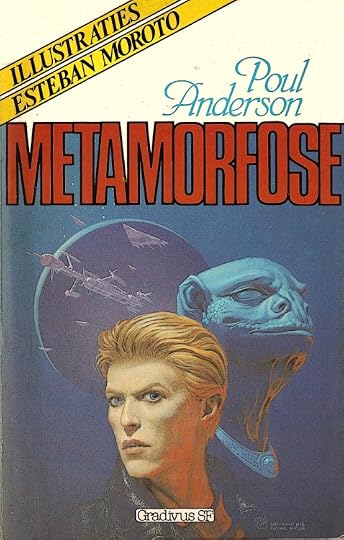
You could be my hero, if you can find me this Dutch edition, artwork by Michael Whelan.

February 16, 2020
Better than most SF in some ways, not quite up to standards in others. Anderson has done another solid job of world-building and created an alien species that is suited to its extreme and very un-Earth-like environment physiologically and culturally. The prose is striking, the characterization strong, and the book does an exceptional job of exploring political and philosophical questions about loyalty to government, even when it's dictatorial and semi-incompetent, as a lesser evil than anarchy and civil war.
On the other hand, there are some truly massive info-dumps that are slotted into the story pretty clumsily, and the plot is nothing memorable. The female protagonist is a strong character, but author and Flandry are still more sexist than they think they are.
If you're a fan of Anderson, especially his Flandry books, and/or of hard SF world-building and alien species creation, you'll probably like this. It's not going to make any top ten lists, but it's a quick and fairly solid read.
On the other hand, there are some truly massive info-dumps that are slotted into the story pretty clumsily, and the plot is nothing memorable. The female protagonist is a strong character, but author and Flandry are still more sexist than they think they are.
If you're a fan of Anderson, especially his Flandry books, and/or of hard SF world-building and alien species creation, you'll probably like this. It's not going to make any top ten lists, but it's a quick and fairly solid read.

May 11, 2012
Flandry - should re-read these

June 3, 2024
Yewwl and her people were excellent (sapient sabertooth tigers with flying-squirrel glider wings? YES PLEASE), and Miriam “Banner” Abrams was a great secondary protagonist—for a SF novel of this era written by a man. Flandry’s junior in age and inexperienced with imperial and military intrigue, but a confident expert in her field, and she got a few exciting action moments of her own! Anderson made some effort to have her and Flandry become friends and equals more than lovers. Ok, my bar is low, here, but it’s hard to get any tolerably interesting women in a Poul Anderson novel. I keep coming back because the style is good, the SF elements strike the perfect balance of exactly enough astronomical detail to produce a vivid and clear picture but never sacrificing interest for a display of the author’s technical knowledge, and I do love a decadent space-Roman empire.

October 31, 2018
Een oppervlakkig verhaal dat wel veel interessante elementen in zich heeft, maar die er niet uikomen. De tekeningen zijn alomtegenwoordig en nemen minstens een derde van het boek in beslag. Jammer genoeg spreken ze me niet aan, van de meeste kan ik zelfs niet uitmaken wat er mee bedoeld wordt.
Dit blijkt een onderdeel te zijn van een grote reeks, misschien is mijn oordeel zo negatief omdat ik de andere delen niet gelezen heb, maar ik betwijfel dat dat de reden is.
Buitenaardse wezens, andere planeten, ruimtereizen, een ruimtegevecht, een verkenningstoch, ... aan de voorradige elementen ontbreekt het niet, het komt gewoon niet over. Ik kan het nog het best beschrijven als een kort jeugdverhaal dat veel te lang uitgesponnen is en vol met woorden voor volwassenen.
Dit blijkt een onderdeel te zijn van een grote reeks, misschien is mijn oordeel zo negatief omdat ik de andere delen niet gelezen heb, maar ik betwijfel dat dat de reden is.
Buitenaardse wezens, andere planeten, ruimtereizen, een ruimtegevecht, een verkenningstoch, ... aan de voorradige elementen ontbreekt het niet, het komt gewoon niet over. Ik kan het nog het best beschrijven als een kort jeugdverhaal dat veel te lang uitgesponnen is en vol met woorden voor volwassenen.

November 21, 2018
Saved from disaster by Anderson’s wonderful prose, the inclusion of Chives, and dashes of grand cosmos worship. Banner is an interesting new character but has little to do, and Flandry remains indistinct multiple books in. The new alien species is mildly interesting, but also kind of silly. One longs for the taut and fun espionage thriller of the original installment. 2.5/5
August 11, 2019
This final novel that centers on Dominic Flandry is better written than many of the earlier books, but the plot seems very formulaic by this time. A duke is plotting against the emperor, a race of aliens is at risk and Flandry becomes involved with another woman. Pleasant enough, but it breaks no new ground.

September 25, 2017
Pretty good. I will say the massive infodump that occurred in chapter six, sharing the well-thought out detail of how this planet and the biology of same works, brought everything to a screeching halt. Just the sort of thing that today would be consigned to an appendix.
November 15, 2018
Seems to be a swan song for Mr. Flandry, though I know there are further stories in the Technic History. I'm expecting it's going to be rather melancholy from here on out.

October 5, 2025
3.5/5

July 17, 2014
It is an easy read, and gives one some things to ponder about concerning empire and government. Perhaps superficially the book explores the tension between loyalty to a decaying empire and to people (alien or otherwise). I did think the romance that ensued was perhaps out of place, and the book would have been fine without it. Overall it was a good diversion with some food for thought.

April 14, 2008
Science Fiction

July 17, 2008
This is one of the last of the Dominic Flandry books and I didn't like it quite as well as some of the earlier ones. It was still quite enjoyable though.

January 30, 2011
Grade A. Book A6.

January 29, 2015
Flandry meets the woman he will marry. Chives is still alive but old. Flandry prevents a coup. A species will be rescued from an ice age.

May 22, 2015
Flandry novel
Displaying 1 - 16 of 16 reviews