A tender story about the power of love in the face of loss Nine-year-old Claudine doesn't want to leave her much-loved home in France to go live in America, not without her parents. But she knows about the shortages, about the yellow stars Jews must wear, and about Adolf Hitler. And she knows that there are some things she needs to do even when she doesn't want to. It's wartime, and there is much that is different now. There are more things that Claudine will lose to this terrible war. But not everything that is lost must be lost forever. Here is a moving story about lost and found lives, and the healing power of love.
I live in Park Slope, Brooklyn and many of my novels take place here. But my new novel takes place in New Hampshire, and I have woven into it a historical component: the tragic story of Ruth Blay, who in 1768 was the last woman hanged in the state. When I read about Ruth, I was fascinated and horrified in equal measure, and I knew I had to write about her. I was educated at Vassar College and Columbia University, where I studied art history. But I started writing fiction in my 20's and never looked back. I am the author of seven novels, 27 books for children and am the editor of two essay collections. I'm also the fiction editor of Lilith Magazine . Please visit my website, http://www.yonazeldismcdonough.com or find me on Facebook https://www.facebook.com/yzmcdonough; I love to connect with readers everywhere.
Oh, wow!!! This story made me cry so hard!! It's technically written for children, but the story and writing are so good that I claim it. I loved the child's perspective on immigrating to America during the early days of World War II, her fear of wearing a yellow star, and her heartbreak over having her family torn apart. There were also some sweet instances of every day life, and the doll theme was pretty cute. It is such a beautiful mix of sorrow and hope!
Best quote: Claudine thinks of the coals. They didn't look dangerous at all; in fact, they looked quite ordinary, even a bit dull. But then there were other things that seemed dull or ordinary and turned out to be dangerous. Words in the newspaper. Or a scrap of yellow cloth, cut into the shape of a star.
Altogether, I thought this was a masterful, sweet story perfect for readers of all ages.
Well, I have not cried that hard over a children’s book in quite some time. Incredibly touching historical fiction story of war, wronging, grief, childhood, and the hope that is still available afterwards. I love a good “doll”book, but somehow this one gets filed as one of those, and also as one that helps remind me that healing and hope are possible even after unimaginable loss.
I was going to give this book to a young person, but after I read it, I knew no young person would be interested in it. It is a nice story of a young girl who was separated from her beloved doll while being sent to safety away from Europe during World War II. But it does not "grab" the reader.
The story is about a girl named Claudine that lives in France with her parents during WWII. She enjoys all things little girls do and even though times are rough, she gets a doll for her birthday and names it Violette. It's not until the Nazis being to show up that life changes. Claudine is forced to wear a yellow star on her coat which immediately changes her outlook on life and friendships. She is shunned for being a Jewish. Her parents encourage her to try to accept how things are and keep busy making clothes for Violette. Angered, Claudine puts a yellow start on the inside of the doll's cape to let the doll decide whether or not she wants to let the star show. As it becomes more and more dangerous to remain in France, Claudine's parents decide to send her to America to live with her aunt and uncle. On the journey, Claudine leaves her doll behind and doesn't hear from her family for years. She assumes they are dead until her father surprises her. Claudine and her father move around trying to get something of their life back in order. In the end, Claudine find Violette, resumes a somewhat normal routine, and her and her father live happily once again.
This book reminded me of those biographies that come with the American Girl dolls. I found myself feeling sorry for the girl, angry at the situation with WWII, and proud that Claudine never gave up. Although she missed time spent with her family, she was never angry or resentful towards her father as we read so much about in modern books.
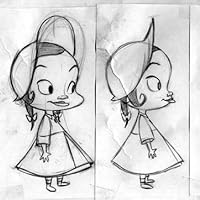
I think the story would be appropriate for intermediate grade students. It's written in a way that girls can relate to and offers an emotional side to WWII away from the usual lesson topic. There were a few pictures scattered throughout the book that looked more of a painting-style. It gave the book an older feeling. The story was a quick and easy read which is perfect for a supplemental literature project, assignment, or discussion.
i read the book in one sitting which I think makes the story more powerful. The part about the doll was a bit unrealistic but it made the story a little more "happy" in a very unhappy world in WWII France.
Gr 3-5-Eight-year-old Claudine is a Jewish girl living in occupied France during World War II. Her loving parents try to keep her life as normal as possible, and even manage to buy her a lovely new doll for her birthday. But after the Germans decree that Jews must wear a yellow star, things begin to change for the worse, and soon Claudine's parents decide to send her to America to live with her aunt and uncle. She convinces them to let her take Violette, on whose clothes she has also sewn a tiny yellow star. But at the end of the voyage, her toy gets lost, and Claudine wonders if she will ever see it or her parents again. A well-meaning yet additional purchase.-Teri Markson, Stephen S. Wise Temple Elementary School, Los Angeles
The book The Doll with the Yellow Star really shows you what the younger children in that time had had to go through during WWII. It also gives a good preview about WWII and what was going on if you don’t know much about it. Through the main character, Claudine, you get to see how hard it was on these children to be separated from their parents and have to start new lives. With the help of a new fluffy friend named Violette, Claudine is able to get through most of the war until she finds out she has lost, possibly forever. She is then reunited with her father, but Hitler took her mother. Claudine and her father one day find a happy and unbelievable surprise when at a market that then changes Claudine's life forever. I would recommend this book to younger youth who don’t know much about WWII or to teenagers who aren’t big on reading books.
I just finished reading a children's book about the holocaust entitled The Doll with the Yellow Star. The setting begins in Paris as Hitler's influence is spreading. It is from a different point of view than I've read before. The main character, a young girl does escape to her aunt's and uncle's house in New York. In the process, however, she looses her doll which was the last present her parents gave her. The significance of that is increased because, Claudine, the young girl, had sewn a yellow star on the inside lapel of the dolls coat so the doll could show it when she wanted. Also sewn on the inside is a picture of her mom and dad. This would be an appropriate introduction for children to the personal losses of war.
WWII Paris, France and Long Island US. On her eigth birthday, Claudine is given a beautiful doll Violette. As life becomes more difficult for her family under the Nazi occupation, her parents decide to send Claudine to live with her aunt and uncle in America. Claudine hates to leave her family and home. She isn't able to bring a lot with her, but insists on bringing her doll Violette. On the ship journey, Claudine is separated from her doll, she hopes to be one day reunited with her doll and with her parents. As the waiting turns into years, Claudine longs for the day when her family will be reunited.
see also "When the Soldiers Were Gone" by Vera Propp