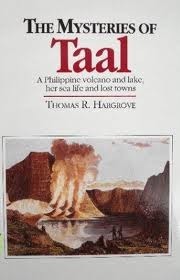
Volcanologists consider Taal one of the world's 10 deadliest volcanoes...indeed, she may be the deadliest. Reading Hardgrove's historic accounts of Taal's violent eruptions, and personal dives to find her sunken ruins, is to re-live the mysterious and lethal history of Taal.
Thomas R. Hargrove was raised on a cotton farm in West Texas, but has spent most of his adult life in South-east Asia. He received his B.S. degree from Texas A&M University, and M.S. and Ph.D. degrees from lowa State University.
In 1988, he received the ACE Professional Award, the Highest honor given to a single communicator by Agricultural Communicators in Education, a 650-member professional society based in the USA. Hargrove was the first awardee honored for work done outside North America. He also received the 1988 ACE Award of Excellence in International Affairs.
Right this very day, 20 January 2022, this volcano is again billowing thick smoke.
It is said to be the most active volcano in the entire world.
In its massive main crater has formed a lake. I learned from this book that as late as the 1930’s sharks still roamed that lake and disappeared only when, after another major eruption, its outlet to the sea was closed by rocks and lava. If you have the means and the time and interest, you could scuba dive and dig there and chances are you’ll find pre-hispanic artefacts and remnants of settlements and villages of old which had been buried by this volcano’s destructive behaviour.
There are photos here but since this volume is printed on cheap paper, they looked less interesting as they appeared blurred.
I am sure that with much deeper research and generous funding a better book about this eternally-erupting force of nature could be written. In rich, glossy paper. But not by this author anymore who died in 2011.
The Taal Volcano is special to me, since both of my parents were born and raised in Cuenca, just a few kilometers from Taal. My fondest childhood memories were spent in the markets and the mountains of my parents’ hometown, and until now we continue with these traditions.
Knowing the history of Taal and the mystery that continues to shroud the place is thrilling, but also frightening. Taal residents have yet to recover from the volcano’s recent explosion, and no one knows when the volcano will erupt again.
But personal biases aside, this book is extraordinary even just for the amount of research and history that was poured into it. It’s always the little details that astonishes us, and this book has plenty.
Taal has always been some field trip memory or the stuff of science textbooks. Until last year when suddenly the facts became reality and literally erupted out of nowhere. I had the chance to talk with a limnologist (freshwater scientist) about the Taal eruption, specifically its impact on Taal Lake, home to diverse marine life—which is baffling because they should be swimming in saltwater.
In Thomas Hargrove’s delightfully entertaining archive/memoir of sorts, we uncover the mysteries of Taal: sunken towns to disappearing towns, saltwaters turning into freshwaters, and tales of old about the volcano island’s fabled history passed down from generation to generation.
A must-read account of our country's rich geography and human history.
A compact history of the major eruptions and ruins along and near the Taal Volcano. I was expecting more depth and details but I was still blown away by the richness of the volcano's history as well as the history of the towns surrounding it.
The Mysteries of Taal gives detailed historical background information about Taal Lake and Volcano. The area surrounding the lake is very populated. In the past centuries, the lake area has been the location of many natural disasters. The combination of people and disasters has created a dynamic environment but since not a lot of historical data is available, the reasons for this dynamism are easily neglected. The Hargrove narrative offers a lot of information and sheds light on some of the resulting developments in the Taal lake area. Considering that the lake used to be the base of a massive volcano, the Taal name will always be shrouded in mystery. Only a 1 hour drive from Manila, lots of people stay on the Tagaytay ridge while the lake and the volcano offer much more. As I lived in the Taal area for more than 10 years, I obtained a lot of insight from this book. The Taal novel is highly recommended to anyone living or visiting the area.
This book tells of a thoroughly engaging adventure that exceeds the exploits of many fictional characters! It is a combination of archeological and biological research and extreme diving (in some cases) in a very mysterious part of the world. Anyone with an interest in the “nuts and bolts” of historical research (often spanning decades, and even careers) or a fascination with diving exploration will be rewarded with an excellent first-person chronicle of a Texan ex-pat in the Philippines.
The extensive inclusion of pictures and maps along with an appendix almost as long as the short book itself provide a connection of the place to the reader as text alone cannot achieve. It is unfortunate that the author died in 2011, as the most recent eruption of the Taal Volcano has once again changed the topography and subsurface features of the lake. It is still rumbling, so I have not yet been back to see it up close and personal since my trip there in 2014.
This book is a good starter for reading the local history of Batangas. Hargrove weaves the local history of Batangas with his personal experiences in the lake, recent marine biology scholarship, and archeology. His bibliography is useful for future researchers who may be interested to study the history of Batangas or of the Taal Lake.
The extensive research, including lake dives, done by the author Thomas R. Hargrove for this book is admirable. It’s a shame he didn’t live to see the eruption of Taal Volcano in January 2020, as he died in 2011.
Nice curiosum. Self published, far from scientific and too much focus on personal author's obsession with theories on sunken villages etc. Poor picture material.
This entire review has been hidden because of spoilers.
The first time I read this book I was immensely entertained with how a foreigner, Thomas R. Hargrove was able to describe every scenario vividly as if he is a native of the Philippines. Regardless, with the help of a fresh insight from his perspective, I came to understand what Taal was like both before, after and long after she has erupted. I grew fond of how he talked about the idyllic, laid back lifestyle of those nearby towns, cities and how they fell and rose, the submerged and remaining lands that surrounded the indeed mysterious Taal volcano. This is a highly recommended book worthy of one's time, money and effort.

Needs more editing but great coverage on an obscure topic on a mysterious and historically rich complex volcano. Taal is also a great place to hike too.