Jump to ratings and reviews
Rate this book

The Barefoot Serpent

Rate this book
The life of Japanese filmmaker Akira Kurosawa combined with a story of a friendship between a small girl and boy in Hawaii. The story of a small girl and her one-day friendship with a strange boy while on vacation with her family in Hawaii. Their lives are forever changed as they explore the island and themselves.Bookended by full-color biographical excerpts from the life of Japanese filmmaker Akira Kurosawa, the central story's themes reflect those of the filmmaker and is told through black and white half-toned, fully-painted artwork. The Barefoot Serpent is offered as a 128-page hardcover graphic novel, in the same size and format as the Little Golden Books of old.This is definitely Scott's most unique and ambitious graphic novel to date.

128 pages, Paperback

First published September 23, 2003

Loading...
Loading...

About the author

Scott Morse

125 books30 followers
Scott Morse (sometimes known as C. Scott Morse or C. S. Morse) is an American animator, filmmaker, and comic book artist/writer.

Much of Morse's published work consists of stand-alone graphic novels, although he is perhaps best known for his epic series Soulwind, a story serialised in a sequence of graphic novels, which was nominated for both the Eisner and Ignatz awards.

Ratings & Reviews

What do you think?
Rate this book

Friends & Following

Create a free account to discover what your friends think of this book!

Community Reviews

5 stars
30 (17%)
4 stars
62 (36%)
3 stars
54 (31%)
2 stars
21 (12%)
1 star
5 (2%)
Displaying 1 - 30 of 33 reviews
Profile Image for Jan Philipzig.
Author 1 book315 followers
June 7, 2016
This book contains two stories that at first glance do not appear to have much in common. For starters, their narrative tones and illustration styles differ fundamentally; their pages are even made from different kinds of paper stock. As it turns out, though, they share the theme of losing a loved one. A two-part biography of film director Akira Kurosawa, who struggled to overcome his brother's suicide, forms the frame, while the embedded story features a young girl trying to deal with the loss of her brother. So far so good. The only problem is that Scott Morse does not really have all that much to say about coming to terms with the loss of a loved one. The beautifully painted and colored Kurosawa biography is all too brief and superficial, and the fictional story about the young girl is not nearly as engaging as it should be.
Profile Image for Dov Zeller.
Author 2 books123 followers
November 14, 2015
Hmmmm. This book defies genre and age categories. It's short, strange, both a biography and something of an allegorical tale. A lot happening in such a slim volume and a bit risky in it's juxtapositions. I was between a 3 and a 4 but I appreciated the contrast in color schemes, and difference in pacing between the biographical parts and the center story. And I enjoyed the filmic qualities of both. I am not sure how I feel about the repetition of "finished (and done) with the world, all right" and the directness and obliqueness with which death and suicide are addressed. Why so graphic in framing narrative and such delicacy in the other? And, just for the sake of a little mirroring, I will end with another Hmmmmm.
Profile Image for Jolanta (knygupė).
1,343 reviews234 followers
July 15, 2018
Sia grafine novele uztikau young adult skyriuje, kurio siaip jau vengiu. Susidomejau ja, nes uzmaciau savo megiamo japonu rezisieriausl Akiros Kurasavos varda. Pasakojimas susdideda is dvieju daliu. Pradzioje ir gale - Akiros Kurasavos biografija susijusi su brolio savizudybe. Tarp ju - mazos mergaits, netekusios brolio, su tevais atvykusios atostogu I Havajus ,istorija.
Nezinau, kazkaip man nesiriso visas tas pasakojimnas...Piesiniai taip pat nesuzavejo.

Manau reiketu perziureti Kurasavos filmus. Maciau ne visus, o ir matytus esu primirsusi. Nes ta istoroja su maza mergaite turi tureti rysi...
Profile Image for Seth T..
Author 2 books976 followers
November 5, 2015
"I know now what he must have been feeling. He was a brother whom I loved very much and I have never gotten over feeling his loss."—Akira Kurosawa, regarding his elder brother Heigo.
The Barefoot Serpent by Scott Morse

I have never personally experienced a close and permanent personal loss. My whole apprehension of such experiences derives from film and literature.1 Certainly I have lost relatives to the grave—though none of tremendous personal meaning. I have been devastated by the ends of romantic affairs, but even the close of these relationships were tempered by the knowledge that so long as we both still lived, breaches could be shored up and repairs might allow friendship to remain. I was, at one point, led to believe that a close friend from elementary, junior high, and high schools had perished, but it had been more than a decade since our friendship had waned—and then he revealed that he wasn't dead at all, which (obviously) took any remaining sting from the news.

The Barefoot Serpent by Scott Morse

Still, I'm getting older and the odds say that if it isn't me first, I will with certainty lose those close to me to the permanence of the soil. But as the future is not yet, I still have no real knowledge of this kind of loss—and for that reason, I'm grateful to books that offer a peek behind such a terrible curtain. Not books like Harry Potter or Game of Thrones where the whole object of a character's end is to sell the plot forward, paying toll at the gates of reader interest—those offer no insight, only titillation. Stories like Jimmy Corrigan or the rending Three Shadows or even possibly Twin Spica are among those that truly let you walk for a time in another's shoes. They are stories that prompt you to experience (for even a moment2) something deeply foreign, if you are fortunate enough that this kind of story should still be entirely foreign. And Scott Morse's Barefoot Serpent joins the muster of stories that aim to treat this trouble for what it is.

The Barefoot Serpent by Scott Morse

Morse follows a very rough chiasmic structure here, bookending his central story with another and setting his climax in the book's center. The Barefoot Serpent begins and ends with a kind of children's picture-book adaptation of Akira Kurosawa's biography. Between these two bookends about a well-regarded Japanese filmmaker of the twentieth century, Morse explores the aftermath of a boy's death and the toll it takes on his family, particularly upon his little sister. One might be tempted to read this as a story about Kurosawa, informed by an episode concerning a little girl, which makes Kurosawa's experience from nearly eighty years ago3 a little more tangible to the contemporary reader. And that may be the case. I, however, am more persuaded that it is Kurosawa's story that provides the frame for what comes between. This is, after all, a common purpose for the chiasmus—to lead up to a climax that occurs in the narrative center and then back away from it in a manner that will draw attention to the climax and inform our reading of it. I'll deal with this more explicitly in an end note, but for now, let it suffice that I believe Morse intends us to read this as a human story that merely looks to Kurosawa for thematic purpose.

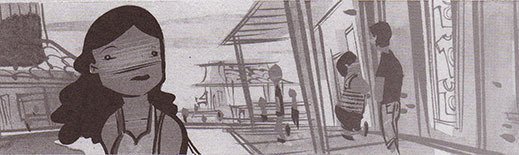
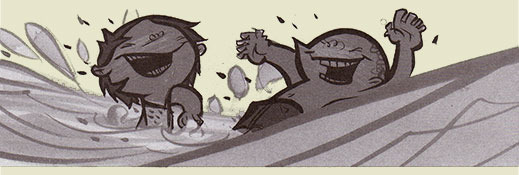
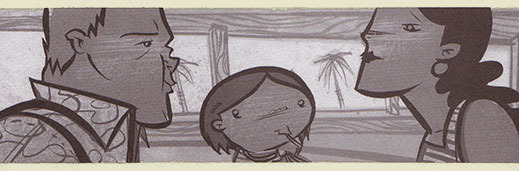
Morse's books are always a pleasure to revel in for their artistry. He includes dialogue here, but keeps it off-panel and out of the way, allowing his images to breathe. His characters are cartoony in that way that permits them to be invested with great personality. His illustration technique gives him the opportunity to craft even supporting characters who possess the illusion of well-rounded characterization despite perhaps only being given a single line of dialogue.

The Barefoot Serpent by Scott Morse

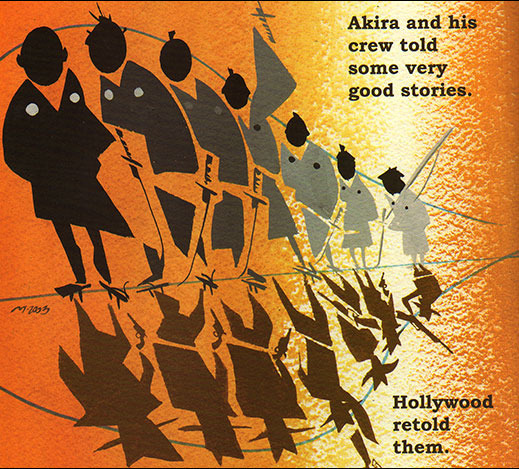
The use of colour, as well, is a powerful device. The two Kurosawa bookends are printed in oversaturated hues and tones on glossy paper and feature sometimes bombastic, fragmented imagery—often more iconic than narrative. The central story, however, is printed on a cheaper matte paper and isn't even really black-and-white. Instead, the girl's episode in bountiful, colourful Hawaii is rendered in a smudge of greys. Even the lightest and darkest portions of her pages are at strongest an off-white grey and an off-black grey. When the girl first pulls a prescription bottle from her bag, it's easy to imagine that pharmaceuticals may be the cause of her story's dreamlike haze. I'll leave the reader to find her own interpretation of Morse's purpose in this kind of colour schematic and simply report that I think it works wonderfully.

As a story, I likewise think The Barefoot Serpent acquits itself admirably. At a terse 128 pages it goes by rather quickly, but if the reader cares to linger I believe he'll be rewarded by its sweetness and calamity. I have never experienced permanent personal loss of deep significance and I don't expect reading a book like this will prepare me. But I do feel I'm better off for having read it. It's an engaging, playful, thoughtful, and hopeful work—one of which I believe Kurosawa would approve.

The Barefoot Serpent by Scott Morse
_____________________

An End Note
If I have on thing against The Barefoot Serpent, it's that Morse ends the book with an afterward in which he explicitly spells out a fair number of his influences and intentionalities. This book is, of course, steeped in thematic resemblances to the works and ideology of Kurosawa, which is one of the things I appreciated—having gone through a minor infatuation with the man's films in the late-'90s.

The thing is: I wanted some time to sit and consider, to contemplate Morse's work and intentions. I wanted to be able to pick up on his references myself rather than have them pointed out to me. My wife, on the other hand, has never seen a Kurosawa film4 and found the immediate excursion into Morse's tribute to the director fascinating and helpful and not the least part intrusive.
_____________________

Another End Note
This one kind of does what I just chastised Morse for (i.e. it talks perhaps too explicitly about What's Going On). So skip it maybe if you haven't yet read The Barefoot Serpent unless you don't care. In which case: sally forth.
If we were to outline The Barefoot Serpent, it might look like this:
A. Kurosawa's young life
  • Youth
  • Low point
  • High point

      B. Family introduced

          C. Family crises
            • Intro of ghosts
            • Girl's crisis journey
            • Mother's crisis journey
            • Father's crisis journey

                  D. Climax at pool

          C′. Family catharsis
            • Girl's resolution
            • Mother's resolution
            • Father's resolution
            • Outro of ghosts

      B′. Family resolves

A′. Kurosawa's later life
  • High point
  • Low point
  • Youth
As I mentioned earlier, while the chiasmic structure is present, it's not rigid. I don't believe I'm reading the structure into the book, but interpretation is obviously subjective. In any case, applying a common form of interpretation here, point D would be the story climax (which seems to be the case) and everything that emerges afterward is a reflection of what came before. As introduction to the chiasmus, the Kurosawa biography gives us a framework with which to ascertain hope and rejuvenation for Morse's characters—themes intimate to both Kurosawa's works and his own life.
_____________________

Footnotes
1) I find song too unwieldy and inaccessible to be a trustworthy source. The poetry of verse backed by the beauty and power of music is so hyperbolic that it seems designed wholly for those already in like circumstances. And so I prefer books and film, which are easier to parse down to the tangible, the believable.

2) Of course, a good argument could be made that to experience such things for merely a moment is not to experience them at all. I would want to agree but I think I'd be happier to say that the momentary experience can give taste to something of the reality without bringing about perfect empathy, which is impossible.

3) As The Barefoot Serpent was originally published in 2003, it was released seventy years after Kurosawa's brother Heigo committed suicide

4) Demonstrating that I have been an awful husband to her.
_____________________

[Review courtesy of Good Ok Bad]
Profile Image for Dave Schaafsma.
Author 6 books32.2k followers
November 13, 2015
A two story book about grief, one about a small girl, the other about Akira Kurosawa, the filmmaker. I guess you might say it is ambitious, as it creates two very different looking styles, appropriate to the characters in their respective stories. But I couldn't quite get into it. I love Kurosawa, as Morse does, and I get the point of this, and I do know grief. . . but I just couldn't get into it.
Profile Image for RSC_Collecting.
448 reviews2 followers
January 6, 2026
Wow! This was excellent. My first Scott Morse book and definitely not my last. The book starts with a partial biography of filmmaker Akira Kurosawa. Then leads into a story that attempts to capture parallels in his life and films. This is the story of a little girl visiting Hawaii. She sees the Night Marchers(a Hawaiian Legend). We later find out through hints and context clues that her brother may have killed himself due to depression. Similar to what happened to Kurosawa. The story then follows the little girl and her new friend, a Hawaiian local boy. They have a little adventure before she returns back to her family. There's a somber nature of the story that increases and then releases towards the end. As each member of her family is able to cope with their loss. Really a fantastic book. The art style is gorgeous too. I'm not even sure how best to describe it. It's so unlike anything else. Highly highly recommend.
January 31, 2019
It was a good book. Throughout they didn't talk in the best grammar by saying dis instead of this. What held it back was that there weren't a lot of words with the pictures in the book. The main little girl was walking around and ran into a little boy from the other side of the island.The little boy was making a mask when the little girl ran into him n the middle of the forest. After they meet in the forest they went back to the side he came from he showed her around and meeting all the people he knew.
Profile Image for Amber Wessies Owrey.
361 reviews3 followers
January 12, 2024
I think knowing more about Akira Kurosawa would help make this graphic novel more powerful. I liked the story in the middle about the little girl and her family, but the biography of Akira portion was very short. Suicide is mentioned twice but only briefly. I thought the writing was very simple, but the pictures told the bulk of the story.
Profile Image for Michael.
3,414 reviews
October 28, 2019
An interesting, if slight, look at grief and mourning, and carry on hopefully after a tragic loss. Morse mixes a very thin biography of Akira Kurosawa with a slightly-less-thin fiction about a young family - each haunted by a death in their family. It's well drawn and designed.
Profile Image for Aryanna Tunstall.
1,313 reviews
November 16, 2022
I loved the short story within this short story about a young girl finding a new friend while dealing with her grief. But I wish there was a bit more information about Akira and all he accomplished in life.
Profile Image for Dani Shuping.
572 reviews42 followers
May 1, 2011
Cross posted from ComicsForge

Now you know you have a different type of book on your hands when one of the blurbs on the back cover is by Don Cheadle. That's right, the actor. Plus Scott Mosier, producer of films like Clerks, Chasing Amy, etc. How often do you see that happen for a graphic novel?? And there's a good reason for having Hollywood show up to review a book. This novel is a mix of a biography about the filmmaker Akira Kuroswa and the story of a family moving on after a tragedy. You wouldn't think a combination like this would work, but it does.

The first few pages of the book cover the early part of Akira's life up to where he made his first film. It very quickly covers who Akira is, how he got into movies, and a bit about his relationship with his family. We then get into the main story of a young girl and her family who at the beach. When she goes to investigate a noise she finds drummers...ghost drummers floating in the sky. Which leads her to a young boy carving a mask and the two become friends...or at least companions on a journey with some strange encounters. The dad and mom also have encounters that remind them of a son who is no longer with them. I won't say the island heals them, but something changes on their journey. The last part of the book covers the rest of Akira's life. His fall from the top of his game, to working his way back up, and at the end realizing that what the critics say doesn't really matter.

I really don't have any other work to compare this to, it's just unique in its layout and its execution. The combining of a seemingly unrelated biography with a short story at first makes no sense what so ever. But reading it and thinking about it, it begins too. Even without knowing much about Kuroswa. There are some similarities and parallels being drawn by the two stories, of loss and grief and hope. He even uses some elements from Kuroswa's films, such as the floating drumming ghosts. The writing is simple and flows easily, but it never lets go of your attention. What Scott Morse has done with this work is beautiful...even for such a simple story it makes you think. The fact that the family never has names makes it easier to put yourself in the story, to see your life or that of your friends before you.

I just have to say I freaking love, love the front cover of this book. It's absolutely perfect. I just wish the entire book was like that. And that's not to say it isn't good, because it is, I just imagine how much more impressive it is/would be in color. And I have trouble imagining that Scott didn't do the entire book in color when he was designing it and then just translated it to grayscale for final publication, because the pictures just look like the have color to them. But...at the same time I think he was going for a parallel between Kuroswa's movies so black and white kinda makes sense. The panels are even laid out on the page like film. Scott's work has a simple elegance to it that makes the drawings both poignant and powerful.

I highly, highly recommend this book to anyone and give it 5 out of 5 stars. You have to read it a couple of times, but it will grow on you.
Profile Image for Matt Hartzell.
395 reviews12 followers
October 20, 2014
I really enjoyed The Barefoot Serpent. The book deals with very difficult issues but remains hopeful at the end. I loved that aspect of the book. I don't know much about Kurosawa, but his biography book-ending the main story was a nice touch. I also appreciated that Morse took a page to reflect on some of the story and to point out some of his homages to Kurosawa's films. Those references were lost on me, and it's great that Morse was not so pretentious as to not offer some insight to the reader.

I also enjoyed Morse's art style. I think it was a perfect style for a story that centers on a very young girl and the grief she is experiencing, along with her parents. Morse is a capable storyteller, and does a great job of capturing how children can look to the needs of others even amidst their own turmoil. After the main story has wrapped up, there is still a final panel that is confusing to me. I'm looking forward to reading through it again.

Another great book from Top Shelf.
Profile Image for Hope.
814 reviews46 followers
September 27, 2008
This is a lovely example of a story told more in images than words. It's both a biography of Akira Kurosawa, and an alegorical story about healing. I just wish I were more familiar with Kurosawa's work - I think I missed a lot, not being familiar with the context. Its very much well worth a read.

The story-telling has a fairy-tale quality to it. It's much more about feelings and ideas. I'm not sure I'd choose it as a children's book - the ideas are mature, although not 'adult' - but it helps to bring a childlike mind to it.
Profile Image for Morgan.
662 reviews27 followers
October 10, 2012
A bittersweet story of a family coming to terms with loss, strangely bookended by a very minimal biography of Akira Kurosawa. I understand how Scott Morse sees the connections but really the Kurosawa part, while visually gorgeous, doesn't add much to the story for me. I'm sure that the family story was intended to reveal something about the Kurosawa, and I'm sure that he'd say I'm missing the point, but honestly the side story is far more noteworthy to me and easily stands on its own. That said, the bulk of the book is quite lovely. As usual, I adore his art throughout.
Profile Image for Susan Rose.
317 reviews41 followers
August 26, 2016
This is a graphic novel with duel narratives. The first is a biography of the filmmaker Akira Kurosawa the second is the story of a family trying to to recover from loss.

I didn't really see why these two stories were put together, and I didn't feel enough time was devoted to either one. Essentially I felt like the biographical section was supposed to be more informative than it was and I felt like the other story was supposed to be more emotionally resonant than it was.

This one just wasn't for me.
Profile Image for Emilia P.
1,726 reviews69 followers
January 13, 2010
I've never seen any Kurosawa, so I didn't get the references to that, but on the heels of a trip to Hawaii, this sparsely worded tale of a young girl's adventure away from the tourist beaches into more magical, friendlier back roads of the island was quite sweet. The layout was a little weird - two long panels per page, and I don't really remember the story, but it left me feeling good and was unique. And that is four star worthy.
Profile Image for Julie.
237 reviews6 followers
April 11, 2013
I don't really have words for this. I'll try. The pages about Akira Kurosawa are beautiful with thoughtful details. and sorrow. and beauty. and pain. And then there is a separate story about a little Hawaiian girl illustrated in black and white inserted in between those stunning Akira Kurosawa pages. Do these belong together? I don't know. But after reading this, I'll most likely ready everything Scott Morse writes/illustrates.
38 reviews1 follower
August 9, 2008
I loved this book. Having a deep-seated love for both Hawaii and Kurosawa films, this book was right up my alley. Scott Morse's art has so much charm while still carrying the weight of the melancholy subject matter. I love his confident line work through out the book. It looks effortless and playful.
Profile Image for Bryan.
157 reviews
September 27, 2008
A story of loss and haunting bookended by a biographical sketch of Akira Kurosawa. Scott Morse's graphic novels have admirable ambition and scope but leave me uninvolved. There is a dreamy distance from his characters that prevents me from connecting directly. He has style and some nice character design. But his layouts are confusing at times and his storytelling is not compelling.
Profile Image for Jason.
3,958 reviews25 followers
October 5, 2010
Weird juxtaposition of subjects, but I could see it better after Morse explained it in the afterword. The story in the middle is very sweet- spare text, proclamatory but not heavy-handed, subtle hints at substory that fleshed out the characters and their backgrounds without distracting from the flow of events...
Profile Image for R.
385 reviews6 followers
December 11, 2013
Very interesting little graphic novel. I guess it's entirely symbolic, which is good, because you feel as though you're not quite getting it otherwise. Once I read all of the meanings behind everything, it made much more sense and was quite interesting. I loved the characters and Hawaiian culture in it.
Profile Image for Crabbygirl.
764 reviews2 followers
June 22, 2022
too bad this book is out of print...
touted as a classic in the realm of the graphic novel, i was curious to see it.
i connected more with the story set on hawaii, but i'm guessing someone who is familliar with the films of akira kurosawa, or even just a film studies student, would get alot out of it.
Profile Image for Cat.
425 reviews17 followers
May 20, 2008
I didn't really get this book. In the end the author explains how he was trying to create a type of biography about Kurosawa using the story of a girl at the beach who has lost her brother. I think if you have to explain it, you didn't do a very good job of teling it the first time around.
Profile Image for Emily.
1,070 reviews9 followers
May 17, 2013
I guess I can't read enough into the internal story to understand how it relates to Kurosawa. I believe I would have found this more interesting if the entire work would have focused on his life rather than breaking for the fictional story.
Profile Image for Loyd.
193 reviews8 followers
October 13, 2008
A very gentle book with wonderful illustrations by Scott Morse. It takes you by surprise that it's actually a book about the life of Akira Kurosawa.

Profile Image for Melissa Shelley.
44 reviews4 followers
October 18, 2009
I wish I knew more about the source material.. maybe it would have made more sense?? Maybe.
Profile Image for Ryan Haupt.
116 reviews15 followers
January 29, 2010
I haven't seen enough Kurosawa to really appreciate this book. Regardless, the art was pretty and the story was cute.
Displaying 1 - 30 of 33 reviews