Jump to ratings and reviews
Rate this book

Lives of Fair and Gallant Ladies

Rate this book
A collection of anecdotes about the amorous lives of the sixteenth-century French nobility, by an author writing frankly about the licentious world of the age he knew so well. Although the content is often of the most scandalous nature they give a wonderfully vivid picture of the author's times, are of high literary merit and of great historical interest. Pierre de Bourdeille, Seigneur de Brantome, was a French chronicler (about 1527-1614). Born at Perigord, he was for many years a traveler or soldier. He retired to his estate twenty years before his death, and used his leisure in writing his Memoirs. The author is vain and egotistical, but thoroughly naive and honest. The style is charmingly piquant, with frequent sallies of wit and flashes of eloquence. He is indeed a fascinating chronicler.

808 pages, Paperback

First published January 1, 1655

Loading...
Loading...

About the author

Pierre de Bourdeille

390 books6 followers
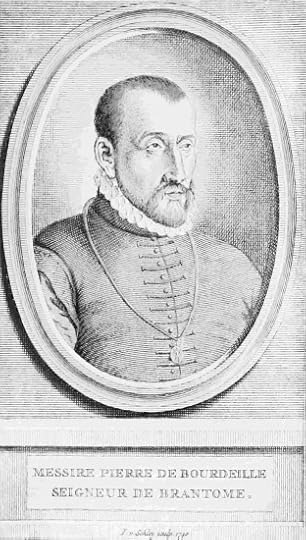
Pierre de Bourdeille, aka Pierre de Bourdeilles, or Pierre de Brantôme (sometimes spelled Branthome) was born in Perigord, Aquitaine, the third son of the baron de Bourdeille. His mother and maternal grandmother were both attached to the court of Marguerite of Navarre, on whose death in 1549 he went to Paris, and later (1555) to Poitiers, to finish his education.

He was given several benefices, the most important of which was the abbey of Brantôme, but had no inclination for an ecclesiastical career.

He became a soldier and came into contact with many of the great leaders of the continental wars. He travelled in Italy; in Scotland, where he accompanied Mary Stuart (then the widow of Francis II of France); in England, where he saw Elizabeth I (1561, 1579); in Morocco (1564); and in Spain and Portugal.

He fought on the galleys of the Order of Malta, and accompanied his great friend, the French commander Filippo di Piero Strozzi (grandson of Filippo Strozzi the Younger), in his expedition against Terceira, in which Strozzi was killed (1582).

During the French Wars of Religion under Charles IX of France, he fought for the Catholics (including at the Siege of La Rochelle (1572-1573)), but he allowed himself to be won over temporarily by the ideas of the Huguenot reformers, and though he publicly separated himself from Protestantism, it had a marked effect on his mind.

A fall from his horse compelled him to retire into private life about 1589, and he spent his last years in writing his Memoirs of the illustrious men and women whom he had known.

Brantôme left distinct orders that his manuscript should be printed; a first edition appeared late (1665-1666) and not very complete. Later editions include:

* one in 15 volumes (1740)
* another by Louis Jean Nicolas Monmerque (1780-1860) in 8 volumes (1821-1824), reproduced in Buchan's Pantheon littéraire
* that of the Bibliotheque elzevirienne, begun (1858) by Prosper Mérimée and L. Lacour, and finished, with vol. xiii., only in 1893
* and Ludovic Lalanne's edition for the Société de l'histoire de France (12 vols, 1864-1896).

Bust of Brantôme at the Medici fountain in Dordogne.

Brantôme can hardly be regarded as a historian proper, and his Memoirs cannot be accepted as a very trustworthy source of information. But he writes in a quaint conversational way, pouring forth his thoughts, observations or facts without order or system, and with the greatest frankness and naiveté.

His works certainly gave an admirable picture of the general court-life of the time, with its unblushing and undisguised profligacy. There is not an homme illustre or a dame galante in all his gallery of portraits who hasn't engaged in what Medieval Christian prescriptions as well as the Victorian society would regard as sexual immorality; and yet the whole is narrated with the most complete unconsciousness that there is anything objectionable in their conduct.

Besides the general promiscuity of the characters, some parts of the work depict in a more or less detailed fashion the practices of homosexualism (almost exclusively lesbianism), cunnilingus, and, marginally, sado-masochism (although the persons engaging in these activities usually aren't identified by name). It also contains a rather long and explicit description of the female intimate parts in general, focusing on their diversity.

Ratings & Reviews

What do you think?
Rate this book

Friends & Following

Create a free account to discover what your friends think of this book!

Community Reviews

5 stars
15 (25%)
4 stars
15 (25%)
3 stars
18 (30%)
2 stars
10 (16%)
1 star
1 (1%)
Displaying 1 - 6 of 6 reviews
Profile Image for Manny.
Author 52 books16.3k followers
Want to Read
April 29, 2019
From Simone de Beauvoir's La vieillesse, p. 367:
Biologiquement, la sexualité de la femme est moins atteinte par la vieillesse que celle de l'homme. C'est ce que remarque Brantôme dans le chapitre de la Vie des dames galantes qu'il consacre à « Aucunes dames vieilles qui aiment autant à faire l'amour comme les jeunes ». Tandis que l'homme à un certain âge n'est plus capable d'érection, la femme « en quelque âge qu'elle soit reçoit en soi comme une fournaise tout feu et toute matière ».
Profile Image for Gintautas Ivanickas.
Author 24 books302 followers
August 29, 2021
Pierre de Bourdeille gyveno XVI-XVII amžių sandūroje. Studijavo Puatjė universitete, savo laikmečiui buvo gana išsilavinęs. Pakariavo prieš turkus, išmaišė pusę Europos, po Pranciškaus II mirties lydėjo jo našlę, Mariją Stiuart į Škotiją, vėliau vėl kovėsi – Prancūzijos religiniuose karuose. Bet 1584 metais iškrėtė tą patį pokštą, kaip ir mūsų Vytautas – nuvirto nuo arklio. Tiesa, kiek sėkmingiau – išgyvent išgyveno, bet sveikata buvo nebe ta, tad de Bourdeille pasitraukė iš viešo gyvenimo, užsidarė savo pilyje ir leido laiką diktuodamas memuarus. Dalis tų memuarų ir yra – „Galantiškosios damos“.
Na, kaip memuarai. Pavadinčiau tai pletkais ir anekdotais. Ir dar gana nešvankiais – tas aišku, vos pavarčius iliustracijas. Bet norit pikantiškų istorijų ir juokelių apie viską, kas susiję su pasidulkinimu į kairę ir į dešinę, imkit geriau „Dekameroną“.
Du iš penkių. Ir tik už tai, kad leidžia geriau suprasti to laikmečio žmonių požiūrį į amoralius išdykavimus. Karalienės Viktorijos laikais džentelmenas tokio veikalo neskaitytų. Tai yra skaitytų, bet slapčia. Ir nesigirtų.
Profile Image for Asaria.
977 reviews71 followers
January 11, 2023
And who has said people of the past were so pure and scorned physical love? Human nature hasn't changed much :)

"Lives of Fair and Gallant Ladies" would be taken for a Renaissance version of a gossip column. Great storyteller the author is, he doesn't hesitate to indulge us with secrets and stories of his contemporaries. What a gossiper! On the other hand, thanks to him we get a nice insight into woman's sexual life during the Renaissance era. They were really naughty :)

I think the first chapter of his essay was the most fun and interesting. It's surprising to see him defending women's rights to sexual freedom and expression. Or mentioning lesbianism and bisexuality. Or reading about cunning ways women outwitted their husbands. One way or another, he was fair for his days.

Brilliant translation by Tadeusz Boy-Żeleński, as usual.
Profile Image for Bettie.
9,974 reviews8 followers
Want to Read
March 6, 2014
The author

http://www.gutenberg.org/ebooks/42515

Opening: DISCOURSE I.

ANNE DE BRETAGNE, QUEEN OF FRANCE.

INASMUCH as I must speak of ladies, I do not choose to speak of former dames, of whom the histories are full; that would be blotting paper in vain, for enough has been written about them, and even the great Boccaccio has made a fine book solely on that subject [De claris mulieribus].

I shall begin therefore with our queen, Anne de Bretagne, the most worthy and honourable queen that has ever been since Queen Blanche, mother of the King Saint-Louis, and very sage and virtuous.

This Queen Anne was the rich heiress of the duchy of Bretagne, which was held to be one of the finest of Christendom, and for that reason she was sought in marriage by the greatest persons. M. le Duc d’Orléans, afterwards King Louis XII., in his young days courted her, and did for her sake his fine feats of arms in Bretagne, and even at the battle of Saint Aubin, where he was taken prisoner fighting on foot at the head of his infantry. I have heard say that this capture was the reason why he did not espouse her then; for thereon intervened Maximilian, Duke of Austria, since emperor, who married her by the proxy of his uncle the Prince of Orange in the great church at Nantes. But King Charles VIII., having advised with his council that it was not good to have so powerful a seigneur encroach and get a footing in his kingdom, broke off a marriage that had been settled between himself and Marguerite of Flanders, took the said Anne from Maximilian, her affianced, and wedded her himself; so that every one conjectured thereon that a marriage thus made would be luckless in issue.


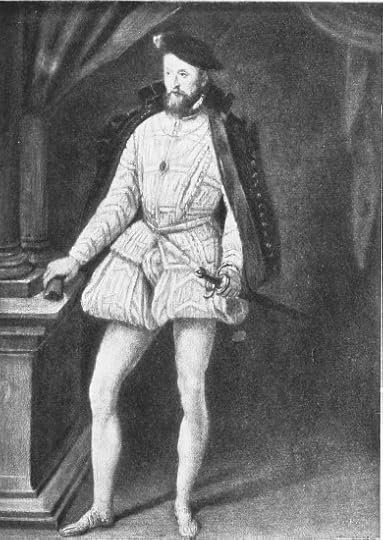
Duc François de Guise
Displaying 1 - 6 of 6 reviews