Jump to ratings and reviews
Rate this book

Legends of the Province-House

Rate this book
CONTENTS Howe's Masquerade Edward Randolph's Portrait Lady Eleanore's Mantle Old Esther Dudley The Haunted Mind The Village Uncle The Ambitious Guest The Sister Years Snowflakes The Seven Vagabonds The White Old Maid Peter Goldthwaite's Treasure Chippings with a Chisel The Shaker Bridal Night-Sketches Endicott and the Red Cross The Lily's Quest Footprints on the Seashore Edward Fane's Rosebud The Threefold Destiny

280 pages, Paperback

First published January 1, 1837

Loading...
Loading...

About the author

Nathaniel Hawthorne

5,606 books3,693 followers
Nathaniel Hawthorne was a 19th century American novelist and short story writer. He is seen as a key figure in the development of American literature for his tales of the nation's colonial history.

Shortly after graduating from Bowdoin College, Hathorne changed his name to Hawthorne. Hawthorne anonymously published his first work, a novel titled Fanshawe, in 1828. In 1837, he published Twice-Told Tales and became engaged to painter and illustrator Sophia Peabody the next year. He worked at a Custom House and joined a Transcendentalist Utopian community, before marrying Peabody in 1842. The couple moved to The Old Manse in Concord, Massachusetts, later moving to Salem, the Berkshires, then to The Wayside in Concord. The Scarlet Letter was published in 1850, followed by a succession of other novels. A political appointment took Hawthorne and family to Europe before returning to The Wayside in 1860. Hawthorne died on May 19, 1864, leaving behind his wife and their three children.

Much of Hawthorne's writing centers around New England and many feature moral allegories with a Puritan inspiration. His work is considered part of the Romantic movement and includes novels, short stories, and a biography of his friend, the United States President Franklin Pierce.

Ratings & Reviews

What do you think?
Rate this book

Friends & Following

Create a free account to discover what your friends think of this book!

Community Reviews

5 stars
8 (13%)
4 stars
15 (24%)
3 stars
23 (37%)
2 stars
12 (19%)
1 star
3 (4%)
Displaying 1 - 13 of 13 reviews
Profile Image for Bill Kerwin.
Author 2 books84.8k followers
April 23, 2021

If you have any interest in Hawthorne, you should read Legends of the Province House. First published in four separate numbers of The United States Magazine and Democratic Review (1838-39), these four separate tales connected by a frame story were conceived by Hawthorne as a single work in four distinct movements, and they were printed as such in Twice-Told Tales. If none of the tales rank among Hawthorne’s finest, each of them comes close, and the best—“Lady’s Eleanore’s Mantle"--is often anthologized.

Yet it is only when the four tales are properly framed and seen as parts of a whole that they reveal their depth and subtlety, for together they form what might be called Hawthorne’s Colonial Sunset Suite, a work that reveals the web of loyalties and frustrations that characterized the American colonies on the verge of the Revolutionary War.

All the tales are told in the bar-room of the Province House hotel, once the home of the colonial governor of Massachusetts. To this comfortable, slightly decrepit relic of another age comes our narrator—a young writer equipped with a notebook and pencil—who transcribes these four gothic, somewhat ghostly tales as they are related to him there: three by an ancient son of the republic, and one by an old Tory who regrets the passing of the colonial days.

The four tales are: 1) “Howe’s Masquerade,” in which a colonial “entertainment” during Washington’s siege of Boston is concluded by a long line of masqueraders who appear to be—or perhaps are?—the ghosts of former governors departing their home forever, 2) “Edward Randolph’s Portrait,” in which the tortured face of an old autocratic governor, indiscernible for years in his blackened portrait, suddenly reveals itself on the eve of the Boston Massacre, 3) “Lady Eleanore’s Mantle,” in which the haughty Lady Eleanore Rochcliff, wealthy young cousin of the governor, brings with her from England something more devastating than her beauty, and 4) “Old Esther Dudley,” in which an ancient servant of decayed nobility remains in the Province House long after the last colonial governor has departed, convinced that one day he will return.

Although Hawthorne took the inner world of the early Puritans as his habitual theme, he seldom treated the public world of the later eighteenth century, with its tensions between freedom and responsibility, liberty and duty. It is a pleasure to see him do so here, in this nuanced and effective symphony of tales.
Profile Image for Jon.
1,516 reviews
March 4, 2017
I was alerted to this collection of four stories--about ten pages each in my LOA volume--by Goodreads friend Bill Kerwin, and I could not write a better review than he did. I thought each one better than the last, as they evoked in ghostly fashion revolutionary Boston, 70 years before they were written, alluding to a past drifting back into the Puritan mists centuries earlier. In one section of the final tale, an old Royalist woman, ancient and regal, mesmerizes young children with her tales of the past, evoking the people of her youth so vividly that the children seem actually to see them, until she stops talking and they fade away. Hawthorne does exactly the same with us.
Profile Image for William.
677 reviews423 followers
December 7, 2017
What a mix of feelings about this book written in 1837. It's first a set of wonderful fabled histories of the leaving of the British rulers and royal mindthink from the colony of Massachusetts, an assertion of the ideals of the new republic, an approval of the education of women, and a somewhat-clumsy and clichéd warning to those of arrogant or greedy natures. The prose is recognisably both modern and constipated.

It's also a microcosm of society just before and 40 years after the Revolution, with modern life surprises: a slice of lemon in the drink (during winter in Boston), the use of gas-fired street lamps, "modern" architecture, the partial defeat (at the time of writing) of small pox, etc

All of the stories are overwritten with the use of 3 words where one would do, and especially the last two stories are clichéd and self-congratulatory of Hawthorne.

I spent 10 years living in Boston+Cambridge, and much of this book resonates with me for that reason. This is probably the only reason to read this book today.

-


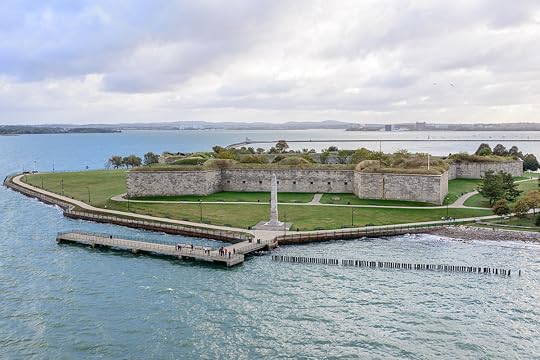
Story #2 refers to "Castle William", now known as a Fort Independence.
Wikipedia-
"In the years leading up to the American Revolution, Castle William became a refuge for British officials during periods of unrest and rioting in Boston. Violence in the wake of events such as the Stamp Act crisis in 1765 and the Boston Massacre in 1770 forced provincial leaders and British soldiers to take shelter within the fort.[7] In September 1765 the stamps to be issued under the Stamp Act were kept at the fort.[4] A re-built Castle William, also known at that time as Fort Adams, shortly after the American Revolution.

As the American Revolution erupted in 1775, American forces quickly commenced the Siege of Boston and British forces made Castle William their primary stronghold. It was not until the Continental Army led by George Washington managed the fortification of Dorchester Heights that Castle William was threatened and the British evacuated Boston in March 1776. Before leaving Castle William, the British set fire to the fort, damaging or destroying it and its ordnance as best they could."

--
What is the subtext of "the nature of Puritan submission" ? Sounds like a contradiction to submission here.

We will strive against the oppressor with prayer and fasting, as our forefathers would have done. Like them, moreover, we will submit to whatever lot a wise Providence may send us,—always, after our own best exertions to amend it."
"And there peep forth the devil's claws!" muttered Hutchinson, who well understood the nature of Puritan submission.


I can only surmise that "Puritan submission" is submission to authority only when there's no escape from the biblical conspiracy to have believers obey the powerful. Ugh.

Notes:
9.0% ... Wow. Never use one word where 3 will do. Ponderous and massive descriptions.

14.0%
".... "These," said Colonel Joliffe, breaking silence almost for the first time that evening,—" these, if I interpret them aright, are the Puritan governors—the rulers of the old original Democracy of Massachusetts."

32.0% .... lemon in Boston in winter in 1836!
Drawing a chair to the fire, I desired mine host to favor us with a glass apiece of whiskey punch, which was speedily prepared, steaming hot, with a slice of lemon at the bottom, ...
Profile Image for Noah McGarvey Dolan.
80 reviews3 followers
October 19, 2025
If I can't visit Boston (thank you, @government), I can at least comfort myself with some stories from
one of the city's great chroniclers. I prefer Hawthorne when he's looking back to the founding of Massachusetts Bay ("Young Goodman Brown" is a top 7 short story all time), but I appreciate that he used this short story cycle to lay down some mythology for his young country and address the tensions between loyalists and rebels that existed in the last days of the colony and remained, simmering, into the Republic's early years.

The result is a Ghost Stories of an Antiquarian but for the Revolutionary Period. The writing is great in places (the description of plague, at the time Small-Pox, would have made for a good revival five years ago) but the stories never quite grip the reader with horror or sadness the way Hawthorne's best do.

I looked up what Province House is today, in the hopes of one day enjoying a drink by its fire and imbibing some form of inspiration from its hallowed walls. It is now, perhaps fittingly, a McDonald's.

Best line: "...if Hope ever seemed to flit around her, still it was Memory in disguise."
Profile Image for Gabi Yuan.
109 reviews
January 28, 2026
3.84/5 - first book for american literature and the corporation, rating jumped higher after first class discussion today.
Profile Image for Marmott79.
141 reviews37 followers
December 10, 2017
Ho come l’impressione di dover scrivere qualcosa di positivo su questa raccolta di racconti.
Non ci riesco.

Per me è meh!

Non dirò che queste leggende siano scontate sebbene i topos si possano ritrovare già nella letteratura gotica inglese a partire dalla metà del Settecento: il capo di vestiario maledetto (o benedetto), il ritratto ammonitore, la presenza infestante di qualche governante, sono temi che si ritrovano piacevolmente, rassicuranti quasi.
Quello che invece è proprio insopportabile è la pedanteria dell’autore. Pesantissimo!
Non solo è pedante ma è talmente didascalico da togliere tutto il piacere della lettura. Si prenda come esempio il passo tratto da “Il mantello di Lady Eleanore”: “La maledizione del cielo mi ha colpito, ché io mi sono rifiutata di chiamare l’uomo fratello, la donna sorella. Io mi sono avvolta nell’ORGOGLIO come in un MANTO”. Non solo l’autore toglie tutto il mistero alla metafora del mantello ma per essere ben sicuro di farsi capire dal lettore lo scrive pure in stampatello cosa che lascia trasparire a mio avviso una certa insicurezza, come una paura di non riuscire a essere sufficientemente bravo a far capire al lettore cosa ci sia dietro alla metafora del mantello.
Dunque pedante, didascalico e infine pesantemente moralista quando parlando della vecchia Esther Dudley scrive “Voi avete conservato come il più prezioso dei tesori tutto ciò che il tempo ha privato d’ogni valore: principi, sentimenti, atteggiamenti, costumi, regole di vita, che le nuove generazioni hanno gettato in un canto”. Grazie Nathaniel, ci mancava l’ennesima lezioncina di morale stile romanzo francese settecentesco.
Interessante sarebbe esplorare la concezione della donna che traspare da questi quattro racconti, argomento che dovrebbe essere approfondito con la lettura delle opere principali dell’autore come La Lettera Scarlatta e La Casa dei sette abbaini, letture che non sono davvero sicura di voler intraprendere perciò l’analisi approfondita la lascio volentieri a qualcun altro.
Tralasciando la figura della donna colpevole de Il Mantello negli altri tre racconti emerge la figura della donna saggia, intuitiva e moralmente lodevole: nella Mascherata è Miss Joliffe a svelare provocatoriamente il significato della processione: “se io fossi una ribelle (…) potrei immaginare che i fantasmi di questi governatori del passato fossero stati evocati per prendere parte al corteo funebre del potere regale nella Nuova Inghilterra”. Come detto precedentemente a proposito delle parole di Lady Eleanore anche qui Hawthorne svela la metafora togliendo ogni piacere al lettore. Non si fa, non si fa, non si fa!
Nel racconto del ritratto invece è Miss Vane che ci fa intuire il significato di quel dipinto così malmesso che tuttavia resta appeso in una delle sale del Palazzo del Governatore. Oltretutto, giusto per non farsi mancare nulla sotto il profilo dei clichés mi piace sottolineare come vengono descritti il dipinto e Miss Vane. Il dipinto: “un vecchio pezzo di tela annerito… dalla superficie nera e impenetrabile”, Miss Alice Vane: “Vestita tutta di bianco, una creatura pallida ed evanescente”, ci manca solo che Hawthorne sottolinei quanto siano in contrasto per completare la pedanteria. Miss Vane: “Quando chi governa non avverte il peso delle proprie responsabilità, non è male che qualcosa ricordi loro il significato che può avere la maledizione di un popolo”.
E a quanto pare Hawthorne non riteneva male neppure le continue spiegazioni dell’autore al lettore che personalmente trovo sgradevoli e noiose: non si può dire tutto al lettore: se scrivi per metafore, e le opere goticheggianti sono costellate tutte da ampie metafore, devi lasciare al lettore il piacere di comprenderle da solo, lasciarlo cullare nell’illusione di essere tra i pochi privilegiati che possono comprendere i significati nascosti nelle opere. Per questo piacciono libri come Il Codice Da Vinci: perché danno al lettore l’impressione di scrivere per un ristretto pubblico di iniziati. Per questo invece viene detestato Il Pendolo di Foucault: perché è davvero scritto per un ristretto pubblico di iniziati.
Profile Image for Marti.
173 reviews14 followers
December 17, 2017
Dall'autore de La Lettera Scarlatta non ci si poteva che aspettare una riproposizione dei toni cupi di una letteratura goticheggiante.

Dopo La Lettera Scarlatta, romanzo per il quale Hawthorne è principalmente conosciuto, ho pensato di leggere anche questi quattro racconti che altro non sono che delle leggende ambientate nel Palazzo del Governatore. Tutte molto particolari, inquietanti e divertenti.
La prima è quella che personalmente mi è piaciuta di più, ma in generale leggerlo non costa nulla, considerando il numero esiguo di pagine.
L'attrattiva di questi racconti risiede principalmente nell'atmosfera gotica, come vi dicevo, che lascia qualche brivido, ma la particolarità consiste anche nel fatto che in modo semplice e veloce si può avere una concisa idea del periodo in cui ci troviamo, e della mentalità che ne è protagonista. Parlo in modo particolare della mentalità puritana.
Profile Image for Glen Engel-Cox.
Author 6 books66 followers
January 2, 2026
Four (kinda ghost) tales (“Howe’s Masquerade,” "Edward Randolph's Portrait," "Lady Eleanore's Mantle," and "Old Esther Dudley”) about the house of the colonial governors of the US, mainly interesting for the insight into that period of American history and the transition between the British governance and the newly formed country. It’s a bit like trying to read Ulysses, however, in that we are so far removed now from that time period that the names of the governors and generals don’t resonate with us as they would have for people of the time or when Hawthorne wrote this.
Profile Image for Sean Harding.
5,864 reviews34 followers
August 2, 2024
Hawthorne Hawks #37
Legends of the Province House #3
Penultimate tale in the four tale series is quite decent, well written and interesting, and keeps you engaged all the way through.
The quest goes on.
Profile Image for Valetta.
360 reviews34 followers
July 27, 2016
Nathaniel Hawthorne è per noi sinonimo de La lettera scarlatta, indimenticabile storia di un'adultera nell'America puritana di fine '600, arrivata anche al cinema con il volto di Demi Moore.

Pochi sanno che Hawthorne ottenne successo innanzi tutto come autore di racconti, che pubblicò su giornali e riviste e poi in diverse raccolte per tutto il corso della sua esistenza e che ancora oggi sono considerati tra i più importanti della narrativa statunitense.

Queste Leggende del Palazzo del Governatore sono quattro storie appartenenti alla collezione Twice-Told Tales (storie raccontate due volte), che si distinguono dalle altre per la comune ambientazione oltre che per la caratteristica di essere tra le più sottovalutate della produzione di Hawthorne.

I quattro racconti infatti, pur conservando alcune delle caratteristiche tipiche della produzione di questo autore, si rifanno ad un periodo storico ben preciso e molto particolare, ovvero gli anni di passaggio fra la dominazione inglese del New England, quando ancora il Palazzo del Governatore di Boston era l'elegante dimora dei rappresentati del governo britannico, e la vittoria dei rivoluzionari americani che costrinsero gli oppressori ad abbandonare il palazzo, destinato a decadere e a diventare una taverna popolare. Tutti i racconti contengono precisi riferimenti agli avvenimenti di quell'epoca e ai loro protagonisti,il che li rende al tempo stesso affascinanti per la possibilità che offrono di riscoprire un periodo storico ormai dimenticato ma anche un po' ostici per il lettore moderno, soprattutto per quello italiano a cui i nomi e gli eventi citati diranno poco o nulla.


L'attrattiva di questi racconti risiede, tuttavia, nell'atmosfera gotica che era uno dei tratti distintivi di Hawthorne, ritenuto uno dei massimi esponenti del Dark Romaticism. L'autore affianca a eventi ordinari come la firma di un trattato o una serata di gala le note cupe, le atmosfere sovrannaturali, i toni carichi di presagi caratteristici di una letteratura che sfruttava il mistero e l'inafferrabile per esprimere ed esplorare i meandri dell'animo umano.

L'ossessione dell'autore per il peccato e la purezza dell'anima trovano poco spazio nelle Leggende, e si concentrano soprattutto nella seconda e nella terza novella, Il ritratto di Edward Randolph e Il mantello di Lady Eleonore, dove i peccati di orgoglio dei protagonisti si tornano a ossessionarli sotto forma di tormenti fisici.

Il primo e il quarto racconto invece, intitolati Il ballo del governatore Howe e La vecchia Esther Dudley si soffermano sul momento di passaggio tra il vecchio e il nuovo regime e sulla difficoltà dei rappresentati del vecchio potere di abbandonare una visione del mondo ormai superata: vecchi, stanchi e reazionari ancorate al passato sono associate nell'immaginario dell'autore a presenze spettrali e figure funeree alle quali l'orgoglio impedisce di abbandonare la propria posizione.

Sebbene leggermente diversi dalla produzione solita di questo autore, quindi, questa breve raccolta proposta da Feltrinelli permette comunque di apprezzare i pregi maggiori di Hawthorne: la sua capacità di approfondimento psicologico, che emerge anche in racconti di poche pagine, e il potere immaginifico della sua fantasia a tinte dark.

Profile Image for Erwin.
1,295 reviews5 followers
December 23, 2022
Hawthorne uses four tales in a novella to tell a tale of the American Revolution.
The narrator takes a tour of the Province House which was built in the 17th Century and has had much history since with its many visitors. While there he hears stories told him by the latest proprietor of some of the more 'infamous' legends of the house.
All of the stories deal with the period of the American Revolution and in the stories there is almost a touch of Edgar Allen Poe himself in the topics. Here is a great quote from one of the tales:

“In the course of generations when many people have lived and died in an ancient house, the whistling of the wind through its crannies, and the creaking of its beams and rafters, become strangely like the tones of the human voice, or thundering laughter, or heavy footsteps treading the deserted chambers. It is as if the echoes of half a century were revived. Such were the ghostly sounds that roared and murmured in our ears, when I took leave of the circle round the fireside of the Province House, and, plunging down the doorsteps, fought my way homeward against a drifting snow storm.”

The illustrations by Merrill add to the atmosphere of a time long gone.
A very different tale from Hawthorne... highly enjoyable.
Profile Image for La Stamberga dei Lettori.
1,620 reviews149 followers
July 2, 2014
Dall'autore de "La lettera scarlatta" una raccolta di quattro racconti ambientati nel periodo di passaggio fra la dominazione inglese del New England e la presa di potere dei coloni ribelli.
Quattro racconti atipici in cui l'ossessione di Hawthorne per la colpa e il peccato si mescola con le atmosfere cupe e cariche di presagi della letteratura gotica.

La recensione completa qui:
http://www.lastambergadeilettori.com/...
Profile Image for Emerson (Ariel).
151 reviews
October 3, 2017
This is my favorite Old Time Radio Show: The Weird Circle's "Curse of the Mantle", so when I went back to read the original ... it was SO hard. Like most of Hawthorne's work, it was painful. Every media adaptation has only improved on his good ideas. Unfortunately, he can't seem to write the passion and emotion that his thoughts convey.

I finished, but had to take small bites to stay awake.
Displaying 1 - 13 of 13 reviews