
What do you think?
Rate this book

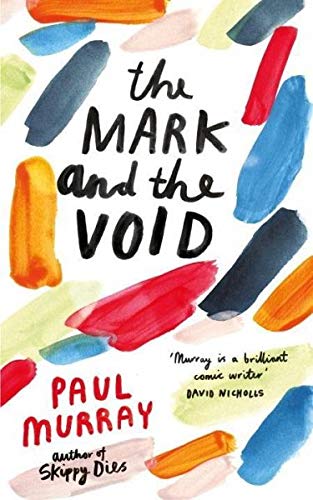
Unknown Binding
First published July 30, 2015


"[The restaurant called] Life is so loud, it takes a few moments to realize it is almost empty."Murray gives his reading audience almost everything we want in a modern novel: a little mystery, a little romance, a little grand larceny. He does not neglect important, relevant subjects like the isolation of lives wrapped in technological bubblewrap or the failure of the banking system to protect and build a middle class. His bright gaze reveals the cracks in individual and institutional facades. But it is all done with a lightness of touch that makes it clear we can understand this, that we must, in fact, understand this, if we are going to save ourselves.
"If it’s a choice between a difficult truth and a simple lie, people will take the lie every time. Even if it kills them."A successful French banker, Claude Martingale, takes a job in Dublin to escape snorts of derision from his father over his choice of career. A blacksmith and former radical, his father was unreasonably proud when his son graduated college with a degree in philosophy. “Philosophy was France’s greatest export,” he would boast to neighbors. How then could his son side with the thieves and quants who knew only how to cut experience into saleable lots, “using the underlying only for what can be derived from it,” rather than understanding the real value of life, of experience itself?
"Technology allows unprecedented quantities of reality to be turned into story. Reality becomes secondary…life becomes raw material for our own narratives."Claude’s investment bank in Dublin creates financial instruments that fictionalize reality. What better place to set a novel? The problem of trying to make interesting the life of a banker was the central struggle of this work, and the central lesson we are meant to take away. Claude’s life in the bank was soulless, but not without moments of excruciating drama. And there was money…lots and lots of money…for some.
"'What is the most reliable area of growth in the twenty-first century?'
’Inequality,’ I say.
‘Bingo.’ "
“Don’t you see the bottom line here? Even when it all goes tits up, you still get paid! Profit is finally liberated from circumstance! It’s the Holy Grail! It’s the singularity!...Seizures in the electricity grid, degradation of ecosystems, the spread of epidemics, the disintegration of the financial system—they’re all part of the same phenomenon. Civilization has become a bubble.”Murray warns us that members of society have a responsibility to call out the farce and refuse to play...or get them to pay. They need us, after all.
”And here, on the teeming road, are the Irish: blanched, pocked, pitted, sleep-deprived, burnished, beaming, snaggle-toothed, balding, rouged, raddled, beaky, exophthalmic; the Irish, with their demon priests, their cellulite, their bus queues and beer bellies, their foreign football teams, betting slips, smart-phones and online deals, their dyed hair, white jeans, colossal mortgages, miraculous medals, ill-fitting suits, enormous televisions, stoical laughter, wavering camaraderie, their flinty austerity and seeping corruption, their narrow minds and broad hearts, their drunken speeches, drunken fights, drunken weddings, drunken sex, their books, saints, tickets to Australia, their building-site countryside, their radioactive sea, their crisps, bars, Lucozade, their tattoos, their overpriced wine and mediocre restaurants, their dreams, their children, their mistakes, their punchbag history, their bankrupt state and their inveterate indifference. Every face is a compendium of singularities, unadulterated by the smoothing toxins of wealth and privilege; to walk among them is to be plunged into a sea of stories, a human comedy so rich it seems on the point of writing itself…”
”But we get on like a house on fire, don’t we, Claude?”We find ourselves at the tail end of the “Celtic Tiger,” just as all the banks become unsustainably overextended and the economy tips into the gutter. Our characters inhabit a weird corner of Dublin, erected especially to encourage high finance with laughable taxes and lax oversight; they are as out-of-place as the Intel microprocessor plant in Costa Rica. Our narrator is French; his boss German, his best work buddy Australian and his love interest from Greece. The characters make occasional forays into Dublin proper, a wrecked state examined so hauntingly by Tana French in Broken Harbor.
I picture the flames, the screaming. “Yes,” I say.
does not say anything, but when our car pulls up at the IFSC he waits for the others to climb out and then turns to me. “You know that as a managerial policy I do not believe in issuing threats or warnings,” he says.I love the description of a female bank director so polished that “she looks like a virtual avatar of herself…People say her husband uses her to charge his phone.” I love that a skeezy strip club is called Velvet Dream’s (punctuation sic). Any author that hates misused apostrophes as much as I do has earned my affection.
“Yes,” I say guiltily.
But there is no more; with that he gets out of the car, closing the door in my face.
 BABT: http://www.bbc.co.uk/programmes/b0639k87
 Claude is an investment banker living in Dublin but to novelist Paul he is inspirational. 2/10: Novelist Paul shadows Claude at work but the banker may be a disappointment. 3/10: Paul gives up on writing the Great Banking novel and Claude begins his own love story. 4/10: Buped and dispirited Claude thinks Paul can help him with the waitress. 5/10: Claude seeks Paul's help to woo Ariadne but things do not go as planned. 6/10: Following Claude's humiliation with Ariadne, he is ready to quit but Paul has other plans. 7/10: Claude is broken-hearted and Paul meets with a figure from his past who offers fresh hope. 8/10: Claude tries to get over Ariadne but Paul pretends they are lovers to get a dinner invitation. 9/10: Paul still will not write his novel and Claude's Bank takes bigger and bigger risks. 10/10: A bank collapses, a heist is averted, and Claude makes a daring decision.


