So I just finished this book and... uh... I... Give me a sec.
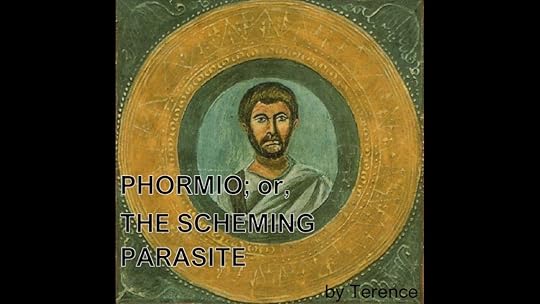
Okay I'm back. Where was I? Oh, yes. Terence. In particular, we are talking about all six plays that African dramatist Publius Terentius Afer wrote in his short career before he disappeared at the tender age of 25. I'm certainly no expert on the poets of antiquity, but the works offered here are not what I expected at all. In what way, you ask?
Well, rather than write an overly lengthy review of all six plays, let's focus on a prime example that I think captures the essence of what you'll find here. The one I'm thinking of is called "The Mother-in-law," originally known as "Hecyra" from 165 B.C. Here is my humble attempt at consolidating the play to the basics.
A young man is forced to marry his next door neighbor by his parents, a girl he doesn't much care for because he is really in love with a prostitute. So he doesn't bother to consumate the marriage. Oh, but it gets better. His new wife gets pregnant anyway. Turns out, she had been raped by a drunken frat boy in the street seven months ago. This very much offends the new husband who wants to disavow this harlot of a woman and her unborn child. He didn't sign up to raise some deadbeat dad's kid! He is considering divorce until he is reminded that he once raped a girl that looked an awful lot like his wife, and stole a ring from her in order to give it to his prostitute. The prostitute shows up wearing the ring that he stole, and the poor pregnant wife's mother recognizes it as belonging to her daughter. DOH! Yep, the baby is his after all! And they live happily ever after.
I know this was over 2100 years ago, but just what is supposed to be the message of this play? Was there supposed to be a moral lesson to young Roman boys to keep their salami in their pants until marriage? Or to know how to hold their liquor? Was this a commentary that was ahead of it's time about the treatment of women in society or the double-standards between the promiscuity of the sexes? Nobody really seems to know. I certainly don't. And I guess that's what keeps people thinking and talking about these plays centuries later.
All six plays have similar themes and characteristics. Hell, they even have the same character names, with monikers like Pamphilus, Bacchis, Chremes, and Philumena attached to different people from multiple plays. The stories all center around some family intrigue. Fathers, mothers, sons, and servants are always scheming and hiding things from each other. The center of the intrigue is always a woman, a stock character known as the "Virgo" who is the main topic of conversation but who, in some plays, never actually appears in any scene on stage. The "Virgo" is always of questionable repute. Like Obama, her citizenship could be under dispute. Or she could be a prostitute, or simply have grown up on the wrong side of the tracks. Four of the stories features rape (or ravishment) of some kind. U.S. President John Adams supposedly praised Terence for his "good morals." Far be it for me to question the morals of American founding fathers, but I just don't see the positive messages that Adams saw.
Perhaps the most striking similarity, however, is that the plays do not deal with grand matters of the aristocracy or political figures. Terence chose very intimate settings involving everyday bourgeois families and their neighbors, the bones of which came from stitching together older Greek source material. So instead of Julius Caesar, we get the Roman equivalent of suburban Jerry Springer drama. In the play "Adelphoe," a father, upon hearing the news that one of his sons had broken into someone's house, beat up the inhabitants, and carried off a girl he was in lust with, essentially responds with "boys will be boys." Yes, two thousand years ago, teenage boys were still high, horny, and hypomanic before settling down for a job in middle management.
I would like to see these plays enacted as faithfully as possible to their original delivery. Though we can't appreciate this from a translation, Roman comedy utilized various metres to help get across certain moods. I actually listened to a demonstration of metre in Terence's play "The Brothers" and was shocked to find that the accented syllables we're stressed in the same rythym as my Sicilian grandmother used to chant her religious prayers. It was eerie to discover a remnant of ancient Roman poetry being spoken in my own family, and I'm sure there is a connection, because like Terence, my grandmother did not stress the natural accents but the verse accents in much the same way.
So I guess you could say these plays were more like musicals. And indeed, certain metres were delivered in accompaniment to music. Terence had his buddy Flaccus provide the musical score on the tibia (aulos), which was a pair of reed flutes. It is likely these flutes evolved into modern bagpipes as well as the double reed flute family. They really have a beautiful sound, and you should search online for performances on these wonderful instruments. Though reading these plays can be a literary joy in themselves, I know that I am missing a great deal of the emotional nuance without hearing the lines chanted in their proper metre and without the appropriate music. Imagine "Jaws" or "Star Wars" without John Williams.
However, he Delphi version of "The Comedies" contains the original Latin texts as well as the English translations, so those of you with working knowledge of the extinct language may get some sense of the prosody and rhythm.
I do not know any Latin, so I can only suppose that the poetry and subject matter translates fairly well into the English language, because these were some of the most understandable and accessible of the classical writings I've encountered. Despite the linguistic gulf between Roman Latin and modern English, the clever wordplay and rich innuendo still shines, a testament to the talent of this poet. The Delphi and Penguin editions are by different translators, but I've not read both so I can't recommend one over the other.
But do I recommend a reading of Terence's comedies overall? Well, actually yes. But be forewarned. They are batshit crazy. They may offend some modern readers. They may leave you wondering just what on earth you just read. And I've even heard that Terence's plays are much tamer than his contemporary Plautus, who really turned up the dirty jokes and the insanity to eleven. But if you are not a typical scholar of the Greek and Roman period, I would say Terence's comedies are a good place to start, and you may find yourself being pleasantly surprised by these plays and hungry to explore more of the classical period. That's a good thing.
SCORE: Despite my initial misgivings, I couldn't help but rate this a 3.5/5, rounded up to four. So wrap up in your favorite toga, help yourself to a bowl of peeled grapes, and experience the misadventures of six Roman pretty boys in need of a damned good thrashing!