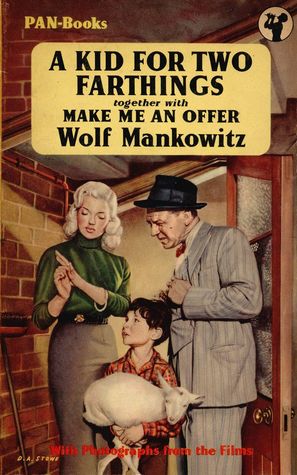
A six-year-old boy in the British immigrant community of Whitechapel believes he has discovered a unicorn for sale at the market. Though it looks to most people like a white goat with a bump on its head, young Joe is certain it will make the dreams of his friends and neighbors come true—a reunion with his father in Africa, a steam press for a tailor shop, a ring for a girlfriend. Others may be skeptical of the unicorn’s magic, but with enough effort, Joe believes he can make it all real.
Transporting. Really. Fascinated by the idea and the time-period and the cast of characters (and that it was in the bargain bin at Amazon) I ordered myself this little book as an experiment.
I've now read two Bloomsbury Group books (a special division of Bloomsbury publications "Launched in 2009, The Bloomsbury Group continues the company's tradition of publishing books with perennial, word-of-mouth appeal. This series celebrates lost classics written by both men and women from the early twentieth century, books recommended by readers for readers). A pretty cool idea, they are all visually appealing, all look interesting. BUT...I don't usually pay more than a couple of dollars for books I'm not sure I want to keep (for cash and space considerations). *If any of you have any of the other books in the series, can I borrow? (I'm talking about the Bloomsbury Group series, this book is not a series, although I'd be happy to try another Mankowitz).
I tried out Miss Hargreaves (also in Amazon bargain bin) and found it hard to rate (see review if you care) and didn't love love it.
This one, however, is a keeper. What beautiful and interesting language. Is it strange that I would say that about a book written in the cadence of a cockney-Jewish accent? Well, I don't think so. Loved the flow and the narrative. All of the characters, even so shortly painted, feel like real people, good people.
This book could just as easily been a horrible story about a really hard way of life in a really poverty-stricken area, with miserable and down-trodden people who only thought of self. Instead, while there is nothing sugar-coated, one very clearly sees the poverty and the hardship, it remains affirming and sweet because the people love each other. The way all of the adults look out for the main character, six year old Joe, is a lovely thing. Again, not saccharine, but in a real, people are really good underneath it all, kind of way. I like books like that.
The ending was abrupt, but that has just made me think about it more.
What a treat - a really charming little story. Telling the tale through the eyes of six-year old Joe is a masterstroke. It's full of wonderful little details of life in London's East End in the 1950s - something with which Wolf Mankowitz was well acquainted.
Joe buys what he thinks is a Unicorn and can therefore grant everyone he knows their wishes. In reality, unbeknownst to Joe, the Unicorn is a deformed goat. Can the magic of the "unicorn" grant the wishes of Joe's friends (a victory in the wrestling ring for Shmule, a trouser press for Mr Kandinsky and the return of Joe's father from Africa)?
Memorable characters abound in this delightful novella (a mere 91 pages). It's wonderful.
4/5
A six-year-old boy in the British immigrant community of Whitechapel believes he has discovered a unicorn for sale at the market. Though it looks to most people like a white goat with a bump on its head, young Joe is certain it will make the dreams of his friends and neighbours come true—a reunion with his father in Africa, a steam press for a tailor shop, a ring for a girlfriend. Others may be skeptical of the unicorn’s magic, but with enough effort, Joe believes he can make it all real
A nice little novella written in the 1950s and recently reissued by Bloomsbury, about a little boy in the East End of London who believes he's bought a unicorn. It's a bit slight, but I enjoyed the picture of Jewish working class life in the Fashion District - the garment factories and tailors, the market, the kitchen down the hall and privy in the yard, the friends and neighbours helping raise the kiddo while mum's at work.
I can still hear these people talk; the characters are that real. It’s a street in London, but it could be a street in NYC in the middle of the last century. Six-year-old Joe finds a unicorn for sale and he buys him in the hopes that the unicorn can satisfy some wishes. I like how this all works out in a way that is both fantastical and realistic.
It is a cute little story of six year old with dreams, believes that he came across a real unicorn. It just wasn't my type of book, but the story line was good.
One of those books not-quite-for-children, yet from the perspective of a child - which is an odd thing, when you think about it. I loved the pacing of this book, very measured and natural. There is very little embellishment in the writing style, and yet it is strong and assured. I love Joe and his circle of friends. This is a simple, moving story of the beauty of a hopeful imagination (which is how I might define childhood -?), and those who nurture it.
If you like light novels from the early twentieth century, try out the books in The Bloomsbury Group (published, of course, by Bloomsbury). Not only are they well-selected, but the design is adorable! This one features a six year-old boy who buys himself a unicorn. Hijinx promptly ensue.
A vignette of life in London’s East End, centred on the district around Brick Lane and Whitechapel, in the 1950s. At that time the predominant ethnic culture was that of the Yiddish-speaking East European Jewish migrants. But by this date the evidence of its steady integration into the Anglo-Saxon mainstream was to be seen in the style and manners of the rising generation of the British-born. The old language was being reduced to the elderly men and women conversing in the markets, the tailors’ union and at schul – the young scurried along helping to forge a new, Russo-Teutonic inflected East End accent as they embraced modern western culture.
In the midst of this change a six year old boy, Joe, wanders out from the workshop of the trouser-maker Mr Kandinsky to inspect the world around Fashion Street every day. His mother works as a milliner; his father off on a mission to Africa to see if there will be a home over there for his family.
The child’s imagination wraps itself around the idea of unicorns and why there are none in England. At one time, according to Mr Kandinsky, they had been as common as carthorses, but the misfortune of having a magical horn had led to them being hunted and trapped, so they had one day all fled to Africa.
Joe wanders streets and visits stalls and shops, converses with a variety of market-folk characters and one day finds a man who has a small unicorn to sell. It is small and sickly, more like the runt of a brood of goat kids that the stately equine unicorn, but that would be explained by it being left on its own all these years when its fellow beasts fled to Africa. Joe makes the purchase and takes it back to Mr Kandinsky.
Mr Kandinsky has one employee – the young buck Shmule, who trains and body builds in pursuit of his plans to be a champion wrestler. The chance to take on Python Macklin looms, and the winner’s purse would buy the diamond engagement ring his fiancée, Sonia, craves. The progress of the days towards this confrontation marks out the progression of the story’s plotline.
This is a story that has haunted me since seeing Carol Reed’s 1955 film of the same name at an age probably not much older than the character Joe. It is a much-criticised effort, With Shmule and his beau (played by Diana Dors) speaking in the ‘I say’ accents of the middle class Home Counties rather than the cockney that was needed. But David Kossoff as Mr Kandinsky and the child actor who played Joe acted out a dialogue between the generations which more than hinted of the vanishing world of East European Jewry and its fabulous past, told to a child as the fable of unicorns and the remnant seeking to survive in the East End. An evocative comment catches the mood as Mr Kandinsky explains Joe’s destiny to him: ‘Unicorns can’t grow in Fashion Street, but boys have to.’
A charming little story of life in the Jewish East End, and an excellent companion piece to Litvinoff's Journey Through A Small Planet. That these familiar places - Brick Lane and Whitechapel and Stepney and Mile End - have changed out of all recognition is testament to the harsh passage of time. Today we have ISIS flags flying in Poplar instead! All that is left of that vanished world of East European Jewry is what the likes of Mankowitz have left us. To read about the boy Joe's walk down the pet shops of Shoreditch or about Mr Kandinsky's tailoring shop in a Fashion St basement or Blackie Isaacs' gymnasium in Middlesex St or the tailors' union in Whitechapel Road or Shafchick's steam baths in Brick Lane (one of the finest amenities in the East End!) or indeed of the centrepiece at the end - the wrestling match between Shmule and Python Macklin - to read about all these is to return to a world within living memory but that is never coming back.
P.S. The provenance of this book takes me from the booklists of Rhodri Jones in the mid-80s to Nilkhet in the mid-90s to a garage in Dallas where the book languished for the best part of a decade before coming round to Denver and, finally, back into my hands.
A young boy living with his mother, and looked after by their kind tailor/landlord, in the East End, wants a unicorn for a pet. And one day he finds one in the market for 5 shillings. A cute-enough story, but it hasn't aged well.
Reason for Reading: I love early 20th century British lit. and I'm enchanted by the entire line of The Bloomsbury Group reprints.
Summary: Joe is six years old, lives on a street near Whitechapel which seems to be the Jewish quarter. Joe and his mother live in a room above Mr. Kadinsky's tailor shop; he is a trousers maker and his assistant Shmule is a young engaged pugilist training to work his way through the ranks to becoming a champion. Joe's father has gone to Africa to make a life for them and will be sending for him and his mother sometime. Joe mostly spends his days with Mr. Kadinsky in the shop while his mother works all day and Kadinsky is a talker and storyteller. He's told Joe the story of unicorns and why they no longer live in England but since everyone seems to be wishing for something Joe decides to check out the market anyway. If he can buy a unicorn he can make everyone's wishes come true and on that day what does he find but a unicorn, now the owner seems to think he's a crippled goat but Joe knows a baby unicorn when he sees one. You can even see the nub of his magical horn starting to grow in the centre of his forehead so Joe brings him home and Kadinsky pays for him. Perhaps now Joe can see that all his friends' humble wishes will come true.
Comments: This is a touching heart-warming story, what I would rather call a novella than a novel coming in at 128 pages and only that because of the large font. At first one is puzzled whether this might be a story for children, with the large font and the six year old protagonist. But it is not. We are shown all the poverty of the immigrant living conditions and the hardships of working continuously just to get by. Sure there are parts a child would enjoy, but not overall. The book is told in the third person and though we see things through Joe, a child's point of view for the majority of the time we also see from Mr. Kadinsky's where the tone and subject matter become deeper. Discussions of trade unions, business dealing and wrestling matches put the book above a children's story. Joe himself is a wise little boy who has learnt a lot in his adult world and often speaks with a deep wisdom that can only come from a child who has been in the adult world. But Joe is a sweet, kind, loving boy with an innocence about him that his world has not touched. He believes in unicorns and magic and this belief may just be enough to enrich everyone's lives. Wonderful characters and an inspiring ending, this book will sure to please readers who like to read about simpler times and want a good, clean read.
Two and a half stars, since two is kind of mean and three is, well, perhaps a bit fulsome. Because really, this book was disappointing. Basically, it's a love letter to the author's childhood in East London's Jewish neighbourhood, and that's fine. But for the man who would later go on to write the script for Doctor No--not a lot happens. This little boy plays around and listens to the grownups in his world talk. And yes, that's what preschoolers do. But I don't know--it was just not very satisfying. When I turned the last page I thought, "That's it? That's all?" Yes, the ending was realistic, and the "magical wishes" were the natural result of the adults' hard work and effort. But the last page just didn't make much sense. A book ostensibly for children, but really for adults, as you can feel the grownups looking at each other over the boy's head and telegraphing messages the whole time. So unmemorable that I can't even remember the boy's name!
My husband mentioned this book in conversation; apparently he heard a radio adaptation of it decades ago. I wonder how it turned out--this quintessentially Jewish working-man's tale, produced under Spain's hardline Catholic dictatorship of those days? They must have changed it out of all recognition. He seemed to remember it fondly, which is why I sought this book out. I wish I could have enjoyed it much more. It's a quick read, but after I had got about halfway he asked me if it was good. I heard myself say, "I don't know yet--I haven't finished it." Which is odd, coming from me, but to be honest, I was more bemused than anything else. The author telegraphs his punches, and in spite of the "life affirming message" larded into every page, there's an unmistakeable melancholy in the writing. Not to mention the patchy, unpolished aspect. I would not call this a children's book. Younger children will miss the significance of all those significant looks and silences, and older kids will be upset by what really happens to the "unicorn."
Wolf Mankowitz captures the innocence of childhood without dramatizing or sentimentalizing it. He also captures life in the East End of London, where he himself grew up, at a point when poverty of means was not accompanied by poverty of spirit.
A slim volume, with only the dramas of everyday life, A Kid for Two Farthings is life seen by Joe, the year before he is enrolled in school. Joe's world is still populated primarily by adults, each with their own dreams and troubles, but rarely too troubled to nourish in Joe his own dreams.
Joe's dreams revolve around unicorns and Africa, where his father has gone to seek work. When he buys a sickly baby goat, believing it to be a unicorn, he is convinced his dreams, and those of his family and friends, will be granted by the unicorn. Some are; some aren't. Mankowitz does not give supernatural magic. He gives the natural sort, that comes about by faith and hard work and love.
This is not a children's novel, but it is written mostly from a child's perspective, and while it is a gentle story it is neither tender nor nostalgic. A 6-year-old boy growing up in Whitechapel before WW2, in the Jewish community. The little boy is best friends with the old tailor whose shop is downstairs from the flat where he lives with his mother -- the missing father is returned to in the boy's memory as a soft sort of longing -- and he spends many hours with the old tailor and his clients. Sent to buy something at the market, the little boy comes home with a sickly baby goat -- the kid -- which he thinks is a unicorn because its little emergent horns look like a single horn. The boy and his unicorn have various quiet, even meditative adventures while above their heads we get a sense of the difficult lives the adults are scratching out of a cold, unyielding city. I loved this book for the tiny shard of magic it allows to sparkle in a dreary world.
I have no idea where I picked this up (likely some used book sale) but I am pretty sure I thought it was a children's book. And it isn't, but rather a charming novella told from the perspective of 6-year-old Joe, a boy living above a tailor's shop in 1950s East End London. Joe's father has gone to Africa to try to make a living in business there, his mother works for a milliner, Mr Kandinsky, the tailor and his unofficial babysitter, teaches Joe just about everything, and Joe hopes to find a unicorn for a pet. The poverty and difficulties of life in the East End are all here, but the novel is charming as it really is a village (at least a neighborhood) raising Joe and taking care of one another. I stretched this out over several evenings as I was really enjoying it. A lovely sketch of the power of imagination in children's lives, and the hope of wonderful happenings, even when that hope is simple.
[2012 blurb] I've never found a book that was more like... a kitten. It comes at you with wide-eyed affection and a singleminded determination to snuggle down on your lap and purr. Mankowitz tells a robustly sentimental story in which the wonder of childhood meets harsh reality and comes through intact because it's been cautiously protected, preserved.
[2010 blurb] This is an utterly cozy little novel about a young boy living with his mother in London's East End while his father is away seeking his fortune in Africa. Mankowitz demonstrates an accomplished, effortless prose style, moving easily between several very different settings and character types. In tone and milieu, the book reminded me much of Rumer Godden's An Episode of Sparrows.
Note: Don't miss the excellent film adaptation by Carol Reed.
This is the first book I have read from The Bloomsbury Group, which is publishing "lost classics" from the early 20th century; I am charmed by the fact that the Bloomsbury Group bases publishing decisions on reader recommendations.
This is a gentle little novel about a small boy who needs a miracle, and decides that a deformed baby goat is really a unicorn, with full wish-granting capabilities. Little Joe lives in poverty in the East End of London, and Mankowitz does not pretend that life is a fairy tale there; the hard reality comes through vividly even when softened by the uncomprehending eyes of a six-year-old boy. Nonetheless, the tenderness of the relationship between Joe and his wise old friend Mr. Kandinsky is utterly heart-melting. A lovely little book.
I'm not how I came across this book but it was a perfect size for my handbag! The story follows six year old Joe who is living in the East End of London with his Mother. His Father is away in Africa and Joe and his Mother miss him desperately. The other character in the book is Mr Kandinsky. He works in the building and takes Joe under his wing. The main storyline follows Joe as he buys himself a unicorn, after several unsuccessful attempts to raise chicks. Mr Kandinsky helps Joe look after the unicorn and Joe believes that the unicorn brings good luck to those around him. I think the story is essentially a children's story but it can be enjoyed by an adult. The downside is that not a lot happens and it only took me 2 days between work to read it all.
This is a sweet little book told from the perspective of a little boy whose experiencing a mostly adult life. The Cannibal King and the utter belief in unicorns is delightful. This was a lovely story, and I thoroughly enjoyed it. But it was lovely in the non-gripping way a sweet little story is. I could have put it down and not picked it up for a week without wondering what would happen. But when it all ended, I had a little sniffle in my eye.
Charming yet unsentimental story of a1950s working class community around a market in Whitechapel, East London. Young Joe has learnt about Unicorns from his neighbour downstairs, Mr Kandinsky, and he's seen one in the market. He hopes the Unicorn will bring the good fortune he and his mum need to be able to join his dad in Africa. And Mr Kandinsky needs a new steam press. All his friends and neighbours could use s little luck, but will the Unicorn come through for them?
To Joe, a six-year-old living in the dreary post-war slums of London's East End, a wish-granting unicorn is the perfect solution to his father's absence, his mother's tired loneliness, Mr. Kandinsky's lagging tailor shop business, and Shmule's uncertain boxing match. But will it be enough? Mankowitz clearly remembers what it is like to be an imaginative boy left to his own devices.
I liked many things about this book, including the setting, the characterization, and the way the author gives us a kid's-eye view while not sugar-coating the realities of life in their neighborhood. I also liked how it shows the interconnectedness of the characters. Definitely a book I would read again.
The writing reminded me of Catcher in the Rye (which I really liked). I'm a bit disappointed in this book. No magic in here. Not much character development. I didn't feel much for the characters.
The writing did transport me to the time period and place, and I liked the boy's imaginary games.
Africana IS the story, and he IS the spirit of the setting. To an adult, he's just a dying goat, but one that needs protection. To Joe, he's a magical being full of wonder. Africana is this moment of time -vulnerable, but also beautiful.
Reading this book makes you feel deeply uncomfortable if you read between the lines, and also incredibly impressed by the gentleness of the adult cast's behavior to a very small child. I imagine a large portion of it is autobiographical, as there are certain nostalgic touches that are hard to imitate otherwise. Author Wolf Mankowitz was born in 1924, making him Joe's age in the early 30's, which matches.
On one hand, it's a story about Joe, a 6-year-old growing up in post WW1 UK, seeing the world the way a 6-year-old does. He knows that things could be better (everyone is unhappy about something) but he doesn't have the experience to grasp just how dire things really are. Joe understands that his father went to Africa, but he doesn't understand that he very likely won't be coming back. He understands that his mom rents a room from the family friend Mr. Klandinsky, but he doesn't understand that his father's abandonment has left them homeless. Mr. Klandinsky is a fine friend who needs a new iron for his business, but Joe doesn't understand the crushing poverty that surrounds him - that the only thing keeping all three of them fed and housed is an old falling-apart iron. Mr. Klandinsky also seems to have a dark history of his own. Why is he 'the last Klandinsky'? What horrible situation ended his family? We can imagine. Given that this is the early 30's, we know that things are only going to get worse. The dark cloud of reality hangs over everything, though Joe is readily protected from it.
Shmule's arc revolves around getting a diamond ring for his betrothed, but they don't love each other. It's likely that Shmule is gay or asexual, focusing all his passion of bodybuilding. The only reason he even has a betrothed if because his mom brought in a matchmaker for an arranged wedding.
And finally, there's Africana, the disabled baby goat who Joe believes in a unicorn. It suffers and dies, though Joe doesn't understand this. Life is so awful here, and Joe's innocence is so pure, that the adults can't bear to break him - the one truly pure thing in this world. So they hide Africana's body and give him a story to believe in.
The book is brilliant in how it skims the surface of a difficult setting. It's one of the most accurate portrayals of early childhood I've read – a childhood that is protected by kindhearted adults who shield but don't coddle. Joe isn't stupid – he's just little, and little kids should not be aware of adult hardship. It kills something beautiful inside them that never returns. I imagine that when Joe grows up, he'll look back on these days with gratitude, realizing just how bad things were but how well he'd been guided away from the darkness.
This entire review has been hidden because of spoilers.
When the Bloomsbury Group tells you that some book is a forgotten classic, believe them. Mankowitz is a London Jewish William Saroyan. The book has no plot – or rather the plot is similar to any month in the life of a six-year-old – in fact, the book is almost a young adult novel. But it’s warm and broad, written with glancing nobility.
The title is from the English version of my favorite Passover song, “Chad Gadya” (English of the sense of from England).
How many more great forgotten novels are there – including the ones by me?
(Hard to believe Mankowitz also wrote two James Bond movies!)
Opening random:
“All the rain and sleet would ruin a good hat, and in bad weather who anyway would be bothered to notice whether a customer wore a new hat?
A slice of life book about a working-class community near London. A six-year-old boy buys a young goat and thinks that it is a magic unicorn because it only has one horn. The author writes the book with warm affection for the many different characters that populate the book.