

What do you think?

Old St. Paul's: A Tale of the Plague and the Fire
One night at the latter end of April 1665 the family of a citizen of London carrying on an extensive business as a grocer in Wood-street Cheapside were assembled according to custom at prayer.
592 pages, Paperback
First published January 1, 1840
About the author
William Harrison Ainsworth
658 books50 followersWilliam Harrison Ainsworth was educated at Manchester Grammar School and later articled to a solicitor, deserting this profession for literature.
Among his best known novels are The Tower of London (1840), Old St. Paul's (1841), Windsor Castle (1843) and The Lancashire Witches (1848).
Among his best known novels are The Tower of London (1840), Old St. Paul's (1841), Windsor Castle (1843) and The Lancashire Witches (1848).
Ratings & Reviews
Friends & Following
Create a free account to discover what your friends think of this book!
Community Reviews
Displaying 1 - 21 of 21 reviews

September 4, 2015

"Old Saint Paul's: A Tale of the Plague and the Fire", is a novel by William Harrison Ainsworth serially published in 1841. It is a historical romance that describes the events of the Great Plague of London and the Great Fire of London. It was the basis for the silent film Old St. Paul's which I now have to go look up when I'm finished with this. The novel ran in The Sunday Times from January 1841 to December 1841, and he was one of the first writers to appear in a national paper in such a form. Ainsworth was paid £1,000 for the work with control of the copyright. The work was later illustrated when it was published in a three volume set by Cunningham which is awesome because I love old books with illustrations. I'm not sure if I would love new books with illustrations, I almost never read new books and have no idea if they are illustrated. But back in Dickens day, and Ainsworth's day obviously, books were illustrated and I am very pleased that they were.
Since I was reading the man's book I did a little looking up of the author himself and found that he originally was trained as a lawyer but had no desire to be a lawyer, can't say that I blame him for that. In 1822 when he was finished with school he began his law studies and worked for Alexander Kay. They did not get along and Kay accused him of being lazy. He wasn't exactly lazy though, having no interest in the law and having been pushed into the field by his father, who was a lawyer, instead of working, Ainsworth spent his time reading literature at his home and various libraries. It sounds like something I would do. He kept up with his law career though, I thought being called lazy would have been the end of it, but a few years later when his father died he even became a senior in the law firm and began to focus on his legal studies. He was writing during all this also, mostly stories that were published in magazines.
Ainsworth's first novel "Sir John Chiverton" was published in 1826, but as time went on and he wrote lots and lots of other books he must have decided he didn't care for the first one anymore because he called it an incomplete work and he later ignored it when creating his bibliography. All this makes me want to read it, but since I didn't read it and I did read "Old Saint Paul's" I guess I'll talk about that for awhile.
To give you an idea of what the book is like, I'll just let Mr. Ainsworth tell us that in the "Advertisement" that is at the beginning of my book:
Advertisement
"The portion of the ensuing Tale relating to the Grocer of Wood-street, and his manner of victualling his house, and shutting up himself and his family within it during the worst part of the Plague of 1665, is founded on a narrative, which I have followed pretty closely in most of its details, contained in a very rare little volume, entitled, "Preparations against the Plague, both of Soul and Body," the authorship of which I have no hesitation in assigning to Defoe. Indeed, I venture to pronounce it his masterpiece. It is strange that this matchless performance should have hitherto escaped attention, and that it should not have been reprinted with some one of the countless impressions of the "History of the Plague of London," to which it forms an almost necessary accompaniment. The omission, I trust, will be repaired by Mr. Hazlitt the younger, Defoe's last and best editor, in his valuable edition of the works of that great novelist and political writer, now in the course of publication. It may be added, that a case precisely similar to that of the Grocer, and attended with the same happy results, occurred during the Plague of Marseilles, in 1720.
For my acquaintance with this narrative, as well as for the suggestion of its application to the present purpose, I am indebted to my friend, Mr. James Crossley, of Manchester.
Kensal Manor House, Harrow Road, November 30, 1841".
And there you have it, some of it anyway, there is the grocer and his family and he does stock up on just about everything you can think of and he does lock the doors and keeps his family inside for months, which seemed like a rather good idea to me considering all the people outside who were dying in the streets, and dying in their homes, and dying in their beds, and anywhere else they were, and then being thrown into plague pits. The main character is Leonard Holt, the apprentice of our grocer Stephen Bloundel, he is madly in love with the grocer's daughter Annabel who is not madly in love with him, she's madly in love with Lord Rochester, why I don't know, I don't know who Lord Rochester is in love with. It was rather disturbing to me at how much I came to hate Lord Rochester, I don't like hating people, even book people. He was barely in the book when two things happened, Annabel was in love with him and I was hoping he would soon die of the plague. I was absolutely amazed to learn a little later that there actually was such a person a long, long time ago, he was disturbing enough as a book person, I can't imagine how he would have been in real life. Although he did redeem himself a tiny bit in my eyes near the end of the novel, either that or I just got used to him. Then there is Nizza Macascree, a woman Leonard meets in the cathedral (I think so anyway) and she is madly in love with him (of course) in about half a line of reading and I don't think I ever figured out why.
There are lots of other characters in the novel doing lots of other things. There is Blaize, the son of the grocer's cook, Blaize was "a stout, stumpy fellow, about four feet ten, with a head somewhat too large for his body, and extremely long arms." Blaize is terrified of the plague and is glad of the grocer locking the doors, which makes much more sense to me than Leonard out walking all over London during the height of it, but not only does Blaize stay inside he also protects him with these various methods:
"he steeped rue, wormwood, and sage in his drink, till it was so abominably nauseous that he could scarcely swallow it, and carried a small ball in the hollow of his hand, compounded of wax, angelica, camphor, and other drugs. He likewise chewed a small piece of Virginian snake-root, or zedoary, if he approached any place supposed to be infected. A dried toad was suspended round his neck, as an amulet of sovereign virtue. Every nostrum sold by the quacks in the streets tempted him; and a few days before, he had expended his last crown in the purchase of a bottle of plague-water."
At one point Leonard enters the room where Blaize is and they have this conversation:
"So you have been poisoning yourself, I perceive," observed Leonard, approaching him.
"Keep off!" cried the porter, springing suddenly to his feet. "Don't touch me, I say. Poisoning myself! I have taken three rufuses, or pestilential pills; two spoonfuls of alexiteral water; the same quantity of anti-pestilential decoction; half as much of Sir Theodore Mayerne's electuary; and a large dose of orvietan. Do you call that poisoning myself? I call it taking proper precaution, and would recommend you to do the same. Beside this, I have sprinkled myself with vinegar, fumigated my clothes, and rubbed my nose, inside and out, till it smarted so intolerably, I was obliged to desist, with balsam of sulphur."
To find out if poor Blaize lives through the book you will have to read it. Or to find out if Lord Rochester lives through the book even though I'm wishing for his death, you'll have to read it. There are also Lord Rochester's three friends who, since they are friends (sort of) with the lord I shouldn't have to mention what I think of them. There is the good Dr. Hodges who as far as I could tell would go to anyone, anywhere, no matter what the circumstances and that every other doctor in London either left the city, was dead, or just didn't make the book. Then there was Solomon Eagle, he went around the city denouncing judgement on it and everyone in it, saying things like all will die by a plague, and the city will burn with fire, and things like that. I liked him for a while, he came in quite handy now and then when I didn't know how a character was going to get out of a situation, there would be Solomon. He is another one of the people who actually exsisted way back then. I certainly had to feel sorry for these people living in London, they just get through a plague that lasted for months and months and killed just about everybody - it felt that way anyway - then when the plague is almost over the city practically burns down. I'm pretty sure when New Year's Eve came and the ball dropped (ok, they didn't drop a ball back then) but when it came time to say goodbye to the old year they certainly should have been glad to get out of it and on to the next one.
I liked this book alot, when I wasn't interested in what the people were doing I was interested in the plague, if I would start losing interest in the plague there was always something new these people were doing to each other, and then we throw a big fire into it yet. I will be looking for more books by Ainsworth, I probably won't find any, but I will look. Either that or break down and read them on an ereader.

September 3, 2015
Well, it was a dark and story night (and couple of days) when I read this novel, and I'm sure that made my reading experience all the more fun, because, let's face it, Old Saint Paul's, while enjoyable to read, is not great literature. It is, rather, a delightful, rollicking melodrama that keeps on going, gets wobbly, and then rights itself, and never ever lets you catch your breath.
I could not help but visualize this novel, set as a play, and performed, lit by gas, in a Victorian theatre. We have villains aplenty, including an appearance by the dastardly Earl of Rochester, beautiful but helpless heroines and gallant young men and suitors for the women.
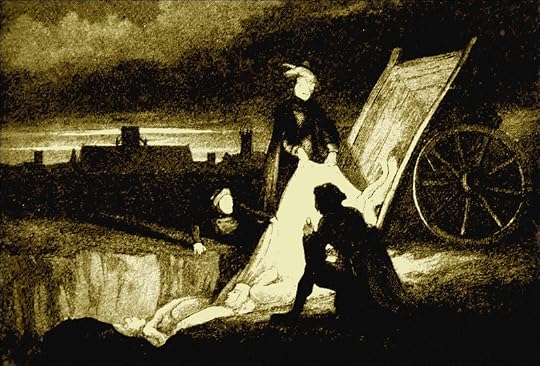
The novel is set during the horrors of the great plague of 1665, and so there are plenty of gory scenes of gruesome death, midnight visits by creepy undertakers and bizarre, but historically accurate methods of the ways the populace confronted and dealt with the plague. If you seek the rich creation of atmosphere and suspense that is offered by Dickens, forget it; if you want to experience the power that Fate has over people as found in Hardy you will be disappointed, but if you simply want a respite from the well-known classic Victorian authors and crave a simple, fun read to experience melodrama and adventure that never quits, read Ainsworth. It will be well worth your while and, I bet, will put a smile on your face.
I could not help but visualize this novel, set as a play, and performed, lit by gas, in a Victorian theatre. We have villains aplenty, including an appearance by the dastardly Earl of Rochester, beautiful but helpless heroines and gallant young men and suitors for the women.
The novel is set during the horrors of the great plague of 1665, and so there are plenty of gory scenes of gruesome death, midnight visits by creepy undertakers and bizarre, but historically accurate methods of the ways the populace confronted and dealt with the plague. If you seek the rich creation of atmosphere and suspense that is offered by Dickens, forget it; if you want to experience the power that Fate has over people as found in Hardy you will be disappointed, but if you simply want a respite from the well-known classic Victorian authors and crave a simple, fun read to experience melodrama and adventure that never quits, read Ainsworth. It will be well worth your while and, I bet, will put a smile on your face.
September 16, 2011
""Enough," rejoined Argentine. "May you be happy with Isabella." And removing his hand from his side, a copious effusion of blood followed, and sinking backward, he expired."
I felt I should read some Harrison Ainsworth when I discovered Thomas Hardy read him. He was one of the most popular authors of his time....well I suppose the Victorians needed their rubbish as well. Badly written with cardboard characters and a preposterous, awkward plot. It came briefly to life when the Great Fire took hold, but even then the best bits were nicked from Pepys. I'd only recommend this novel if you want to remind yourself how good Trollope, Dickens, Eliot and Hardy are.
I felt I should read some Harrison Ainsworth when I discovered Thomas Hardy read him. He was one of the most popular authors of his time....well I suppose the Victorians needed their rubbish as well. Badly written with cardboard characters and a preposterous, awkward plot. It came briefly to life when the Great Fire took hold, but even then the best bits were nicked from Pepys. I'd only recommend this novel if you want to remind yourself how good Trollope, Dickens, Eliot and Hardy are.
July 19, 2009
I loved this book. I have to say that I laughed a lot. The story had absolutely everything in it that you would find in a novel of that period and before. All of the missed recognitions, unknown paternity, a brother narrowly missing the seduction of his own sister, and much much more. It has been 31 years since I read this and I still remember quite a bit about it. That is pretty good since I frequently can't remember much about something I read a week ago now.
August 4, 2015
History as it is best
I really love to read old books. This made the world of the olden days live. I could feel the fear of the plague and understand why they thought everyone would die
I really love to read old books. This made the world of the olden days live. I could feel the fear of the plague and understand why they thought everyone would die

July 8, 2022
Victorian historical novel of the plague and the fire of London. A bit too melodramatic really, but images 17th century London quite well evoked. Some elements recalled scenes from "The Betrothed", not too surprising I suppose given plagues feature heavily in both.
April 8, 2010
A stunning story with great details of how to survive in the plague years.
Very gripping and a good read.
Very gripping and a good read.
July 9, 2024
I decided to do a DNF at 50% thru this book.
This book was written 184 years ago, so very old English language, which is cool. Makes you think as you read it. It is a story about the plague and fire (did not reach the fire part) in London, and centres on a family in Wood Street, which is close to Saint Pauls.
The book revolves around the Grocer and his family, and their staff. But it became a bit of a bore with the same theme. (beautiful daughter of the grocer being courted and abducted by a rich gentleman and his friends, in their many disguises, and the employee of the family rescuing her)
I think the most interesting thing would have been to have a map of London and a highlighter pen to follow the path of the story. Having worked in London I knew a lot of the street names.
In the end boredom won out.
I may revisit this down the road. With a map.
This book was written 184 years ago, so very old English language, which is cool. Makes you think as you read it. It is a story about the plague and fire (did not reach the fire part) in London, and centres on a family in Wood Street, which is close to Saint Pauls.
The book revolves around the Grocer and his family, and their staff. But it became a bit of a bore with the same theme. (beautiful daughter of the grocer being courted and abducted by a rich gentleman and his friends, in their many disguises, and the employee of the family rescuing her)
I think the most interesting thing would have been to have a map of London and a highlighter pen to follow the path of the story. Having worked in London I knew a lot of the street names.
In the end boredom won out.
I may revisit this down the road. With a map.

January 8, 2026
I was quite disappointed in this. Having read his book on the witches and enjoyed it, this was far too much sex trafficking and not enough plague and fire! Though I did love all the quotes from the Bills of mortality! (I even realised one of the things I've been saying wrong when I present these to groups at work) The main character apprentice was a bit dull. I don't think he quite got the horror and claustraphobia right. But I learned a lot about the old St Pauls, and enjoyed all the street names. I read a lovely old edition that I got for £25 and that was definitely the right way to read this.

September 4, 2026
Despite the title, this novel is at least equally about the characters of Amabel and Nizza attempting to escape their would-be seducers, as it is about the Great Plague of 1665 and the Great Fire of 1666 in London. The plot reminds me of something Samuel Richardson would come up with, and is more reminiscent of the Georgian era than the Victorian, other than not being epistolary. Ainsworth also seems to have been an architecture enthusiast, if the amount of print devoted to descriptions of the city layout and various buildings is an indication.

April 30, 2018
A very engrossing novel full of hiss worthy bad guys and trembling maidens. Its very melodramatic (sometimes too much) but the story is always interesting and the main characters are easy to root for.

January 5, 2024
Though long and too descriptive about locations, Old St Paul’s is a descriptive account of the plague in the mid 1600’s. It develops on to the burning of London after the plague subsided. It is called a romance but not a typical 20-21st century type. I recommend it for the historical value.

October 16, 2021
4.5*
I loved it! Chronicling the plague of 1665 and the Great Fire of 1666 through the eyes of some wonderful characters, Old St. Paul's is part history, part romance, and part sensation novel.
I loved it! Chronicling the plague of 1665 and the Great Fire of 1666 through the eyes of some wonderful characters, Old St. Paul's is part history, part romance, and part sensation novel.

August 21, 2022
Charming, informative and well-written.

October 5, 2022
2.5⭐️

Did Not Finish
January 30, 2025I needed to step away from this as it is quite harrowing. Ainsworth is quite skilled at demonstrating the horrors of the plague. It's just too much for this sensitive reader.

May 24, 2010
[These notes were made in 1986; I read this in a 19th-century Routledge edition:]. "A Tale of the Plague and the Fire" - and the descriptions of each are as lengthy, well-researched and gruesome as one has come to expect from Ainsworth. These set pieces, together with the loving descriptions of Old St. Paul's Cathedral (handily the centre-point of all the novel's action) are the real meat, and in order to work them in, Ainsworth occasionally has to strain his characters a bit. For instance, what on earth is that upright apprentice/hero Leonard Holt doing, taking a ride on the Thames and appreciating the terrible sublimity of the Great Fire, when he still has close friends and a loved one to warn and search for, respectively? However, the fact that I notice breaks in character implies that there must be a character there to start off with - not that we are ever given any real insight into how Leonard manages to transfer his affections from the dead Amabel (now there's a name!) to the living (and rich) Isabella, whose obscure parentage is, of course, revealed towards the end by a repentant (and in this case perishing-rather-horribly) member of the elder generation. We have a wild "enthusiast" prophet, who helps his fire prophecy along a bit; we have a severe but immensely good father, whose prudence leads him to immure his family against the plague for six months; we have a pair of villains (the worse being the woman) who inhabit the underworld of the Cathedral; and we have the somewhat Lovelace-like Rochester, who is completely villainous at the beginning and shows some signs of being a rather good fellow at the end. A couple of comic underlings and some exemplars of rustic virtue complete the cast. There is a particularly Romantic insistence on the sublimity of the fire, and the plot is fairly well-handled. Good stuff.

September 20, 2012
One must suspend modern cynicism in order to enjoy this book, and instead immerse oneself in a 19th-century author's sensibilities about the 17th century. The story is outright melodrama with all the attendant, over-the-top set pieces, but with enough clear description and historical grounding to make portions of it really come alive.

April 5, 2013
This was a recommendation from my husband and mother in law - she grew up in London during the war and said it was a great read so I decided to give it a go. I really enjoyed this book, great storyline, written language a little strange to start with, in parts its very old English, but a quick reference in the dictionary cleared up any confusions - great book, definitely worth a read!

December 20, 2015
En skikkelig røverhistorie! Nokså langdryg og platt, men verdt det på grunn av noen kostelige scener og en intens skildring av bybrannen i London.

December 22, 2016
Historical fiction. Detailed. Great for movie plot.
Displaying 1 - 21 of 21 reviews