

What do you think?
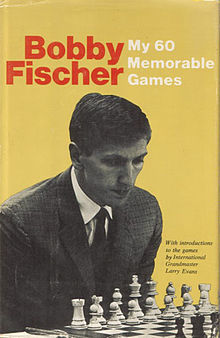
My 60 Memorable Games
In this book, published by Simon and Schuster in 1969, Bobby Fischer analyzes his most important and representative games. He shows the strategic considerations, the tactics, and sometimes the blunders, that occur during the pressure of tournament play. He assesses his opponents’ thinking as well. Each game has, in addition to Fischer's own annotations, an analytical introduction by International Grandmaster Larry Evans.
385 pages, Paperback
First published January 1, 1969
Ratings & Reviews
Friends & Following
Create a free account to discover what your friends think of this book!
Community Reviews
Displaying 1 - 30 of 82 reviews

November 20, 2008
If you're a chess player and you haven't read this book... I'm struggling to complete the sentence. It's sort of like you claim to be a Christian, but haven't read the Bible. You'd better do something about it!
The short-list for "greatest chess player of all time" only has two names: Fischer and Kasparov. Kasparov had the unquestionable advantage of being sane, so he lasted much longer. But when Fischer was in the zone, he was so ferociously unstoppable that no real comparison is available. No one else has ever won a Candidates match (World Championship quarter-final and subsequent) with a clean sweep. Fischer did it twice. My 60 Memorable Games is his only book. He wasn't really a writer, and apparently he had to get help from Larry Evans to do the parts that weren't just game annotations. It matters about as much as the fact that Mozart didn't also write the libretto to The Magic Flute.
Before Fischer, people only ever put wins in their game collections, and entitled them "So-and-So's Best Games". Fischer knew he was the best, so he prioritized interesting games, even if there were a few he didn't win. He includes his horribly painful loss to Spassky, where Spassky surprised him by playing the King's Gambit, at that time a completely unfashionable choice. Fischer was so angry that he went off, and a few months later published his famous article containing what he claimed to be a refutation of this opening. He also has the equally unpleasant loss to Geller, where they got into a complicated middle-game position with competing attacks, and Fischer missed a forced win. Most people would just have tried to forget these games, not wanted to tell the whole world about them.
Of course, most of the games are wins. It feels a bit silly to recommend specific examples; it's rather like telling people that Shakespeare's Sonnet XVIII is quite good, and Hamlet isn't bad either. But, if I had to pick one out, I guess the 1963 game against Robert Byrne. Fischer plays an incredibly complex and well-calculated sacrifice; according to legend (I will be so disappointed if I discover this isn't in fact true) the commentator was saying that Fischer had got it wrong and Byrne was winning, when Byrne, having seen more deeply, finally understood the point of Fischer's idea and resigned.
You don't see that kind of thing very often. But then you don't see talent like Fischer's very often either. In any field.
The short-list for "greatest chess player of all time" only has two names: Fischer and Kasparov. Kasparov had the unquestionable advantage of being sane, so he lasted much longer. But when Fischer was in the zone, he was so ferociously unstoppable that no real comparison is available. No one else has ever won a Candidates match (World Championship quarter-final and subsequent) with a clean sweep. Fischer did it twice. My 60 Memorable Games is his only book. He wasn't really a writer, and apparently he had to get help from Larry Evans to do the parts that weren't just game annotations. It matters about as much as the fact that Mozart didn't also write the libretto to The Magic Flute.
Before Fischer, people only ever put wins in their game collections, and entitled them "So-and-So's Best Games". Fischer knew he was the best, so he prioritized interesting games, even if there were a few he didn't win. He includes his horribly painful loss to Spassky, where Spassky surprised him by playing the King's Gambit, at that time a completely unfashionable choice. Fischer was so angry that he went off, and a few months later published his famous article containing what he claimed to be a refutation of this opening. He also has the equally unpleasant loss to Geller, where they got into a complicated middle-game position with competing attacks, and Fischer missed a forced win. Most people would just have tried to forget these games, not wanted to tell the whole world about them.
Of course, most of the games are wins. It feels a bit silly to recommend specific examples; it's rather like telling people that Shakespeare's Sonnet XVIII is quite good, and Hamlet isn't bad either. But, if I had to pick one out, I guess the 1963 game against Robert Byrne. Fischer plays an incredibly complex and well-calculated sacrifice; according to legend (I will be so disappointed if I discover this isn't in fact true) the commentator was saying that Fischer had got it wrong and Byrne was winning, when Byrne, having seen more deeply, finally understood the point of Fischer's idea and resigned.
You don't see that kind of thing very often. But then you don't see talent like Fischer's very often either. In any field.

February 17, 2013

D'Angelo: Now look, check it, it's simple, it's simple. See this? This the kingpin, aright? And he the man. You get the other dude's king, you got the game. But he trying to get your king too, so you gotta protect it. Now, the king, he move one space any direction he damn choose, 'cause he's the king. Like this, this, this, aright? But he ain't got no hustle. But the rest of these motherfuckers on the team, they got his back. And they run so deep, he really ain't gotta do shit.
Bodie: Like your uncle.
D'Angelo: Yeah, like my uncle. You see this? This the queen. She smart, she fast. She move any way she want, as far as she want. And she is the go-get-shit-done piece.
Wallace: Remind me of Stringer.
D'Angelo: And this over here is the castle. Like the stash. It can move like this, and like this.
Wallace: Dog, stash don't move, man.
D'Angelo: C'mon, yo, think. How many time we move the stash house this week? Right? And every time we move the stash, we gotta move a little muscle with it, right? To protect it.
Bodie: True, true, you right. Aright, what about them little baldheaded bitches right there?
D'Angelo: These right here, these are the pawns. They like the soldiers. They move like this, one space forward only. Except when they fight, then it's like this. And they like the front lines, they be out in the field.
Wallace: So how do you get to be the king?
D'Angelo: It ain't like that. See, the king stay the king, aright? Everything stay who he is. Except for the pawns. Now, if the pawn make it all the way down to the other dude's side, he get to be queen. And like I said, the queen ain't no bitch. She got all the moves.
Bodie: Aright, so if I make it to the other end, I win.
D'Angelo: If you catch the other dude's king and trap it, then you win.
Bodie: Aright, but if I make it to the end, I'm top dog.
D'Angelo: Nah, yo, it ain't like that. Look, the pawns, man, in the game, they get capped quick. They be out the game early.
Bodie: Unless they some smart-ass pawns.
****
Not the way Fischer would have explained it - a whole lot more patient and polite!

July 6, 2016
A great book with 60 great chess games and insights/annotations , from one of the greatest, or probably, the greatest chess player of all time! Not only was Bobby Fischer a phenomenal chess genius, he is the most interesting, eccentric and enigmatic of all the great chess players.
In this book Fischer shares with us 60 favourite games of his, with detailed analysis and annotation with great comments on all the critical and interesting parts of the games. The writing style is simple , honest and highly enjoyable. He doesn't refrain from criticising his errors, or from praising and giving credits to excellent moves and play from his opponents.
I know that I don't and will never have a 100th of his playing strength and understanding of the game, but that doesn't stop me from appreciating great chess games!! :) . A must have for any chess lover!!
In this book Fischer shares with us 60 favourite games of his, with detailed analysis and annotation with great comments on all the critical and interesting parts of the games. The writing style is simple , honest and highly enjoyable. He doesn't refrain from criticising his errors, or from praising and giving credits to excellent moves and play from his opponents.
I know that I don't and will never have a 100th of his playing strength and understanding of the game, but that doesn't stop me from appreciating great chess games!! :) . A must have for any chess lover!!

March 21, 2019
Probably the best chess book ever: and a peak into the mind of a troubled man who is almost indisputably both the most dominant and one of the greatest chess players ever.

August 26, 2018
A bit light on narration/explanation, heavy on alternate lines, which wasn't what I was looking for. One could probably find these games with similar annotation online, but I'm sure I'll end up returning to this.

May 25, 2012
Brilliant!
Bobby Fischer is without question a chess genius.
As a person, Fischer is an enigma. He is a very high genius who as a young man exploded on the chess scene like a supernova. He won the US Chess Championships at the age of 14, an amazing feat by itself but only the beginning.
He is best known for his winning the World Championship from Boris Spassky in the 1970's. While many know this they do not know how amazing that feat really was.
International Chess is not the easiest forum to play in. In the 1970's and before it was dominated by the Russians. That is still true to some extent today, but not like it was back in the 1970's. Winning Chess tournaments where there were so many Russians involved was difficult especially because to put it nicely, the Russians would work as a team to help their designated leaders win. To put it not so nicely, they would help each other so that they would create the result that they wanted. Agreed upon draws after only a few moves were common. Collaboration on adjourned games was common.
Bobby Fischer's accomplishment in winning the world championship in this setting is a testament to his brilliance and his perseverance. Bobby played to win .... always! A planned draw just wasn't in his nature.
As an individual, Bobby Fischer beat them on his own, and he has never really been given the credit he deserved.
That having been said, Bobby Fischer has always been something of a recluse and for that reason the world has been robbed of his genius as he has dropped from the scene and arisen only occasionally to world notice.
He replayed Spassky and ran afoul of US immigration and has had legal problems since then. Recently he turned up in Japan and last I heard was granted citizenship and asylum in Iceland, where ironically he originally played Spassky back in the 70's.
All this is to say that this book represents Fischer's brilliance and unfortunately there are few other sources in which to find it in terms of his analysis and commentary.
Other reviews refer to the reprints which have altered the original and so the discerning buyer should make sure he is getting an original. Unfortunately, they usually are not cheap.
It is truly a gem and valuable for it's insight into chess as well as the rarity of its existence and being hard to find.
Say what you will about Fischer's social qualities, there has never been his match in Chess, and when you understand what he accomplished, how passionate he was (and is) about Chess and how difficult his accomplishments were, you have to just give him a tremendous amount of credit.
Bobby Fischer is without question a chess genius.
As a person, Fischer is an enigma. He is a very high genius who as a young man exploded on the chess scene like a supernova. He won the US Chess Championships at the age of 14, an amazing feat by itself but only the beginning.
He is best known for his winning the World Championship from Boris Spassky in the 1970's. While many know this they do not know how amazing that feat really was.
International Chess is not the easiest forum to play in. In the 1970's and before it was dominated by the Russians. That is still true to some extent today, but not like it was back in the 1970's. Winning Chess tournaments where there were so many Russians involved was difficult especially because to put it nicely, the Russians would work as a team to help their designated leaders win. To put it not so nicely, they would help each other so that they would create the result that they wanted. Agreed upon draws after only a few moves were common. Collaboration on adjourned games was common.
Bobby Fischer's accomplishment in winning the world championship in this setting is a testament to his brilliance and his perseverance. Bobby played to win .... always! A planned draw just wasn't in his nature.
As an individual, Bobby Fischer beat them on his own, and he has never really been given the credit he deserved.
That having been said, Bobby Fischer has always been something of a recluse and for that reason the world has been robbed of his genius as he has dropped from the scene and arisen only occasionally to world notice.
He replayed Spassky and ran afoul of US immigration and has had legal problems since then. Recently he turned up in Japan and last I heard was granted citizenship and asylum in Iceland, where ironically he originally played Spassky back in the 70's.
All this is to say that this book represents Fischer's brilliance and unfortunately there are few other sources in which to find it in terms of his analysis and commentary.
Other reviews refer to the reprints which have altered the original and so the discerning buyer should make sure he is getting an original. Unfortunately, they usually are not cheap.
It is truly a gem and valuable for it's insight into chess as well as the rarity of its existence and being hard to find.
Say what you will about Fischer's social qualities, there has never been his match in Chess, and when you understand what he accomplished, how passionate he was (and is) about Chess and how difficult his accomplishments were, you have to just give him a tremendous amount of credit.

October 21, 2013
Fischer is an enigma. He was probably one of the two strongest chess players of all time. For a spell in the 1960s and 1970s there was no-one to touch him. He introduced a strength of self-belief and focused concentration that was frankly scary. Playing through his games you still get an incredible sense of anger and fire. This was someone who absolutely had to win. The Mike Tyson of the chessboard. That's Mike Tyson at his imperious best, not the ear-chewer of later declining times.
But...
You have to admit that he is not an easy person to love. That same monomania that made him a fearsome opponent also made him an uncomfortable person to live with. His demands for the 1972 World Championship match with Spassky seem more than a little childish. The jury is still out on whether this was a deliberate attempt to unnerve Spassky, a legitimate desire to improve playing conditions or a symptom of Fischer's inner demons. For what it's worth, my money is on the latter, but that's a story for another time.
And the less said about his outspoken views on women and religion the better.
There is another problem for those of us who don't stand up when the marching band starts "oh say can you see...". Fischer is absolutely idolised by some of his countrymen. In their eyes he can do no wrong. And that can make it feel like a club that the rest of the world is not invited to join.
Put all of that to one side. "My 60 memorable games" is rightly a classic. This is Fischer at his best. A chess book that you simply have to own, whether you are a Fischer fan or not.
But...
You have to admit that he is not an easy person to love. That same monomania that made him a fearsome opponent also made him an uncomfortable person to live with. His demands for the 1972 World Championship match with Spassky seem more than a little childish. The jury is still out on whether this was a deliberate attempt to unnerve Spassky, a legitimate desire to improve playing conditions or a symptom of Fischer's inner demons. For what it's worth, my money is on the latter, but that's a story for another time.
And the less said about his outspoken views on women and religion the better.
There is another problem for those of us who don't stand up when the marching band starts "oh say can you see...". Fischer is absolutely idolised by some of his countrymen. In their eyes he can do no wrong. And that can make it feel like a club that the rest of the world is not invited to join.
Put all of that to one side. "My 60 memorable games" is rightly a classic. This is Fischer at his best. A chess book that you simply have to own, whether you are a Fischer fan or not.

February 27, 2022
When IM John Watson was interviewing GMs, one of the obligatory questions was: which book did influence you most?
Interestingly, but few of them mentioned this very book because it included at that time unprecedentedly frank comments, like: "I'd always thought my line was an improvement... but a closer look at this game shows that Black may have resources", or: "At that time [but not any longer] I was convinced this was the sharpest."
Not to mention that three games (plus a couple of hard fought draws), which Bobby lost, are also included, like the game against Spassky in the King's Gambit ("I started to feel uncomfortable, but little did I imagine that Black's game would collapse in four short moves!").
Indeed, when every author is just concerned to glorify his wins (a genre of chess literature which never dropped out of fashion), for many strong players it was a revelation to read how a strong player rethinks the assessment of his moves.
Interestingly, but few of them mentioned this very book because it included at that time unprecedentedly frank comments, like: "I'd always thought my line was an improvement... but a closer look at this game shows that Black may have resources", or: "At that time [but not any longer] I was convinced this was the sharpest."
Not to mention that three games (plus a couple of hard fought draws), which Bobby lost, are also included, like the game against Spassky in the King's Gambit ("I started to feel uncomfortable, but little did I imagine that Black's game would collapse in four short moves!").
Indeed, when every author is just concerned to glorify his wins (a genre of chess literature which never dropped out of fashion), for many strong players it was a revelation to read how a strong player rethinks the assessment of his moves.

September 4, 2013
The great chess books are great less for their prose style than for their insight into the application of highly controlled violence. "My 60 Memorable Games" was written while Bobby Fischer was still on his steep ascent to the world-champion title -- and long before the slide into madness that ended with his death in January. He recounts his eviscerations of some of the most brilliant minds of the mid-20th century. But Fischer was never content with victory alone; he aimed to inflict agony on his opponents -- in his own words, "I like the moment when I break a man's ego." Where did such ferocity come from? Fischer, who never knew his own father, once explained that "children who grow up without a parent become wolves."

April 1, 2010
If you want to get a sense of Bobby Fischer's view of his 60 greatest games, this is an intriguing volume. Fischer was enigmatic, eccentric. . . His selection of sixty games from 1957 to 1967 includes matches with such great players as Petrosian, Larsen, Gligorich, Tal, Korchnoi, Botvinnik, Najdorf, and Byrne.
Fischer notes of these games that (Page 11) "All of the 60 here contain, for me, something memorable and exciting--even the 3 losses." Fischer also provides a quotation from Emanuel Lasker (Page 12): "On the chessboard lies and hypocrisy do not survive long."
So, if interested in Fischer at his best, in his own judgment, take a look. . . .
Fischer notes of these games that (Page 11) "All of the 60 here contain, for me, something memorable and exciting--even the 3 losses." Fischer also provides a quotation from Emanuel Lasker (Page 12): "On the chessboard lies and hypocrisy do not survive long."
So, if interested in Fischer at his best, in his own judgment, take a look. . . .

August 10, 2020
1800 rated, not saying I am great but I am no beginner. While the games are fascinating, it’s extremely heavy on variation lines and less actual explanations for moves. Which is good for pattern recognition but not so much as understanding bobby. Also the Botviniik game was atrocious. 2 pages of lines on ONE variation in an endgame with only ONE diagram and so many branching lines. I got absolutely lost in that study trying to remember the position before alternate lines appeared.

December 20, 2020
I would recommend learning some opening strategy and positional tactics before reading this book. Fischer gives plenty of variations and suggested alternatives, but lacks some explanation for why he chooses to move where he moves. But if you approach this book with some intermediate knowledge, the plans that Fischer lays out become more meaningful, and it allows for a deeper understanding of the game.

August 8, 2012
Obviously just for chess enthusiasts.
Fischer was US Champion at 17, and was the first player outside of Russia to win the World Title in
1969.
Easy to read, very instructive-written by Fischer himself.
Fischer was US Champion at 17, and was the first player outside of Russia to win the World Title in
1969.
Easy to read, very instructive-written by Fischer himself.

August 19, 2012
Fischer at his best! An amazing book that is a must read for all chess players! There is a reason why many consider this one of the best chess books ever written. Amazing games and amazing analysis. Lets you get inside the head of a genius.

Read
August 20, 2019A privileged glimpse into the analytical rigor, incandescent creativity, and arrogant will to conquer that defined everyone's favorite batshit paranoid, anti-Semitic Jewish world chess champion, Bobby Fisher.

May 21, 2014
Last time Gary came over for dinner, he pulled this book down from my shelf and proceeded to list aloud, from memory, every single mistake in Fischer's analysis. I will never forgive him. Bastard.

November 28, 2021
Son 60 yilda satranc kurallari neredeyse hic degismese de satranc maclari radikal bicimde degisti. Bu durumun temel sebebi bilgisayarla yapilan analizler. Fischer'in maclari tabii ki keyifli ve ogretici ama insan incelerken maclarin eski donemlere ait oldugunu kolayca hissedebiliyor. Riskli acilislar, sezgisel hamleler, masa basi cozumlemeler... İnsan keske satranc o gunlerdeki gibi kalsaydi demeden edemiyor.
Kitap icerigine biraz daha odaklanacak olursak, Fischer'in dunya satranc sampiyonlugu oncesinde oynadigi maclari goruyoruz. Ozellikle e4 oyunculari icin zevkli oyunlar var (acilislar yer yer guncelligini yitirmis durumda olsa da). Fischer'in belirli bir tarzi var acilislar degisse de onun tarzini hissedebiliyorsunuz. Bu guzel maclari gorunce zaman zaman ben de onun tarzinda oynamaya heveslendim. Tabii ki tarz konusu oyuncunun kisiler ozelliklerine gore degisir ama tarz sahibi olmanin, belirli yapi ve sistemlere asina olmanin onemini Ficscher'in maclarinda kolayca goruyoruz. Benim bir diger dikkatimi ceken nokta, acilis-oyun ortasi-oyun sonu gecislerinin cok basarili olmasi. Agresif bir acilistan sonra sakince gelistirilebilir oyun ortasina gecisleri hatta oyun sonu planlarini gormek ilginc geldi. Keske bu sampiyon uzun yillar oynamaya devam etseydi de elimizde daha cok maci olsaydi.
Fischer'in satranc anlayisini biraz daha iyi anlamak isteyenlere tavsiye ederim.
Kitap icerigine biraz daha odaklanacak olursak, Fischer'in dunya satranc sampiyonlugu oncesinde oynadigi maclari goruyoruz. Ozellikle e4 oyunculari icin zevkli oyunlar var (acilislar yer yer guncelligini yitirmis durumda olsa da). Fischer'in belirli bir tarzi var acilislar degisse de onun tarzini hissedebiliyorsunuz. Bu guzel maclari gorunce zaman zaman ben de onun tarzinda oynamaya heveslendim. Tabii ki tarz konusu oyuncunun kisiler ozelliklerine gore degisir ama tarz sahibi olmanin, belirli yapi ve sistemlere asina olmanin onemini Ficscher'in maclarinda kolayca goruyoruz. Benim bir diger dikkatimi ceken nokta, acilis-oyun ortasi-oyun sonu gecislerinin cok basarili olmasi. Agresif bir acilistan sonra sakince gelistirilebilir oyun ortasina gecisleri hatta oyun sonu planlarini gormek ilginc geldi. Keske bu sampiyon uzun yillar oynamaya devam etseydi de elimizde daha cok maci olsaydi.
Fischer'in satranc anlayisini biraz daha iyi anlamak isteyenlere tavsiye ederim.

October 29, 2010
We all know that Bobby Fischer was a great chess player. This book reveals that he was a talented writer as well. His analyses are rock-solid. As far as I know, these have stood the test of time.
His narrative of the games is fascinating as well. Often he describes the setting of the game and gives personal insights into his opponents.
While Mr. Fischer has a well-deserved reputation for arrogance, this book reveals an uncharacteristic humility. There are 3 losses and several draws in this collection. Normally grandmasters only highlight their most brilliant wins.
This is a good book for the chess enthusiast. It is interesting look into a brilliant chess mind.
His narrative of the games is fascinating as well. Often he describes the setting of the game and gives personal insights into his opponents.
While Mr. Fischer has a well-deserved reputation for arrogance, this book reveals an uncharacteristic humility. There are 3 losses and several draws in this collection. Normally grandmasters only highlight their most brilliant wins.
This is a good book for the chess enthusiast. It is interesting look into a brilliant chess mind.

January 20, 2017
What talent, what ego. Coolest things about the games: he included three losses, he won a “magic” game where they still haven’t found that his opponent made an error yet still lost, zugzwang is the perilous equilibrium where you’re fine right now, but any move you make will lead to disastrous consequences, he often fianchettoed his bishop, and finally, he put together a broad pawn center so that the pieces could hide behind them and then swing out like real soldiers behind shields.

January 7, 2021
Speaks a whole different language. Chess notation with little side notes. I couldn't read without a chess board in front of me. I wish I had this book in a physical copy not ebook. Not an quick easy read, more like a 50 minutes per chapter slowly working through a game.

December 1, 2021
Good:
* Fischer wrote down some of his ideas.
* Interesting games.
Bad:
* The analysis is filled with errors. Some of the moves that are claimed as bad are actually good and vice versa. Reading this book without chess engine is dangerous.
* Fischer wrote down some of his ideas.
* Interesting games.
Bad:
* The analysis is filled with errors. Some of the moves that are claimed as bad are actually good and vice versa. Reading this book without chess engine is dangerous.

April 15, 2022
You can learn from this book how a chess grandmaster thinks. So you'll learn from it: the common thinking patterns, how he likes to open the game, how he manages his Bishop, his Knight etc. It was a pleasure to read it.

March 23, 2014
Not much elaboration on strategy. Most annotations merely provide alternate variations and whether they would be better or worse.

July 7, 2019
A was having a really hard time reading this book. Not understanding what's going on even reading the notes. It may be suitable for GMs. I have to stop after 100 pages.
September 8, 2020
Very interesting book to work my way through. I'm a real bad chess player so I'm sure I missed most of the nuance but Fischer's moves are so clean and logical that it makes the game look easy.

January 7, 2023
I’m sure this a good book but I didn’t understand half. 😂

September 5, 2024
3.5 stars. Playing through the games and variations and sub-variations, what leaps off the page, other than the supreme technicality and limited repertoire (lots of sharp Ruy Lopezes and Najdorf Sicilians), was that it seemed as though in every chess position, Bobby Fischer consciously or subconsciously thought there was only one correct move. Even if Stockfish rated four potential moves as 0.0, it seemed like Fischer would find refutations for three of them. Maybe that mindset arose out of the sharp openings he liked to play. His psychology could've also played a role, as someone who was famously obsessive about chess and despised, maybe even feared, losing.
I'm also struck by how different Fischer and I evaluated positions. Some positions that Fischer commented were fine or even advantageous (especially as Black in the Najdorf), I found incredibly dangerous. And some positions that he scoffed as dubious or subpar (especially in the early middlegame), I thought were perfectly playable. Obviously, this difference comes in part from the fact that I'm very much a lowly class player and he's the master - those dangerous positions are dangerous because I don't have the extreme precision required to survive them, and those early middlegames aren't dubious because I don't have the positional/tactical wherewithal to exploit them.
But also I think even if I were a master-level player, there would still be the same difference of opinion. It seems as though Bobby Fischer and I want different things out of our chess. Fischer wanted his games as sharp as possible, where his technical ability would prevail. I want flexibility and an interesting, open-ended position, where the better overall chess ability prevails.
So is Bobby Fischer the greatest chess player of all time? Well... I don't know. From a results perspective, no one except maybe Kasparov matched the peak of Fischer. America loves a winner, and in the 1960s and 70s America loved a US vs. USSR story, and the 1972 World Championship title and Fischer's sudden departure from chess definitely catapulted his legend into the stratosphere. Playing through his games, I never got the feeling I was watching something truly dominant, an unstoppable force (even though results-wise, he was). Despite his annotations, the games always felt equal for long stretches, until they weren't and Fischer won. Even his famous 1971 Candidates Quarterfinal and Semifinal when he went 6-0 against both Mark Taimanov and Bent Larsen were all grindish games and not just Fischer buzzsawing his way through elite players, as the chess world remembers it as.
The book itself is very variation-dense and beginners will quickly get overwhelmed, especially if they lack a familiarity with tactics and positional concepts, and especially especially if this is their first chess book, as it’s quite the classic and many people are tempted to tackle it right away. Most annotations by Fischer are related to his evaluation and calculative thought process, and he doesn’t bother with the why or the how of the positions.
Still, this is a interesting book that pairs well with the biographies. It’s like lifting the hood of the car and seeing how the engine runs.
I'm also struck by how different Fischer and I evaluated positions. Some positions that Fischer commented were fine or even advantageous (especially as Black in the Najdorf), I found incredibly dangerous. And some positions that he scoffed as dubious or subpar (especially in the early middlegame), I thought were perfectly playable. Obviously, this difference comes in part from the fact that I'm very much a lowly class player and he's the master - those dangerous positions are dangerous because I don't have the extreme precision required to survive them, and those early middlegames aren't dubious because I don't have the positional/tactical wherewithal to exploit them.
But also I think even if I were a master-level player, there would still be the same difference of opinion. It seems as though Bobby Fischer and I want different things out of our chess. Fischer wanted his games as sharp as possible, where his technical ability would prevail. I want flexibility and an interesting, open-ended position, where the better overall chess ability prevails.
So is Bobby Fischer the greatest chess player of all time? Well... I don't know. From a results perspective, no one except maybe Kasparov matched the peak of Fischer. America loves a winner, and in the 1960s and 70s America loved a US vs. USSR story, and the 1972 World Championship title and Fischer's sudden departure from chess definitely catapulted his legend into the stratosphere. Playing through his games, I never got the feeling I was watching something truly dominant, an unstoppable force (even though results-wise, he was). Despite his annotations, the games always felt equal for long stretches, until they weren't and Fischer won. Even his famous 1971 Candidates Quarterfinal and Semifinal when he went 6-0 against both Mark Taimanov and Bent Larsen were all grindish games and not just Fischer buzzsawing his way through elite players, as the chess world remembers it as.
The book itself is very variation-dense and beginners will quickly get overwhelmed, especially if they lack a familiarity with tactics and positional concepts, and especially especially if this is their first chess book, as it’s quite the classic and many people are tempted to tackle it right away. Most annotations by Fischer are related to his evaluation and calculative thought process, and he doesn’t bother with the why or the how of the positions.
Still, this is a interesting book that pairs well with the biographies. It’s like lifting the hood of the car and seeing how the engine runs.

September 17, 2024
This collection of Fischer's games, each a chess masterpiece in its own right, offers a fascinating study of tactics, strategy, and sheer brilliance in different phases of the game. Bobby Fischer's genius comes alive through each of these encounters, highlighting his ability to switch between intense aggression, deep positional understanding, and masterful endgame techniques. Here's a brief overview of the selected games I loved the most.
Game 23: Fischer vs Tal – Super Aggressive Draw
In this aggressive draw against Tal, Fischer showcases his fighting spirit. Tal’s creative, attacking style matches Fischer’s calculating mind, and the result is a thrilling game that ends in a well-deserved draw, both players walking the tightrope of danger and ingenuity.
Game 25: Lombardy vs Fischer – Beautiful Endgame
Fischer's precision in the endgame shines here. Against Lombardy, Fischer demonstrates his unique ability to convert small advantages into victory, highlighting his strategic depth and exceptional technique in simplifying complex positions.
Game 32: Fischer vs Tal – Sicilian Defense with a Queen Sacrifice
In another encounter with Tal, Fischer opts for a Sicilian Defense that builds into a tactical masterpiece. His queen sacrifice, coupled with the double rooks, leads to an unstoppable attack, demonstrating his ability to calculate multiple moves ahead with precision.
Game 38: Fischer vs Keres – Queen Sacrifice and Rook Endgame
This game showcases Fischer's deep understanding of endgame theory. The queen sacrifice that could have led to mate transforms into a rook endgame where Fischer, with methodical precision, steers the game towards a winning position. His grasp of seemingly small advantages creates a strong winning plan.
Game 40: Fischer vs Najdorf – Sicilian Defense with a Rook Sacrifice
Facing the formidable Najdorf, Fischer uses a rook sacrifice to disrupt Black’s ability to castle, leading to a chaotic and brutal attack. Fischer’s relentless pressure forces Najdorf into resignation before the position fully collapses—a signature example of Fischer’s devastating attacking prowess.
Game 44: Fischer vs Fine – Evans Gambit Accepted
This thrilling Evans Gambit features an array of sacrifices. Fischer's brilliant pawn sacrifice on h4, followed by a rook sacrifice on e1, leads to the final crushing blow with Qf3. This combination exemplifies Fischer’s aggressive style and sharp tactical eye, where one misstep by Fine leads to mate in an unstoppable sequence.
Game 50: Fischer vs Celle – Evans Gambit with Spectacular Sacrifices
In this game, Fischer navigates through a complex web of sacrifices in the Evans Gambit. Despite losing minor pieces, Fischer’s relentless attack wins the queen and averts a potential back-rank mate. This game is an artistic display of Fischer’s creativity and his fearless willingness to sacrifice material for an eventual crushing advantage.
Game 53: Fischer vs Portisch – King's Indian Defense with Rook and Queen Exchange
Here, Fischer's deep understanding of imbalanced material shines. After Black gives up two rooks for White’s queen, the game enters a tense endgame with two rooks and a bishop against a queen and knight. Fischer’s knight sacrifice simplifies the position, and his queen-side pawns prove too strong for Portisch to handle, leading to a decisive victory.
Each game showcases a different aspect of Fischer's mastery from tactical fireworks to endgame finesse—making this a truly enjoyable collection for anyone looking to dive deeper into Fischer's extraordinary career. Whether it’s an aggressive battle against Tal or a delicate endgame against Lombardy, Fischer's ingenuity leaves an indelible mark on the history of chess.
Game 23: Fischer vs Tal – Super Aggressive Draw
In this aggressive draw against Tal, Fischer showcases his fighting spirit. Tal’s creative, attacking style matches Fischer’s calculating mind, and the result is a thrilling game that ends in a well-deserved draw, both players walking the tightrope of danger and ingenuity.
Game 25: Lombardy vs Fischer – Beautiful Endgame
Fischer's precision in the endgame shines here. Against Lombardy, Fischer demonstrates his unique ability to convert small advantages into victory, highlighting his strategic depth and exceptional technique in simplifying complex positions.
Game 32: Fischer vs Tal – Sicilian Defense with a Queen Sacrifice
In another encounter with Tal, Fischer opts for a Sicilian Defense that builds into a tactical masterpiece. His queen sacrifice, coupled with the double rooks, leads to an unstoppable attack, demonstrating his ability to calculate multiple moves ahead with precision.
Game 38: Fischer vs Keres – Queen Sacrifice and Rook Endgame
This game showcases Fischer's deep understanding of endgame theory. The queen sacrifice that could have led to mate transforms into a rook endgame where Fischer, with methodical precision, steers the game towards a winning position. His grasp of seemingly small advantages creates a strong winning plan.
Game 40: Fischer vs Najdorf – Sicilian Defense with a Rook Sacrifice
Facing the formidable Najdorf, Fischer uses a rook sacrifice to disrupt Black’s ability to castle, leading to a chaotic and brutal attack. Fischer’s relentless pressure forces Najdorf into resignation before the position fully collapses—a signature example of Fischer’s devastating attacking prowess.
Game 44: Fischer vs Fine – Evans Gambit Accepted
This thrilling Evans Gambit features an array of sacrifices. Fischer's brilliant pawn sacrifice on h4, followed by a rook sacrifice on e1, leads to the final crushing blow with Qf3. This combination exemplifies Fischer’s aggressive style and sharp tactical eye, where one misstep by Fine leads to mate in an unstoppable sequence.
Game 50: Fischer vs Celle – Evans Gambit with Spectacular Sacrifices
In this game, Fischer navigates through a complex web of sacrifices in the Evans Gambit. Despite losing minor pieces, Fischer’s relentless attack wins the queen and averts a potential back-rank mate. This game is an artistic display of Fischer’s creativity and his fearless willingness to sacrifice material for an eventual crushing advantage.
Game 53: Fischer vs Portisch – King's Indian Defense with Rook and Queen Exchange
Here, Fischer's deep understanding of imbalanced material shines. After Black gives up two rooks for White’s queen, the game enters a tense endgame with two rooks and a bishop against a queen and knight. Fischer’s knight sacrifice simplifies the position, and his queen-side pawns prove too strong for Portisch to handle, leading to a decisive victory.
Each game showcases a different aspect of Fischer's mastery from tactical fireworks to endgame finesse—making this a truly enjoyable collection for anyone looking to dive deeper into Fischer's extraordinary career. Whether it’s an aggressive battle against Tal or a delicate endgame against Lombardy, Fischer's ingenuity leaves an indelible mark on the history of chess.
August 7, 2019
I love this book so much. Personally, I am a chess fan who plays chess literally every single day for an hour. This book was fascinating as it thought me how to think properly or in a way masters of chess would think by moving out the moves printed on the book with my own chess set or with the computer analysis by chess.com. This was the first time I read a chess book and it taught me a lot more in openings and the basic principles you should follow in the opening. For example, I was weak in some gambits such as the Evans gambit, but I overcame it and started knowing what moves would be possible and great to move. I really really recommend this book to all chess players, try being attentive and study this book with all your heart. This would surely benefit you in your chess career onwards.

February 12, 2025
Me: Huh, this looks interesting. Gotta take some books out of this FULL free library to make room for my donations, anyway!
Also me: ...oh, it's literal transcriptions of his favourite *60 chess games*...
Well. I do appreciate the effort for folks who CAN follow this. I mean, I know the rules and such, but it's basically Greek to me to try to follow in transcription format. (Heck, even watching it, I'm not sure I could follow without a LOT of study.)
Rated accordingly for benefit of the doubt. ("Why did you even bother writing a review, if you didn't even try to read it?" I periodically mention, I have a goal to review EVERY book I've ever read within reason, and there's no reason I can't give a rough impression.)
Also me: ...oh, it's literal transcriptions of his favourite *60 chess games*...
Well. I do appreciate the effort for folks who CAN follow this. I mean, I know the rules and such, but it's basically Greek to me to try to follow in transcription format. (Heck, even watching it, I'm not sure I could follow without a LOT of study.)
Rated accordingly for benefit of the doubt. ("Why did you even bother writing a review, if you didn't even try to read it?" I periodically mention, I have a goal to review EVERY book I've ever read within reason, and there's no reason I can't give a rough impression.)
Displaying 1 - 30 of 82 reviews