Jump to ratings and reviews
Rate this book

Nights as Day, Days as Night

Rate this book
Nights as Day is a diary of over a hundred short dreams composed over the four decades. (...) By transcribing the events of his daily life as if they were episodes in an ongoing dream, by recording his dreams as if they embodied the true narrative of his waking existence, Leiris in effect defuses the distinction between two.

198 pages, Paperback

First published January 1, 1961

16 people are currently reading
897 people want to read

About the author

Michel Leiris

156 books96 followers
Born in Paris in 1901, Michel Leiris was a French surrealist writer and ethnographer. In the 1920s he became a member of the surrealist movement and contributed to La révolution surréaliste. In those years, he wrote a surrealist novel: Aurora.

After his exit from the surrealist group, he teamed up with Georges Bataille in the magazine Documents.

Ratings & Reviews

What do you think?
Rate this book

Friends & Following

Create a free account to discover what your friends think of this book!

Community Reviews

5 stars
30 (20%)
4 stars
65 (44%)
3 stars
33 (22%)
2 stars
16 (10%)
1 star
2 (1%)
Displaying 1 - 19 of 19 reviews
Profile Image for Glenn Russell.
1,529 reviews13.4k followers
February 22, 2022

French surreal fiction writer Michel Leiris in 1922.

Nights as Day, Days as Night - More than one hundred entries in this book, the author's dream journal, composed over a span of forty years. Here is the very first entry: "In front of a crowd of gawking spectators - of whom I am one - a series of executions is being carried out, and this rivets my attention. Up until the moment when the executioner and his attendants direct themselves toward me because it is my turn now. Which comes as a complete and terrifying surprise."

What I especially enjoy about this dream is how Leiris, as dreamer, is initially merely a spectator but then there is a radical shift - the main players within the dream, the executioner and his attendants, turn their attention on the dreamer. Which leaves us with the question: Now that his turn has come, what will be the experience of the dreamer if he is executed? Similar in spirit to all the other dreams in his journal, Michel Leiris neither poses the question nor provides an answer since he regards his dreams as a kind of poetry, dream prose poems to be recorded free of analysis or commentary.

As Maurice Blanchot notes in his excellent ten-page forward, for Michel Leiris, dream is not an escape; rather, dreams emerge from the same crucible as our waking day thoughts; we can’t shake off our desires and fears. Indeed, Leiris begins his dream journal with a quote from Gerard de Neval: “Dream is a second life.”

For me, reading this book was a decidedly intimate experience; I had the distinct feeling dream was even more than the author’s second life – dream took center stage; dream was his primary life. And, why not? Michel Leiris was a highly creative literary artist who, similar to nearly all his fellow surrealists, favored a dream narrative over the more conventional forms of poetry and the novel.

Turning to the entries themselves, poetry and the arts are frequent subjects and abiding themes, as when Michel Leiris, as dreamer, walks along a broad Paris avenue and passes a huge dark building that turns out to be a psychiatric hospital. The patients are out on the sidewalk, each caged up, sort of, by a circle of bars that comes up to his or her waist. All the lunatics are screaming and waving their arms. Michel recognizes several people, among them Georges Gabory, whom he congratulates on his recently published book of poems. After looking carefully, making sure no hospital guard is watching, Georges escapes from his cage and joins Michel on a long walk.

In another entry, Michel observes a bit of dialogue between André Breton and Robert Desnos as the two men perform as actors on a stage. Or, on further reflection, Michel might be actually reading the words on a page with stage directions. And in still another entry, a Scotsman plays a bagpipe in the shape of a gigantic bloated man in the manner of Picasso’s Baigneuse. With dreams like these, is it any surprise Michel Leiris had a longtime affiliation with the surrealists and surrealism?

Here is one of my favorites, a shorter three sentence entry: One night, drunk, on the Boulevard de Sebastolpol, I pass an old wretch of a man and call out to him. He answers: “Leave me alone . . . I am the master of the heights of cinema.” Then he continues on his way to Belleville.

As readers, we may ask: How does the dreamer know he is drunk and what does it feel like to be drunk within a dream? How does being under the influence of alcohol affect the clarity of the dream? Are the words Michel calls out garbled? Again, as the poetry is in the dream itself, Michel Lieris recounts as accurately as possible the dream content without further elaboration or explanation. Such is the nature of dreams that in a curious and ticklish way, the more quizzical, the more perplexing and puzzling, the greater the entry’s poetic and imaginative power.

Another surreal entry: My friend André Masson and I are soaring through the air like gymnasiarchs. A voice calls up to us: “World-class acrobats when are the two of you finally going to come down to earth?” At these words, we execute a flip over the horizon and drop into a concave hemisphere.

I encourage anyone who feels the call to join these acrobats of the sky, anyone ready to take the leap into concave hemispheres, to treat your imagination to this collection of surreal dreams. And when you return to earth, you can also join Michel Leiris when he becomes part of a cubist painting, that is, when his very being, via his gaze, projects itself into the painting, into a cubist world without perspective.


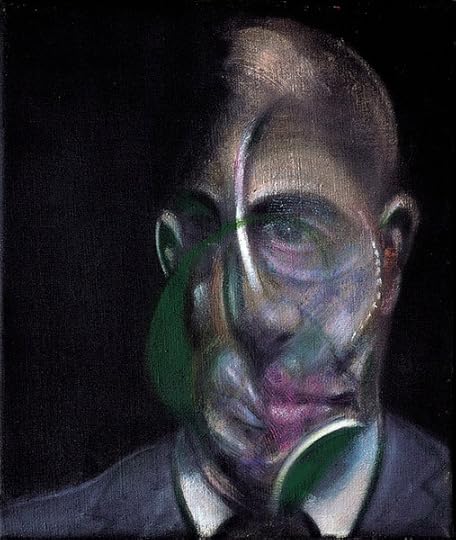
Portrait of Michel Lieris by Francis Bacon.
Profile Image for S̶e̶a̶n̶.
989 reviews593 followers
March 22, 2020
This is a very fine collection of dreams recorded by Monsieur Leiris. Horror, humor, drama, and absurdity all play out with characteristic dream-disruptive pacing on stages set with the uncanny architecture of the oneiric. It is a singular work that rivals the most unique collections of consciously fabricated tales. (Bonus read = preface by Blanchot!)
Profile Image for Eddie Watkins.
Author 11 books5,557 followers
October 14, 2014
Probably the best dream diary I've come across. Many people think that hearing (or reading) other people's dreams is worse than any Sartrean hell, but I'm fascinated by it, that is assuming the person doesn't go on too long and elaborate overmuch, and provided they don't offer their own analysis.

This is a dream diary written with the cold eye of a scientist and the warm ear of a surrealist. Also included are dream-like waking events, but also, and most interestingly, a few examples of dreams actually portending the future.
Profile Image for Lori.
1,398 reviews60 followers
September 28, 2016
An interesting collection of snippets or prose poems mostly recounting various dreams Leiris had during the period of 1923 to 1960. The early pieces show a clear influence of Leiris's friends in the Surrealist movement and can easily be envisioned as a Dalí painting, although that also lends them an air of artifice, as though Leiris was editing them to fit a certain aesthetic, or perhaps Surrealism simply influenced his dreams? WWII and the occupation of France, however, mark a decided shift as the chaotic nature of war (explored very well in Catch-22 ) blurs the boundaries between imagination, hallucination, and reality. From a dream in 1942:
I am the actor Jean Yonnel and I am declaiming a Racinian sort of tragedy. Suddenly I no longer remember my lines. Speaking slowly in short jerky sentences, though still maintaining my declamatory fervor, I proclaim that because present circumstances have made me conscious of tragedy, I can no longer perform tragedy as I used to, a performance which only my lack of awareness had made possible.
A much later dream in 1958, in which Leiris finds himself a tourist in an unknown city he cannot match to any country, reminded me quite a bit of Ferenc Karinthy's excellent Metropole . Overall a fairly quick read but worth going back to.

Translated by Richard Sieburth.
Profile Image for Tosh.
Author 14 books785 followers
April 23, 2008
Dream diaries are usually not that interesting, but then Michel Leiris is not your usual man. A close friend of Georges Bataile and a leading critical writer - he explored the same territory as Bataille but had a more dream like aspect to his writng. And here we have his dream diary - which is quite amazing.
Profile Image for Brendan Monroe.
677 reviews195 followers
September 21, 2024
A book of dreams that will send you straight to sleep. There are a couple of interesting passages here, but they're dwarfed by many more mundane ones. I keep a dream journal myself and, while I may be biased, I find my own dreams far more interesting than the ones included here, which are written in the most tedious style imaginable.

For an "author, ethnographer and art critic who pioneered a unique form of autobiographical writing," as the author's bio says, this is disappointing. But add to that the fact that this author lived in France through both world wars, formed an anti-fascist resistance group later discovered by the occupying Nazis, and was deeply engaged in the struggle against French colonialist endeavors in Algeria and elsewhere?

How is this not more interesting than it is??
Profile Image for Morgan Thomas.
160 reviews28 followers
Read
July 12, 2024
Many people who know me, know I'm a big Bataille fan so I had been recommended this author on several occasions. The last book I read began with the death of Michel Leiris so I thought it would be interesting to read him next. And I was not disappointed. This dream diary shows the innermost thoughts of Leiris in all of its crazy, surreal and bizarre (dream) reality. I myself do not remember my dreams and when I do they operate on a strange sort of logic much different from our own world. Nothing makes sense, no one is who they are supposed to be, places form together. No such thing happens with Leiris and I appreciated for the most part that the dreams were easy to follow. Even when they got more dark. World War II caused a turn in his dreams as you would expect and they also became less frequent. But nonetheless poignant and interesting. As they should be.
Profile Image for Open Books.
44 reviews51 followers
October 23, 2014
For me, autobiographical work always carries a risk that the writer chose an easy way. Maurice Blanchot, the very same person who wrote introduction to "Nights as Day, Days as Night, once stated that Paul Valery is by no means a hero, since he found it good to talk and write about everything and this doesn't belong to the extreme of literature (in this sense, most journals but also some novels - see Knausgard's fiction - don't). But when an autobiographical writing is done properly and when it's obvious that it was a hard work and big sacrifice to uncover deeper layers of conciousness and subconciousness, well, than it can really achieve greatness. And Michel Leiris was always - not only in this book - one of the writers to do it just right.
Profile Image for Dana Jerman.
Author 7 books72 followers
March 14, 2025
Screaming before waking is the pastime of the rebirthed!!
This really cooks toward the end. Enjoyable for all the images of performances, ascentions (staircases and corridors), friends, lovemaking and groups of women and girls.

Le rêve est une seconde vie
- Gérard de Nerval
Profile Image for Katrinka.
780 reviews35 followers
Read
July 2, 2022
It feels odd to rate people's dreams, even though I realize relating them in meaningful fashion does take a great deal of skill. No rating, then, other than the unnumbered variety: I love when excellent authors let us into what their minds get up to while sleeping.
Profile Image for Joseph M..
148 reviews9 followers
March 22, 2020
The form itself in which Leiris presents his dreams is the most interesting aspect of this work for me. Maurice Blanchot says in the introduction,

"These were once dreams; they are now signs of poetry." (p. xxii)

The poetics of dreams has fascinated me recently. In the past I've seen many structures that have a residue of something that can't be captured in the waking world or in language. It's hard to give someone else your dream and have them understand what makes it so deeply evocative for you- but Leiris can do this somewhat well.


April, 1926
(half-asleep)

A meat tree, each of whose roots bears a beefsteak. One night a year, Jesus Christ appears among these roots to proclaim the Republic. Whereupon the roots turn into an inverted Christmas tree, laden with lights and hams, with Jesus Christ, the Virgin Mary, and the Apostles in a halo at its center.


This reads almost like a parable. The imagery builds and build towards its final image and the dream freezes there, leaving us hanging on something who's meaning is indeterminable but which still, in an unidentifiable way, makes sense. Psychoanalysis would likely try to pin some sort of meaning on this dream by analyzing it's constituent elements and the free associations that spring from them towards the residue of past experiences. But Leiris doesn't do this. Sure, he gives us interpretations and points out potential wordplay- but it's never reductionist, because it always ends in a "I guess that could be what it is, but who knows?" Ultimately, what matters for Leiris in the dream are the evocations of new feelings, of a sense which is not a meaning.

Profile Image for Joseph Schreiber.
595 reviews192 followers
April 14, 2017
In maintaining a record of dream experiences for almost forty years, Leiris created a poetic engagement with dreaming that is surprisingly engaging and illuminating. If his initial inspiration came from his connections with the French surrealists, his training as an ethnographer influenced his approach to collecting his own dreams. For my full review, see: https://roughghosts.com/2017/04/13/dr...
Profile Image for Maria Mendoza.
412 reviews18 followers
April 26, 2022
Bien dice el dicho: Haz fama y échate a dormir. Ser famoso y del club de lo surrealistas no garantiza tener sueños especiales ni la capacidad de describir con habilidad lo que se sueña pero sí que te publiquen. Me pareció un libro aburrido, el señor se la pasa presumiendo sus logros, amigos famosos y viajes con el pretexto de explicar algunas referencias oníricas, aprovecha para poner comentarios micro machistas, misóginos y parece que le gustaban las niñas pequeñas.

No lo recomiendo a menos que de plano no haya otro libro a su alcance y necesiten matar el tiempo. Están más divertidos y sorprendentes los sueños del bot de Twitter: @ayer_sone o hasta mi diario https://lenmmblog.wordpress.com/2021/...
Profile Image for Lukas.
72 reviews3 followers
November 28, 2024
makes me sleepy which is good, apparently was intended to be a prose poem and accordingly I find the couple sentence long dreams more compelling than the page-and-a-half life recollections. but both are good. no dream journal is ever destined for greatness, but it has the natural inspiration only brought about by the unfiltered subconscious only brought about by dreams. the wartime stuff is cool too
Profile Image for Fer Aportela.
225 reviews4 followers
February 15, 2026
Esperaba sueños más surrealistas y delirantes, pero Leiris escribe sueños que se sienten más como vivencias, suposiciones y confesiones. Más que imágenes oníricas potentes, el libro funciona como una autobiografía fragmentaria desde el sueño. Tiene destellos interesantes, pero en general no logró atraparme.
Profile Image for Alice Rovani.
123 reviews8 followers
January 6, 2025
vie vécue, vie rêvée, rêve vécu, rêve rêvé : la seconde vie de Leiris à comprendre comme état littéraire second
Profile Image for Luis Alv.
329 reviews5 followers
June 16, 2024
Me gustó, pero creo que los diarios de sueños, en general, no me apasionan.

Es enriquecedor ver cómo los sueños de Leiris muestran cosas a veces sin sentido, pero casi siempre mediante la combinación de símbolos que sí poseen sentido. Me pregunto en qué medida serán distintos los sueños de un artista y de una persona que no se interesa por el ámbito del arte, en qué medida serán distintos los sueños de alguien esta noche y hace cien años.
Displaying 1 - 19 of 19 reviews

Can't find what you're looking for?

Get help and learn more about the design.