As an act of violence spirals out of control to encompass the entirety of the news media, a cult has emerged from the errors and retractions that have ruined careers, marriages and even lives. Under direction from his cult master, The Hand leads an army of followers committed to revolution, willing to die for their cause.
Jonathan Hickman is an American comic book writer and artist. He is known for creating the Image Comics series The Nightly News, The Manhattan Projects and East of West, as well as working on Marvel Comics' Fantastic Four, FF, and S.H.I.E.L.D. titles. In 2012, Hickman ended his run on the Fantastic Four titles to write The Avengers and The New Avengers, as part the "Marvel NOW!" relaunch. In 2013, Hickman wrote a six-part miniseries, Infinity, plus Avengers tie-ins for Marvel Comics. In 2015, he wrote the crossover event Secret Wars. - Wikipedia
Six part mini-series sees Hickman craft a very intelligent story of an American-based American run terrorist cell out to take on the American/World media. Maybe a bit confusing at times, the documentary parts are fascinating, but the core story is a bit lacking. 7 out of 12. Three Stars for Jonathan Hickman's debut series! 2013 rad
How do you turn the brilliant but rather prosaic writings of Noam Chomsky and Edward S. Herman into a comic book? Jonathan Hickman came up with this idea: you just copy some of their sentences, then add a few statistics from a recent article on globalization. Oh, and then you throw in lots of self-righteous violence, of course, so that comic-book readers can relate to the whole thing. "Noam Chomsky Meets the Punisher," basically. Sounds like an ill-advised approach? Well, that's because it is.
In their book Manufacturing Consent: The Political Economy of the Mass Media, Chomsky and Herman argue that the mass media impose propaganda designed to manipulate the general population into accepting economic, social and political policies that are actually not in their best interest, but only in the interest of small political and economic elites. This ideological manipulation is argued to be the result of the mass media's very structure, most significantly of the concentration of media ownership, and of the media's reliance on advertising and governmental news sources.
The Nightly News provides a very rough and sketchy introduction to the theories developed by Chomsky and Herman, quoting a sentence here and referencing an argument there. The spotlight is on the fact that our access to critical information on the topic of globalization is very limited, as the mass media we have come to rely on for information have every reason to keep us in the dark on the subject. After all, why would global media conglomerates and the advertisers they rely on have an interest in us becoming aware of the harmful implications of processes that have been immensely profitable for them?
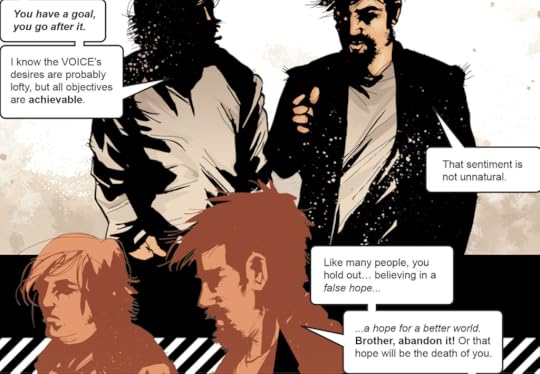
So far so good. Unfortunately, the story Hickman has constructed around those scattered globalization facts is not only awful from a storytelling perspective (cardboard characters, etc.), but falls prey to the very ideological mass media tendencies it purports to criticize. The anti-globalization activists that the story presents us with are not reasonable human beings fed up with multi-national corporations having unregulated political power, but psychotic cult members duped into rebellion by a recorded voice, ruthless and arrogant mass murderers ("We ain't the good guys... we're killing without conscience, bad men with big ideas.") who look down on non-violent protesters (as they, it is claimed, "offer nothing of consequence") and have given up all "hope for a better world," recommending that you simply "abandon it." Apparently, they are in it just for the killings.
In short, the book's demonization of political activism is even more absurd than the one usually provided by the mass media, and the false claim that peaceful activists are fighting for a lost cause simply repeats one of the most commonly trumpeted myths designed to discourage us from exercising our democratic rights. Under its pseudo-intellectual surface, The Nightly News thus adds up to little more than Fox News in disguise. While the book pretends to provide the kind of globalization critique that is usually repressed in our corporate-controlled media environment, it is at its core every bit as close-minded, neoconservative, and manipulative as your typical mass-cultural commodity.
Until a more insightful and sincere comic book comes along (by Joe Sacco, maybe?), I recommend you explore some of the many excellent conventional books or documentary films on the crucially important topics of globalization and mass-media propaganda. The writings of Noam Chomsky, clearly a (not even half-digested) key influence on The Nightly News, would be a great place to start.
The original graphic novel that burst forth mega-writer Jonathan Hickman onto the scene, who has spent the last decade revolutionizing Marvel's flagship titles with considerable quality and science fiction Big Ideas.
The Nightly News is ambitious and intelligent (and very impressive considering he illustrated/designed it as well), and doesn't show much hint of the author's future as a mainstay of the superhero genre. But it does show his extremely subversive element, a kind of 'Fight Club'-esque lashing out at mainstream society and all things wrong with the world!
This story of a weird terrorist cult killing journalists has aged somewhat poorly. Before our current age of digital misinformation becoming the primary villain, there was a real danger of corporate media consolidation back in the early 21st century. Hickman, with his patented comic infographics, has well-sourced all of these issues. The rage and Chomsky references do feel earned and justified.
However, there are some hints at the problematic aspects that media criticism has now evolved into. It's just too lazy these days to say "the media sucks" without analyzing what that really means, and without defining an ideology. Is the problem profit motive, the corporatism? Or is it that journalists are elitists who look down on the common man? Without defining such terms, it's easy to see how general complaining can lead faux populism--inevitably right-wing in nature--which just makes inequality in society far worse.
Complaining about the government from the perspective that all sides are equally corrupt, something the Congressional subplot here also does, betrays the nature of these problems. Anyway, it's self-evident that politicians conspiring with powerful CEOs is an extremely bad thing. I don't happen to be convinced that individual journalists being biased or caught in the occasional scandal is the main structural problem, but okay Hickman is clearly mad about that. So what is the solution?
And that's what makes it an interesting but frustrating read as social commentary: There's no solution presented at all. No calling for, say, unionizing employees in order fight back against capitalist excesses. It's just plain lashing out in anger, with the cult assassinating TV personalities one after the other while making badass quotes. It's certainly a well-done narrative, with some good twists and turns and you can learn some media criticism along the way too, but overall what's the point?
In the 15 years since this was first published, we live in a world where everyone vaguely hates the so-called monolithic establishment "media" and therefore have turned towards algorithmic social media as a replacement. Are we better and smarter for it? The fact is, we clearly are not and everything is far worse now. Perhaps it's time for a sequel to address that...
Although I have a lot of critiques, The Nightly News by Jonathan Hickman is very much worth reading for fans of the author. An excellent historical artifact. It's just that, post-2016 and especially post-2020, it doesn't have the same impact anymore.
A sniper begins shooting journalists and anyone connected to the media, journalists, cameramen, sound guys, all in the name of an obscure cult leader called The Voice. John is recruited to join this mysterious and deadly organisation after a news story destroyed his life where he meets similar people who've had a rough deal from the news companies, wrongful accusations, etc. They begin the fight back against the information monopoly the media corporations hold and the way these corporations abuse this power to mould our reality.
I've enjoyed Jonathan Hickman's work a lot - his FF series with Marvel, his books with Image - they're great, so it made sense to me to pick up his critically acclaimed debut comic book which writers like Andy Diggle and Brian Michael Bendis positively gush about in the blurb and Brad Meltzer even says "This is what the future looks like". Well, if this is the future of comics then I can only imagine that in the future we've all become significantly stupider.
You know how some kids go to college for their first term and return completely changed, believing that having heard a lecturer talk of big ideas and treat them like adults for the first time, they now know everything? This is the impression Hickman gives in this book. Reading "The Nightly News" is like reading someone who has just read Noam Chomsky for the first time and is clumsily fashioning a story around his barely-digested teachings.
Here's Hickman's take on news reporting: journalists and everyone in the media are evil. So evil they deserve to be shot in the head with a high-powered sniper rifle. And to make sure the reader is on the side of the lunatic with the gun, he makes every single journalist evil too. He makes them say things like "I tell people who to pick as the next president, what stocks to buy, what to think about foreign affairs. The Japanese have a saying `The press leads the public'. They're goddamn right." So they're all amoral and deluded with god-complexes: they deserve to get shot right? Especially when they're in collusion with the politicians who are even more evil and scary.
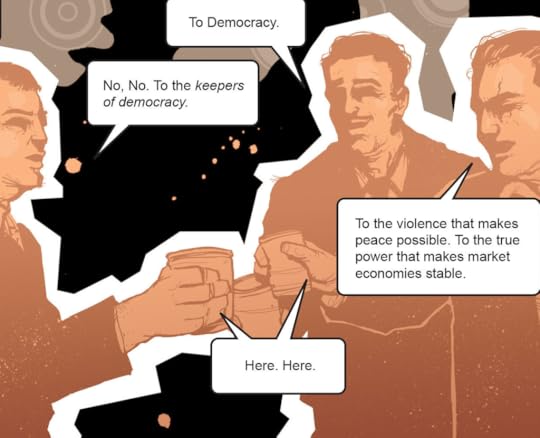
Like cartoon Bond villains the politicians make toasts such as "To the violence that makes peace possible. To the true power that makes market economies stable" and say even nuttier things like "We destroy people without fear of retribution or litigation. It's what we do." And when the evil media types and the even more evil politicians get together Hickman has them literally quoting Goebbels and Hitler along with exposition like "our revenues are tied to our dominance on the front line of ideas". Yeah that's convincing dialogue, Jonathan, they would really be saying that to one another.
But we're clear so far, class? Media and political types are just bad. They deserve all the bullets and bombs the cultists throw at them. Because the cultists know what's really going on, they're the smart ones. They're so smart they say things like "We call them programming facilities. You call them public schools. 99 of 100 students are automata. They are careful to follow prescribed paths and customs, not by accident but by the result of ample education." Riiight. We're all "automata". Thanks guys, for lifting the veil of deceit and showing me the truth - now I see the world for what it really is.
Hickman sprinkles info dumps in each chapter showing charts, figures, and stats in the midst of the story with a snarky and smug disclaimer along the lines of "To find out more about poverty/hunger/rape/genocide read below, however if all you're concerned about is entertainment, skip this and continue reading the next page." He also includes smarmy comments throughout like an un-asked-for commentary along the lines of "here's why I made this artistic choice because you wouldn't be able to handle anything more challenging". It's so unbelievably patronising.
On the one hand you have more-evil-than-Darth-Vader politicos and rich media types vying for some kind of Orwellian future and on the other you have brain-dead anarchists represented here as heroes looking to create a utopia through nihilism. And then between the two you have an author sneering at the reader with an array of facts lecturing you that you're a bad person because you bought this comic book for entertainment and that unless you're fighting the system and the corporations, you're an "automata". I don't know which I disliked more, the authorial voice, the characters in the book, or the story - I just know I hated them all.
I get that 6 giant corporations owning all of the media outlets in the west is a bad thing, but Hickman's solution in the book is "shoot them all". For a book posing (and boy is it posing) as intellectual and knowing, that's a pretty trite answer. Why put so much effort into making yourself look educated and smart when your only conclusion is chaos - surely it undermines the entire point of the book? If you want to address serious problems and talk down to people who ignore them, you can't then turn around and claim the solution is out and out violence, some brainless bang bang boom. It betrays the central premise that this is an adult book with adult issues if you supply childish answers. How about saying something intelligent and/or original? Hickman subtitles this book "A lie told in 6 parts" to cover himself from critiques about his actual political stance and the fiction he's writing. He can make a political statement and then back away from it claiming "hey, it's fiction, it's all a lie!" - in other words he can have his cake and eat it. It's a cowardly approach.
And a hypocritical approach too. Hey Jonathan, if corporations are so bad, why do you work for one? Marvel is owned by Disney who are owned by Buena Vista, one of the Evil 6 you singled out. Writing "The Nightly News" and then going to Marvel to write "Fantastic Four" is like if Tyler Durden made his "you are not a beautiful or unique snowflake" speech and then put on a suit and went to work for Goldman Sachs.
But political posturing aside, how's the story? Well, tedious to be honest. The - and I say this very loosely – “heroes” of the book kill journalists and media types and then the book ends. They're not "characters" as Hickman doesn't really give them character, they're just ciphers at best. There are other plot-holes in the book which I won't go into but are glaringly obvious if you choose to read this.
There are a couple of good points. I liked Hickman's art. I didn't even know he was an artist but he draws pretty well and sets out the pages like graphic design rather than comics layouts and it's quite effective. At times I felt the pages were a bit overstuffed with boxes of information but I suppose that's Hickman educating a robotic schlub like me to think than just read a comic for entertainment. Thank you sir, may I have another?
Overall, this book is astonishingly crap. Bad story and even worse characters aside, being condescended to on every page became very tiresome very quickly and I struggled to make it through the end. This is political thought as written by an immature, thoughtless half-wit who is parroting back ideas bigger than he conceive in a convoluted and messy way. Hickman's response to 21st century media saturation is to throw his toys out of the pram while mumbling banalities about how everyone's an idiot. I cannot believe writers I respect are in cahoots on this book, that a good writer like Hickman wrote this and that Bendis and Diggle praised it. "The Nightly News" is one of the dumbest debuts I've ever read and the kind of book a 15 year old would think is cool and righteous because they're 15 years old. Jonathan Hickman, if this is you trying to prove your intellectual veracity, shut the hell up and get back to writing about the Thing and Spiderman, ok? You're embarrassing yourself, mate.
Cute book. While Hickman never actually throws away his credibility with the word 'sheeple', there is that vibe there. The plot smacks of the convenience that marks conspiracy theory, which is either a reflection Hickman's personal philosophy, a boon to streamline his writing, or both. One always has to fall on one or the other side of the Great Conspiracy, as there seems to be a lot of evidence both ways, but for the cynical, never enough to convince.
Hickman himself admits that the idealism of the conspiracist is no more pure or useful than that of those he opposes. There is some balance in his presentation--a degree of subtlety and satire--but I don't think it quite overcomes the straw men and picked arguments in the book.
But then, he's trying to provoke a reaction, which takes a delicate hand when dealing with dull and frightened people, which is how he paints his readership. Perhaps, hedging his bets, he wrote the story for that sort of person; hey, why write an instructional book aimed towards people who should be intelligent enough to have figured things out already?
I prefer writing as if to a peer, but it can be terribly tempting to imagine the world to be full of ignorant people with no self-will, and raging against it for the damage it does to you.
Hickman litters his book with charts, quotes, and invectives which can be quite amusing. I particularly liked the characters confusing quotes between Chomsky and Goering (particularly apt because of the fascist way Chomsky tries to control his field and silence detractors).
The shout-out to Tufte was also appreciated, but not unexpected, given the design-focus of the creator. I should, for a moment, mention the art, which is conceptual and explorative. Hickman doesn't mind flaunting his design background, and it really helps to give the book an original tone, even if it sometimes looks like a T-Shirt from Express.
But the simplified color scheme, intense inking, and stylization means that very specific and consistent character design is necessary to maintain the flow of the story, which Hickman doesn't always achieve. But overall the design aesthetic is a nice change from your run-of-the-mill book, especially seeing as a lot of those have same-face problems, too.
Nietzsche scholar Rick Roderick expresses that it is the nature of society to wear people down, to make them similar, and to replace their singular, free-thinking parts with socialized, communal ones. As a metaphor, identity is a sort of 'last bastion', under constant siege from without, and hence, any depression, frustration, or desperation you feel is not the symptom of maladjustment, but the perfectly natural reaction to being trapped under external pressure.
But, personifying this social/individual conflict edges too close to pathetic fallacy: more pain and injustice is caused by ignorant, thoughtless actions than by malicious ones. Certainly, there is a consistent form that this conflict takes, which some authors represent in personal terms, but usually, this allegorical representation is about as apt as suggesting that bears meet secretly in order to plan better ways to use their claws and teeth on hapless salmon.
Certainly there is a destructive imbalance at play, and it is soul-wearing to labor beneath it, but it is disingenuous to represent this power-play as ultimately purposeful and unnatural. It makes for an exciting story, gets the revolutionary blood pumping, making you feel alive, and revealing, for a moment, all the bare scaffolding of our unequal society, but it's an oversimplification.
Like Fight Club, it's meant to wake you from your daze, your useless, work-a-day life, and make you feel righteous, for a moment. Beyond that fleeting fist pump, the method is rarely effective. I always prefer works that treat the reader more respectfully: presenting multifaceted, subtle arguments, allowing the reader to come to their own informed conclusions.
There is some subversion in TNN, but it is difficult for me to see what line Hickman intends to draw between cynicism and idealism. The character of the author is always acknowledged, and despite some deliberate self-deprecation, Hickman portrays himself as informed, sure, and freed from social control by his knowledge and will. Combined with the portrayal of the reader as weak and ignorant, Hickman comes off as somewhat egotistical and deluded, as conspiracists tend to be: no one would be out to get you if you weren't worth getting.
The book wasn't one-sided, and it did reverse its themes a few times, but it’s rather linear, and if you think you’ve guessed the Big Twist, you have. His attacks on the media evoke other comic greats, particularly the talking heads from Miller’s ‘The Dark Knight’ and the struggle between information and power from Ellis’ ‘Transmetropolitan’.
He has other similarities to Miller, as well: with his thick ink and violent storyline of a small armed man acting against a large power structure, it is evocative of Sin City. However, TNN doesn’t have the heavy satire of Dark Knight, nor is its exploration of journalism and the power of ideas as vivid as the gonzo sci fi adventures of Spider Jerusalem. Hickman’s story is going for a much more realistic approach, yet he seems to have traded a sci fi fantasy for an ideological fantasy.
Hickman states several times that the book is meant to be a fun, simple revenge story, though condescendingly prefaces these admissions with the implication that the reader would be incapable of seeing anything deeper, anyways. Perhaps he's trying to be funny, or perhaps it's merely an extension of the little trust he puts in the reader, or maybe, he's simply hedging his bets: putting his philosophy of the world out there, and then indicating that no one will 'get it', since, if changing people were as easy as entertaining them with personified inequality, the world would have long ago grown better on the backs of willful, informed, revolutionaries.
But then that's never how it plays out. Every power structure comes to resemble the ones before it, independent of who put it there or why. I could have done with some more cynicism about both 'revolution' and 'enlightenment', but then, Hickman needed there to be a firm ideological structure for his revenge-bent protagonist to follow.
Unfortunately, the straw men he's fighting him make his journey feel rather weak, and perhaps that should clue us in. If Hickman isn't capable of presenting the enemies of revolution as sympathetic human beings, then he probably isn't capable of comprehending why such structures develop, despite all the illumination he places before us in pretty charts.
In the end, the bad men in his allegories are more villains than characters, sociopathic and acting not out of their own ideals or confusion, but from ennui and a need for chaos. He suggests that his protagonists’ methods aren’t that different, but since their enemies are not true foils, it becomes clear where Hickman's sympathies lie, and that those sympathies are coloring his conclusions.
I enjoyed this book, but I would have liked it more if it respected the reader and painted the situation in realistically complex ways, showing the difficulty of trying to comprehend the Big Picture. But maybe that's a problem Hickman, himself has, which would have come off better if he presented this flaw as something to struggle with instead of something to idealize.
The Nightly News is the story of a group that becomes labeled as the Cult of the Voice and their attempts to bring justice to corrupt journalists by any means necessary. While the author makes it very clear that he’s not advocating violence, this cult of anti-news activists use a system of identifying corrupt or lazy reporters that have ruined the lives of others by pursuing story rather than fact and kill them on live television. The Nightly News is essentially a treatise against the twenty four hour news cycle and the lack of objectivity and fact in news today. It makes the argument that the news is created to indoctrinate the public rather than to inform them and that it is engineered that way by a complicated, corrupt web of politicians, businessmen and journalists. The cult aims to create a world free of that pervasive influence and they kill many of those that they see as contributing to this culture of indoctrination. The story is supported by a unique art style and infographics that may or may not be factual but that add to the story being told. The web woven throughout The Nightly News is complicated and occasionally hard to follow but it’s certainly not short on hairpin curves.
To say I'm not a Jonathan Hickman fan is a fairly significant understatement. I have yet to really like one of his stories but I flat out HATED Pax Romana. The Nightly News is a step above Pax Romana in several ways but the best I can say about it is that it’s not quite as terrible. Just like with Pax Romana, the story is essentially a tiresome treatise on a subject that appears to be near and dear to Hickman’s heart. It’s like if you mashed Noam Chomsky with the lunatic on the street corner and then gave him a gun. Stories often have a point that they want you to walk away with when you’re finally finished reading but I truly hate when the story gets lost in that point. For a large part of The Nightly News, I felt like I was reading some manifesto posted on some obscure blog. At no point did I care about a single one of the characters because I was never given a reason to do so. They weren’t fully fledged people, they’re just talking points for Hickman. It also falls prey to what appears to be Hickman’s fatal flaw: an addiction to babbling on and using an art form meant for SHOWING to TELL you everything. There were understandable and relatable points in the story and lessons in which I somewhat agreed with Hickman, only to have him take it to some conspiracy nut wet dream’s extreme and lose my attention completely. It’s not quite on the same level of Pax Romana, but I feel no smarter or emotionally changed from reading this. Mostly, I was just bored.
A large part of the reason that it IS actually better than Pax Romana however is the art. While Pax Romana’s panels were so heavily dominated by text that I could barely tell that there was art in there at all, The Nightly News does very interesting things with the art work. Gone are the traditional panels. It has the same strangely pretty art style as I’ve come to expect from Hickman but he uses shadow and color to have violence without it being gory. It’s still somewhat shocking but more stark and therefore more interesting for it. There is still a lot of text but instead of hiding the art, it accentuates it. For a story with this much text and extraneous infographics, it’s actually easy and compelling artistically to follow the progression from page to page.
Given my deep hatred of his previous work, I had pretty low expectations of The Nightly News. Perhaps that colored my opinion but frankly I’m still not convinced that Hickman knows that graphic novels are supposed to tell stories along with the moral. If you’re fascinated by conspiracies and the idea that the news is really just propaganda, The Nightly News may be just the book for you. To be fair, the art makes it worth flipping through even if you’re as bored by conspiracies as I am.
Oh my god. This is UNBELIEVABLE dreck. I know this is one of Hickman's earlier works, but between this and Black Monday Murders, which is much more recent, I'm starting to think that Hickman's a bit of a, um, complete nutcase. This is fully Q-Anon shit and it is miserable to read. I truly can't believe it.
So, this charming story is about a bunch of people who have been called by some mysterious, culty higher power to kill journalists en masse. That's it. That's what it's about. And I would find it disturbing but readable if Hickman seemed to be writing this from a standpoint of "look at these horrific people," but instead he seems to think these deluded, fascistic murderers are soooo cooool. This is evidenced by the fact that Hickman repeatedly uses real-life examples and little insipid infographics to make the point that journalists are an untrustworthy lot that are controlling us all and therefore deserve to be killed. I simply cannot believe this comic was NOMINATED FOR AN EISNER. What are we doing here???
Look, I agree that media consolidation is a terrible thing, and that it's leading to an unprecedented narrowing of what information is disseminated by these mega companies. I believe that these companies should be dismantled and their monopolies destroyed. But I don't blame the fucking journalists. This book is so stupid and infuriating I can't even wrap my head around it.
Also, it's not even "good" by any reasonable measure. The story plods along, constantly interrupted by Hickman's idiotic grandstanding and infographics. There are no characters to give a shit about. The art is sparse and muddy and it's nearly impossible to tell characters apart. This is, in every way, one of the worst comics I've ever read.
Consider me a bigtime Hickman Skeptic now. I've loved a lot of his work, but this feels written by an angry person who has no idea what to do with his frustration. It honestly actually reads like a manifesto. If he didn't want it to? If he thought this was satire? Too bad. It ain't. This is part of the problem, and I absolutely hate it.
It's a rare occasion when I worry that a comic book purchase will land me on a Homeland Security watch list. After reading the first chapter of the elegant hardback that I picked up at Westfield Comics, I was concerned.
The Nightly News was creator Jonathan Hickman's debut work. In it, he attempts to channel the popular rage that films such as Network and OutFoxed attempted to bring to the forefront. The pages are packed with "info-graphics" which (despite many disclaimers stating that the account is fictional) put forth a great deal of real information as it relates to the structure of corporate media in the United States and the world at-large.
This is a book that was several years ahead of its time. When the first of six issues came out in 2008, we had yet to witness the effects that the Arab Spring, Occupy, and Anonymous movements would have on the popular discourse. The only people screaming about globalization and the concentration of wealth into the hands of an ever-smaller circle of people were anarchists, ultra-liberals, and the basement-dwelling conspiracy theorists.
The book is a scathing indictment of the "systems of control" that have been created over many decades. Media, education, pharmaceuticals—nothing is out of bounds as Hickman verbally assaults the establishment.
Four years after its release, many of the topics that are addressed with violence in the book are core issues for the rising wave of populism that started with Egypt last spring and continued on through the Winter. Hickman's mysterious driving force, "The Voice," would be perhaps proud to see the new generation of activists who are not content to merely wave sins, but actively work to tear down the corporations, politicians, and purveyors of control whose works define the world in which we live.
If The Nightly News were to come out today, it would be hailed by the Occupy movement and decried by Fox News as a blatant call for violent uprising. In truth, it is a tremendous story whose broad, sweeping narrative reminds us that the struggle for freedom is ongoing and, as Thomas Jefferson famously said, that "the tree of liberty must be refreshed from time to time with the blood of patriots and tyrants." I'm sure The Voice would agree.
I've heard nothing but gushing praise for Hickman, so I'm going to jump on the bandwagon by checking out all his early stuff 5 minutes before he starts his gig at Marvel.
This book looks amazing. Stylistically, it's like nothing I've seen before. Every page is a feast for the eyes. The story is also just the sort of thing I like, blending Fight Club-subtle political discourse with a wicked sense of humor and wish-fulfillment violence against "the man."
The trouble is, it left me feeling pretty empty. The characters don't have much depth and are often difficult to tell apart. The intricate design work, while fascinating to look at, doesn't always make for the clearest reading. There isn't enough of a plot to hang the message on, and what there is doesn't reach any satisfactory conclusions. Maybe if I was still more of an Angry Young Man I could overlook the storytelling flaws in favor of the fight-the-power sentiment. But telling me that a handful of giant corporations own the media is only a first step. You then have to do something interesting with that information beyond just putting bullets into members of said media.
The potential here is obvious, and I look forward to seeing more from Hickman. This one, while entertaining, just didn't hit all the necessary notes with me.
I think my favorite part of this whole book is Hickman's final words. It made the most sense of it all haha.
So what's this about? Well a bunch of news or media people are getting shot in the head. Like Bam, boom, head gone or big motherfucking hole in the head. Why? Because a group of people are being controlled by "The Voice" and told to do these awful things. With a abstract look of it all, not common comic paneling, and a ton of philosophy questions, the comic begins a dark spiral trip down a dark way.
Good: Really enjoyed a lot of the dialog. The back and forth made me think, made me question things, made me scared of my own thoughts sometimes even. The twist and turns kept me intrigued and really loved the ending. I also thought the structure was well done and told a complete, one shot story.
Bad: The art isn't my favorite. Can't really tell who is who. Everything is blotchy and dark. The structure is hard to follow at first and takes awhile to get used to. The questions are tough and maybe a bit too wordy for some.
Overall this was pretty interesting comic. I don't know if I'd suggest it to a new comic reader but once you read a few, this is something to check out since it's SO different. I'd go with a 3.5 out of 5.
I've enjoyed nearly everything Jonathan Hickman has done, and The Nightly News has been sitting on my bookshelf for some time now, waiting to finally be read.
The book is described in one blurb as a cross between Fight Club and Network, and it's absolutely correct in that assessment. It follows a cultlike group that's effectively killing off news reporters for being bad at their jobs. It's very ultraviolent and extreme, and as a choice, it's not really a bad one. The story is interesting and really keeps things moving.
The key of Hickman's early work, however, is the style. It's always pretty jolting, with a lot of abstract stuff combined with quite modern looking text boxes and speech bubbles. The style, in this case, both works in ways to advance the story well while also acting as a sort of barrier to get things moving forward. It was a bit of a struggle in this one that didn't exist for me in other things he did, like Pax Romana.
Still, worth reading. It's unlike much of anything else I've read in a comic up to this point.
This is an incredibly twisted, well-reseached piece of lit. Well rounded characters despite their seemingly shallow motivations (vengeance against the system that betrayed me) doesn't usually strike me too much, but JH does a terrific job giving these martyrs let and nuance. The artwork and layouts too are amazing.
I'll come straight out with it here... I sadly wasn't a fan of The Nightly News.
I did appreciate the cinematic plot that, as a concept, seems to progress somewhere in a space between The Network and Fight Club movies, but the book just seems inherently bloated and long winded, even though it comes in at under 200 pages!
It's like an explosion of information tied up in political rants with their feet firmly planted in social conspiracy, which in itself, sounds like an experience, but this just seemed to lack coherence for me.
The stylised vector illustrations throughout were undoubtedly impressive, but it's definitely not my preference. Although it gives a very iconic look, the pages themselves become too busy and seem to be filled in irrelevant material.
Overall, I found this heavy on dialogue, convoluted on plot, and extreme with visuals. The premise is certainly interesting, but sadly not enough for it to be memorable.
While Hickman has definitely grown in just about every aspect of his writing, seeing his groundbreaking use of graphic design and info graphics to create humor, build character, and deepen the world is undeniably exciting. Oftentimes pages don’t have panels, with images and words blending together to create a map of story. He uses the facts of the real world as world building tools, treating 2006 America as his own fictional landscape where every fact is connected to deepening the story. Even when the book itself doesn’t give us much of an opportunity to get to know the characters, Hickman has a way of summing them up in three sentences that manages to be variously humorous, foreboding, or exciting. As for the story, it’s exciting, entertaining, relevant and often prescient. It’s treatment of women though (the only two that can be called characters are a victim of rape and murdered respectively) and language around sexual assault are its most dated aspects and make the book tough to read at times. The book is dated, messy, angry, and of its time, which makes it an interesting read as a piece of comics history and Bush-era art.
The book begins with a screed against corporate media that is seductive in its raw honesty and emotion, but immediately shows our lead character committing acts of violence that would turn most stomachs. These are not heroes. By the time our lead John meets the deprogrammer we realize the cult of fanatic hate he is a part of is not too different from the very media complex he hopes to destroy. In a present day where journalists are mistrusted, threatened, and attacked, John and the cult of the Voice could be seen as precursors to the far-right conspiracy theorists and violent domestic terrorists that spin out of places like Qanon forums, who are rightly fed up with the human destroying symptoms of Capitalism, but subsequently misidentify the source. The book is about how the top to bottom corruption in media leads to the disillusioned seeking something more violent, something that misconstrues facts and massages information to make you believe in something just as misguided. Hickman opens with a warning that this book is “plagiarized, misrepresented, factually incorrect, or complete fabrications“ and that is the very subject of what you’re about to read. We are all in a cult or at risk of being a part of one in some way or another, with information being used as a tool to manipulate the less powerful.
This is a real interesting book but I think it was cause I was reading it the same time I was reading Fahrenheit 451.
Nightly News is mimicking movies like Network. They news and all the organizations that own all the news are trying to control us, and to make everyone thing a certain way, much like the government in Fahrenheit.
The story involves a group called The Hand that is starting to attack the news media through brutal attacks and bombings throughout New York City. The problem is that it really doesn't feel like it follows through. Who is the leader of this group? And are their methods really going to have a real effect? Most of these seem to be a let down in the end. The style of the book is what drives this though, and the mix of story with actual statistics about news organizations and what they do.
This comic is certainly different from the mainstream. The page layout hits you first as unique and original. You get the main story together with statistical facts, quotes from a character called the Voice, even facts about physics where they are relevant. Unfortunately, the setup makes it a slow read.
The setting is the modern day when a secretive order is carrying out terrorist acts to punish the corporate media and disable their propaganda. Their order has a cult-like hierarchy with the Voice as the leader. None of the members may see or directly speak with the Voice. The Hand is ordered by the Voice to carry out terrorist acts and he then assigns tasks to regular members. They are the Cult of the Voice, a group of individuals whose lives were destroyed by the media and they now want revenge.
The views in this comic might be a bit hard to swallow for some. They are extreme to say the least - the media, the government and the school system are constantly blamed for the corruption of society. Still, it can be argued that, even if the media doesn't do in real life what the author describes, it does have the means to do so. It this story their corruption is a premise.
John Guyton ended up on the streets after a racism scandal. Alexander Jones wants to show him the truth about how his case was manipulated by the press. As the new Hand, John starts a war against the corrupt press, shooting to death several journalists and cameramen using a sniper rifle.
I didn’t realize that this was Jonathan Hickman’s debut comic till after reading it. That seems to make more sense since this felt a little unrefined. The art style using graphic design certainly felt unique in a similar fashion to Matt Fraction’s Hawkeye though I thought that was MUCH better. There was something a bit basic and “low budget” feel in this one.
My biggest complaint about this book is how much time we spent with the Cult of the Voice. Of course, the violence they commit is atrocious and makes me squirm though I wouldn’t shy away from the violence just reflexively. I think a good narrative is important but that’s where it lost me. We really humanized and expanded on the Cult while every “establishment” character was involved in a conspiracy and beholden to nothing but their own interests. Maybe this is largely a philosophy problem for me. Yes, there are conspiracies and devious architects but we’ve been on this spinning rock for a short time especially at the individual level. I think it’s a bit naive to imagine vast conspiracies at every level. Humans are too short-lived, independent, shallow and just plain random for that to every truly be believable.
Also, in 2020, this book against media doesn’t age so well. We get enough of that hatred on the internet. Journalism is part of the bedrock of Democracy and this certainly can fuel the wrong person by what’s in it and that’s a bit scary.
Also, the ultimate thesis and reveal didn’t make too much sense to me. Maybe it just went above my head but the reveal felt a bit expected and didn’t really expand on it much. John’s actions felt a bit uneven and unexplained as well.
I did ultimately like the characters and I think the characters had a lot of relevant points. The black and white arena just felt too strong. Granted, there are multiple caveats that the author himself is separate from the work which makes sense here - it’s still jarring to read.
Hickman's page layouts are exciting conceptually, though they give me a bit of a headache in practice - in what is incidentally a potent simulation of the rootlessness many cult-susceptible people feel, the lack of detailed environments made this thing feel like a bunch of floating heads spouting arguments.
I do enjoy how messy this book is. Its voice is Palahniuk adjacent, its characters a collection of straw mans designed for you to deconstruct and poke holes in.
Call me a little silly but the colors + character designs weren't distinctive enough for me to remember who the hell everyone was, so I had to look up the plot summary when I finished reading to figure out what happened. Boomer moment from me, sad.
I like the infographics and the recurring intros between all 6 issues, especially the way they descend into further aggression - a nice microcosm of how one slowly falls prey to the influence of a cult.
I do wish I enjoyed this more, it feels more like an outline of a story than a story.
Thanks to Driscy with a Biscuiy (how do I spell this previously phonetic nickname?!) for gifting me this
Premier comics publié de Jonathan Hickman. Assez lourd dans son propos. Se veut disruptif et iconoclaste mais le thème et son traitement ont assez mal vieilli, dans l'Amérique contemporaine de la post vérité et du harcèlement des journalistes.
I picked this up at the latest comic book convention I went to without knowing anything about it. My purchase was based solely on Hickman's name (I liked some of the epic, sprawling stories he did at Marvel a few years back). Then I started reading it. Wow. I had some real issues with this book. Let me start by saying that it's really well-written and the art/design style (a mix of comic book art and graphic design photo-realism) is pretty unique. The book for the most part eschews the traditional panel layouts, but it works very well. (Other reviewers have complained about this and found it hard to read/follow; I had no such problems.) The book first came out in 2008, but reading it now, 11 years later, is a real punch in the gut. The story is about a violent cult (referred to as the Cult of the Voice) and their mysterious, unknown leader (The Voice, whose identity is revealed only near the very end). The cult sets out after members of the media - the corrupt, corporate, profit-driven media - and there's certainly a story to be told there. But seeing the cult assassinate journalists left and right (both metaphorically and politically) is very disturbing in the era where the president of the U.S. claims the media are "the enemy of the people" and blatantly promotes violence aimed at them. Did Hickman see this coming down the pike? Let's hope not. And let's not confuse the author with the story, either; these characters are very seriously fucked up and manipulated, and definitely not a stand-in for the author's views (he says as much in the trade paperback's bonus material). Unfortunately, it hits way too close to home for the modern era, and it made me cringe and my skin crawl when reading it - and I couldn't do more than one chapter at a time. I was prepared to give this three stars until I got to the end and discovered Hickman's notes, which explained and expanded on various points throughout the book. I loved these and was really happy to see them included; enough so that it bumped my rating up to 4 stars. Still, this book left me feeling mighty uncomfortable.
The Nightly News has not held up particularly well ten years after its publication. Yes, the media still dictates to the masses, but in our modern Trumpian era, the concern is fake news, not big news. Big news is kinda the hero now, in a weird way. Oh, and social media has upended this whole thing.
Anyway, it would be fine if The Nightly News merely failed to be prescient - who would expect that, besides Jonathan Hickman? The real issue is that it's basically unreadable. The format is so aggressively different that it's nearly impossible to follow dialogue across the page or determine which characters are which. I grasped that the story is about revenge against the media, but the why of it all remains a complete mystery. The motives for individual characters are sketchy at best.
The book seems designed primarily to shock the reader. Look at this wild design! Check out the facts about why we're all dumb animals! See some reporters get shot for no apparent reason! I guess I was shocked for those reasons, but also by how bad the book was.
"Following the orders from the VOICE, they marched through one of the largest polling companies in New York killing 3 of every 5 employees."
I heard the author's original pitch for this was Network meets Reservoir Dogs. Yep. The mingling of news brokers and power brokers molding public consensus meets a rising cult dedicated to killing those journalists. Running through it all is a cynicism that says both the news and the cult are fundamentally about brainwashing.
The style is highly distinctive, taking more from monochromatic info-graphics than from primary colored comics. After the first dozen pages I had to restart, because it took me that long to get a good feel for how the pages/story were presented. Refreshingly the story is finished within this single graphic novel.
Brilliant and very apt, raises issues that are always going to be current and a nice bit of storytelling. Cool art as well and put across a part of life & society that has annoyed me for years.
"Believe it, kid... We ain't the good guys... we're killers without conscience, bad men with big ideas. We're the twilight holding off the night... Who the fuck did you think we were?" – Brother David Cox
(Note: If at any point it sounds as if I'm getting too far ahead of myself with specific plot details, just know that I'm making the conscious effort to restrict my review so that it primarily covers impressions that can be gleaned from the first two issues (of six). So here goes nothing...)
In Jonathan Hickman's The Nightly News, John Guyton – under orders from a mysterious figure named the VOICE – leads a dangerous cult (i.e. The First Church of the Brotherhood of the VOICE) on a murderous rampage targeting New York reporters. As "HAND" of the VOICE, John acts as "high priest" for the Church, recruiting followers to serve its cause, and spearheading numerous terrorist attacks in the city. He, as well as each of his brothers and sisters, have all had their lives destroyed by inaccurate or supposedly unjust media attacks. It is the goal of the VOICE to harness the combined "righteous anger" of their victimized followers, and channel it towards the dismantling of the corporate media machine – a titan whose power and influence is so vast that it has been able to brainwash the general public while serving its selfish interests by lying, cheating, and killing without compunction.
One of the biggest things that had bothered me about the plot is John's character. Compared to the previous HAND (i.e. Alexander S. Jones), John struck me as rather narrow-minded and a bit unsure of his mission. Early on in the first issue, John makes it clear to readers that his primary motivation is to achieve some measure of revenge against the institution that wronged him and his brothers. Alexander and the VOICE, on the other hand, seem more concerned with the intellectual liberation of the common people, and the exposure of their prolonged indoctrination and slavishness. But honestly, this is only one of several objections I had with the character, and I will leave those (and some notable writing missteps) to be discussed in the postscript.
More generally speaking, the plot itself was quite intricate, and at times, difficult to follow. But if you're an intelligent reader whose entertainment diet consists of documentaries and political thrillers, there's a good chance you wouldn't have as much difficulty as I did. And I wouldn't quite label this as a flaw in the story, but its narrative jumps (i.e. bouncing from past to present) and diversions may not be for everyone. I also really wouldn't be surprised if many readers are turned off by Hickman's inclusion of his little "educational" asides (charts, diagrams, and factual snippets). If you're someone who is very knowledgeable in areas such as economics, politics, and sociology, then I suspect you'd get little out of them. Personally, I found them very informative and enjoyable, right up to the point where they began to hinder the smooth and expedient progression of events in the main plot later on.
The complexity of the plot really kicks into gear during the second half of the book, and this coincides with a change in the narrative much more favoring solid plot progression over supplementary asides. Starting from the fourth issue, Hickman starts the engine and doesn't let up, and the book finally starts to feel like a true thriller. This ought to be the closest you get to being fully immersed in the story, since everything that precedes it just sets the stage for the final three chapters. The way I see it, all that previous focus on the numerous failings of modern society was provided and thoroughly explored in an effort to add legitimacy to the Church's cause, as well as develop sympathy between readers and the key cult members.
At some point closely following the end of the third issue, I felt I pretty much got where the VOICE and his Church were coming from, and agreed that something should be done to alter the status quo. However, Hickman's portrayal of that world's corruption may have been a little heavy-handed. I do believe his basic premise may hold at least *some* merit outside of the story, but the writer's lack of subtlety made things a little tough to digest. For instance, there were times in the story where politicians and news executives would say things among themselves that too blatantly implied sinister intent. Below, I've included one such instance from issue #2 that struck me as awkward and forced.
And as I briefly touched on before, the events in the second half propel the story at an exciting rate, and actually end up leading to a vastly satisfying climax and plot twist. There's quite a bit of action in this part of the book, but even the times when the characters were just talking seemed more interesting than they had before. I especially liked the political deliberations between the media executives in response to the actions of John and the Brotherhood. Admittedly, I don't think I understood everything that transpired during these discussions, but the parts I did get (and even some of the few parts I didn't) seemed oddly intriguing. Part of this probably had to do with Hickman's uncanny ability for clever dialogue; there are so many quotable moments in this comic it's not even funny.
But in the end, Hickman's spectacular artwork had to be one of the greatest strengths of the book. Again, this was another shared element also present in Pax Romana, and one that was just as successful here. Aesthetically, I see Hickman as a comic book Zack Snyder, and I was yet again puzzled about just how he was able to pull off such impressive and unique visuals. For those readers who just *have* to know his secret, Hickman kindly includes a "How to Process" section at the back of the book that outlines how he drew the images in this graphic novel. I'm not much of an artist, but if I were, I'm sure I'd get a heck of a lot out of that.
Similar to Pax Romana, Hickman tackles some provocative philosophical concerns here, using them to help raise the stakes and make the central conflict more engaging. What initially seemed like a somewhat simplistic and childish perspective on the part of the Church, became something more, and I was impressed to discover what Hickman had in store for me. So although it was flawed, the fact that Hickman brings his usual sharp writing and intellectual flair made this book well worth reading, and I'd recommend any comic book fan to check it out and come to their own conclusions. But to anyone who liked this at all (and maybe even if you didn't), I implore you to try and get your hands on a copy of Pax Romana, and spread the word if you like it; I think it's way too good to be so greatly overshadowed by this book.
Postscript:
Possibly the most noticeable shortcoming when it came to John had to do with the ambiguity surrounding his motivations. The two images included below seem to indicate that John was unable to make up his mind about whether the goals of the VOICE are even attainable, and I could see no rationale behind this discrepancy.
The next problem I wanted to address is a pretty big spoiler, but feel free to click it if you've already read this book (or don't intend to):
Also, it seems one of John's very early acts as the HAND is to brazenly disobey one of the *three* simple rules he was given by his predecessor. () For me, what this did was raise some pretty serious questions that I needed to have answered by the end of the book. Unfortunately, I was not too impressed with Hickman's explanations (or lack thereof). By the time I finished the story, I suppose I had enough information to make some shit up and fill in the apparent holes left in the plot, but doing so feels too much like doing Hickman's job for him, and almost seems to unfairly assume that I – the reader – am the cause of the misunderstanding.
------------------------------------------------
And another thing: When analyzing the basic tenets of the Church, as well as it's proposed mission as stated by the VOICE, a glaring piece of irony popped up in my head early in the story, and I wasn't really able to shake it off. Fortunately, it's addressed later on in the miniseries, but having me endure nearly half the story before reaching any measure of relief was kind of cruel (or sloppy) on Hickman's part, and made me start to suspect that he himself had missed it. I think it actually would have made the story more enjoyable had Hickman just tackled it earlier, and I'm sure many other readers may have caught it as well. (Click below for the specific instance:)
Boy, I can only imagine this read very different a decade ago. I’m a big fan of Hickman, but this is some of his weaker stuff. Not just because it’s his early stuff but because the climate it was written in is so different it hasn’t aged the greatest. For better or worse it probably wouldn’t be published today.
Don’t get me wrong. It’s not bad... it just feels a bit naive nowadays. The complaints about the news institutions are certainly valid. Even more so now. But it falters by painting a slightly unbalanced picture. The journalists and peaceful protesters are vilified slightly more than I feel is accurate, with all the journalists being part of the big media conspiracy, both knowingly and willingly. In contrast, it feels like the Cult of the Voice has the potential to be misread as heroic. Maybe it was more obviously a caricature when it was published, but with journalists in danger around the world as a result of doing their job, a comic where the ‘heroes’ (the word being used sarcastically here) kill them it feels... icky. The ending does a great deal to assuage those concerns but it still slightly feels like too little too late.
Good, but not great.
P.S: Been keeping my comics out of the Reading challenge as I read a lot and not in trade which makes it difficult to tally in terms of what constitutes a book. Making an exception here as not only is it a self contained mini collected in trade but due to the photo referenced art and abundance of words it counts as close enough to a book for me to add it. Plus I wanted to write my thoughts on it.
(Zero spoiler review) I picked this up as The Black Monday Murders was exceptionally good, and this one seemed more than a little familiar to the aforementioned series. I mentioned in my TBMM review that it seemed Hickman had an inkling about what was really going on in the world, even if the themes tackled in this series are far more 'entry level' conspiratorial' then the higher concepts TBMM dealt with. Sadly, not only was this a more mundane read from this point of view, but it was far less entertaining and engaging a read overall as well. There was precious little characterisation throughout the story, though this was significantly hampered by the art style, which although fairly unique, did not either lend itself to the story or make for easy reading at the best of times. The panelling was obscure, even unpleasant at times, and I frequently found myself struggling to figure out who was who, and what was what. There were a few moments here and there when I thought that we were really going somewhere, and things were looking up, although a few pages later, and it was back to being obscure and rather bland. I really wanted to like this. I mean, I really wanted to like it. Sadly though, Hickman had the right idea, although his execution was all wrong. This could have been an amazing ongoing series, although sadly, it was a rather weak and impotent six issues. Disappointed. 3/5