

What do you think?

The Oxford Book of Essays
Now in a more readable format, this sweeping collection ranges from the early 1600s through the 1980s and includes 140 essays by 120 of the finest writers in the history of the English language. John Gross, former book critic for The New York Times , has collected classics and rare gems,
representative samples and personal favorites, intimate essays and learned, serious reflections and hysterically funny satire, by both British and American writers. The authors Gross has gathered form a gallery of genius, all indispensable masters of rhetoric, from Samuel Butler to Samuel Johnson,
from George Eliot to George Bernard Shaw, from John Dryden to Ben Franklin, from E.B. White to Joan Didion. Including book reviews and travel sketches, history lessons and meditations, reflections on art and on potato chips, these essays sample four centuries of eloquence and insight in a collection
that is at once immensely enlightening, edifying, and entertaining.
representative samples and personal favorites, intimate essays and learned, serious reflections and hysterically funny satire, by both British and American writers. The authors Gross has gathered form a gallery of genius, all indispensable masters of rhetoric, from Samuel Butler to Samuel Johnson,
from George Eliot to George Bernard Shaw, from John Dryden to Ben Franklin, from E.B. White to Joan Didion. Including book reviews and travel sketches, history lessons and meditations, reflections on art and on potato chips, these essays sample four centuries of eloquence and insight in a collection
that is at once immensely enlightening, edifying, and entertaining.
704 pages, Paperback
First published January 1, 1991
About the author
John Gross
59 books10 followersJohn Gross was the editor of The Times Literary Supplement in London, a senior book editor and book critic on the staff of The New York Times in New York, and theatre critic for The Sunday Telegraph. He was also literary editor of The New Statesman and Spectator magazines.
Ratings & Reviews
Friends & Following
Create a free account to discover what your friends think of this book!
Community Reviews
Displaying 1 - 17 of 17 reviews

April 19, 2018
From "Disintroductions" -
You incautiously meet your friend Smith in the street; if you had been prudent you would have remained indoors. Your helplessness makes you desperate and you plunge into conversation with him, knowing entirely well the disaster that is in cold storage for you.
The expected occurs: another man comes along and is promptly halted by Smith and you are introduced! Now, you have not given to the Smith the right to enlarge your circle of acquaintance and select the addition himself; why did he do this thing? The person whom he has condemned you to shake hands with may be an admirable person, though there is a strong numerical presumption against it; but for all that the Smith knows he may be your bitterest enemy. The Smith never thought of that. Or you may have evidence (independent of the fact of the introduction) that he is some kind of thief - there are one thousand and fifty kinds of thieves. But the Smith has never thought of that. In short, the Smith has never thought. In a Smithocracy all men, as aforesaid, being equal, are equally agreeable to one another...
Some days...most especially those days...Ambrose Bierce is bound to hit the mark.
Other essays of note came from Mark Twain, Robert Louis Stevenson, Leigh Hunt, T.H. Huxley, James Baldwin, Jan Morris, and a terribly poignant piece by Charles Lamb on grieving the loss of children. These were exemplary, yet about two-thirds of the collection was well worth the trouble. A healthy assortment of authors to sample...and perhaps further investigate.
You incautiously meet your friend Smith in the street; if you had been prudent you would have remained indoors. Your helplessness makes you desperate and you plunge into conversation with him, knowing entirely well the disaster that is in cold storage for you.
The expected occurs: another man comes along and is promptly halted by Smith and you are introduced! Now, you have not given to the Smith the right to enlarge your circle of acquaintance and select the addition himself; why did he do this thing? The person whom he has condemned you to shake hands with may be an admirable person, though there is a strong numerical presumption against it; but for all that the Smith knows he may be your bitterest enemy. The Smith never thought of that. Or you may have evidence (independent of the fact of the introduction) that he is some kind of thief - there are one thousand and fifty kinds of thieves. But the Smith has never thought of that. In short, the Smith has never thought. In a Smithocracy all men, as aforesaid, being equal, are equally agreeable to one another...
Some days...most especially those days...Ambrose Bierce is bound to hit the mark.
Other essays of note came from Mark Twain, Robert Louis Stevenson, Leigh Hunt, T.H. Huxley, James Baldwin, Jan Morris, and a terribly poignant piece by Charles Lamb on grieving the loss of children. These were exemplary, yet about two-thirds of the collection was well worth the trouble. A healthy assortment of authors to sample...and perhaps further investigate.

July 5, 2018
I've been reading this slowly for 6 months; it is a belter. Gross has given me tender feelings for a hundred dead people, and what is one to do with those, except what I'm doing right now?
Great essays share something. These essayists wouldn't all agree on anything, I'm sure. But there's something about their voices: personal, rational, intimate, concise, forceful. The essay is in the process of being superceded by the article and the blogpost, but we shouldn't judge those two forms by the dross we are all seeing from day to day; surely most essays were also petty and inelegant.
Just one example: I bear quite a lot of ill-will toward Churchill; but his entry here is just incredibly beautiful; a hallucinatory conversation with his dead father, with junior struggling to bridge the violent gap the last two generations made in culture and history. I would not have believed him so self-aware:
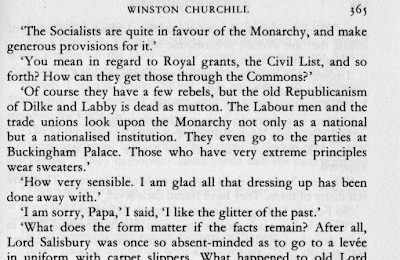

I also find myself nodding in agreement with the likes of Cardinal Newman and Makepeace Thackaray. I will again, too.
I went and got Gross' Oxford collection of aphorisms, ready for the slow treatment.
Great essays share something. These essayists wouldn't all agree on anything, I'm sure. But there's something about their voices: personal, rational, intimate, concise, forceful. The essay is in the process of being superceded by the article and the blogpost, but we shouldn't judge those two forms by the dross we are all seeing from day to day; surely most essays were also petty and inelegant.
Just one example: I bear quite a lot of ill-will toward Churchill; but his entry here is just incredibly beautiful; a hallucinatory conversation with his dead father, with junior struggling to bridge the violent gap the last two generations made in culture and history. I would not have believed him so self-aware:
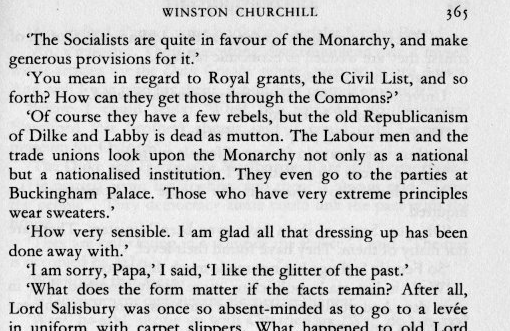

I also find myself nodding in agreement with the likes of Cardinal Newman and Makepeace Thackaray. I will again, too.
I went and got Gross' Oxford collection of aphorisms, ready for the slow treatment.

Read
September 1, 2020Διαβάστε και την κριτική μου στα ελληνικά στις βιβλιοαλχημείες.
During the first week of this promising year *laughing track* I didn't have any new books to read on my shelves. I was expecting four, so while waiting for them to arrive I was browsing my bookshelves to find a book I haven't read before. I didn't want another re-read in the same month so I grabbed this one.
This book was not a required reading for my course back at university, but I bought it to be on the safe side. And of course I haven't read it since then.
It is a humongous book, with 680 pages of essays from the Renaissance until the 1980's and I wasn't planning to read it in one go.
So I decided to read at least 1 essay per day. And for a book with this size and 120 essayists it meant 120 days of reading essays.
Eventually I read it in 105 days between the Twelfth Night (Jan 6) and Orthodox Easter Sunday (April 19)
I'm glad I finally read it after 10 years of it idling sitting on my shelves. I enjoyed quite a few of the essays but most of them were real snoozers!
It was 1st published in 1991 and my edition was a 2008 reissue.
And if we check the statistics of this collection is not very up-to-date.
Out of the 120 essayists, 108! are men and only 12 are women.
Out of the 120 essayists, 78 were British, 33 were Americans, 7 were Irish, and only 2 from a different country (South Africa 1, Australia 1)
None from Canada, none from New Zealand. (also predominantly English-Speaking countries)
Out of the 120 essayists, 118! were white people and only 2 were people of colour, namely James Baldwin and V. S. Naipaul.
In other words the editor, presumably British and white selected mainly white British men. Some of them pretty obscure and out-of-date and of course the 12 women and 2 people of colour shows how massively underrepresented they are in this collection.
The title is a bit deceitful because on the front cover it says «The Oxford book of Essays», and that makes you think essays from around the world, *nah*.
On the back cover in small letters it says "Over 150 of the finest essays ever written in English,"
Of course this collection contains 142 NOT 150 essays let alone over 150.
Do I recommend this book? No.
You can find some gems in this collection like Baldwin's essay on race «Stranger in the Village», George Orwell's «Reflections on Gandhi», Sir Winston Churchill's «The Dream», Charles Dickens' «City of London Churches», and Leigh Hunt's «Getting up on Cold Mornings».
And as I said 12 women essayists out of the 120 in total. That's 10%!
No Susan Sontag, no Adrienne Rich, no Flannery O'Connor, no Mary Shelley, no Mary Wollstonecraft! None, Nada!
Only 2 essayists were people of colour. That's 1.6%!
No Maya Angelou,no Langston Hughes, no Audre Lorde, no Zora Neale Hurston, no Martin Luther King, no Toni Morrison, none of those. uh-uh. . .
Only some British military men from the 18th century, some long dead psychoanalysts, some philosophers from the distant past, that are only read by Philosophy graduates, some obscure humourists/columnists, most of them British and White.
There are much better collections out there than this, more divers,e and more interesting.
I'm not saying it is a bad book, but it's mostly white men and dull essays even for non-fiction fans.

November 5, 2013
Whenever I run out of new books to read, I go back to this one. A well-chosen collection of essays. I keep it within reach for those "oh-gosh-my-brain-is-hungry" kind of moments. You'll love the selection. :)

July 7, 2019
This is a fine book of essays but I'm confused about the essay selection process. Women and writers of colour, and writers from places other than the UK and US are massively underrepresented. This is sort of justifiable in Gross's selection of essays from the 1600s, but gets jarring as time goes on. I'm also mystified about how Gross chose to represent the essayists included. For example, the essay by Joan Didion is about Hoover Dam, hardly memorable compared to many of her other offerings. A lot of the essays are criticism on particular books and authors, which don't make much sense decontextualised from the texts under review or from the time they were writing.
Altogether an interesting overview of the form through the ages but guilty of erasure and some odd choices.
Altogether an interesting overview of the form through the ages but guilty of erasure and some odd choices.

August 11, 2008
This collection is filled with hidden gems that not only tantalize with a variety of styles and subject-matter, but remind us what a typographic culture (that we are moving away from) can capture in terms of depth, nuance, and daring. Reading this entire collection made me realize how byzantine, uncanny, and poetic each mind can be when attempting to express something beyond a single impression. Do we even try to do that anymore? Is it even possible for us?

September 23, 2019
Finally! Took me almost a year to finish. I won't lie, the beginning was hard going. This is a collection for true essay enthusiasts only. I waded through the first 1/3 of the book for months, but then, once you get to mid 19th century, the essays become more approachable to modern readers. Some imperial exceptions notwithstanding, these are all English/British or American essays. Also, some of them are not essays at all, but excerpts of larger works, which made me feel a bit cheated. There are few women, predictably. If new to the genre, I'd much rather recommend Philip Lopate's Art of the Personal Essay. It is a global, more balanced and much more accessible collection. But this was worth the read for George Eliot's and James Baldwin's essays alone.

September 10, 2020
I suspect that most of the authors in The Oxford Book of Essays didn’t consciously intend to be entertaining when they wrote their essays.
Ralph Waldo Emerson writes about “The Conservative.” Sir Winston Churchill writes about “The Dream.” Katherine Anne Porter writes about “The Necessary Enemy.”
This is a collection for the reflective reader, the auto-didact, the thinker who savors the concatenation of the right words.
You know who you are.
Dig in.
Read more of my book reviews and poems here:
www.richardsubber.com
Ralph Waldo Emerson writes about “The Conservative.” Sir Winston Churchill writes about “The Dream.” Katherine Anne Porter writes about “The Necessary Enemy.”
This is a collection for the reflective reader, the auto-didact, the thinker who savors the concatenation of the right words.
You know who you are.
Dig in.
Read more of my book reviews and poems here:
www.richardsubber.com

February 26, 2023
2014
Though I failed to post a review then, the first time I read this must have been sometime in late 2013 or 2014, very likely while or immediately after reading Gibbon's first volume of The History of the Decline and Fall of The Roman Empire, but before I read further books on the Caesars and ancient Rome. I say this with certainty since I gave an effusive star to Gore Vidal's essay on page 365, titled Robert Graves and The Twelve Caesars; without prior knowledge of these first emperors, the piece would have meant nothing to me. Other starred essays were Sir Winston Churchill's whimsical The Dream, Benjamin Franklin's The Levee, Ambrose Bierce's Disintroductions, D.H. Lawrence's Insouciance, Sir Henry Taylor's On Secrecy, George Orwell's Reflections on Gandhi, and Loren Eiseley's The Snout, which I had previously read in one of his books. Some of my many appreciative check marks went to William Hazlitt's On the Pleasure of Hating, Nathaniel Hawthorne's The Haunted Mind, Anthony Trollope's The Plumber, Aldous Huxley's Meditation on the Moon, E.M. Forster's My Own Centenary, Oscar Wilde's The True Critic, James Thurber's My Own Ten Rules for a Happy Marriage, Edmund Wilson's A Preface to Persius, Rebecca West's The Sterner Sex, Pauline Kael's Movies on Television, and Graham Greene's The Lost Childhood. Five stars.
26 February 2023
While browsing and categorizing books in my new home library, I came across this book and scanned the table of contents. As customary when reading anthologies and compendiums, I had penciled stars and check marks for the articles I found particularly moving and worth rereading. But despite these markings, I could only recall three pieces: Orwell's Reflections on Gandhi (it's hard to forget how Gandhi's adherence to a vegetarian diet for his family almost cost his daughter's life), Churchill's The Dream (the retired PM's own take on a Dickens classic), and since I was quite taken the first time I read it in one of his books, Loren Eiseley's The Snout. It was disheartening, looking at all those starred and checked titles, and failing to remember how or why they moved me. So I read the whole book again. Curiously, some essays which struck my fancy the first time failed to move me now. Examples: William Makepeace Thackeray's Autor de mon Chapeau, which I had starred in 2014, failed to garner even a check mark now, while the opposite played out for Hilaire Belloc's jocular On the Departure of a Guest and Virginia Woolf's two essays, Harriette Wilson and The Death of the Moth (from nothing to stars upon thars). Even more extraordinary, Joseph Epstein, one of my favorite writers, gained star nor check mark before, but of course gets a star from me now. But for the most part, my tastes have been consistent. I still failed to appreciate the earlier writers (Sir Francis Bacon, Samuel Butler, Jonathan Swift, Joseph Addison, Lord Chesterfield), and still found Orwell's, Churchill's and Bierce's essays to be standouts. And while some pieces have been elevated from check to star (Graham Greene's The Lost Childhood), a few others simply didn't make the cut this time (James Stephens's Finnegans Wake). Four stars.
* So I don't forget: The left column of The Table of Contents indicates the writer and the title piece. Stars and check marks on that left side were written in 2014, and therefore reflect my sentiments in 2014. The right column shows the page for each title. My starred or checked review is penciled on this right side, encircling the page number for good measure. After rereading the whole book, these reflect my sentiments for 2023. Four and a half stars.
Though I failed to post a review then, the first time I read this must have been sometime in late 2013 or 2014, very likely while or immediately after reading Gibbon's first volume of The History of the Decline and Fall of The Roman Empire, but before I read further books on the Caesars and ancient Rome. I say this with certainty since I gave an effusive star to Gore Vidal's essay on page 365, titled Robert Graves and The Twelve Caesars; without prior knowledge of these first emperors, the piece would have meant nothing to me. Other starred essays were Sir Winston Churchill's whimsical The Dream, Benjamin Franklin's The Levee, Ambrose Bierce's Disintroductions, D.H. Lawrence's Insouciance, Sir Henry Taylor's On Secrecy, George Orwell's Reflections on Gandhi, and Loren Eiseley's The Snout, which I had previously read in one of his books. Some of my many appreciative check marks went to William Hazlitt's On the Pleasure of Hating, Nathaniel Hawthorne's The Haunted Mind, Anthony Trollope's The Plumber, Aldous Huxley's Meditation on the Moon, E.M. Forster's My Own Centenary, Oscar Wilde's The True Critic, James Thurber's My Own Ten Rules for a Happy Marriage, Edmund Wilson's A Preface to Persius, Rebecca West's The Sterner Sex, Pauline Kael's Movies on Television, and Graham Greene's The Lost Childhood. Five stars.
26 February 2023
While browsing and categorizing books in my new home library, I came across this book and scanned the table of contents. As customary when reading anthologies and compendiums, I had penciled stars and check marks for the articles I found particularly moving and worth rereading. But despite these markings, I could only recall three pieces: Orwell's Reflections on Gandhi (it's hard to forget how Gandhi's adherence to a vegetarian diet for his family almost cost his daughter's life), Churchill's The Dream (the retired PM's own take on a Dickens classic), and since I was quite taken the first time I read it in one of his books, Loren Eiseley's The Snout. It was disheartening, looking at all those starred and checked titles, and failing to remember how or why they moved me. So I read the whole book again. Curiously, some essays which struck my fancy the first time failed to move me now. Examples: William Makepeace Thackeray's Autor de mon Chapeau, which I had starred in 2014, failed to garner even a check mark now, while the opposite played out for Hilaire Belloc's jocular On the Departure of a Guest and Virginia Woolf's two essays, Harriette Wilson and The Death of the Moth (from nothing to stars upon thars). Even more extraordinary, Joseph Epstein, one of my favorite writers, gained star nor check mark before, but of course gets a star from me now. But for the most part, my tastes have been consistent. I still failed to appreciate the earlier writers (Sir Francis Bacon, Samuel Butler, Jonathan Swift, Joseph Addison, Lord Chesterfield), and still found Orwell's, Churchill's and Bierce's essays to be standouts. And while some pieces have been elevated from check to star (Graham Greene's The Lost Childhood), a few others simply didn't make the cut this time (James Stephens's Finnegans Wake). Four stars.
* So I don't forget: The left column of The Table of Contents indicates the writer and the title piece. Stars and check marks on that left side were written in 2014, and therefore reflect my sentiments in 2014. The right column shows the page for each title. My starred or checked review is penciled on this right side, encircling the page number for good measure. After rereading the whole book, these reflect my sentiments for 2023. Four and a half stars.

January 5, 2018
I sure do love myself an Essay! This is a really cool collection!!! Would make a nice gift.

August 16, 2023
Really good reference text for the long history of the essay in English. Would recommend.

December 29, 2025
I am not a Literature reader but I selectively read only the essays that piqued my curiosity.
February 4, 2008
'Like food to read these men and women of Letters.

April 13, 2013
Some good ones and some bad ones..
February 8, 2014
I LOVE GOOD ESSAYS!

January 21, 2015
Great collection of essays.

Read
May 11, 2014Fine Collection of essays, from men of letters....
Displaying 1 - 17 of 17 reviews