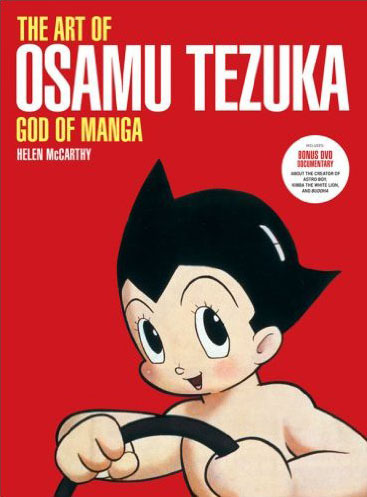
Osamu Tezuka has often been called “the god of manga” and “the Walt Disney of Japan,” but he was far more than that. Tezuka was Walt Disney, Stan Lee, Jack Kirby, Tim Burton, and Carl Sagan all rolled into one incredibly prolific creator, changing the face of Japanese culture forever. Best known for Astro Boy and Kimba the White Lion, Tezuka was instrumental in developing Japanese animation and modern manga comics.
The Art of Osamu Tezuka is the first authorized biography celebrating his work and life and featuring over 300 images—many of which have never been seen outside of Japan. With text by respected manga expert Helen McCarthy, The Art of Osamu Tezuka: God of Manga pays tribute to the work of an artist, writer, animator, doctor, entrepreneur, and traveler whose curious mind spawned dozens of animated films, and over 170,000 pages of comics art in one astonishingly creative lifetime.
The Art of Osamu Tezuka: God of Manga also includes an exclusive 45-minute DVD documentary covering Tezuka’s prolific career, from his early manga characters to his later animation work. The package is out of the ordinary as well. It is a hardcover with an onlay and a vinyl jacket.
Available for $6 on amazon. Have to look for it-another listing sells it $16=still a good deal! I finally just scored my own copy of this great book this week. I bought it 2 years ago, at Uncle Fun's of Chicago 2 years ago. I am really getting into this author and his works now. Very enjoyable on many levels-many moral lessons throughout the stories.
Come molti testi divulgativi, non è un libro che si presti a essere letto tutto d'un fiato. Ciò premesso, è il libro da cui consiglio di passare prima di qualsiasi altro approfondimento su Tezuka. Contiene una quantità notevole di informazioni che è difficile immaginarsi ed è facile attribuire erroneamente ad altri. Spicca su altri tentativi per la mole di fonti consultate e la chiarezza espositiva.
Many of his masterpieces are available only in the original Japanese. I am so sorry for those who cannot read the language. Here is something that offers a taste of them.
Much can be said about his ideas, themes (like the abandoned children), characters, etc. ... but don't forget to check the artwork! Look how dynamic the pictures are. Even the windows are not just plain squares; they change in size and shape.
Here's a look at The Art of Osamu Tezuka which isn't out yet online, but I managed to find it in the bookshop. Lucky!
It comes with cardboard onlay of Astro Boy pasted on top the hardcover, a 45 minute documentary DVD and a soft transparent vinyl dust jacket. There are two publishers for the book, Ilex and Abrams ComicArt, with Ilex distributing for the UK market.
The author Helen McCarthy has compiled a rather in depth biography of Osamu Tezuka. The content is presented chronologically detailing the different characters, book titles and animation he has created. Over his career, he has created a staggering amount of over 170,000 pages of comic in over 700 titles. He's a prolific artist at the start who became even more so after using comic assistants, a system currently used today to create comics and animation.
In addition to the manga and anime art, there are also a lot of great photos of Osamu Tezuka, even from when he was a kid born in 1928, thanks to his father who's a photographer. The biography looks at his life of creating comics from when he was a kid, to studying medicine and to the post war period when he rose to fame with the numerous creation to his name.
Since he created so many titles, the book only list his key works and characters. But even so, there are quite a lot ranging from his 4-panel strips to Black Jack and later on animation titles. It's interesting to find out that many characters he created actually cross over to other titles making cameo appearances, sometimes even including Osamu Tezuka himself. Many themes in his comics are from his philosophy and influences from life.
On the DVD, the documentary shows us how he works when camera men are allowed, for the first time, into his personal studio. There's a section showing him rushing for a publication deadline while chasing a flight overseas at the same time. He was drawing on the car, with his editor holding a watch, constantly informing him of the time left. There's a shot of his assistant smiling which I interpret it to be, "That's how he is all the time, drawing." He finished the rest of the pages on the plane and met the deadline by faxing them over.
Osamu Tezuka is really in love with his work, blurring the line between dedication and addiction. His last words when he died in 1989, at the age of 60, were, "I'm begging you, let me work."
This book is really well put together and comes with a great video documentary as well. It's recommended to all fans of Osamu Tezuka.
Oh My God Of Manga, this book really opened my eyes. It's like Mythbusters, in that instead of urban legends it busts the mythologising of Osamu Tezuka as God of Manga, depicting him as a skilled craftsman, but yet he was a human being all along. Certain details of his life are confirmed as true - his getting beaten up by the foreman of the asbestos factory Tezuka worked in during the harshness of Japanese wartime, his seeing things so horrible that his pages of manga depicting what he saw during the war are so powerful that not much explanation beyond historical context is needed.
The book is called "The Art of Osamu Tezuka: God of Manga", but it is a title which is misleading, since although it rightly praises Tezuka as a genius, the details of his career such as him not being the first guy to invent manga or even manga for girls as he is often credited with, the truth surrounding the myths are far more powerful than the myths themselves, he was larger than life but the way he dealt with his creative struggles even though his critics called him old fashioned and irrelevant, is a testament to his commitment to the human and creative spirit.
Depending on what edition you get of this book, the one I got from my brother for Christmas gives you the biggest treat of all: a DVD documentary detailing a week in the life of Osamu Tezuka as he goes on his daily business. NHK Television just didn't see it coming, sometimes even the kitchen of a great artist is kind of a dump and not really worthy of gasping over. Tezuka's life in the DVD documentary is far from glamourous: he misses deadlines, naps, and scratches himself as the 24 hour camera rolls. If you expected Tezuka to be some super-efficient manga God, this documentary humanises him far more than even I was prepared to see, and the end of the documentary moved me as I saw Tezuka expressing his anxieties over the future, hoping to work till he was 100. Considering he died in 1989, the year before I was born, and me being a HUGE fan of his... it almost reduced me to tears to see him getting all Leonard Cohen over how he's getting old and his critics think he's lost it and he can't draw circles like he used to. I guarantee you it's a documentary in subtitles on par with Man on Wire and even The King of Kong, and if you're a big Tezuka fanboy seeing what was probably the last of Tezuka's prime will probably make you a bit teary.
I'd always been very interested in the work of Osamu Tezuka, but his life was an utter mystery to me. I knew his popular characters--Astro Boy, Kimba, Unico, Black Jack, and many others, but what did I know about the manga artist himself? Almost nothing. So I decided to find out. The book starts off with the very beginning of Tezuka's life. He was born in a pre-WWII Japan, and had a very relaxed and comfortable childhood, with parents who supported his art and were very interested in art themselves. Tezuka's talent was extremely apparent at even the age of six. Learning about his childhood was one of my favorite parts of the book, because it's so interesting to see the origins of the so-called "god of manga." As the book progresses and getting more into Tezuka's manga career, it splits into two different parts each chapter. The beginning of the chapter will detail all the events in Tezuka's life during that period and what influenced him. The second part of the chapter is a thorough breakdown of all the works he created during that period. This is very helpful since he was quite a prolific artist and he has many works that most people have never heard of. You can also see how his themes and ideas change as he continues to work. The book also contains a "star chart", which is a list of the popular and recurring characters that Tezuka's works feature. There's also a plethora of images from Tezuka's life that you wouldn't find anywhere else. There are many drawings and panels shown from extremely obscure works that had been lost for years, as well as panels from his much more famous works. Since Tezuka produced so many visual things, it is important that his biography is very visual as well. The Life of Osamu Tezuka: God of Manga was a very enjoyable read, even for those who have never seen any of Tezuka's work. It is a well written biography that is easy to follow and keeps your attention.
This is an excellent visual biography on one of the great artists of the 20th Century. To call him the Walt Disney of Japan is not exactly the right description, but for those from the West, perhaps the most understandable.
The truth is Tezuka was an amazing visionary and I see him as a combination of Jacques Tati, Jules Verne, and a hardboiled crime novelist -as well as writing mangas for kids. A remarkable figure in the annimation arts as well as a businessman who built an empire.
There is also a 40 minute documentary on DVD that comes with the package and that is quite interesting as well. Hardworking to the end!
Exactly what I love from a “coffee table book”. This large book was filled with photos, artwork, and just the perfect amount of info regarding Tezuka’s creations. There’s quite a few works I look forward to checking out in the near future.
Also, this book came with a bonus documentary that unfortunately wasn’t exactly on par with the book. I personally found it to be a little strange.
If you want to discover more about the works and life of Osamu Tezuka then you need to read this book. Well organised and layed out and delves deep into the influence Tezuka had on Japan after the war through the medium of manga and animation.
I had no idea how influential the creator of Astro Boy was to comics and anime. I also didn't realize he created Kimba the White Lion! Fascinating book about a prolific storyteller.
The Art of Osamu Tezuka: God of Manga is a large and beautiful book. It should be, because cataloging Osamu Tezuka's massive body of work along with biographical information, historical context, and art criticism in a single volume is an ambitious undertaking! The book package also includes a television featurette of the artist at work, which I watched and enjoyed.
Overall, I think that McCarthy makes great connections in the book, though there was one section of painful reading. It's a rebuttal page near the end titled "Negative Viewpoints," where McCarthy defends Tezuka against criticisms of what has been called dated, uninformed, or racist artistic representation of non-Japanese characters in his works. This section came off as excessively defensive and unwilling to admit that Tezuka may have been ahead of his time in some ways but typical for (or behind) the times in other ways, and that not all of his art has "aged well." If I were the editor I would have removed this section from the book and instead organized the text/images to point out these criticized representations throughout the chronology, allowing the reader to see for themselves and draw their own conclusions.
Big and bright this book is the perfect companion to the manga biography the Osamu Tezuka Story. The structure is perfect for tracing this history of the artist - it starts with a biographical overview of a decade and then offers up snapshots of the manga and anime projects for that decade.
The rich reward are the many pictures of stories - especially those that remain untranslated for the English market.
This is a great history of a key slice of manga and anime.
Loaded with photos and illustrations, the book provides a glimpse into Tezuka's childhood and early beginnings plus an overview of his three decade career. His most famous works are covered as well as some of his unfinished works and enduring legacy. The 45 minute DVD included in the book is also a great bonus. It shows Tezuka at work in his studio along with some interviews with Tezuka himself that provides some insight into the artist that came to be known as the "god of manga".
269 pages indexed with a CD. If you are a fan of the artitst buy the book. Otherwise get this from your library. The book is more about the artist than it is about Astro Boy. That said I found the book and artist fancinating. The CD alone opens up and inside view of Tezuka's world and of urban Japan..
To a manga fan, who really enjoyed reading his epic classics of "Astro Boy", "Black Jack" , "Buddha" and probably even "Dororo" this book sums up Tezuka's life works. Which is AMAZING. For new fans of Tezuka, one might even want to use this book to decide on which manga series of his one wants to start reading firs, as there are short sypnosis to the story and also snipshots from the manga.
A terrifically important book, but probably the worst written book-on-comics I've ever read. McCarthy's prose is sloppy, inconsistent, awkward, jarring. The design, layout, and paperstock are also all kind of regrettable.
This book exposed me to a lot more of Tezuka than I ever thought I'd learn and gave me an immense appreciation for what he accomplished. While I don't think it's necessary to go quite as in depth into all of his story plots, this is a great resource for those who are curious about any of his work.