Join the farmer's cat on his fascinating nighttime journey through fields, farms, forests, and even the city to see what only he can see after the sun sets. Legendary artist Dahlov Ipcar mesmerizingly alternates between dark night scenes and vivid color to deliver a beautifully illustrated children's classic.
"When the farmer goes to bed, he winds the clock and he puts the cat out. But what does the cat do out there in the darkness all night long?"
This book is about a cat and what it does all night long when everyone else is sleeping. Children will learn simple facts about how cats are nocturnal and can see at night.
The illustrations in this one are fun. The author alternates dark night scenes with colorful ones to illustrate how cats see differently from humans at night. It feels like a surprise with each turn of the page. This is another beautiful book perfect for nighttime reading.
The illustrations are marvelous and I like the questions included in the text such as, "The cat is walking through the dark woods now. We can see the black trees, but what can he see that we don't see?" that further engage children, as you read out loud to them and invite responses, sometimes quite imaginative or insightful ones.
Originally published in 1969. Beautifully illustrated. The cat at night features a farmer's cat who is let out at night. He has quite the whole night adventure. Since he can see at night as well as we can see in the day he roams through the fields, woods and city streets. Visiting sleeping animals and awake animals in the woods, City streets are full of danger, cars and other cats looking for a fight. When he returns in the morning, he laps fresh milk and sleeps the day away dreaming of his next adventure. Loved the story but the brilliant illustrations, so vividly done really drew my attention.
I was given a complimentary copy of this book. All opinions expressed are my own.
Readers will enjoy finding the black cat in the nighttime pictures in this reissue of 1969's The Cat at Night. Thank you to NetGalley and the publisher for allowing me to read an advanced copy of this title!
The farm cat goes outside every night. This is the story of what he can see with his nighttime sight. I bought it for the artwork and because it’s about a cat.
A cat spends the night roaming the farmyard, the surrounding fields and forest, and the nearby town before returning home.
This book introduces young readers to the concept of nocturnal/diurnal as well as the common animals (both domestic and wild) in North America's temperate zone.
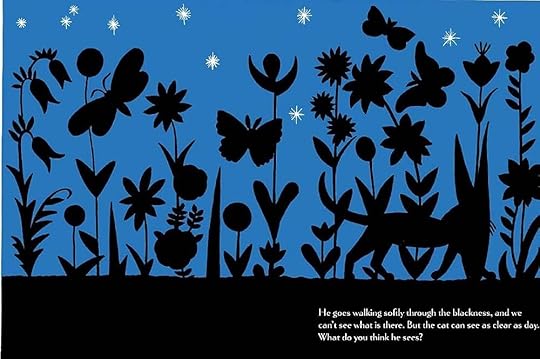
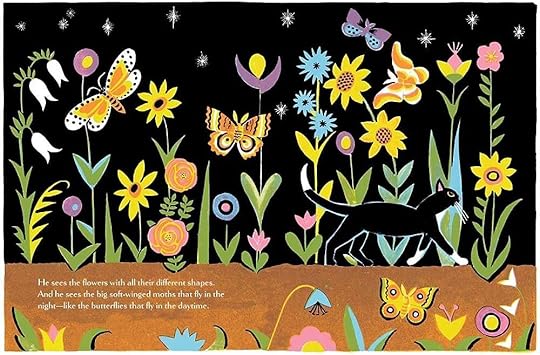
The design employs a clever device to convey how a nocturnal animal sees at night. The same scene is presented first in black silhouette and then color to contrast how a daytime creature and a nighttime creature would see the same thing.
Thank you NetGalley and Publishers for giving me early access to The Cat at Night! I love a book that asks open ended questions to guide a discussion for the kiddos. I also liked the color scheme on the pages, and how minimalistic it was. The illustrations were beautiful. I enjoyed the cat progressing through different locations. It was a very calming book to me, and seemed to have a relaxing effect on the kids in my class.
As with so many picture books, the idea is so simple and clearly born from a very close experience with that idea so all that’s really needed is for Ipcar to find the best way to articulate it. My cat Cluedo just used to hunt at night for hours, but that’s probably a bit too bloody for a children’s classic so what she does so brilliantly here is ask the reader to imagine what they’re about to see before they actually see it, and when you do see the image it more than lives up to what you imagined and even surpasses it. So simple but so brilliant
This is a wonderful Ipcar book that introduces children to the "nightlife" of cats. The pages alternate between dark, silhouetted nighttime scenes (how we would see it) and lighter, clearer pages that show the same scene the way the cat would see it at night. My kids enjoyed trying to find the cat in the darker scenes and figuring out what setting he was in before we turned the page.
The black and white contrast was beautiful in the illustrations of this book!
The story was simple but easily keeps the reader engaged and predicting what is hiding in the illustrations!
As an Early Childhood Educator that strives to add new and fresh books to the shelves, I would recommend this book! It would open up many conversations about nocturnal animals and could open up many avenues for lesson plan extensions!
First published in 1969, the re-release of this children's classic is a splendid addition to children's booklists of 2023. The text is simple and the illustrations are sublime as they alternate between the silhouette-filled world that humans see at night and the richly detailed world that cat's see. The element of a guessing game that comes from seeing the human-view first will make this book a terrific read-aloud at bedtime or storytime. Dahlov Ipcar's book is getting a very well-deserved reintroduction.
I love this! Newly re-issued this year (originally published in 1969), her art is reminiscent of Wanda Gag's work and Eve Rice's Goodnight, Goodnight. The contrast of silhouette spreads with colored spreads lends the book to many uses with pre-k and up audiences, and creates a mini-mystery on each set of pages.
Another one from Aunt Sally. I like the unusual spin of showing the same illustration--once in shadow then seeing it through the eyes of a cat at night. I think Sally told me this artist lives close to her in Maine--near Five Islands (if I'm getting that name right). She pointed out her house when we were in the area for fresh lobster and steamers.
This is a quite unique book. The story is about all the things that a cat does during the night, all the places it goes, and all the animals he encounters. The illustrations are amazing and interesting since they represent the vision of the cat at night. Dahlov is the best. Recommended age: 6 years old or more.
Great book for homeschooling or any schooling! Shows how a cat sees things at night that we can't. It first shows a picture of a dark scene followed by the next picture showing the same scene through the cat's eyesight.
this was actually so cute and creative. the little guessing game as to where the cat was was a fun demonstration of cats’ super night vision abilities.
Pair this children's classic published in 1969, revised in 2008, and brought back to life once again here, with the recent Where Have You Been, Little Cat? Both are lovely tributes to imagination and the active night life of felines, but the artwork in this one is simply stunning, intricately detailed, and carefully planned. While it might not be best practice in these days, as part of his nighttime rituals, a farmer opens the door to his house so the cat can roam at will. At daybreak, the cat comes back inside and sleeps, leaving the farmer to think that the cat is lazy since it presumably sleeps during the day and during the night. But what he doesn't realize is that the cat has been quite busy all night long and has definitely not been snoozing. As the text poses questions about what the cat's been doing while out of doors, readers first see dark scenes as might be viewed by the farmer and other humans. Each dark double-page spread is followed by one in color, showing what the cat is seeing--the same scene from two different perspectives. Instead of slumbering on the porch, the cat looks for a rat, wanders through the garden, moves through the woods, and heads to town where he meets up with other cats to fight and/or sing the night away. Then, he walks back home. The book is simply filled with a sense of childlike wonder. Readers will want to check out the back matter that provides insight into the artwork and creative mind of the author/illustrator. I'm sure that I'm not the only person who is glad to see this one still in print.
This is, accounting for taste, a cute book about a cat's nighttime adventures after the farmer puts him out for the night, assuming the cat just sleeps somewhere. Not so—since cats have night vision, it's like exploring during the day, but with nighttime activities. Every other page of the cat's stroll is a silhouette of what we humans would see, then the following page is what the cat sees of the same scene.
Qualms: - The cat's apparently free to roam the henhouse. Uh. - Cat has no fear of foxes. Okay. - They feed the cat milk fresh from the cow, which is BAD for the cat.
This specific copy I have mentions seeing a family of raccoons hunting for frogs, but no such illustration exists—the middle pages have been torn out. I'm annoyed by this, but at the same time, the book doesn't REALLY lose anything from it. It would be like if a crossword puzzle book had the four middle pages torn out. I paid (some) money for this book, though, so it's aggravating that someone sold this to the used bookstore in a defective state (and the store is so unconcerned about the children's books that they don't even track which ones are sold, only that I bought a children's book for whatever price was on the sticker).
A nice wholesome(ish) book, but I'm sure similar ones exist that are newer and intact.
I love The Cat at Night - especially how the narrator invites young readers to actively engage with the story through queries about what the cat may see on each silhouette page. Small children will be delighted to theorize what the cat sees and identify profiles they recognize. The scenes are quite lovely - it is easy to see why Ipcar's work is acclaimed and she the recipient of so many accolades. Back matter shares Ipcar's statement, "...a picture book...needs some valid idea...sometimes educational [The Cat at Night teaches] shape recognition." She does this effectively; before reading the back matter, I was already thinking The Cat at Night fosters a child's connection with a book, and between literature and life. The Cat at Night is a pleasure for the adult reader and rolls comfortably off the tongue while the young listener will be captivated by the cat's exploits and the question of what will be seen next. This re-release presents a valuable addition to your child's bookshelf or library bag. The Cat at Night is a timeless story; as long as cats are cats, humans will be fascinated by them. And Ipcar's portrayal of one cat's night is entrancing.
I adore Ipcar's illustrations, and have many of her books in my collection. This one is a reprint from 1969, and the author's artwork fairly pulses with dayglo colors.
The farmer may think his cat spends the night sleeping on the porch when he's put out at dusk, but little does he dream of what his pet gets up to in the dark. Lucky readers get to experience the nighttime world through feline eyes. We see two versions of the same scene, one in stark silhouette, the other - the brilliant technicolor world seen through the cat's night vision. Kids will enjoy sharing cat's nocturnal activities, perhaps right before they head off to sleep for a night of dreaming up their own adventures.
Many thanks to Tilbury House Publishers for bringing this gem back for a new generation of book lovers.
Princess Fuzzypants here: We cats sleep. A lot. We get a “bad rap” for being lazy when we snooze through the day. What some humans do not realize is the rich and active lives we lead long after our humans have gone to be. In fact, because we see so well in dusk and dawn and even in the dark, there is a whole world that we experience that is invisible to human eyes.
This is a charming story of a farm cat who wanders through the farm, seeing all the animals as clear as day. Some are sleeping. Some, like the cat, are wide awake. He walks into town where he meets with his cat furriends and get up to all sorts of shenanigans until it is time to return to the farm. The story has delightful pictures of the passing scenes both as humans might see it and as the cat sees it. It has tidbits of feline information that will interest the young reader. The text is simple so it could be read by a child or by an adult to a child.
|| THE CAT AT NIGHT || #gifted @fireflydistributedlines • I would say great for kids age 3 to 7. 🐈 Originally published in 1969. The Cat At Night is a timeless story about a farm cat and what it does at night. Traipsing from here to there, through fields, forest and town, meeting other animals playing in the night. I loved how this was Illustrated, night time dark images as humans would see them and then the following page in vivid color as a cat sees them. It was such a creative way to tell the story and the artwork is gorgeous, kaleidoscopic, expressive and visually stimulating! This author/ illustrator had a distinctive style and an illustrious career. Writing and illustrating over 30 childrens books and painted into her 90s! I'm obsessed!
Published originally in 1969, this title and its great illustrations is perfect for today. The focus of the cat being able to see in the dark sets up the sequence of the illustrations by showing black illustrations as what humans would see and then what the cat is seeing on the next two page spread. I especially like the illustration of the garden at night. And the text telling saying that butterflies are seen in the daytime and moths appear at night was a nice touch. Wonderful that Ipcar's illustrations and picture book are timeless.
Una característica obra gráfica infantil que cuenta las aventuras nocturnas de un minino que vive en una granja. Sus ilustraciones son realmente notables, entre el Art Decó y el Pop art ( por sus colores), con trazos llamativos pero que en su conjunto dan una sensación de elegancia. Asimismo, su narración a través de los ojos del gato hace que los dibujos sean dobles: en negativo y positivo, muy inspiradores para la lectura y muestra al infante. Una gran obra para la edad más temprana, por su inspiración y estilo.
I have to knock off a star for science, sorry. Neat concept to build a book around, though.
"Cats cannot see the array of pretty colors we humans can, but they can see some colors. Cats mostly see things in gray, tinges of blue and yellow, and possibly a bit of green."
Let’s take a trip back, to read a story that was written and illustrated by the late Dahlov Ipcar.
The Cat at Night follows a black farm cat on it’s nightly prowl. From scaring the farm rats away, to visiting the other sleepy animals, this cat has a nightly job to do.
The illustrations are bright and eye catching, the contrast between what a human sees at night and what the cat may see at night is a concept that has held up over time. Keeping the reader engaged, I feel like that all ages will love and appreciate this story. A timeless classic!
A deftly imagined picture book that compares the world at night as humans see it, versus how cats might see it by way of alternating dual-page spreads of nighttime scenes in blue & black silhouette (human sight) and bright color with a black background (cat sight). The text is truly married to the pictures, but would be mundane on its own. The real star, of course, is the striking full-color artwork...and the cats.
At night, the farmer puts the cat out. In the morning, the cat comes back in and begins a long day of sleeping in various patches of sunshine. But what does the cat do in the meantime? After all, it's dark outside.
I enjoy the way this book plays with expectations and a few scientific facts. It's not a really compelling read, but it does invite readers to see things from a little different perspective.