As it takes us on a tour of some of the most unique and beautiful structures, this book shows how the purpose of each structure dictated its design, or location. Here are soaring glass skyscrapers (for working people) and a humble stone barn (for working animals); a sealed tomb hewn out of a limestone hillside (for buried reasure) and a majestic marble building, honoring a goddess. As it reveals what lies inside each structure, this book gives insight into the people who designed these buildings -- into their hopes, their lives, and their concepts of beauty. Included -- for budding engineers and architects -- are statistics such as the year built, square footage, materials used, height, and other little known statistics.
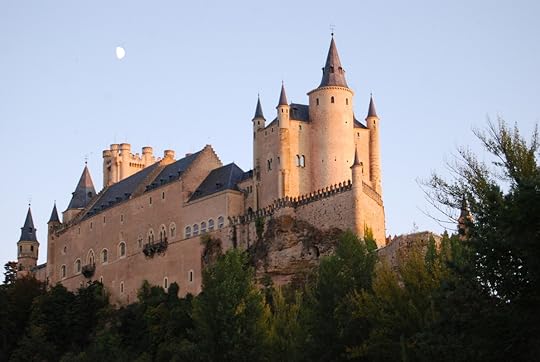
Structures included Tomb of Tutankamumn in Thebes, Egypt The Parthenon in Athens, Greece Temple of Kukulcan in Chichen Itza, Mexico Buddha's Place in Shanxi Province, China Walled city of Toldeo in Spain Alcazar Castle in Segovia, Spain Independence Hall in Philadelphia Shaker dairy barn in Hancock, MA A Circus big top tent, which traveled to many American cities The Guggenhem Museum in NYC The Sydney Opera House in Sydney, Australia The Petrona Towers in Kuala Lumpur, Malaysia The Georgia Aquarium in Georgia, Atlanta
This is a wonderful book! So interesting, I loved looking through these pages, packed with information and beautiful folk art style illustrations.
Looking at famous large structures we get to look inside them and learn some interesting facts. It was hard to get the full benefit of this on reading the book online, constant internet problems mean it's hard to enlarge the areas you want go look more closely at and losing internet connection frequently meant I had to keep going back to the book. This must be a great book go look through as a paper copy. I wish the circus hadn't had performing animals, not good to see. The rest of the book was so interesting and beautiful to look through, I will definitely be looking for more by this author/illustrator.
Absolutely wonderful book with gorgeous illustrations of national landmarks around the world. Among my favorites are: Puerta del Sol (Gate of the Sun) or the Blacksmith's Gate in Toledo, Castilla La Mancha, Spain; Alcazar (castle) of Segovia in Segovia, Castilla La Mancha, Spain (the castle in Disney was modeled after this castle); and Georgia Aquarium in Atlanta, Georgia.
Despite hating circuses (and not being convinced of circus tents being used as examples in this book) and not being a huge fan of aquariums either, I really enjoyed this book. It would have fascinated me even more when I was 9-11 years old.
I love the format here. A picture of a structure and then on the next page shows what’s inside it, and all sorts of facts about it. Facts include name, location, date of construction, materials, today, and little known fact, and when known builders, dimensions, etc. The last page is of a town street and asks what the reader thinks is inside the lit room. And what a fun page that turns out to be!
At the very end there is also a glossary of architectural terms, each term having its own mini illustration.
Buildings covered are the Tomb of Tutankamun, The Parthenon, the Temple of Kukulcan/El Castillo, the Sakyamuni Pagoda/the Wooden Pagoda, Puerta del Sol/the Blacksmith’s Gate, Alcazar castle of Segovia, Independence Hall, Shaker dairy barn, a circus tent/big top, the Guggenheim Museum, the Sydney Opera House, the Petronas Twin Towers, the Georgia Aquarium, and the aforementioned town street, which highlights some architectural details readers saw in the buildings featured in this book.
The illustrations are fabulous. They’re intricate with so many details and so much to view.
This book is fun and educational, and might get readers hankering for world travel. It did me as I’ve seen only a very few of these in person and am interested in seeing most.
This is one of those great accidental finds. I saw this book last spring at my local library. It actually had not only been recently purchased, but had just come out. (Publishing release date was April 6th, 2009.) This is the first book that Giles Laroche both illustrated and authored. Through a form of bas-relief made with drawing, painting and paper-cutting Mr. Laroche introduces the reader to various architectural structures found around the world. He successfully draws the reader in, holds our attention, and keeps us wanting to know more. He does this not only through his gorgeous, brightly colored paper-art, but through descriptive text as well. First, he introduces us to the outside of the structure (in illustration and text), noting scenic, historic, and artistic/ architectural elements. Then he poses the question, “What’s inside?” After we turn the page, we see another view of the structure; this time it is an inside view. Along with the picture, he has a paragraph describing what can be found inside. In the left-margin, he tells us the name of the structure, it’s location, the date of its construction, materials used in its construction, who built it, information about how it is today, and finally a little-known fact. Finally, there is a glossary of architectural terms in the back. Each term is accompanied by a small picture and a brief explanation.
This book would be fantastic to use as a read-aloud in grades 2 and up, or as a resource in grades 4 and up. What I think is so wonderful is that actual architectural and artistic terms are used along with visual depictions. (After trying to come up with a companion book for this in another class, I realized just how few books there are for younger or more limited readers concerning architecture.) It gives the reader a chance to see these elements in an actual context. This book would be especially useful with older students with learning or language challenges because they have text and illustrations that reinforce each other.
One possible way to use this book would be to read it together as a class. After reading the book together and keeping track of the terms used, students could try to find examples of these in their own communities. They could take photographs or draw pictures of these places, noting the architectural and artistic elements they found. Then, as a final project, students could make 2-D or 3-D models of their own made-up structures, including these architectural and artistic elements. This study could be done with 2nd graders and up, varying elements of the study and assignments as would be appropriate. 4th graders and up could do additional research, looking for modern and classical buildings containing these architectural elements.
This book, subtitled "Fascinating Structures Around the World" gives the reader a super fun look into famous buildings around the world. On one page, the outside of the building is shown and when the page is turned, we get to peek inside and learn about the history of how it came to be. We get to see inside Mayan temples, circus tents, castles, the Guggenheim Museum in New York and other unique buildings. There is a vertical strip of facts alongside the picture but the book doesn't overwhelm with facts. I paired this book with "Iggy Peck Architect" by Andrea Beaty. Iggy Peck is the story of a quirky little boy who is enamored with architecture but doesn't like school very much. Instead he would rather build the Taj Mahal out of fruit or vegetables or anything for that matter. One day he gets to go on a field trip to experience a famous building in person and things change. These two books were another obvious pair for me as Iggy would have loved to read "What's Inside." Both books expose the reader to architecture and encourage a little more thought about the buildings we see and sometimes get to go inside.
A chance to look inside some building whose exteriors are very familiar. The format is a question and answer, with a few clues to the name of the building. The next page gives the answer in a sidebar plus some basic facts about the structure, including some little known facts. Here are some examples: "The Parthenon was originally painted in shades of blue, ocher, and gold." "No nails were used in the [Wooden:]Pagoda's construction." Students old enough to be interested in these buildings might be put off by the picture book format and the simple text, but the paper-sculpture illustrations themselves are delightful: "The bas-relief illustrations were created on a variety of paper surfaces through a combination of drawing, painting, and paper-cutting." There is a list of the most significant sources at the end, and a glossary of architectural and other terms, including "Pentelic marble," and "cupola."
a great book that gives neat details about structure around the world....very nice art and great information including when things were built, where they are, what they were used for and little known facts. Great information.
This is a fun book about specific buildings/structures from around the world. Not only does Laroche highlight the building but he asks a questions about each one, such as who's inside or what's inside. This gives the reader a chance to infer who would use or what the building would be used for. I enjoyed trying to figure each one out. Some of the structures are well known, such as the Parthenon or Independence Hall, but others were new to me, such as the Petrona Towers or the Buddha's Palace. I appreciated the map included at the end showing the location of each structure. The illustrations are primarily cut paper collage and they are incredible. I looked at each illustration and imagined the many hours spent on each the details of each page. I highly recommend this book for sharing, it would make for some great discussions about different places and buildings around the world.
Paper and multi-media collage are used to illustrate this look at interesting buildings around the world. There is good variety, some familiar, a few less so. The Shaker Barn from Hancock Village is included as well as the Guggenheim. A great introduction for kids with a sweet conclusion that brings it home. One interesting fact that caught my attention was the Alcazar of Segovia laying claim to being Disney's inspiration for the castle at Disneyland. I had read that Neuschwanstein Castle made the same claim--and upon further investigation, it seems both were used in the design. I do love castles!
*** This book gives a peek inside some famous structures from all around the world. I love the concept (how many times have you seen a picture of the Parthenon? How many times have you seen a picture of what's inside the Parthenon?), but I wish that the information about the structures had been displayed more prominently. It's printed in small type against the side of the page. I love that structures around the world are included, but the inclusion of a circus tent and a Shaker barn seem a little out of place. A neat concept with wonderful, detailed illustrations and a few flaws.