Evangeline Walton was the pen name of Evangeline Wilna Ensley, an American author of fantasy fiction. She remains popular in North America and Europe because of her “ability to humanize historical and mythological subjects with eloquence, humor and compassion”.
Hope might be a mockery, but a man cannot live without hope
Evangeline Walton’s masterful retelling of the Mabinogi continues with The Song of Rhiannon. The Third Branch of the Mabinogi is far more subdued than the violent Second Branch. While the previous volume, The Children of Llyr, chronicled shocking violence, a cataclysmic war that destroyed two peoples, and the tragic destruction of a royal family, The Song of Rhiannon reads more as a melancholy coda to that tale. Instead of violence and bloodshed, this third book tells of powerful illusion and malicious trickery.
Manawyddan, the last survivor of the children of Llyr, has joined the young hero Pryderi, son of Rhiannon and heir of Pwyll (hero of the First Branch) as he returns to his home in Dyfed. There he marries Rhiannon, Pwyll’s widow, and attempts to make a new life from the ashes of the old. But powerful magics and illusions bedevil them, and all of Manawyddan’s cunning and wisdom is taxed to their limits to survive this Otherworldly onslaught.
Walton expands a good deal on the Mabinogi, which is a sparse framework compared to this lush embellishment of the tale. Her additions work beautifully, however, especially as she reworks a vibrant pagan world back into an ancient story that had been Christianized by medieval monks.
The Song of Rhiannon, a retelling of the Third Branch of the Mabinogion, isn't as powerful as The Children of Llyr, which is a relief, in a way. There's a time of healing for the characters, as well as what they suffer during the action of the story, and there's a happy end for them as well. It continues to follow the characters of Manawydan, Rhiannon, Pryderi and Kigva. There are actually few other characters in the story, fleshed-out or not, but the character of the Bogey made me smile quite a bit, as did his interactions with Manawydan.
Once more, Evangeline Walton brings the characters to life. I can't remember anything in the Mabinogion about some of the elements she introduces, e.g. about Pryderi's father, but they all seem to belong quite naturally.
If I didn't already care about Pryderi, Rhiannon and Manawydan, though, I don't know how much I would have loved this book. The retelling of the Second Branch is the strongest so far, and can stand alone, but this can't, to my mind.
I have serious love for her version of Manawydan, in all his wisdom and dignity and his love for his land.
I just finished all of this four book set. If you haven't read them you really should. They are the finest retelling of ancient legends that I have ever read. I first read them in college more than thirty years ago. I enjoyed them then. But now that I have experienced more of life they are even more enjoyable. And filled with a richness that I was not equipped to recognize in my younger days.
I have no real review nor rating for this book. I read it for my Medieval Literature class, and it’s a retelling/detailed adaptation of one of the Mabinogi branches. However I just felt that taking a classic medieval story and then expanding it like this (especially the way/writing the author used) was incredibly unnecessary. Just read the original. But if you really enjoyed it for some reason and wanted to see some of those boring scenes of them deciding what job they were going to, moving around, and doing nothing expanded to like 20 pages each go ahead and read this. That being said, the author did take some liberties from the original story that were interesting, and obviously the story itself is fascinating, but not extremely entertaining when expanding a 30-50 page story into 200 pages.
Excellent. Although she continues to romanticize the pagan past--which is, by definition, unrealistic--I love these books. Walton retells the stories of the Mabinogion with grace, respect, and great beauty. Although she is definitely a modern writer, with a modern writer's concern for psychology and detail, her books never make me feel like I am reading a modern attempt at retelling an older story. Rather, they have such integrity that they read seamlessly with the air of authenticity. The only thing I do not like is her tendency to expand the meaning of a sentence with a sentence fragment after the sentence. Which she does fairly often.
In this installment, fae forces cast an enchantment on the land of Dyved, making it desolate except for Rhiannon, her son Pryderi, and both of their mates. They wander other lands, their success at whatever they undertake resulting in jealousy and reprisal from others. Shenanigans continue to ensue until the fae get what they wanted -- the return of Rhiannon to the fae realm. One cannot help but think there might have been a better way to make that happen than laying waste to a kingdom and waiting patiently for decades until she accidentally wanders back into the fae.
While still interesting and readable, this is probably my least favorite of the Mabinogion Tetralogy.
Book 3 of the Mabinogion is like a fairy tale, but a fairy tale for the middle aged, which is nice! Rhiannon, who was a fairy bride to a potent king in Prince of Annwn, has outlived him, and goes on to experience further love and adventure with one of the secondary characters in an even earlier book, The Children of Llyr.
For me it lacks the profundity of the earlier books, but it is interesting to see Rhiannon less as goddess and more as a mortal woman, which of course she now is, however powerful. And Manawyddan is just lovely.
I’d not heard of the Mabinogion before, just picked up this book in a second hand book shop. Likely it is better to read them in order or end up very confused as to the importance of Bran and Branwen…
I quite liked it and clearly there is some inspiration in the source material for Tolkien’s elves. Rhiannon’s choice to leave her ethereal realm and join Pwyll in mortality might be the origin of the Beren and Lúthien or Arwen and Aragorn story arcs?
A thoughtful and accomplished retelling from Walton, continuing her interpretation of the Mabinogion. I'm not hugely familiar with Welsh mythology though I have a vague and excessively superficial understanding of the main players, but one doesn't need prior knowledge to understand what's going on here. A young and well-meaning king makes a mistake that dooms his land to emptiness (all the inhabitants being turned to butterflies or dragonflies or somesuch) and it's up to his long-suffering stepfather - who's not actually a stepfather - to out-think the otherworldly force behind all this trouble. It's an enjoyable read, simply and quietly told, with the odd moment that really gleams (usually in the characterisation), but I feel more admiration than emotional connection.
This book completes my reading of the Mythopoeic Award winners. It won in 1973. It’s the third branch of the Mabinogion Tetralogy. It begins with a tale that is actually a part of the first branch in the original epic. Then it jumps ahead to the time shortly after The Children of Llyr. It’s about the only survivors of the royal family of Dyved after the great war with Ireland and their interaction with the Fae. It’s not as dark and intense as the second branch, but still, any dealing with the Fae does not a happy book make. I liked this book a lot even though the middle dragged a bit.
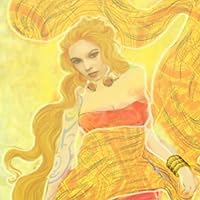
The cover art pictured here, wow it's awful! I have a 1973 Ballatine Books paperback and the cover art (by David Johnston) is amazing, just like this retelling of branch 3 of the Mabinogion.
Like in the previous books, I really appreciate Evangeline Walton's afterword, referencing sources and inspirations for her interpretation of the source text. American schools should really add this to the curriculum instead of just using the Odyssey as the entire ancient world folklore / mythology section. The messages of Evangeline Walton's books, they're better, and it's just as relevant a part of our cultural history.
I almost gave up. The story wasn't engaging me, and the writing felt like a Victorian school translation at times, with a word order that's more Latin than English. "And so did Manawyddan King upon the throne sit, the dawn with pleasure great looking upon." You know the kind of thing.
By the end, it all wraps up nicely, but I'm not sure I can face any more of this. I'm switching to a modern translation of the Mabinogion by Sioned Davies.
The Third Branch of the Mabinogi is by far the silliest, and seems to intentionally be so, with elements of social satire woven into it. Therefore, Walton's insistence on trying to take even the silliest sections seriously in this retelling kind of misses the point. Full review: https://fakegeekboy.wordpress.com/202...
Branch 3 of the Mabinogion is my least favourite of the branches so it stands to reason that this would be my least favourite of Walton’s retellings.
However, she does have a really beautiful writing style and I especially find the way she describes the seasons and nature to be very evocative. That was my favourite aspect of this one.
Rather strange, short installment with Dyfed cleared of all population by a curse, and with just four people left wandering about wondering what to do (Deathly Hallows style!). Nice conclusion with the Gray Man and the plague of mice(!) though, but topping out at 3.5 Stars and rounding down.
4.5 - Another fantastic installment in the tetralogy and a well-deserved and much-needed happy end for Manawyddan after the tragedy that was the last book!
Also, who came up with the idea of giving this book a 70s porn cover lol?!
Acceptable sequel to the previous branch. The plot is kind of wonky but interesting. It's been a few days and there are no moments that stood out in hindsight besides the general plot.
The Song of Rhiannon (1972), the third volume in Evangeline Walton’s Mabinogion Tetralogy, begins with Manawyddan, son of the sea god, haunted by grief and feeling directionless after the events of The Children of Llyr. (I haven’t read The Children of Llyr, but I have read “Branwen Daughter of Llyr,” the medieval Welsh tale on which it is based. It features a Red Wedding’s worth of deaths.) His friend Pryderi, prince of Dyfed, gives him new purpose in life by offering him a home at his palace and the chance to court Pryderi’s widowed mother, Rhiannon.
I found this rather a tedious read and a step down from the prior instalments. The narrative wained a lot and I found very little compelling about it. Walton's prose is gorgeous, as in the other instalments, but the story is repetitive and I would say mostly unsatisfying. I almost dislike this novel, but it has its redeeming qualities.
I was an English teacher in China when I was reading this book and I remember feeling a little self-conscious about taking it out of my bag to read in class while I showed the students American movies.
See, the cover is a bit suggestive. The story is flat and not at all interesting - in my opinion - but students couldn't see that.
Maybe some of those students thought of this picture later and are now reading this book. I feel sorry for them, for this old English/Celtic storyline, and the language used for it, won't grab their fancy.
The 2 stars missing from my rating represent whatever is lost in the translation from the original script, coupled with my lack of heredity, not having the depth of experience growing up with these tales in my youth. I feel certain that these elements are essential in understanding how this seemingly mundane story could survive through the years the way it has, the passing down from generation to generation giving it it's inherent magical quality. To me it felt clunky and lifeless and mostly uninteresting, saved almost entirely by the final chapter and the coming of the Gray Man.
Even better than I remember it. Less epic than Children of Llyr, but the magic, as in the chapter where all of Dyved vanishes overnight, is unutterably eerie. And her descriptions of the land make me feel it would be wonderful to live in a pre-industrial agragrian society, and I know perfectly well I'd hate it. The story comes from the Third Branch of the Welsh Mabinogion, and it's beautifully written on top of everything.
I couldn't get into this one as much as The Children of Llyr. The characters just kind of mope around for most of the book. Also, I wasn't sure if I were reading The Song of Rhiannon or The Song of the Rhiannon--the "editor" (I use that term loosely) didn't seem to know either. Still marveling at the sheer number of mistakes in this omnibus edition.
Despite the title, Rhiannon is a secondary character in this story. Ultimately, it is her life that shaped the plot, and her power that changed it at the end, but the point of view throughout belongs largely to Manawyddan, last son of Llyr and rightful High King. His adventures in this branch of the Mabinogion are varied, and prove both his skills and inner nobility.
Another captivating adaptation by Walton. She's bolder in this, the final branch. She adds her own take on Stonehenge and mixes some Irish folklore into the tale, creating a believable world out of the ancient Welsh mythology.
In this retelling of the third branch of the Mabinogion, there is less battling and more domesticity, but this does not detract from the story. I first read these books when published under the Adult Fantasy imprint: I am enjoying them from a different perspective this time around.