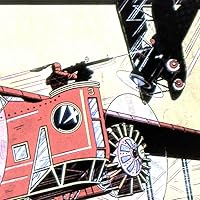
Bursting from the pages of 52 and SUPERMAN/BATMAN-- it's brilliant inventor Doc Magnus's sentient metallic creations, the Metal Men - Gold! Platina! Mercury! Iron! Lead! Tin! and Copper!. The seven robotic heroes are back and ready to take on all new threats and some old, reimagined ones. Together they must face-off against the evil forces of Chemo, Doctor Yes, B.O.L.T.S., The Balloonatic and his Orphan Army, as well as the Robot Renegades. But their greatest threat lies in Le Cabinet Noir and its bid to control the natural order using dangerous lieutenants like the Nameless, an armored being that feeds off the blood of the innocent and controls the Gogoloth, giant stone Golems made of Granite, Bizmuth, Onyx and Lime.
Duncan Rouleau is an American comic book writer and artist, and is a part of the Man of Action Studios collective of creators (along with Joe Casey, Joe Kelly, Steven T. Seagle), who created the series Ben 10, that aired on Cartoon Network.
I thought I really enjoyed this series when I read the original comics years ago, but this time I found it completely incoherent. Maybe it felt less overwhelming broken down into monthly installments? There are good bits in it, and I really liked the art, but I couldn't follow the plot at all.
This is one of the worst graphic novels I've ever read. I love the Metal Men, but all we see here is jumping back and forth in the time stream, too much scientific jargon, and well, not much in the way of a story. When I read Fantastic Four or Iron Man, there is the perfect balance of science talk and action, not so here. Its all the same.
Much of the charm of the original Metal Men (who first appeared in 1962) lay in their clear personalities and interactions with one another. So Tin was extremely timid, but given to acts of astonishing heroism in an attempt to overcome what he saw as cowardice, Mercury was an egomaniac who tended to end up splashed all over the place, and Platinum was tough and brave, the whole marred only slightly by her tendency to break off whatever she was doing, be it overseeing an experiment or fighting off intergalactic monsters, to declare undying love to her creator, Doc Magnus. Indeed, a lot of the fun lay in the fact that the Metal Men were far more human than their rather tiresome creator, whose repeated statements that they were only robots, and robots didn't do that kind of thing, made one wonder if if he really was as bright as he was claimed to be.
In this twenty-first century reboot, much of that charm is lost. The Metal Men are reduced to a collection of cheerful dunderheads, who are almost always in the background of a story of alarming convolution. One might wish that they were given more opportunity to take the foreground and shine. So, Platinum's love of Doc Magnus only appears about two-thirds of the way through, and is dealt with in the form of a few throw-away comments, then forgotten again. A new Metal Man, Copper, is introduced, apparently to have more than one woman in the team, only to be given nothing whatever to say or do. Now, of course, there's no reason why the new Metal Men should be the same as the old. The problem here is that the writer appears to believe they should be both the same and different: they should be a comic chorus and have the same traits as the old characters. This doesn't really work.
This, however, is not really my reason for the three star rating. The story, as these things go, is fine, if rather over-complicated, and I think I understood more or less what was going on. What I did not understand, however, was the treatment of the lead female character, Doc Magnus' girlfriend. She is reasonably important in the first two-thirds of the book, but then she simply drops out, to become a mute walk-on character, having been thrust into the arms of a character who screams 'rotter', and is then the object of a grotesque example of male willy-waving, where Doc Magnus and the rotter argue over her ownership in terms like 'Your name isn't written on her; I know, I've looked all over her'. And she doesn't object, and goes away quietly and submissively with the winner of the argument. That this kind of thing appears in a recent book is bad enough, but when one discovers that its sole purpose is to make the hero look pale and romantic (thwarted in love, he has only his work) it goes beyond bad and into the territory of despicable. Especially if one considers what the original Platinum might have made of a Doc Magnus with a steady girlfriend . . .
You know the term "hot mess", when someone is so very attractive even though you know they are insane on the inside? This book is a hot mess. I was attracted by the beautiful stylish, cartoonish art and snazzy colouring but then I read it. Small wonder Grant Morrison helped with the "plot". As another reviewer noted, it is scientific jargon with no reason, it skips between two time periods but doesn't create a clear readable story in either one. It is not a long graphic novel but it was so off putting and confusing it took me five attempts to get through. In the end it was NOT worth the effort. I love the IDEA of the Metal Men and was hoping for a story that lived up to their potential, but this is not the case. Look, focusing on Magnus, their creator, was a good idea but the character was not consistent with other portrayals of him and because of the focus there is almost no focus on the rest of the metal men. There is a new member Copper that I didn't even know about and gets no dialogue that I can recall. The story feels like it was put together by a person on an Acid trip who had ideas rushing at them so fast they couldn't capture them all fast enough and would go on to the next idea before completing the last one. Dr. T.O. Morrow shows up but I am not sure why. A Manhunter shows up and leads a team of robots...I am not sure why...but he betrays them for another team of robots...but who cares because I don't even know who the villains are or what they want or...well anything. What a hot mess. Beautiful to look at but messed up and crazy once you get to know it.
I ABSOLUTELY LOVE the art in this series. Unfortunately the story was so twisted with time travel that I almost never understood what was going on. It reminds me of the Steampunk comic, Chris Bachalo is probably my favorite comicbook artist, but I was lost a bunch of the time and sometimes his frames are so full and dark it's hard to tell what's actually happening. The same thing is happening here with Mr. Rouleau.
Would definitely love to collect all his work to look at, just not sure I would enjoy reading it.
My first experiences with the Metal Men was reading about them as the backup feature of issues of my dad's comic book collection. I remember my dad telling me that they were all humans that died and had to have their consciousness inserted into robots. (I've never found evidence of this. But for a few issues, the Metal Men wore human disguises to protect their identities. So maybe this is what my dad was thinking about.)
Anyway, I really enjoyed the fantastic adventures of Dr. Magnus and his Metal Men: Gold, Platinum, Lead, Tin, Mercury and Iron. They fought a lot of science based villains and used their imputed knowledge of science, physics and chemistry to save the day. The Metal Men also had the ability to mold their shape and join as a kind of early version of the Transformers into large pieces of equipment or flying machines. Knowing even at a very young age that all metals except Mercury are pretty rigid and solid was the only fanciful downside to my complete enjoyment. What can I say? I was an early realist, much like Neil DeGrasse Tyson. Just not as annoying.
This hardcover collects the 2007-08 miniseries that continues Magnus and his Metal Men's story from DC's weekly series 52. Along with the addition of brand new team member Copper, the Metal Men are under the microscope thanks to Dr. Magnus' corrupted actions with the mad scientists on Oolong Island. (What do you expect when you almost cause a third World War?)
In the present day, the Metal Men have been captured by Checkmate. They will remain under quarantine until the covert agency can determine if the Metal Men are threats to humanity thanks to a techno-virus that is corrupting anything with a microchip and a CPU. Meanwhile in the ancient past in the waning days of the Roman Empire, a nameless evil seeks revenge for the loss of a primitive version of the device that powers the Metal Men, as well as enables these solid titans to mover like a fluid. (Finally, I have an explanation for this!)
Anyways, the thief of this device has repercussions in the not too distant past during the early days of the creation of the Metal Men. Having bidden its time for centuries, the Nameless seeks a genius who can reconstruct the missing machine. People like Da Vinci, Edison and Einstein weren't brilliant enough to rebuild it. Only Dr. Will Magnus had the foresight to take the fiend's blueprints and make life out of nothing!
Written and illustrated by Duncan Rouleau (Ben10), this miniseries' storyline is taking place essentially during 3 points in time, at the same time. We also get glimpses of an apocalyptic future that may or may not be at the hands of the Metal Men. There's even some parts taking place out of time. This all makes for a very confusing storyline. Thankfully, I still had a vague recollection of what occurred in 52. I think without that I would have been a lot more lost than I was.
With the time travel part aside, this was still a confusing book. Duncan Rouleau adds a lot of technobabble, science talk and chemistry into this story. Did he forget that this was supposed to be a work of science FICTION? I'm sorry. But anytime you add letters to numbers, my eyes glaze. When it came to these parts of the story, I glossed over as much as possible.
The artwork was amazing. I've no complaints there. And the new character and the origin story of the Metal Men were great. I felt that there was finally a good explanation as to why the Metal Men can change shapes. Plus, to explain that the robots are also not 100% made of the metals of which they are named explains how Dr. Magnus could afford to build them. Unfortunately, this just wasn't enough to combat the mind-bending quantum physics and min-numbing science and math that overtakes the majority of this miniseries.
I think you can blame story plotter, Grant Morrison for this. He tends to overreach with his ideas. I guess Duncan Rouleau wasn't able to reign that overactive imagination in too much with the final product.
Duncan writes the Metal men and Doc Magnus well, but everything else is a jumble. Kind of fun to see where real science is used to expand the metal men's abilities and to explain some of the sci-fi elements, but the info dump format used is clunky, especially since it happens every other page.
Like Will coming to terms with his life, his work and his being sad but still accepting things, wish we could have done it with less time travel and without his evil brother trying to bang his girl friend...yikes!
Like Helen and hope we see her again, hated Will's evil brother. Unsure if David is actually part of Metal men history or yet another pointless bit Duncan jammed in to the story.
The time travel was used interestingly in the finale, but the jumping around and needing endless captions to tell us what the heck was happening got old real fast.
And while I never get tired of the MM fighting Chemo, having every other villain they fight be just more evil robots wears thin. It's right up there with the Flash fighting evil speedsters all the time, or Martian Manhunter only seems to fight other aliens. It's a decent time waster, but it's not great.
Based on an idea by Grant Morrison, this is exactly the sort of mess you might expect when someone else tries to execute one of his more oddball concepts. So the alchemical implications of robots who each express the personality of a given metal are to the fore, there's lots of clever time travel stuff, and the just-about-plausible science is paired with a slightly puzzled introduction by an actual mad scientist from the Jet Propulsion Laboratory. But the dialogue is filled with the sort of garbling which suggests at least one if the writer and editor didn't really follow the details, and at points the timeline is less ingenious than simply confused. As an artist, Rouleau has just the right sort of cartooning style to do the Metal Men justice, and his Doc Magnus is dead on. Had he drawn a full Morrison script for this, it could have been a treat. But flying solo...no.
Oh boy...so this book took me a little longer to finish through then a normal 8 or so issue trade should have. So the parts I really liked were the dialogue between the metal men and their comedy. Also the art is really great. For as interesting as the plot was it was a train wreck. It just goes to prove that when you are using story boards from Grant Morrison, you should probably let only Grant Morison create the books they go with. I imagine it's like creating this really cool scientific experiment and then half way through letting someone who has no idea take over and finish it. There is also tons of scientific jargon crammed in the story. It's a shame that this seems like one of the only real books that the metal men have had, because I totally love the characters now.
I REALLY wanted to really like this one, but I ended up just liking it. First off, I thought it was interesting that the story and art were both done by Rouleau. Perhaps because I immediately compared writer illustrator Jeff Smith (Bone, TASL) to this feat I became not so impressed. The story was literally everywhere. I am not the smartest guy, nor the dumbest and I had a heck of a time keeping up. Also, in a criticism of the art I felt that it was also hard to follow at times. Transitions between ideas were sometimes choppy and not very well nuanced. Gallant try, but Rouleau could have dumbed it down a little. Wish it could have been better. I have always liked the Metal Men.
Not a bad book. I enjoyed the art and the story behind it, but I found it really over used the mock-science and I kinda faded out when they started doing that.