A blistering critique of digital media and a kaleidoscopic depiction of consumer culture, Eden II is both fanciful and satirical, a combination of deft cartooning and virtuosic storytelling. In the grungy, punk-inflected world K. Wroten creates, a cast of disaffected young characters struggle to find their purpose in life. Faced with a dying Earth and numbingly useless jobs, protagonists Ellis and Dr. Otis Heck invent an immersive virtual reality game, Eden II. But when Heck betrays Ellis and sells the game to a mysterious corporation, the lines between fantasy and reality begin to blur. As each chapter highlights a new character in the ensemble, the game’s impact grows as the world becomes consumed by fantasy. Coming off the heels of their acclaimed queer comics Cannonball and Crimes , Eden II is Wroten’s magnum opus, establishing them as a breakout graphic novelist. Philosophical, sarcastic, self-assured, Eden II is a vital work of the moment that positions Wroten alongside recent comics luminaries like Emily Carroll, Isabel Greenberg, Melanie Gilman, and Tillie Walden. Reminiscent of the stylized angst of Gregg Araki and Jamie Babbit’s works, Wroten’s imagery in Eden II reflects the blighted pastiche of Andrei Tarkovsky’s Stalker―and they have suffused that pastiche with a dark sense of humor and technologically enhanced moral ambiguity. Full-color illustrations throughout
beautifully drawn dream-like logic filled with memes and internet timbits graphic novel
Wish the author would have assumed the readers to be really slow n made a less convoluted narrative, or maybe that's just me maxing out my reading comprehension skills
Okay so, I have to start this review with a technical gripe as I believe it is indicative of a larger whole - It is honestly astounding to me, that a professional publication like this is so incredibly unreadable due to the poor choice of speech bubble layouts and design.
Here's what I mean, basically, lesson #1 of making a comic is "Make your words legible and your text readable" because like, that's how you tell half the story. It is actually an extremely deceptively complex thing to fully understand and do well, which is why you have editors and proof readers. Here's the other thing though; as a fellow cartoonist I can attest that for most people, this is also an extremely unfun, annoying, and painfully boring task to do by hand. Digital tools exist to try to make these tasks both easier and faster, while being useful for the reader. But, in my personal opinion, it can also be incredibly tricky to do well, but for different reasons - that being I think that it can look incredibly tacky when paired with certain styles of artwork.
Here's the next thing though, traditionally when you are writing a comic, you start with your panel layout, and then you write the dialog/exposition into the panel. Because that's how you know how much room is left for your artwork. Obviously is both more complicated and different for each artist, but I need to set up how important it is to make sure readers who are unfamiliar with the process of creation are able to understand that this is where it stops being just personal gripe or just opinion, this is how a writer communicates to their audience.
This is where the comic completely loses me, the speech bubbles ARE NOT BUILT INTO THE COMPOSITION OF THE PAGE OR PANELS. It's so very obvious that the art and panels were done first, and the text was later digitally added on! Text bubbles hover over panel borders, cut into artwork and composition; the tails to all the speech bubbles are incomprehensible, thin black lines in a sea of (mostly) black and white line-work, and worst of all, the characters not drawn the positions of where the dialog is, causing constant crossing of lines and inability to understand who is saying what.
Sure, there is always room for experimentation, which is something I absolutely welcome in the comics-sphere. I think Wroten's artwork is pretty great at doing this at times, their compositions and artwork border into abstraction while blending cartoon and realism in a way that I think is both visually interesting and indicative of the themes of the story. And, like I said, I can completely understand the personal hatred of lettering and drawing bubbles. I can move past my personal opinions of the bubbles looking like tacky, obvious click and drag tools you do on something as basic as Photoshop or Clip Studio Paint - it's the fact that Wroten makes seemingly no effort to make their story (which is already quite convoluted) understandable to their audience.
Which is a perfect opportunity to talk about the actual story. And whoof,,,,,, do I have thoughts on the story too. How do I even begin to talk about it?
Okay so, the story tries to tackle a few incredibly dense and complex topics while mixing post-ironic and scathing(?) cultural critique. Most basically, a disillusioned 20-something-year old, Elise Flowers, having failed psychology grad-school, turns to making video games in an effort to try something creative while living in the not-so-distant capitalist hellscape future. They do this by....... creating the meta-verse. Their professor, a man on a full scale trajectory to personal and financial ruin, steals their work and sells it Amazon-Raytheon capitalists who expand upon the program creating the new digital-age of consumption and reliance. With the help of their plucky, misfit roommates and and the professor's hyper-intelligent daughter on a quest to make penance on her father's sins, Elise and their crew try to stop the new update to the software that would cause everyone to die and become permanently stuck in the evil capitalist Eden by taking it back and creating a new digital reality that is the utopian dream of Elise's original vision.
The story is told through many narratives, through Elise Flowers, the creator of Eden II, their various roommates and their jobs/lives, the professor, his daughter, the capitalists, and other characters that weave in and out of digital and corporeal realities. The narrative is sectioned off into chapters like "The Body", "Enter the Abyss", "The Eg0" "Judgement", "The Higher Self", and "Demiurge". You may think, "hm, these titles are starting to sound like a beginning level philosophy class," and that's because, it is!
The thing is, the story wants you to think that having a large cast of characters would help the world feel more real, letting the reader piece together the interwoven components of what makes a capitalism reality, and how Elise's game changes every character's position to reality - but what the story actually feels like, is a mouth piece for Wroten to spew every 101 community college level philosophy book they read during the pandemic. I cannot understate how badly the philosophy falls so completely flat and unbearable to read.
There are legitimately great character moments and story being told when Wroten lets the story actually unfold. I did, genuinely, find myself being engaged in small portions in the middle where Wroten explores the complexity of character and sadness in the professor's daughter. There are some great moments of story when a couple characters are allowed exploration in the digital landscape of Eden II. Only for it to be ripped away by the comic hard pivoting to a character word vomiting a philosophy quote or notion. I think it's supposed to be like, ironic that characters do this. Like this is where the satire comes in.
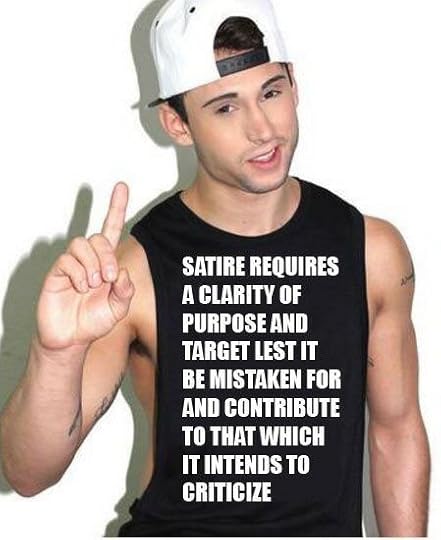
And let's talk about the "satire" in this comic for a minute. This comic, is dated. Like you wouldn't necessarily think a story that basically explains the philosophical concept of Hyperreality, modern technology in a capitalist world, and changing expectations of human communication would come off as immediately dated with a release date of mid-2023, but amidst references to bitcoin and cyptoland, Elise's girlfriend calling them a "themcel", putting "yeet" as a onomatopoeia all while making references/quoting Milton, Rachmaninoff, Dante, Henry Littlefeild etc. etc. etc. but it comes off as extraordinarily snobby and downright cruel at times. Saying it in the most simplistic of terms, I give you this classic meme, more relevant than any of the references Wroten makes themselves:
The long and short of it all is, honestly, I am sick of this post 90s-ironic post-modernist wanking. It doesn't feel sincere; and I think it completely ruins the momentum of the plot and any characterization. It is shocking to me how little forethought seemed to be put into the readability of this comic, you could even say it feels like a first draft that nobody bothered to look over. So trudging through this bloated, confusingly placed, condescending philosophical quotes only to be rewarded with all the characters getting to fuck off to their utopias and not face any true consequences for their actions, that the ultimate message is "fuck humanity, we're doomed anyway", makes me want to throw this strikingly well designed book and it's stupid plastic slip case into a river. Or pawn it off to some shmuck who might get something out it.
So, where does this leave me? I was a fan of Wroten! They have MADE OTHER GRAPHIC NOVELS! Since their public coming out and name change, Wroten's catalog is separated here on Goodreads, but you can search their older works under the titles Cannonball and Crimes. It has been a while since I read them, but I had a generally positive opinion of them! Or so I thought, Eden II has completely shattered my image of Wroten being competent! I even went to my bookshelf and flipped through their old books just to make sure I wasn't going crazy about the quality of their comic making!!
So, safe to say that if I had no context for this book, I probably wouldn't be so harsh on it (but not much). It's just so, deeply disappointing that a comic artist I thought I liked not only made something I didn't like, but specifically in a genera and topics that I'm really, really interested in. Considering they've announced their next book, a teen emo romance called, "Everything Sux But You", I don't think I am the target audience for their work anymore.
I wanted to like this so so so badly. The artwork was incredible and the concept of the story was fabulous! The follow-through? Not so much. More often than not, Wroten gets so bogged down in the philosophical musings of the characters that the plot becomes hard to follow and I can’t tell if this is intentional.
Err.. I feel like the three stars are pretty generous, when judging the whole experience. But, you know, reading 'Eden II' IS an experience in itself, and the whole concept deserves some praise.
Sadly enough, this is one of those cases where the idea sounds awesome; and that probably has to do with the way the blurb summarizes and presents such concept. But then, when it comes to the execution, and the reality of the matter, there's just way too many philosophical ideas, and the story gets quite muddled in the process.
Pretty experimental, really. If that's not your thing, you might be better skipping this. Still, fun in a way, but extremely quirky.
Still out here trying to read all the stuff Fantagraphics and Drawn and Quarterly puts out. I understood maybe 2% of this. Really not for me, it turns out.
Finally sat down and read this after putting it off for a year. It's an intimidating book. A gorgeous one too, but woof. 452 pages is a COMMITMENT, and boy did I commit. Anyway, this book was amazing? Weird? Confusing? A funny, stylish, kind of messy esoteric satire on the meaning of life and love? I don't know, I kind of went through the stages of grief reading this book and laughed my ass off at the last page.
Yes, I had to put my glasses on and really get in there. The first maybe 10 pages were a little bit of a slog, and some of the philosophical and gnostic concepts Wroten was playing with threw me for a loop, but guess what. Google is very helpful for that. This book has some masterful cartooning and visual gags, not to mention the dumbass dialogue that had me giggling like a freak. I really fell in love with the characters! There's so much funny shit here, and a real heartfelt core to the story that got me misty eyed 300 pages in. This book ended up being surprisingly suited to my specific tastes and I'm very glad I got over myself and read it. Hope you do too!
This is an absolute masterpiece however I would not recommend this for everyone. A mature, slow, thoughtful read that one should take their time with. Makes very pointed and spicy commentary on reality, consumerism, our relationships with technology, and work versus passion. Full of colorful characters that are perfectly crafted. I found myself so obsessed with everyone in this piece and wanting to know more about them. The story unapologetically spits you into this world and forces you to catch on. Once all the smaller narratives within it come together and click for you, your life will be changed. You even get some deadpan humor and romance, what else could one want? Recommend to your local depressed art kids.
It’s wonderful to see a talented artist reach their full potential. Eden II is an instant highlight to me, and will sit firmly among my favorite graphic novels. The story and style explore the full range of emotion without straying too far from a good laugh; it was an amazing experience to drift from laughing out loud to weighing the emotional story beats with my own grief and coming back to the story realizing my eyes were wet. Hap Heck is a new favorite character of mine. This is a masterwork.
what the fuck guys this was the coolest comic ever. I don’t quite know how to explain what happened, but it made me feel things, man I’m not used to a comic this dense with prose, but I loved it. It took me several sittings to read, mostly because I had to just stop and remember to breathe. I found myself seeing myself in each one of the characters, and terrified of the antagonists. It really preyed on my existential fears. It feels like something that could really happen.
Thought this book was definitely for me, but I was often confused by the events as too many characters overlapped in design. Very intriguing premise and I liked the world set out here, just not sure the story met expectations.
Envisioned as virtual paradise to escape the harsh realities of a crumbling society, disaffected game developer Ellis Flowers develops "Eden II" as a means for self-actualization for other like-minded people. But when his business partner sells out the game to an unscrupulous corporation, the final product begins to escape Ellis' initial designs. Caught in a tug of war between Ellis's desire for a social utopia and the moneyed interests of the capitalist forces, Eden II begins to blur the lines between the fabricated reality and the decrepit conditions of the real world.
Ambitious in scale, Kenny Wroten's Eden II does a decent job exploring the scope of the premise it sets out too. Unfortunately, the story does feel unnecessarily dragged out over the course of the lengthy page count and felt like it overstayed its welcome by the end. Wroten's loose linework feels reminiscent of Dash Shaw, and in particular, Shaw's work on "Bottomless Belly Button". Similar to Shaw's book, Eden II is a massive tome but unlike the former, there isn't as much depth to the narrative to justify the lengthy story. The character of Ellis Flowers is a bit of a bore (though it seems a bit intentional on Wroten's part) which compound how little investment I felt reading about his struggles against the corporate overlords he has to deal with. Overall, I'd say that Eden II does enough of a satisfying job tackling the overdone themes of consumerism and late capitalism in an ambitious way, but the story doesn't quite feel as tight as it could have been.
I needed this to be about 30% less online. Yes, this is a book about virtual reality and capitalism and the end of the world. I still need characters who aren't terminally irony poisoned! The art is often beautiful and there are gorgeous character moments and they are regularly undercut by someone making a fart joke. I don't have anything against fart jokes per se but it makes the book feel unconfident, like the author wasn't sure the character moments would land and so wanted to distract us.
Also another reviewer pointed this out but it did drive me bonkers. What is with the text bubbles being laid out after the art? We have cross bubbles, we have characters on the right speaking first (with bubbles on the left), we have bubbles that cut over art in ways that were CLEARLY not intentional. This is a really basic comics layout rule for readability and if you're going to break it it needs to be for good thematic and artistic reasons, not just because you drew the art first and then put in the dialogue.
I truly love an ambitious mess but this didn't ever really click for me. It was also a rare occasion that I bought the book (because it was big and big books mean big value! duh!). I won't be keeping it. That's not to say I didn't enjoy it but it was kind a drag to read. Maybe it's too big? I don't really want to say that though because I can't even begin to imagine how you make something like this and I don't want to live in a world where artists feel discouraged about being weird and whimsical (unless they want to)! Anyway, that's why it's four stars even if I didn't love it. There's just too much here to dimiss. However I think to some degree it's so unwieldy it loses connection to the real world, which is unfortunate because the book is about that exact problem! I hope after writing this, K put the pen and computer down and went outside for a very very long time.
4.4 rounded down. This is a wildly ambitious work, and has ideas that are profound in a way that connects with me on a deep level. I wish I could rate this higher, and maybe I will in the future, but it was incredibly hard to follow at times for a couple of reasons. The story is complex, which is necessary for the material and not an inherent flaw, but it’s also paired with dialogue written and positioned in a way that you don’t always know who’s talking, and that made it very difficult to follow the narrative. I’d say I understood like 75% of what was going on, and that 75% was mind-blowing in the best way possible, but that other 25% would’ve been really helpful. It’s still a masterful work by an obviously-talented author/philosopher/artist, though, and I will definitely be revisiting it later—both to understand it more, and for inspiration.
I honestly think I am probably too young or undereducated to fully understand this book. The art and the direction with the use of color was phenomenal and truly helped express what was going on. The characters felt like real people most of the time and were written very well in my opinion. Eden II was very philosophical and I will likely return to it when I’m older so that I can have a better grasp of the concepts within, but until then I am going to remain perpetually confused about some of the topics I think. (Also the foreshadowing with the clown was so cool! And the thing with the cover really helps with stepping into the story, I can’t explain it but it feels different than just flipping open a book)
This entire review has been hidden because of spoilers.
Hard to rate this one. Concept was interesting and ambitious, there was a lot I liked about it, but I felt like it was a little too crowded, and also that it spent too much time in the most obvious places (corporatism), which is frustrating in a work that clearly has other ideas that are more original. I think it could have been broken up into multiple books which each explored different elements a little more, or just if it were more serialized (like Saga) and took its time and was actually a longer and more fully fleshed out. I liked where it was going but I don't know if it quite got there (or rather, I don't think actually earned it when it did).
A book I think I will return to for many years and never fully grasp... and I think that's the intention. If you've been wanting a comic that is dense, philosophical, but also full of wild humor and satire and love and dreamy imagination, it is this book. It is also a splendid art object, which fits form to content--this story really sees art as a key to a "higher self," in my view.
Kenny Wroten artfully extracts prescient truths in interrogating theology, the occult, psychology, horny friend groups, bedrotting, anime games and a perennially suicidal cartoon character, to answer: Why DO we eat the pleasure peanutbutter corporations offer us, even when we know there's a poison pill inside?
Some sort of virtual reality personal fulfillment/group world is developed, but quickly stolen and sold out to big corporations who turn it into a consumer product as a way to enslave the world through this capitalist organization that gets you hooked and sells you a sliver of dream at the cost of all your humanity. It's long, it's dense, it's hecking weird for a lot of it. But it can be darkly funny, has some big ideas, and some great art with a lot of personality.
Aw man I had such high hopes for this one and it turns out it's just kind of pretentious drivel
I would praise the art but while individual panels look great Wroten doesn't seem to have much grasp on like how sequential art actually works? It's pretty much impossible to follow the action from one panel to the next. Which is mostly fine because the characters just sit around quoting books Wroten read.
I'm being generous for the sake of the art which is undoubtedly gorgeous. But this was not a story that needed 448 pages, and it wasn't really even a story that we needed at all. At least in this fashion. I'm not upset by being challenged with the amount of references, quotes or philosophical concepts because I enjoy all of those things. I'm upset that this completely regurgitated and convoluted and boring which is a combination you really don't want in a graphic novel. Can't recommend.
Maybe you read the synopsis and saw comparisons to cartoonists like Emily Carroll and film makers like Gregg Araki and Andrei Tarkovsky and maybe you read the words 'magnum opus' for a young cartoonist you've never heard of and you think 'Gee, that sound's pretentious.' Well boy howdy, you don't even know.
The first thing I've read ever that accurately depicts our relationship with technology right now. I need to read over it a second time to really make sense of it entirely, yet we are currently doing what the book describes--making imaginary utopias in a technoverse as the real world burns around us.
a trippy trip. makes sense if you’ve done shrooms and gaf but also dgaf <3
the ending having an immortal lesbian inhabiting a live sized replica of an idol avatar shoot the first fish that crawled out of the ocean and calling them a “pugnacious worm!” is so funny.
I actually really loved the illustration style and format, while sometimes the text boxes were confusing i just had to slow down and reread.
K. Wroten's gorgeous cartooning brings hilarity and heart to this complex tale of economic dystopia and digital existentialism. Something like a cyberpunk Ghost World, or maybe Craig Thompson doing a Black Mirror episode? 9/10
Didn’t think K. Wroten could top Cannonball, but they did, by MILES.
I feel like this is the Great American Comic. It’s so good it needs to be studied. If Thomas Pynchon could draw and was a millennial, this is what he would draw.
Thought provoking with incredible art. Towards the end I had to work harder to follow the thread, but that didn't bother me. It reminded me of some of my favorites--Philip K Dick, Terry Gilliam, Ursula K LeGuin--but in a different medium. I'll definitely read more from this artist.
Emotional, beautiful, the art is amazing and is a reflection of both what is present and missing in our modern world with an urge to delve deeper into cyber space and further away from honest connection with others.
I stupidly started reading this right before the semester started, which meant I ended up getting too busy and having to take a 3.5 month break from it, BUT I just got back to it and finished it and absolutely loved it.