Jump to ratings and reviews
Rate this book

Blue in Green

Rate this book
The latest work from the veteran novelist called “one hell of a writer” by James Baldwin, “wonderfully wry” by Donald Barthelme, and a “writer’s writer” by Ishmael Reed, Blue in Green narrates one evening in August 1959, when, only eight days after the release of his landmark album Kind of Blue, Miles Davis is assaulted by a member of New York City Police Department outside of Birdland. In the aftermath of Davis’s brief stint in custody, we enter the strained relationship between Davis and the woman he will soon marry, Frances Taylor, whom he has recently pressured into ending her run as a performer on Broadway and retiring from modern dance and ballet altogether. Frances, who is increasingly subject to Davis’s temper—fueled by both his professional envy and substance abuse—reckons with her strict upbringing, and, through a fateful meeting with Lena Horne, the conflicting demands of motherhood and artistic vocation. Meanwhile, blowing off steam from his beating, Miles speeds across Manhattan in his Ferrari. Racing alongside him are recollections of a stony, young John Coltrane, a combative Charlie Parker, and the stilted world of the Black middle class he’s left behind.

Blank Forms’s release of Blue in Green continues the contemporary reenagement with Brown’s work which began with last year’s new McSweeny’s reprint of Tragic Magic, the author’s first novel. Published in 1978 and edited by Toni Morrison, Tragic Magic concerns Melvin Ellington, a man jailed for protesting the Vietnam War; Brown began work on the novel while himself incarcerated on the same charges. In 1992, the author wrote Life During Wartime, a play about the death of street artist Michael Stewart, a victim of police brutality who died in custody. Blue in Green again interrogates detention’s personal, political, and cultural consequences.

A historical novel much like his 1994 volume Darktown Strutters, the story of a minstrel performer, Blue in Green takes up the voices of a multitude of twentieth-century entertainers at a pivotal moment in American culture and race relations. Staging the conversations of not only Davis, Taylor, Horne, Parker, and Coltrane but also Eartha Kitt, Billie Holiday, and Bill Evans, Brown engages facts to explore relationships between artists of different generations, races, and genders, all of whom must negotiate their positions in what Davis irreverently calls “the business’ known as show.”

68 pages, Hardcover

Published October 27, 2022

4 people are currently reading
133 people want to read

About the author

Wesley Brown

46 books19 followers
Novelist, playwright, and teacher Wesley Brown was born and raised in Harlem, NYC. His work includes three acclaimed novels (Tragic Magic, Darktown Strutters, and Push Comes to Shove) and three produced plays (Boogie Woogie and Booker T, Life During Wartime, and A Prophet Among Them).

Brown's work often reflects his political involvement. In 1965, Brown worked with the Mississippi Freedom Democratic Party on voting registration. In 1968, he became a member of the Black Panther Party in Rochester, New York. In 1972, he was sentenced to three years in prison for refusing induction into the armed services and spent eighteen months in Lewisburg Federal Penitentiary.

He is Professor Emeritus at Rutgers University, where he taught for 27 years. He currently teaches literature at Bard College at Simon's Rock, and lives in Spencertown, New York.

Ratings & Reviews

What do you think?
Rate this book

Friends & Following

Create a free account to discover what your friends think of this book!

Community Reviews

5 stars
16 (20%)
4 stars
30 (38%)
3 stars
27 (35%)
2 stars
4 (5%)
1 star
0 (0%)
Displaying 1 - 11 of 11 reviews
Profile Image for Cody.
997 reviews306 followers
June 20, 2025
What Brown does here is absolutely genius. Mind you, I am dispositionally inclined to love this novella; Miles, Miles Davis’ autobiography, is a book I’ve read countless times. That isn’t exaggeration; 25 years ago, it sat on a coffee table at my apartment, and I read at it variously while smoking or ignoring the TV. Combine this with the straight cover-to-cover reads I’ve done, and I know that book as well as any.

In Blue in Green, Brown takes much of Davis’ dialogue from ‘Miles’ (book; fuck you, GR—still not coding) verbatim and recontextualizes it into a lightly fictive retelling of the infamous ‘clubbing by the cop’ outside the club. Also, he works in the literal drop-quote Davis says about Coltrane, one I’ve always adored: “I loved that motherfucka.” That is sort of the equivalent of my Jerry Maguire—‘you had me at motherfucka.’

But the most truly revolutionary decision Brown makes is to take Davis’ Night of the Yellow Suit and give agency to FRANCES Davis, Miles’ long, long-suffering first wife. By focusing a good deal of the attention away from the resident male geniuses so thoroughly fellated by everyone everywhere (including me), Brown explores the possibility of what it would have been like to be within that world’s very home but barely registered as peripheral—Miles was his own sun and Earth, and little thought is given to what the unsung contributed to that galaxial symphony. The prices the wives not named ‘Alice’ or 'Lynda' played, to use shorthand. It is just impossibly humane, and a noble idea executed by a writer in the full confidence of his august years. So, thank God no one reads it…
Profile Image for Alan (the Lone Librarian rides again) Teder.
2,722 reviews259 followers
November 8, 2022
A Fictional Miles Davis & Frances Taylor Novella
Review of the Blank Forms hardcover (October 27, 2022)
This white policeman comes up to me and tells me to move on. I said, “Move on, for what? I’m working downstairs. That’s my name up there, Miles Davis,” and I pointed to my name on the marquee all up in lights.
He said, “I don’t care where you work, I said move on! If you don’t move on I’m going to arrest you.”
I just looked at his face real straight and hard, and I didn’t move. Then he said, “You’re under arrest!” He reached for his handcuffs, but he was stepping back…I kind of leaned in closer because I wasn’t going to give him no distance so he could hit me on the head… A crowd had gathered all of a sudden from out of nowhere, and this white detective runs in and BAM! hits me on the head. I never saw him coming. Blood was running down the khaki suit I had on.
- excerpt from Miles: The Autobiography (1989)
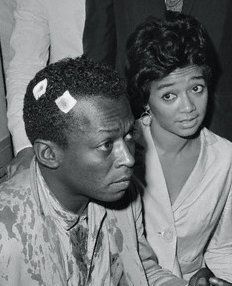
In Blue in Green, author Wesley Brown creates a fantasy fiction which takes the NYPD assault of jazz musician Miles Davis on August 25, 1959 and imagines an extended evening after then girlfriend dancer/actress Frances Taylor has come to the local Police precinct to bail him out. After driving Taylor home to their apartment, Davis rebuffs her and drives off into the night and visits various iconic NYC jazz locations in his life while reminiscing about his career. Taylor returns to their home and reminisces about the acting and dance career she gave up in order to stay with Davis.


Miles Davis and Frances Taylor on the night he was assaulted by the NYPD. Image sourced from Who Dated Who.

Both fantasies allow each of them the opportunity to remember and or meet up with figures from their past. Davis thinks of members of his so-called 'First Great Quintet' such as Cannonball Adderly and John Coltrane, his home and his parents back in St. Louis, his early days with the Billy Eckstine Orchestra and Charlie Parker. He drops into the apartment of pianist / arranger Gil Evans to discuss their plans for the now iconic "Sketches of Spain" recording. Some of the friends hint at their disapproval of his treatment of Taylor, an abuse often due to the influence of cocaine addiction, but also likely the result of the internal demons & feelings of inadequacy which he withheld from displaying in his public life.

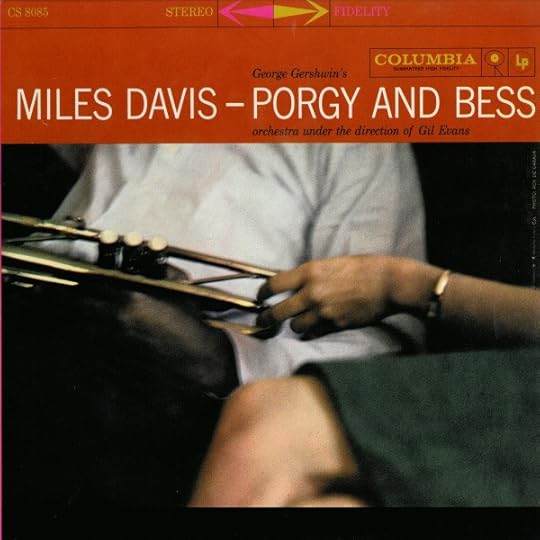
Taylor remembers her early love of dance, her debut with the Paris Opera Ballet, her training with the Katherine Dunham Company, an encounter with Eartha Kitt, performing off-Broadway in "Porgy and Bess" and "Carmen Jones", rehearsing for on-Broadway in the original cast of "West Side Story" (she must have had the Anita role before Chita Rivera, as she sings "I want to be in America" to herself) and having to leave the production when asked to do so by Davis.

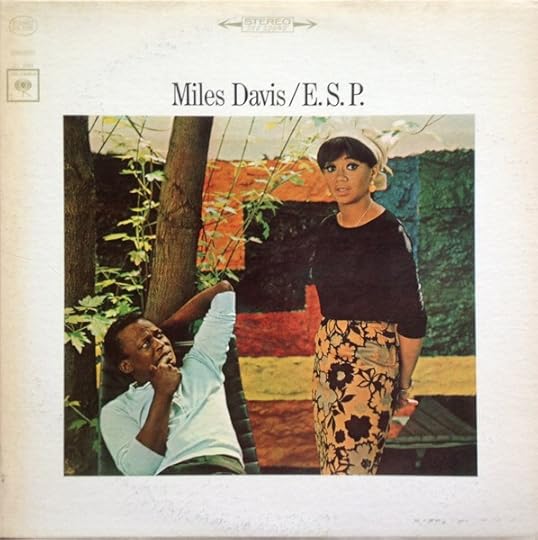
In real life, Frances Taylor would go on to marry Miles Davis in December 1959. She would leave him in mid-1965 shortly after being photographed with him for the cover image of the "E.S.P." album. Although Blue in Green is ostensibly about Davis and his early career (the title is from one of the tracks of the "Kind of Blue" album), the main lament here is for the life of Frances Taylor and all that she gave up in order to be his muse and inspiration, but also the target of his domination and insecurity. In that, it is a lament for all partners of domestic abuse.

Soundtrack
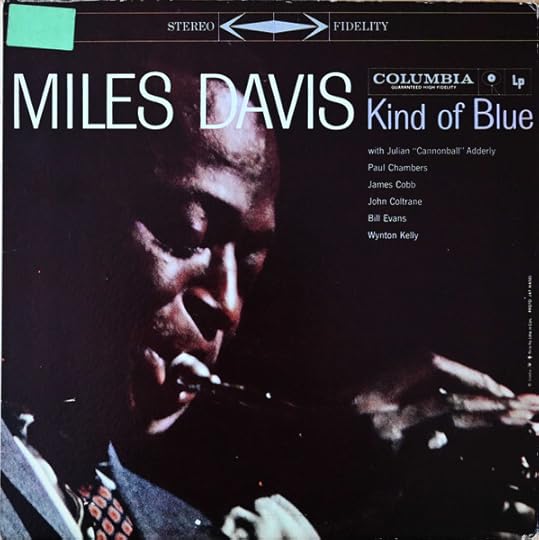
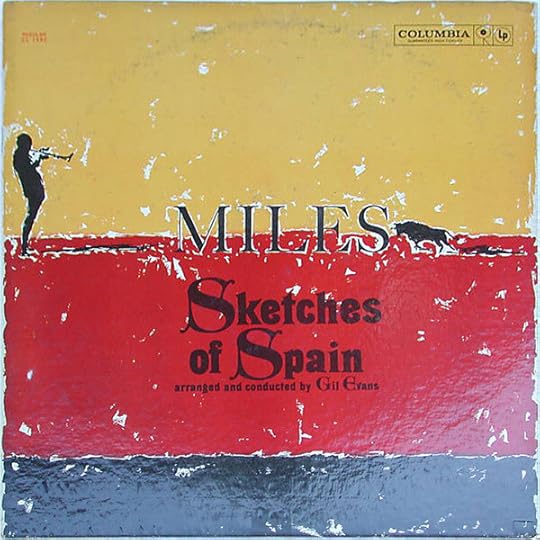
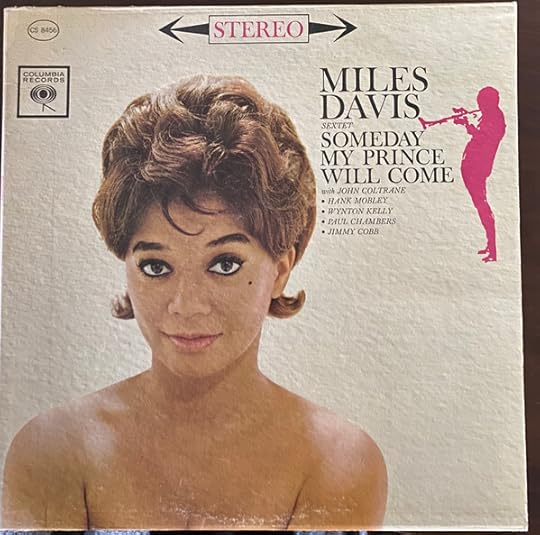
These were the Miles Davis albums that I was listening to while reading Blue in Green. These are the main Miles Davis albums influenced and/or inspired by Frances Taylor or which feature her in the photograph on the album cover:
1. Porgy and Bess (1959) Recorded July/August 1958, released March 1959.

Cover image sourced from Discogs.
Listen to the full album on YouTube here.

2. Kind of Blue (1959) Recorded March/April 1959, released August 1959.

Disc image sourced from Discogs.
Listen to the full album on YouTube here, extended version with bonus tracks.

3. Sketches of Spain (1960) Recorded December 1959-March 1960, released July 1960.

Disc image sourced from Discogs.
Listen to the full album on YouTube here, extended version with bonus tracks.

4. Someday My Prince Will Come (1961) Recorded March 1961, released December 1961.

Cover image sourced from Discogs.
Listen to the full album on YouTube here.

5.E.S.P. (1965) Recorded January 1965, released August 1965.

Cover image sourced from Discogs.
Listen to the full album on YouTube here.

Trivia and Links

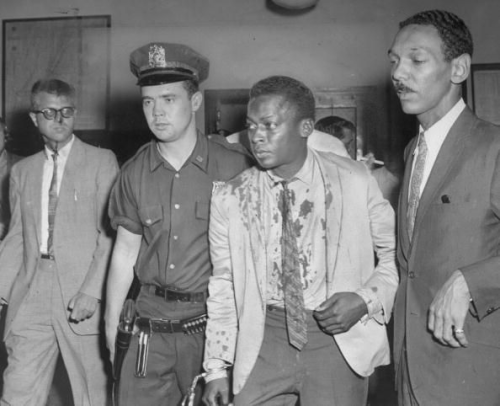
Miles Davis being escorted by the NYPD on the night he was assaulted by them. Image sourced from Open Culture (link below).

There is an article on the Miles Davis assault by the NYPD at Open Culture.
Profile Image for Keith Book Korner.
199 reviews33 followers
April 19, 2025
Really was just a ok story
Felt like the story was just all over the place. No real continuity at all.
Profile Image for Jeff.
740 reviews28 followers
August 20, 2023
Another writer might be more conspiratorial about the forces arrayed against Miles Davis on August 25, 1959, six months after the death of Buddy Holly, a week after the release of Kind of Blue, when, having helped a white woman get into a cab in front of the Blue Note, where his quintet was performing, he was confronted by police who beat him about the face and body for his verbal intransigence.

But Wesley Brown's exquisite settings of dialogues from among Miles' crew in the 24-hour-aftermath of that assault takes its cues not just from Miles' tonality, but from Frances Taylor's lines, that have to be imagined, since by then she had already given up her career in the dance, and herein lies the act of generosity that this historical novel represents. Brown's novel moves back and forth between being an adept analysis of the Davis biographical trove, and a sympathetic imagination of how lonely Taylor and Davis must have been in their marriage. Brown wants to change our sense of what Davis needed in women, and what he was greedy enough to take.
Profile Image for Gino.
32 reviews1 follower
March 13, 2023
This book wasn't even 60 pages; I found that initially enticing. I wanted a break from my long-winded dramas and to see if I would enjoy a histrorical-ish dramatic telling. I did not.

Generously, there were some things I liked about it. Wesley Brown described his characters so uniquely; Freddie Freeloader was "a grungy, scraggly bearded Black man seen by Frances at clubs where Miles played, was a part-time bartender, sometime bodyguard who ran errands, often showing up in a sun visor, wearing a string of trumpet mouthpieces ar0und his neck and two drumsticks strapped, Western style, to his waist. He talked in a salty jazz argot, seeing himself as a kind of roving disc jockey and jackleg emcee. He was sometimes allowed to be a proverbial fly on the wall at recording sessions." Brown is masterful in his relentless, warp-speed barrage of descriptors and commas. Brown's dedication of his few pages in this novella to such photograph-crisp imagery is probably my favorite part. I also sympathized a lot with the (my) protagonist, Frances. Frances putting her promising dance career behind her due to misogyny and abuse was absolutely disheartening. Combining her plight as a woman with the plight of a black creator in this time, I just absolutely wanted to hold Frances. You see the same plight of a black creator in the Miles Davis side of the story; but you won't catch me sympathizing that hard considering the misogyny and domestic abuse that Miles Davis was also allegedly rocking with. I wonder if the author was trying to make us hate Miles. But then again, I remember the first page of this story starting with an unprovoked police baton cracked up the back of his head sucker punch style. I guess I can never, ever know the pressure and scope of the lens he was under. Maybe Brown didn't want to make our opinions for us; he just wanted to provide the information.

I rate the novella so low due to overall lack of emotional affect. Again, I wanted to comfort Frances and her story was effective, but I was emotionally stunted with Miles due to his character flaws and he was half of the book! I also think the book devoted way too much time to describing the music. I get it; I think we were supposed to be submerged in the "magic" of his music in a hypnotizing Whiplash-esque way. But considering how short the book was and the already ample devotion to describing the characters, the impeccable detail of the music taking up space as well did not allow for much fictional narrative juice. If your book is less than 60 pages, I need the narrative to be top tier. I think this could have benefited from being longer; allowing more room for growth amongst the characters would have been nice to see.

Should you read this? If you want a change of pace. It is likely not the story to scratch your creative itch though.
Profile Image for Tom.
1,182 reviews
November 7, 2022
Blue in Green begins on a night in August 1959, when Miles Davis, on break between sets at Birdland, is beaten by police, booked, and released. In addition to the humiliation of the attack—hit from behind by a cop he never heard approaching—just weeks after the release of Kind of Blue, is a cauldron of bad feelings: He’s begun beating his wife, Frances Taylor, whom he’s coerced into abandoning her career in ballet and dance, and friends of Davis and Taylor sense something is wrong in the relationship, with Davis as the likely “something”—a man violently jealous in direct proportion to his many insecurities and self-doubts. With few exceptions, Davis trusts almost no one. Coltrane has left his group, Billie Holiday and Lester Young—people he strongly respected and could talk to—recently died, and he’s dealing with his own set of drug problems.

The form of the story is a kind of Odyssey, with Davis driving around Manhattan to cool off after the beating, and Taylor at their apartment, waiting for him to come home. Wesley Brown creates a space to lay out the case of what happened, what preceded it, and what came of it. The sympathy doesn’t mean Brown condones brutal acts against others and self-destructive tendencies. Like Joyce’s Ulysses, Taylor, as Penelope’s stand-in, has the last word, but unlike Joyce’s Ulysses, it ain’t a “yes” for Davis.

Wesley Brown packs a lot of biographical and cultural information into a tidy 65 pages of compulsively readable prose that provides a complex, sympathetic acknowledgement of the psychic forces Davis, Taylor, and other Black artists of the time had to negotiate, compelling them to act as they did.

For more of my reviews, please see https://www.thebookbeat.com/backroom/...
Profile Image for Rich.
30 reviews
December 31, 2025
Blue in Green is a novella you don’t read so much as listen to. Set over one night in 1959 after the NYPD assault on Miles Davis, Blue in Green moves through memory, rage, genius, and love with the rhythm of a late jazz set.

What truly elevates it is Freddie Freeloader—not just a reference, but as a a character and witness. Freddie breaks down the artistry from the outside, translating genius into lived experience, reminding us that jazz is made in rooms full of people, not myths. Alongside him, Frances Taylor’s reflections add moral weight: ambition deferred, love strained, and the cost of orbiting brilliance.

Lyrical, compressed, and fearless—jazz history felt from the inside. 🎺

⭐️⭐️⭐️⭐️/5
Profile Image for John Ward.
437 reviews6 followers
September 27, 2024
Excellent, thoroughly enjoyed. Need to read more of this author.
9 reviews1 follower
July 29, 2025
It was nice to learn about Miles Davis… spoiler… he is not a good man. Very quick read with under 100 pages. A bit confusing to follow at times.
This entire review has been hidden because of spoilers.
Profile Image for Austin P.
11 reviews1 follower
December 19, 2025
relative to the novels length it took me a while to realize the genius that so many people mention. it really is genius and such great writing.
30 reviews
October 16, 2024
I loved this novella! It takes you on an imaginative, yet chaotic tale of great musical talents. Although its not all non fiction, It gives you the insight to how turbulent great artists life can be.
Displaying 1 - 11 of 11 reviews

Can't find what you're looking for?

Get help and learn more about the design.