Jump to ratings and reviews
Rate this book

Sword of Honour #1-3

Sword of Honour

Rate this book
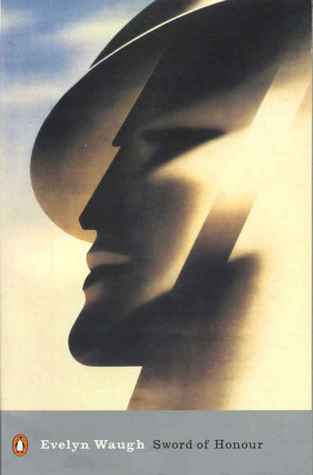
Fictionalising his experience of service during the Second World War, Evelyn Waugh's Sword of Honour is the complete one-volume edition of his masterful trilogy, edited with an introduction by Angus Calder in Penguin Modern Classics.

Waugh's own unhappy experience of being a soldier is superbly re-enacted in this story of Guy Crouchback, a Catholic and a gentleman, commissioned into the Royal Corps of Halberdiers during the war years 1939-45. High comedy - in the company of Brigadier Ritchie-Hook or the denizens of Bellamy's Club - is only part of the shambles of Crouchback's war. When action comes in Crete and in Yugoslavia, he discovers not heroism, but humanity. Sword of Honour combines three volumes: Officers and Gentlemen, Men at Arms and Unconditional Surrender, which were originally published separately. Extensively revised by Waugh, they were published as the one-volume Sword of Honour in 1965, in the form in which Waugh himself wished them to be read.

Evelyn Waugh (1903-66) was born in Hampstead, second son of Arthur Waugh, publisher and literary critic, and brother of Alec Waugh, the popular novelist. In 1928 he published his first work, a life of Dante Gabriel Rossetti, and his first novel, Decline and Fall, which was soon followed by Vile Bodies (1930), A Handful of Dust (1934) and Scoop (1938). In 1939 he was commissioned in the Royal Marines and later transferred to the Royal Horse Guards, serving in the Middle East and in Yugoslavia. In 1942 he published Put Out More Flags and then in 1945 Brideshead Revisited. Men at Arms (1952) was the first volume of 'The Sword of Honour' trilogy, and won the James Tait Black Memorial Prize; the other volumes, Officers and Gentlemen and Unconditional Surrender, followed in 1955 and 1961.

If you enjoyed Sword of Honour, you might like Ford Madox Ford's Parade's End, also available in Penguin Modern Classics.

'Marvellous ... one of the masterpieces of the century'
John Banville, Irish Times

694 pages, Paperback

First published January 1, 1965

349 people are currently reading
3276 people want to read

About the author

Evelyn Waugh

347 books2,954 followers
Evelyn Waugh's father Arthur was a noted editor and publisher. His only sibling Alec also became a writer of note. In fact, his book “The Loom of Youth” (1917) a novel about his old boarding school Sherborne caused Evelyn to be expelled from there and placed at Lancing College. He said of his time there, “…the whole of English education when I was brought up was to produce prose writers; it was all we were taught, really.” He went on to Hertford College, Oxford, where he read History. When asked if he took up any sports there he quipped, “I drank for Hertford.”

In 1924 Waugh left Oxford without taking his degree. After inglorious stints as a school teacher (he was dismissed for trying to seduce a school matron and/or inebriation), an apprentice cabinet maker and journalist, he wrote and had published his first novel, “Decline and Fall” in 1928.

In 1928 he married Evelyn Gardiner. She proved unfaithful, and the marriage ended in divorce in 1930. Waugh would derive parts of “A Handful of Dust” from this unhappy time. His second marriage to Audrey Herbert lasted the rest of his life and begat seven children. It was during this time that he converted to Catholicism.

During the thirties Waugh produced one gem after another. From this decade come: “Vile Bodies” (1930), “Black Mischief” (1932), the incomparable “A Handful of Dust” (1934) and “Scoop” (1938). After the Second World War he published what is for many his masterpiece, “Brideshead Revisited,” in which his Catholicism took centre stage. “The Loved One” a scathing satire of the American death industry followed in 1947. After publishing his “Sword of Honour Trilogy” about his experiences in World War II - “Men at Arms” (1952), “Officers and Gentlemen” (1955), “Unconditional Surrender" (1961) - his career was seen to be on the wane. In fact, “Basil Seal Rides Again” (1963) - his last published novel - received little critical or commercial attention.

Evelyn Waugh, considered by many to be the greatest satirical novelist of his day, died on 10 April 1966 at the age of 62.

See http://en.wikipedia.org/wiki/Evelyn_W...

Ratings & Reviews

What do you think?
Rate this book

Friends & Following

Create a free account to discover what your friends think of this book!

Community Reviews

5 stars
951 (45%)
4 stars
767 (36%)
3 stars
306 (14%)
2 stars
65 (3%)
1 star
24 (1%)
Displaying 1 - 30 of 179 reviews
Profile Image for Matt.
1,052 reviews31.1k followers
September 26, 2024
“The sapper steered. They moved quite fast across the water, out of the oil and floating refuse. As they watched they saw that the crowd on shore had all turned their faces skyward.

‘Stukas again,’ said the sapper.

‘Well, it’s all over now. I suppose they’ve just come to have a look at their spoils.’

The men on shore seemed to be of this opinion. Few of them took cover. The match was over, stumps drawn. Then the bombs began to fall among them…From the boat they saw havoc. One of the airplanes dipped over their heads, fired its machine-gun, missed and turned away. Nothing further was done to molest them. Guy saw more bombs burst on the now-deserted water-front. His last thoughts were of X Commando…waiting at their posts to be made prisoner. At the moment, there was nothing in the boat for any of them to do. They had merely to sit still in the sunshine and the fresh breeze…”

- Evelyn Waugh, Sword of Honor Trilogy

Evelyn Waugh’s Sword of Honor is an interesting take on the standard Second World War literary epic. In terms of page-count, scope, and ambition, it presents itself as something similar to the hefty tomes produced by Vasily Grossman and Herman Wouk. But in terms of pacing, theme, and characterization, it is really rather unique.

For much of its length, it chooses inaction over action, stillness over movement, and small moments over spectacle. In Waugh’s universe, war is not so much hell as it is a bureaucratic nightmare populated by smallminded idiots sending orders in triplicate to other smallminded idiots. There are many times when Waugh seems to purposely toy with his reader’s expectations, hinting at narrative pathways that later become dead-ends. A man gets on a ship to go to war, but the ship breaks down. Another man trains for a mission, and then that mission gets cancelled. It can be frustrating, especially if you are expecting a more traditional war novel, but it has its own rewards.

***

Sword of Honor is an omnibus comprised of three separate novels published between 1952 and 1961: Men at Arms, Officers and Gentlemen, and Unconditional Surrender. At the risk of torpedoing my reading challenge, I am treating it as a single whole, rather than looking at its component parts.

Told in the third-person omniscient, the main character is Guy Crouchback, heir of a fading aristocratic family. He is in his late thirties when the novel opens, divorced and living alone in a villa in Italy. With the coming of the war, he returns home to join the effort, quickly discovering that his modest talents are not really in demand. Eventually, after several false starts and go-nowhere conversations, Guy joins the Royal Corps of Halberdiers.

From there, his adventures – and misadventures – take him to Scotland, Africa, Crete, and Yugoslavia, mostly on the periphery of events. In Crete, for example, much of Guy’s time is spent simply trying to find the front lines, while his superior officer makes a run for the beach. Despite being set during the greatest conflict in world history, battle scenes are few and far between, and generally raging elsewhere.

Instead of the visceral thrill of combat, Waugh meditates on the boredom, drudgery, and politics of army life. One early set piece involves a junior officer and a brigadier warring over possession of a field toilet. Another sequence has Guy growing a moustache and getting a monocle. A secret mission to occupied France ends up with some commandos running from a Frenchwoman with a shotgun.

Much of this plays as farce, though Waugh has an ability to lull you into thinking this is a slapstick comedy, right before delivering an emotional sucker punch.

***

Guy is a somewhat passive antagonist, with slender shoulders upon which to rest such a long tale. Things mainly happen to him, rather than him driving events, which makes intellectual sense – he’s just one aging acting-captain in a globe-spanning inferno – but can be dramatically unfulfilling. He is smart enough, but no great thinker; brave enough, but no hero. His defining trait is a somewhat detached, ironic bemusement, though by the end, he is subtly altered in a way that feels earned and organic.

For the first third, we stick extremely close to Guy, observing things mainly from his perspective. Upon reaching the middle section, though, and continuing to the end, Waugh opens his story up considerably, and we begin following many different threads.

Waugh’s supporting cast is mostly excellent. There is the posturing Apthorpe, whose impeccable etiquette is but a thin veil for the very British ass-holism raging just beneath the surface; the one-eyed, seemingly unkillable Ben Richie-Hook, who is always looking for a fight; the slyly dangerous Corporal-Major Ludovic; and the chameleonic Trimmer, a former lady’s hairdresser who is trying to woo Guy’s ex-wife, Virginia. Many of these figures share the same trait: an imbecilic knack for failing upwards. They also tend to be one-dimensional, used to land a joke or push the plot. That doesn’t make them any less memorable. Beyond that, Waugh occasionally gives his archetypes a surprising angle. The old, overweight Jumbo Trotter, for instance, first appears to be mere comic relief, a useless relic of an earlier war. As things progress, though, Waugh shows him to have a singular gift for navigating the military’s byzantine administrative rules.

***

A famed satirist, Waugh spends much of Sword of Honor balancing right on that edge. For example, there is a running gag with an intelligence officer who is convinced that Guy is a Nazi spy, and who creates a super-secret file that is so important that no one can see it.

There are also moments, however, when Waugh plumbs deeper emotions, especially in the relationship between Guy and his father. This is important, because if the characters are just props and setups, there is no investment in the outcome. Though it is fleeting, the sporadic sympathy that Waugh musters helps to balance out the mockery and the cynicism, turning Sword of Honor into a more resonant work.

***

Published after the fall of empire, there is probably something to be said about Sword of Honor being the quintessential self-reflective English novel, critiquing, deconstructing, and puncturing British manners, traditions, and ideals, while also celebrating them as faded remnants of a nobler age. But I was most impressed with Waugh’s ability to capture the feeling of what it must have been like to be a very small cog in an incredibly large machine, to have only a fraction of a fraction of the information you need, and to have your destiny decided – often cruelly – by unseen and uncaring forces.
Profile Image for Ted.
515 reviews737 followers
March 23, 2019
Many literary careers are doomed to go on slightly longer than they should, and to outlive the author's original engrossing talent.

So concludes Christopher Hitchens, in a 2003 Atlantic article, "Evelyn Waugh: The Permanent Adolescent", reprinted in his collection of essays, Arguably. Actually, the sentence is the first of his concluding paragraph, which goes on
Waugh himself lived to lament the Second Vatican Council and to deplore the abolition of the Latin Mass - which meant that he became not more Catholic than the Pope but more curmudgeonly than his own confessors and more conservative than the Church itself. This has the accidentally beautiful result of making Sword of Honour into a literary memorial not just for a lost world but for a lost faith. In Catholic doctrine one is supposed to hate the sin and love the sinner. This can be a distinction without a difference if the "sin" is to be something (a Jew, a homosexual, even a divorcee) rather than to do something. Non-Christian charity requires, however, that one forgive Waugh precisely because it was his innate - as well as his adopted - vices that made him a king of comedy and of tragedy for almost three decades.
Hitchens lays the ground for this conclusion by pointing out that Guy Crouchback, the protagonist of the trilogy, has to be taken as a stand-in for Waugh himself, since he's given the same day, month and year of birth as was the author's. And he expresses views about things that happened in the areas of Europe to which Waugh was posted during WW II that, when I read the book, I assumed to be ironic in the extreme, but perhaps actually reflected the author's own thinking. For example, Hitchens quotes from Waugh's private journal - "The Russians now propose a partition of East Prussia. It is a fact that now the Germans represent Europe against the world." - and continues, "The long and didactic closing stages of Sword of Honour are amazingly blatant in the utterance they give to this rather unutterable thought. Guy Crouchback regards the Yugoslav partisans as mere ciphers for Stalin, sympathizes with the local Fascists, and admires the discipline of the German occupiers. We know from many published memoirs that Waugh himself was eventually removed from this theater of operations for precisely that sort of insubordination."


nevertheless ... (to segue into my original thoughts on the trilogy)

I enjoyed the novels tremendously. Many laugh-out-loud moments, but there's a serious story here too (and yes, it is somewhat "somber" as it says on the dust jacket). Very unusually for me, once I started reading the trilogy I read nothing else until finishing the whole thing 700 pages later. I have the Everyman's Library edition, which is a really first class book. I read the introduction (by Frank Kermode) after the novels, found it very interesting. It's largely about the "Catholic aristocracy" of which Waugh was a converted member. There's a real nice (one page) bibliography of books about Waugh, and a very cool Chronology (14 pages long) of the events in Waugh's life, which places them in two different contexts: Literary and Historical Events.

Just writing this short review less than three years after reading the book makes me want to read them again. I guess that's a good recommendation!

it would be hard to reread without taking Hitchens' thoughts into account, however.


. . . . . . . . . . . . . . . . . . . .
Previous review: The Conquest
Next review: Cinderella Man the story of the boxer James Braddock
Newer review: Down on the Farm gentle humor from the Minnesota northwest

Previous library review: The Hobbit There and Back Again - Tolkien
Next library review: The Once and Future King T.H. White
Profile Image for Roman Clodia.
2,898 reviews4,652 followers
April 18, 2020
1. Men At Arms ~ 3*
This first part of what was originally a trilogy was quite uneven for me. Guy Crouchback is a well-intentioned though ineffective man who, in his late 30s, joins the army to 'do his bit'. The opening section in training is the funniest with the farcical episode of Apthorpe and his 'thunder box' being especially hilarious. But there are long sections where Guy is shunted around aimlessly or himself goes off on a quest to locate the owner of a legacy for which he has taken responsibility which are dull.

The bureaucracy and confusion of a national military force being mobilised is conveyed, but there's also an old-fashioned sense of the army being led by old buffers who inhabit privileged clubs in Piccadilly which perhaps gives a skewed view of the British war effort: the officers who see Dunkirk as 'running away', for example.

There's a typically Waughesian episode on the Isle of Mugg which lifts things towards the end, but I'm finding this looser and less sharp than I expected: 3-stars for this first volume.

2. Officers and Gentlemen - 3*
In this second part, Guy manages to both take an active part in the war, and to gain some warmth from me. His concern for a dead man on Crete finally made him come to life as a person and not just a PoV character there to offer up a detached observation on the war and a filter for Waugh's own views. His joy at being greeted with welcome by his old Halberdier company and his ability to remember the name of at least one man serving under him helped. And the description of the chaotic retreat from Crete is well done, though it's quite opaque as to what happens while Guy is delirious.

With Virginia back on the scene I thought this book had turned around for me - until the German invasion of Russia happens in the background and Guy's reaction turned me against him all over again:

... two years before when he read of the Russo-German alliance, when a decade of shame seemed to be ending in light and reason, when the Enemy was plain in view, huge and hateful, all disguise cast off; ... now that hallucination was dissolved [...] and he was back [...] in the old ambiguous world [...] and his country was led blundering into dishonour.
To write off the deaths of 20m+ Russians in the struggle against Hitler as a British alliance of 'dishonour' seems extraordinary to me.

For all the fine writing, the humour, the tragedy and pathos, fundamentally I just can't get on with Waugh's reactionary political views which are on full display here. He despises the Russians, the Americans who are arriving in London, anyone working or middle class, anything that speaks to a sweeping away of old and entrenched social hierarchies and aristocratic values, and quite a few women. I can't share Waugh's politics or misanthropy but I'm interested enough to finish the trilogy.

3. Unconditional Surrender - 2*
This third and final part went downhill for me as it becomes increasingly episodic and picaresque. Yet again Guy is hanging around London looking for a job, yet again he bumbles through his training and injures his knee (yep, again)... Things pick up when he gets sent to Yugoslavia to liaise with communist partisans fighting fascism and we have another of those brief moments, like the one in Crete, where Guy actually comes to life and shows some compassion for the Jewish refugees with whom he's confronted. But that's soon over. For someone who's supposedly concerned with his Catholic spiritual welfare, I find Guy remarkably emotionally cold and uncaring:

Overall, then, this has been an interesting read for me as I found myself not agreeing with the general plaudits this book receives. The writing is often sharp and the bitter satire can work wonderfully but I would guess I'm too far out of tune with Waugh's own essentially conservative and reactionary politics that inform this book - his snobbish despair of the modern world, and his desire to get back to some kind of 'civilised' aristocratic and feudal past is all the more heinous since it never was his: his own solidly middle-class, Golders Green background actually makes him one of the 'new men' that his books so despise.

It's remarkable, too, that there's very little sense of fighting against anything: indeed, Crouchback is far more galvanised against the Russians than against Hitler or the Nazis, and there's a sneaking suspicion when he's in Yugoslavia that he's more impressed with the organised German war effort than the necessarily more messy activities of Tito's partisans. Some wars, as so many reviews state, may well be meaningless and unnecessary - I'm just not sure that WW2 was one of them.

So, a challenging book for me. In places Waugh's writing is sublime, his farcical scenes can be hilarious (the thunderbox!), and his characterisation memorable. But, for all that, this just isn't a book which speaks to me - I find Guy Crouchback opaque, at best, and Waugh's politics reprehensible.
Profile Image for Cecily.
1,320 reviews5,331 followers
May 23, 2021
Men at Arms - Part 1 of Sword of Honour

What fun - a bit like a cross between MASH, PG Wodehouse and Brideshead!

An upper class British Catholic divorcé leaves his home in Italy at the start of WW2 to try to join the army, and eventually succeeds.

The story is populated by quirky characters and strange coincidences, with glimpses of poignancy. Most of the characters are in a perpetual state of genial incomprehension and incompetence.

Waugh served in WW2 and if his experience was anything like what was described, it's amazing that we won. However, there are clearly some parallels, as the book is peppered with mentions of specific dates and events (helpfully explained in footnotes, in my edition).

Apthorpe's too literal "thunderbox", the old colonel that should have retired but no one quite wants to tell him he's not needed any more, bizarre and nonsensical bureaucracy, all beautifully written.

And best of all, there are two sequels - let's hope they're as good.


Officers and Gentlemen - Part 2 of Sword of Honour

In many ways this is very similar to the previous book about Guy Crouchback of the Halberdiers: soldiers being resigned to the comic ineptitude of their commanders and all sorts of intriguing characters.

However, this volume has more about the tactics and experience of war, so that I did slightly lose track in places (despite all the historical footnotes) and less outright comedy, less of life back home, less Catholic angst (less Catholicism altogether) etc.

The loucheness in Alexandria was good, and accidental heroics of were fun, but overall, I enjoyed it less.

Let's hope part 3 reverts to form.


Unconditional Surrender - Part 3 of Sword of Honour

Back to form (like part 1): a better balance (for my taste) between army and civilian storylines, but still plenty of eccentric characters, some shady secrets and lots of amusing bureaucratic inefficiency (the "intelligence" officers who consistently misinterpret Guy's connections and flag him as dubious are rather like a comic riff of Kafka), sprinkled with thoughts of faith, loyalty and doubt in terms of religion, relationships, nationality and class.

I feared the ending was going to be too obvious and tidy, but I need not have worried: it was more interesting that I'd feared.
Profile Image for Nigeyb.
1,475 reviews404 followers
April 13, 2020
Evelyn Waugh did not have "a good war" as a soldier however he was able to transmute his uncomfortable personal experience into something wonderful. Through Guy Crouchback, the detached observer and would-be knight, who mistakenly believes his private honour will be satisfied by war, Evelyn Waugh perfectly captures the bureaucracy, pettiness, absurdity, humour, and confusion of war. It all rings true with numerous little details that make this book so satisfying. It's everything that great literature should be - beautifully written, evocative, poignant, funny, tragic and profound.

I wonder how many of the great characters are also based on real people. I really want Jumbo Trotter, Apthorpe, Ludovic, Box-Bender, Trimmer, Virginia, Peregrine, and - of course - Brigadier Ritchie-Hook to be real characters, as I do, the denizens of Bellamy's club.

In April 2013, I finally read Brideshead Revisited and was captivated from start to finish. You probably don't need me to tell you it's a masterpiece. Before embarking on Sword of Honour, I would never have believed that Evelyn Waugh could have written two masterpieces. He has. Brideshead Revisited and Sword of Honour. That's in addition to all the other wonderful fiction and non-fiction.

Epic and extraordinary. You really should read Sword of Honour. A wonderful book.

5/5

NOTE ABOUT DIFFERENT EDITIONS:

Sword of Honour was originally published as three separate volumes Men At Arms (1952), Officers and Gentlemen (1955), and Unconditional Surrender (1961), however Waugh extensively revised these books to create a one-volume version 'Sword of Honour' in 1965, and it is this version that Waugh wanted people to read.

The Penguin Classics version of 'Sword of Honour', contains numerous informative and interesting footnotes and an introduction by Angus Calder, each time Waugh changed the text there is also a note. Most of sections that Waugh changed or removed was with a view to ensuring that his "hero" Guy Crouchback is perceived as more worldly and experienced than was the case in the original version of the books. I can see why Waugh would choose to change the emphasis in this way and I think it makes the overall narrative more convincing and effective.

Profile Image for M. D.  Hudson.
181 reviews128 followers
July 9, 2019
There is something fundamentally wrong with these books (referred to here as SOH so I don’t have to keep misspelling “honour” over and over), and I am not sure I can say exactly what that is, but I felt somewhat soiled after reading them. But this book (I will also refer to it in the singular, despite it being a trilogy, for simplicity’s sake) is not early, funny Waugh, but deep, dark Catholic Waugh, so the laughs are gone now, replaced by a tedious and desperate kind of spirituality.

The black heart of it all might come from its bent Catholicism. I say this since the book is, I think, supposed to be primarily about religion, redemption, etc. etc. The protagonist, Guy Crouchback, comes from an ancient line of English Catholics who never knuckled under to the Protestants, an heroic ancestry that we are ponderously made aware of from time to time. Sure, there were the occasional cowards and insanity cases, but mostly the Crouchbacks were a stalwart English bastion of Rome -- ponderously handled in terms of fiction, but not immediately objectionable. What bothered me is what a Catholic monster Guy is, really. His bland, depressed spirituality drifts through the book like a wan ghost, almost always revealing itself to be pitiless when real, live human stuff happens. Two events are particularly telling. One, Guy takes a bottle of whiskey to a “friend” who is in hospital. Said friend, Apthorpe (see below), is an alcoholic and guzzles the whole bottle as soon as Guy leaves. This kills him, and yet Guy tells us he has nary a twinge of guilt over this. Even his benighted, stupid, superiors say this was not cricket, but Guy’s soul is snow-white. The second incident has a set up too ridiculous to go into, but during an idiotic reconnaissance raid on Dakar, which is held by hostile Vichy French, Guy’s commanding officer tosses to Guy the head of an African French sentry he has decapitated. I realize body parts as souvenirs has a long history, even into WWII (although usually in the Pacific), but for all of Guy’s fine-grained sensibilities, he seems just as amused, or at least unconcerned with this bit of barbarity as the rest of the soldiers are. He doses off with the head in his lap and carries it back to his quarters on the ship. Next morning he brings it to his commander and has a cup o’ tea. The head shows up later on a hospital ship, where Guy’s commanding officer had commanded it to be “pickled” by His Majesty’s doctors… Beyond the racism, I thought it entirely possible that as a French soldier, this African may well have been a fellow Catholic.

But then Guy isn’t much interested in other Catholics or anybody else either. Guy attends Mass regularly – he is a good Catholic that way. But it annoys him when other people attend Mass as well (especially other ranks!). He is happiest in a chapel, alone with a sepulchre carved with a medieval crusader in repose, dappled with daubs of stained-glass window light. This relentless solitary pursuit of salvation seems to be the book’s soul purpose (forgive the pun). Such a spiritual journey might be of more interest if it ever involved charity, kindness, or compassion. It does not. There is a flinty selfishness at the heart of this book that if not pure evil is at least simply wrong.

If spiritual quests don’t interest you, you’re out of luck, because the fact is that Guy Crouchback, for all his moody maundering (some of which is vaguely aesthetic and takes place in Italy), doesn’t seem to have a thought in his head. Or bullocks in his pouch. It is tiresomely apparent that Waugh is trying to render in him a portrait of “Empty Modern Man in Search of a Soul” or some such thing, but it wouldn’t have been any harm in having him read a book from time to time. This is the closest thing to a main character built around his own soul that I’ve ever read – and souls, lets face it, aren’t very interesting without an actual human being wrapped around them. Early on, Guy does attempt to seduce his own wife, which was meant to make him human, but really all it does is set her up for all the catastrophes that will later beset her (see below) because she insists on being Guyless. Seduction scenes with one’s own ex-wife should be, I suppose, clumsy, but this was like Jan’s blundered-first-kiss episode of The Brady Bunch. It was hard to believe Guy had ever been an adult.

***

The SOH’s characters are sometimes unforgettable, if only because they are so implausible. Here are a few of them:

Apthorpe, the friend Guy poisons in hospital, is the best part of the (first) book, although he is so defective, stupid and probably insane that I am not sure why Waugh bothered with him. He came in from the African colonies, from a mysterious background spent in the bush (later debunked). Apthorpe becomes Guy’s friend. Guy likes being around people he can feel superficially charitable towards, which is the only explanation for the connection since Apthorpe is at all times a bloviating idiot. But an important idiot, apparently, since the whole first book of the trilogy (Men at Arms) is divided up into ponderous sections “Apthorpe Gloriosus” and so on, so Waugh must’ve considered him important (I suspect this was not planned as a trilogy and this volume was meant to stand alone). Apthorpe gets a promotion, of course, and proves himself predictably insufferable and incompetent. At this point, Guy’s loyalty seems to have something to do with self-mortification (at least I can’t figure anything else out). Guy’s whiskey, as noted above kills off Apthorpe, and this death is so quickly and sketchily brought about that it’s hard to tell why Apthorpe passed through the book in the first place. There is an elaborate joke involving a portable commode goes on far too long and is not funny at all, although Clive James and others seem to think this is the height of 20th century British comedic writing (the commode is called a “Thunder Box,” so beware the knowing wink-wink-nudge-nudge references among Waugh’s many fans). This being said, Apthorpe is rendered more three-dimensional than about anybody else in the book and I found myself developing a weird sympathy for him.

Guy’s Dad, Sir Whatever Crouchback is a phenomenally good Catholic that makes Mr. Chips look like Goebbels. Really, the kindly goodliness of this saintly man is artery-clogging. This being said, the scenes with him, despite being so relentlessly wholesome, are usually well-written, which made his appearance kind of a relief. When he dies, finally, it turns out that despite being made out to being so unworldly it is surprising he didn’t starve to death because he forgot how to hold a spoon, the old man was actually pretty darned shrewd about managing money and therefore left his son Guy enough money to make him a viable human being in society again. And so Guy’s one true chance to save his own soul by getting a real job for once, gets thwarted by the ancient and intact family harf-crown. There’s a boring funeral scene for the old man at which far more people than were expected show up, including, I think, a murmuring mud-spattered collection of background peasants being grateful and dropping haitches. Maybe not. I don’t remember for sure. Boo.

Guy’s Uncle Peregrine was far more interesting than Guy’s dad. He’s an English eccentric of the grouchy old bachelor type and I suspect he is supposed to represent the partially-damned in Waugh’s manipulative yet simplistic theology. Rather surprisingly, he makes a pass at Guy’s ex-wife Virginia (see below) that was actually somehow interesting – it was one of Waugh’s best moments, although I fail to see why it happened novelistically or that such a thing, given Peregrine’s antiquity and bachelorhood, was remotely plausible. Of course his nephew Guy was such a self-absorbed eunuch, the old man thought he had a chance. Ultimately Uncle Peregrine was unbelievable, but he had a certain vintage Waugh (or a mean-spirited version of Wodehouse) panache.

Guy’s ex-wife, Virginia is one of those fabulous bitch goddesses that male novelists loved conjuring up c. 1920-1950. You know: utterly beautiful, sexually incontinent, manipulative, heartless, wears too much lipstick, irresistible, sleeps in the nude, gossips, gets bored every living moment they aren’t at a party and then they are bored even at parties. Fitzgerald’s Daisy Buchanan is the only one of these women who actually come across, because Fitzgerald could be a genius sometimes, but the rest of them are spots all over the adolescent face of Anglo-American fiction of the time. I think there’s one in Brideshead Revisited, isn’t there (I’ve never read the book, but I’ve seen a couple film adaptations)? I’m sure the Dance to the Music of Time has two or three. For sure Hemingway had a several such ball-snippers. Virginia has her interesting points as a human being, to be fair to Waugh, but he can’t help but use her as an example of depravity and so inflicts on her all sorts of disasters. After she rebuffs Guy’s attempt to seduce her, we see her next in Scotland at a restaurant, rendered by Waugh with exquisite cruelty as a woman past her prime (she’s barely 30 at this point), her last coin as a woman spent. This is when she falls in with a cad (see below). A couple years after this, Virginia comes back to Guy, since she is desperate and hears he now has some money. But Guy, who has drifted considerably heavenward by this time in the book, won’t take her back. That is, not until she tells him how truly desperate she is – that she is pregnant by some cad (see below). Then, of course, St. Guy marries her right away. Afterwards, she then provides a week of recuperative sex for Guy as a kind of high-class comfort girl, since she is, you know, really good at sex and then -- O outrageous spoiler! Waugh kills her off with a late-war German buzz bomb! Nazi ex machina – you could practically see Virginia’s damaged (but not damned thanks to Guy) little soul go fluttering off for a few millennia in purgatory before being welcomed to the Bosom of Abraham. As Oscar Wilde said about Little Nell’s death, a reader would have to have a heart of stone not to laugh out loud. Despite the ridiculous down-at-the-heels belle dame sans merci crapola, Virginia had balls.

Virginia’s lover (the one who knocks her up) is absurd, but he is so brutally manhandled by Waugh that he becomes one of my favorite characters out of sheer pity. He has six or seven names, since he is a cad, but he is mostly referred to by his nickname Trimmer. He is one of Guy’s fellow officers, a real rascal who, unlike every other officer in the British Army, actually had a real job in peacetime! A ridiculous one to boot: he was a hairdresser on a luxury liner! Zounds! How contemptible! If this useful, skilled background had been known, Trimmer would never have been allowed to be an officer. To make it worse, Trimmer is a lady’s man. And since Waugh can’t help piling on his characters he doesn’t like, Trimmer is an utter poltroon as well – his active, unapologetic cowardice during a commando raid executed for the newspapers was rather funny in an early-Waugh way. The army’s propaganda bureau turns this eeny-weeney man into a hero to send around the USA to show how the British fighting man can really fight (oh the irony). Trimmer falls in love with Virginia, who only slept with him initially because one does become so frightfully bored during ocean cruises or World War II, doesn’t one? But once Trimmer loves her, she spurns him since he is now no good to her as a boy toy (this is how those kind of women roll in novels, you know). This love, which unlike any other emotion in the book seems genuinely sloppy and human, renders Trimmer into a babbling idiot, making him unsuitable to send to the USA to promote the British war effort. Therefore, pressure is exerted on Virginia by the military and she is forced to accompany Trimmer to the States so that he doesn’t fall apart during his lecture tour (yes, this all sounds very plausible, doesn’t it?). It is while doing her patriotic duty in the sack that the odious Trimmer impregnates her (see above). God, I hate novels sometimes.

Ludovic: Note the Slavic non-meat-n-potatoes, non-Yorkshire name! Bad guy alert! Ludovic saves Guy’s life, but he is relentlessly unpleasant. Large, greasy, somewhat fat, mysterious – you know, just like the Soviet Union. He is a writer – not educated, but given, grudgingly, talent by Waugh. He falls in with the English wartime boho crowd. For a few fleet moments in the book, I had hope Ludovic was going to turn out to be a real human being, since this book desperately needed a few. He is the quiet guy in the regiment always writing in a notebook off to the side. We are occasionally allowed to see what he is writing, and these excerpts are among the most penetrating things in the book, despite Waugh’s contemptuous plan to make him seem “literary.” I even fantasized that Crouchback would become friends with somebody intelligent, but this did not come to pass. Instead, Waugh turns Ludovic into a villain; in fact we are lead to believe he fragged his commanding officer on Crete (an unbelievably craven coward hysteric named Fido). Ludovic goes insane and starts babbling and carrying around a tiny pet dog he has named…Fido, after the officer he killed. Waugh attempts here, I think, to administer just deserts on the Godless, but as with all the other characters from Guy on down, the action is disjointed, the characters too sketchy or cartoonish.

Everard Spruce is a caricature of Cyril Connolly, the English editor and man of letters. As a caricature, he is pretty well done, actually. He is almost worthy of early “Vile Bodies” Waugh. Waugh is grossly unfair to him, I suppose (I’m an admirer of Connolly), but the nitwit aspects of literary life everywhere (the posing, the jockeying for position, the vanity, the lack of actual good work) are done quite deftly. My main complaint is that Spruce and his circle (those barefoot boho women who run his office!) are fairly one-note, Waugh’s portrait blighted, as always, by his customary outrage and disgust.

Jumbo is a retired Blimpish officer who at first glimpse appears to be senile, hanging around the rec room shooting pool (or billiards or snooker or whatever English officers did in rec rooms), his enormous ass hanging over the edge of the table (Waugh endows a couple of his characters with huge arses, apparently as a signal that we are not to take them seriously, like a clown’s big red nose). Jumbo, however, suddenly turns out to be a shrewd, energetic manipulator of the military establishment, and once so established, he is actually one of Waugh’s more amusing, plausible characters. Jumbo’s plot line is busier and therefore somewhat more interesting than most of the rest of the book, and he also is important for getting Guy where he needs to be in the military establishment, while also providing an insider’s glimpse of the establishment that mopey, outsider Guy could never manage. Which is to say Jumbo is pretty well rendered. The problem is that in that first introduction he is so utterly different than what he turns out to be that it makes Jumbo really hard to believe; he goes from senile bumbler to energetic, adroit manipulator in a 400 words. Waugh really, really needed an editor.

There are a host of other characters, of course – it’s a trilogy. There’s a mutilated, one-eyed WW I general who represents the thwarted but finally triumphant English fighting spirit (he’s the one who cuts off the French Colonial sentry’s head) – for reasons I cannot explain, I always pictured him standing only 18” tall and always shouting as if from a great distance. There’s an American called Loot who serves as a kind of plot mover throughout the book – it is disappointing the Loot does not come in for some scathing Waughesque criticism of Americans, but all he comes in for is the usual wartime anti-American English whining (he has a nicer uniform, more money – probably better teeth), but otherwise he is little more than a blandly genial scene-advancer. There is an outrageously racist depiction of a black witch doctor, used by the British secret services to put a hex on Hitler – so desperate are the British to win the war (or rather not lose it) they try the occult. This witch doctor is the go-to abortionist as well. Of course. Big or small, you can be sure that pretty much every character except Guy gets their comeuppance one way or another. Who cares? There were far too many types in this book and not nearly enough human beings. On top of that, class distinctions are almost 19th century throughout this book – “other ranks” are rendered as background smear from which an occasional name emerges, usually to tug a deferential forelock or otherwise advance a scene. For instance there’s a tiresome, ancient, and often boiled butler at Guy’s club, is a source of patrician amusements amongst the clouds of cigar smoke and snifters of bad wartime sherry. The few soldiers who emerge from the background khaki blur are doughty Tommies of the Dunkirk mold, dogged and loyal and etc.

***

As for structure, my guess is, this “trilogy” reads like a one-holer that got a couple of additions much later on. All three books have a decidedly different feel to them and an only tenuous cohesiveness. There are fine moments – Waugh is, at his best, an unquestionably powerful writer (although I have come to believe he was better as a travel writer than a novelist). The best part of the book has to do with the defense and evacuation of Crete by British, Commonwealth, and Greek forces. Waugh was actually there, and the hot, dusty, exhausting work of running away (as opposed to actually fighting) reads with real authority. The end of the book, when Guy is sent to Yugoslavia to work with the anti-Nazi partisans is also fairly well done – the partisans are not made to look utterly ridiculous, which surprised me, they being so foreign. I mean, of course there is a sort of Zorba the Greek heavy-handed earthiness to them that you’d expect from Waugh, but nothing too outrageous.

SOH ends tidily with a post-war coda with Guy all warm and cozy and his “saved” and neatly tucked-in and tooth-brushed soul made fully ready for bedtime. I can’t remember the particulars. For all its theological and spiritual pretensions, this was a heartless book full of far too many authorial cheap shots and get-out-of-hell-free cards, too much easy-cheesy spiritual “redemption” for a character – Guy Crouchback – who is cut far too much slack by his far too sympathetic creator. This is the kind of novel that makes me not really want to read novels for another six months or so. It doesn’t want to make me attend Mass either.
This entire review has been hidden because of spoilers.
Profile Image for E. G..
1,175 reviews797 followers
April 6, 2022
Introduction, by Angus Calder
Further Reading
List of Abbreviations
Preface


--Sword of Honour

Appendix: 'Synopsis of Preceding Volumes'
Notes
Profile Image for Phrodrick slowed his growing backlog.
1,077 reviews68 followers
December 5, 2017
The dystopian and satirical world of and unprepared England World War II

If this were just a review of the ineffective, jaundiced, sarcastic snobbish, effete England portrayed by Evelyn Waugh throughout the Sword of Honor Trilogy, this would be a 4 star review. It is depressing when it is not negative when it seems to fail to see any part of England before, during or after World War II as a home to honest, good hearted or even competent people. However Waugh writes well. He builds his story on crafted paragraphs and a highly directed story arc. I have no complaints about his craftsmanship as an artist nor can I entirely discount his version of England in World War II. I also do not think he has any sense of fairness and seems to be pining for a long ago world before we all started going to the dogs. Those good old days never existed.

Guy Crouchback is given to us as a stranger in his own land. He is from a family well on its way from a knightly and powerful house to one that may end with him. He is never portrayed as especially bright, well trained, athletic or creative. He is an average kind of well off Englishman Everyman. We join him as he returns from a failed venture as a planter in Africa and a mostly do nothing kind of guy living on the last of family money at a family manor house in a less well known part of Italy.

His return to an England he hardly knows is so that he can become a soldier in the cause of England’s honor in World War II. Although at 37 he is a bit old to become an Army Officer connections get him into an officer training unit of an ancient and elite formation of halberds.

Book I, Men at Arms and Book II Officers and Gentlemen are timed to cover the so called Phony War and the early disasters that the British Army suffered from the then victorious Axis Armies. As such Guy is the reader’s guide into an England not mentally or organizationally prepared for or serious about fighting war. He and his fellow halberd suffer all of the confusion and inefficiencies any people inside of a large organization, under extreme tests may encounter. There is only the slightest indication that anyone in the army or in the civilian world is bringing into the war the last of prior better days. No one except his wise father is much more than minimally right for the duties attendant to the successful prosecution of a war.

There is much bumbling about and some high and low humor. The battle of the Private Privy is a well construct mix of both at one time. Elsewhere the satire become so heavy handed as to be sarcasm. Guy has nothing good to say about America, and little good to say about England or her common wealth soldiery. He has taken on England’s false belief that World War II is to be won in the Mediterranean theater.

As much as I like Waugh the story teller, my patience came to an end reading his Synopsis that precedes the third book, Unconditional Surrender. “As Guy in the late autumn of 1941 rejoins his regiment, he believes that the just cause of going to war has been forfeit in the Russian alliance.”

I can grasp that “Uncle” Joe was as vile as Hitler. For Guy to reject all things Communist and especially Russian Communist is legitimate. What I find so terrible is that there is no similar moral outrage at Hitler or Nazism. I do not think Hitler’s name is used 3 times in the entire trilogy and there is never a thought about the Nazi enslavement of captured peoples or of his death camps or much more than the notion that the Germany just happened to be the enemy Almost nothing about the nature of that enemy nor of the threat it cast on western civilization.

It is well documented that in the years leading up to the German invasion of Russia, many on the political left had unending excuses in favor of Communism. Those that were not merely wrong-headed excuses would prove to be wrong headed and hypocritical. What is rarely discussed is the number of usually upper crust British, and not a few powerful Americans who would have continued to appease Hitler, even at the expense of ending all of the liberties of the English speaking peoples. Either Waugh or at least his narrator seem to be incapable of submitting Nazism to the same degree of critical analysis as is used to against the failure of Russian Communism.

Over all Guy’s travels and travails with his country’s progress through World War II seem to follow a tradition of the bewildered, mostly passive observer of his illogical dangerous world. Guy is in the tradition of The Man of La Mancha and The Good Soldier Schweik. I can see many papers written comparing him to Lucius in The Metamorphoses of Apuleius AKA The Golden Mule (in the original the word Mule is not used) and as another satiric war novel much like Catch 22. Where that all to The Sword of Honor Trilogy, I would recommend it as a 4 star read. The moral failure of the writer/narrator makes it hard for me to defend, never mind recommend.
Profile Image for Roger Brunyate.
946 reviews741 followers
June 14, 2016
Waugh's Final Words

Essentially, this is Waugh's swansong: three novels about the adventures of his quasi-autobiographical hero, Guy Crouchback, in the Second World War, gathered together by him and edited into a single volume at the end of his life. This is a compendium of my separate Amazon reviews of the individual volumes as I read them, followed by a brief consideration of the Trilogy as a whole.


Men at Arms (1952)

Amazon suggested Evelyn Waugh's Sword of Honour trilogy, the novel sequence that crowned the author's career, as something of similar interest to Anthony Powell's Dance to the Music of Time, which I am engaged on currently. Whereas Powell covers three decades in twelve volumes, Waugh treats half a decade in three—a fiction distilled from his own checkered experiences as a somewhat older officer in the Second World War. I have not reached the equivalent period in the Powell yet, but I find it hard to believe that he could be anything like as immediate, touching, or downright funny as Waugh. For Waugh is a satirist, but a satirist with serious concerns and an unusually realistic touch. For although this clearly falls into the general category of army comedies—a frustrating saga of administrative snafus and occasional action—it also comes over as a convincing account of how things must have felt as Britain was muddling through that deceptive period of the "phony war" before complacency got shattered at Dunkirk.

Waugh's protagonist, Guy Crouchback, is 36 when this first novel opens. A scion of an aristocratic Catholic family that has fallen on bad times, he has spent most of his adult life as an expatriate, first in Kenya and later in Italy. Returning home to "do his bit," he finds most doors closed to a man of his age. But a friend of his father's gets him a probationary commission in the Halberdiers, an unusual outfit combining ancient regimental pride with an unconventional approach to training and leadership. Glad though I am never to have been mixed up in anything like this myself, I found the descriptions of mess life and daily routine to be quite fascinating. Guy's position as an older volunteer allows the reader to look on as a voyeur, even as Guy is giving himself heart and soul to his new family.

For this is what I think the book is really about: belonging. Guy has suffered numerous losses: one brother to the previous war, another to suicide, the family home to debt, his years in Kenya and Italy lost to circumstance, and his wife to divorce. He is a Catholic in a predominantly Anglican world. He is looking for something or someone to give him a family, an identity, a place to belong. He finds this, at least at first, in the Halberdiers. Anyone who remembers their first days in a new school will feel for him, but also smile. For by a masterstroke, Waugh contrasts Guy with another older volunteer, an old Africa hand named Apthorpe, who speaks all the lingo, knows all the ropes, possesses all the right equipment. It takes a while for us to see Apthorpe as a comic figure, the boastful miles gloriosus that he is—the saga of his "thunderbox" or private portable toilet is a masterpiece of farce—but meanwhile Guy's failure to move up so quickly has got to hurt. Yet it is Guy who is involved in real action at the end, in a sequence off the coast of Dakar that is both the culmination of his real military abilities and the end of his love affair with the regiment. It is a very funny book, but with the sad tinge of truth.


Officers and Gentlemen (1955)

Let me state the negatives first. This, the middle novel of Waugh's Sword of Honour trilogy, is not a book I would recommend reading out of context. Although the references to the first novel, Men at Arms, are mostly incidental, they are frequent and often unexplained. The first volume was held together by the story of its protagonist, 36-year-old Guy Crouchback, finding his way into a temporary commission with a rather unusual regiment, the Halberdiers, in the first years of WW2. Here, however, Guy disappears for long stretches. Readers of the first volume will recognize secondary characters as old colleagues from the Halberdiers mess, or subsequent husbands or lovers of Guy's divorced wife, but without those connections the first half of the novel may seem rather diffuse. Fortunately the ending makes up for it.

A major theme of the novel is contained in the title. Officers and Gentlemen, in popular speech, are supposed to be synonymous. But in wartime, not necessarily so. Guy, as minor aristocracy and a quietly resourceful soldier, is decidedly both. But much of the focus of the first part of the book is given to an operator called Trimmer. A former hairstylist, he is certainly no gentleman, and pretty useless as an officer too. Yet he happens to fill the bill for a nation starved for heroes, and after a farcical episode has been inflated into a selfless act of derring-do, he finds himself promoted far beyond his deserts. But gentlemen can fail as officers also; there is at least one character of impeccably blue blood who lets the side down rather badly. Although he never seems to win the laurels, Guy is the rare touchstone by which most of the others are measured and found wanting.

The novel begins in the world of P. G. Wodehouse: upper-class twits exchanging vapid repartee in London clubs. Soon this changes to satire of a different sort, making fun of the self-perpetuating bureaucracy of warfare, where everyone and everything is referred to by an alphabet soup of initials. The comedy would probably mean more in the postwar years when people were still reeling from a surfeit of such absurdities; at times it seems almost like a British version of Catch-22.

But then at the halfway point, the tone changes. Guy, as a member of a commando outfit called Hookforce, gets sent to Crete just too late to prevent the German invasion. This part is almost autobiographical, and it shows. Waugh himself, as part of a similarly-named force, was one of the last to escape Crete before the final surrender. Suddenly the picture of the chaos of war becomes horribly true. The tone of comedy remains, but it is no longer distinguishable from the real thing, for war itself can out-satirize any satire. The last third of the book is a magnificent achievement that almost compensates for the diffuseness of the opening, and most certainly sets the stage for the final volume.


The End of the Battle (1961)

I have to express disappointment, though, that this final volume was not published in the USA under its original title, Unconditional Surrender. Perhaps that sounded too negative for a book set in the last years of the Second World War, but despite their superficially happy endings, Waugh's novels do typically have a dying fall. Besides, the original title has many meanings beyond the military one. It might refer to the protagonist Guy Crouchback's acceptance of his situation in the wartime army, seeing many less able men promoted around and above him. It might refer to his ex-wife Virginia's surrender to the Catholic faith, part of a gentle transformation that develops the character far beyond her former role as a femme fatale and plot complication. It might describe the elegiac atmosphere surrounding the funeral of Guy's elderly father, which makes a central set-piece of some seriousness. And it certainly refers to the book's final sections, when Guy is sent to monitor mopping-up operations in Yugoslavia, as bands of partisans fight other bands, with an eye less to the imminent elimination of the Germans, than to positioning themselves in the postwar world, with respect to communism and the underlying ethnic tensions that we have seen flare up in recent years.

This is one section of the book that does not seem at all dated. In the earlier parts of the novel, as elsewhere in the trilogy, I sometimes felt I was reading a roman à clef without the key. One senses that contemporary readers would recognize the peripatetic civilian Sir Ralph Brompton, who manages to have a finger in every pie. They would know the questionable merits of the literary magazine "Survival," published with government funds. And when Guy's Corporal-Major Ludovic from Officers and Gentlemen devotes the last years of his war to producing a mammoth best-selling novel, contemporary readers would have had one or two candidates in mind.

Still, these are minor lacunae. What makes the novel work for me are two moral threads running through its episodic structure. One is political and muted: the dilemma of taking as an ally a country (Russia) which, in every respect other than its anti-fascism, seems the moral antithesis of traditional English values. The other is personal and deep-seated. Struck at his father's funeral by a sense of his own uselessness, Guy prays that God will give him "the chance to do some small service which only he could perform, for which he had been created." In fact, he gets two such chances: one concerning his ex-wife, and the other working to help a group of Jewish refugees who have been sidelined in the Yugoslavian strife. That neither opportunity has an entirely perfect ending, and that the final pages of this comedy have a distinctly tragic tinge, only adds to the moral weight which ultimately ballasts its often-irritating flippancy.


The Sword of Honour Trilogy

As I consider the trilogy as a whole. I find myself torn between two conflicting views. One is the attitude that I expected to have, that the whole is greater than the sum of its parts. It is, as I said, Waugh's swansong, that he took the trouble to revise and publish as a single whole at the end of his life; many of these revisions have been un-revised in the present edition, however, but the details are relatively minor. Reading the three books in swift succession is greatly preferable to reading either of the later volumes separately, since characters and events are continued from one novel to another without much explanation. Characters who appear trivial in any one novel gain stature when you are more aware of their continuing presence in the background. Certainly the scope of the three novels, from 1939 to 1945 (with a brief postlude in 1951), makes this an incredibly valuable view of Britain at the time of the Second World War, especially as it is seen less glamorously but more typically from a point of view largely on the sidelines. There are also larger social themes, such as the decline of aristocratic privilege and the loss of moral clarity in warfare, that resonate better in a symphony than a sonata.

But I am also disturbed by the opposite sense, that the parts may be more satisfactory than their sum. For one thing, there is a certain repetition of pattern between the three volumes. Approximately two-thirds of each show the protagonist, Guy Crouchback, rattling around in Britain, attached to various military outfits. At the end of each volume, he is engaged (as the author himself was) in some inconclusive military exercise: an aborted raid on Dakar in 1940, the allied withdrawal from Crete in 1941, and the last months of the war in Yugoslavia. The second and third of these are magnificent pieces of writing, but they only point out the comparative lack of continuity in the first part of each book, which is especially problematic in the second of them.

Then there is the question of tone. Frank Kermode, in his magnificent introduction to the Everyman Classics edition, writes: "Here in his final work there run together the two styles, of mischief and gravity, that can be noted in his writing from the beginning." Totally true, but mischief becomes dated a lot more quickly than gravity. I have the feeling that, for readers who had been through the War and seen its absurdities, injustices, and unexpected rewards, the Trilogy would have read as a hilarious and immediately recognizable satire. Seventy years on, however, many of the targets require footnoting, and some of Waugh's running gags (such as the ubiquitous appearance of an apparently never-promoted American Lieutenant of unspecified attachment, known as "the Loot") just seem silly. Where the connecting thread is one of personal self-discovery, as it is in the first volume, or a gathering moral dilemma as in the third, these comic sections do have some momentum. But it is a balancing act that may be harder to maintain today than when the books were first written.
Profile Image for Jamie Smith.
521 reviews113 followers
January 19, 2021
My first impression of this trilogy was that it reminded me of Joseph Heller’s Catch-22. There is the same hapless protagonist, buffeted by the same institutionalized incompetence of Army life. But whereas Heller’s antagonists were painted with broad strokes, cartoonish in their imbecility, Evelyn Waugh’s characterizations are more subtle and nuanced. Catch-22 pivots suddenly to a very dark place as the incompetents are revealed to be not just inept, but murderously so, but Sword of Honor ends almost elegiacally, with the protagonist Guy Crouchback coming to an understanding that could be summed up as, This is all there is. Life is hard, full of pain and sorrow. You have to put up with it and seek your own meaning and purpose, or your whole existence will be just one damn thing after another.

For the most part Waugh adopts a tone of ironic detachment and uses a light touch with his humor, but there are some laugh-out-loud moments that are brilliantly arranged. For instance, there is a joke involving a witch doctor and a box of scorpions that plays out in three brief episodes spread over a hundred pages. The punchline comes suddenly and unexpectedly, while the plot is in a completely different place, and pulls everything together with a single sentence. It had me laughing manically, a brilliant setup and payoff.

It is not all humor. Waugh does an excellent job pointing out the rot at the heart of the Army, where career officers insulate themselves from the consequences of their actions by fostering a culture in which junior officers accept the blame for their seniors’ mistakes. In one example Crouchback got in trouble for taking his platoon out on night exercises without filing the proper paperwork so that the regiment knew where he was. Only, he had submitted everything, but it had been lost or misplaced, and those responsible were perfectly willing to keep silent and shift the blame to an underling.

In an even crueler episode the regimental adjutant slipped Crouchback a bottle of booze to take to an officer in the hospital, with unfortunate results. When an investigation was launched Crouchback was forced to accept full responsibility and was kicked out of his beloved regiment. The adjutant never apologized; his only comment, “There was nothing I could do.” Nothing, in other words, he could do to exonerate a junior officer for carrying out the orders he had given him, not if it meant he would have to take responsibility for his own actions.

The book is full of outrageous characters, many of whom sound like they are at least partially based on real people. There is Apthorpe, with his self-made reputation as a great African bush hunter, whose “thunder box,” a portable field toilet, leads to one of the more madcap episodes in the book. There is Trimmer, whose evolution into a war hero is entirely manufactured, and Waugh’s deadpan recounting of what actually took place during that “heroic” incident is brilliant. There is Virginia, Crouchback’s ex-wife, who floats in and out of the plot seeking financial and social security in the chaos of London at war. There is also Ludovic, who plays a major part in certain episodes in the book, but who remains a cipher, as if Waugh started to develop this character and then got bored with it. Finally, there is the most memorable person in the book, Brigadier Ritchie-Hook, the barking mad one-eyed general twice recommended for a VC, twice court-martialed for insubordination, who seemed determined to die in action, along with as many of his soldiers as possible.

The best scenes in the book take place in Crete, and they are some of the best war writing I have ever read. Waugh was there himself during the debacle, and his description of the retreat is unforgettable. It made me search out a non-fiction account of the battle, Anthony Beevor’s Crete 1941, which I have queued up to read. When you see maps of battles, the advances and retreats are shown with neat little boxes and directional arrows, and written narratives focus on unit movements and enemy contact, but Waugh presents in striking prose what a defeated army looks like as it slouches toward surrender. Command breaks down as higher echelons vanish; no one knows whether the front is ahead of them or behind; flanks are uncovered; and soldiers just give up, throwing away their equipment and surrendering or thinking only of their own safety as they stream to the rear.

In the final third of the trilogy Crouchback finds himself assigned as a liaison officer working with the Communists in the Balkans, and by this point in the war, with victory assured, there is plenty of time for career officers to start politicking for post-war assignments. The level of competence goes down, while the level of absurdity goes way up, as exemplified by a Soviet office in Italy whose sole function was to remove the labels from American donated food and replace them with Cyrillic labels indicating Russian origin. The Communist officers Crouchback works with are secretive, suspicious, and constantly complaining that their offensive capabilities are limited by the lack of unlimited American war material. Crouchback’s own superior, who was previously his subordinate, is a secret Communist himself.

Back in London Waugh does a fine job describing what life was like under V-1 attack. In the fall of 1944 the Germans were launching up to one hundred of these a day. Imagine, for a moment, hearing the buzz-bomb’s distinctive sound, growing louder as it approaches, and then cuts out, and you pause amid the sudden silence and wonder where it is going to hit, and if this is the one with your name on it. (According to Wikipedia, the V-1 rockets killed 6,184 civilians in London and and injured 17,981. The later supersonic V-2s killed an estimated 2,754 people in London, with another 6,523 injured. A further 2,917 service personnel were killed as a result of the V-weapon campaign.)

There is no great happy ending in Sword of Honor, but a return to more-or-less normalcy, as people try to put their lives back together in a society that has become harsher and more selfish than formerly, where politicians promise what they cannot deliver, and society retreats once more to its clubs and bars. Nothing was learned from the war because nothing was expected to be learned. War came, it was fought, hundreds of thousands died, and it ended with victory, more or less. Waugh’s Crouchback takes us through these turbulent times with humor, sorrow, and pity. There are no great revelations, because life is never as romantic as fiction.
Profile Image for Checkman.
606 reviews75 followers
February 20, 2023
An immensely entertaining and thought-provoking account of one man's experience in WWII. Despite Guy Crouchback's (thinly veiled fictional version of Evelyn Waugh) best efforts to "do his part" to he is destined to always be on the periphery of the war. Contributing, but not very heroically. Even when he finds himself in the thick of things (Battle of Crete. May 1941) his experience is as a glorified message boy. He is constantly walking from one post to another during the battle. An officer without troops. No chance to make his mark. In the end though Guy's unspectacular wartime career ends up working out for the best. He is spared being horrifically wounded and maimed, he isn't shattered by his experiences and, of course, he lives.

I've never read Evelyn Waugh before. Like millions of other Americans, I've seen the television mini-series of Brideshead Revisited, but this is the first time I've read any of his work. Though I know that others have expressed a distaste for Waugh's satire and prose I liked it. I don't know if the upper class and middle class of England were really like this, but I had a great time, nevertheless. I felt as if I was in an Agatha Christie story and went left when Hercule Poirot went right and found myself in the study with Waugh and his creations. There is humor and gravity in this novel. Waugh combines the two elements, and it works very well. I'm impressed. This is not a glorification of the war or the generation that had to participate in it. People are just people. Some are heroic while others are cowardly. Often at the same time. Competence and incompetence go hand in hand. Though there is the exaggeration that is to be expected of a work of fiction, especially a satirical work of fiction, the descriptions of the sheer boredom and ennui and the chaos of "Action Now" are dead on. Armies exist to fight wars and wars are both ludicrous and deadly serious. Often at the same time. Waugh realized this and he does an excellent job bringing this dichotomy to life.

If you go into this book expecting a novel about British WWII daring do, along the lines of Alistair Maclean or Hammond Innes, you will be tremendously disappointed. You probably won't get beyond the first fifty pages. However, if you're wanting to read a novel about how one of the greatest catastrophes in Human history effected the small island of England (people, society, Catholic church and so on) I think you'll enjoy "Sword of Honor".
Profile Image for David Prestidge.
178 reviews6 followers
May 20, 2010
In my opinion, the masterwork of 20th century English fiction. 'Brideshead' lent itself to million dollar TV adaptation, but the books 'Men At Arms', 'Officers And Gentlemen', and 'Unconditional Surrender' are almost too good for TV or screen. There was a fine (and now lost) TV version in the 60s, with Edward Woodward as Crouchback, and host of character actors, (including Ronald Fraser as Apthorpe) playing the supporting parts, and an all-too-brief 2001 version for TV with Daniel craig as Crouchback.

The nuances, the subtleties, the acute observations of English social niceties and the bitterness that unites and divides us are almost impossible to portray on screen.

In terms of characterisation, Crouchback is almost (but not quite) a non-entity. He bestrides the novel almost as a catalyst for all the other characters to react to. The novel is genuinely funny, but the humour is usually the humour of cruelty. If you have tears to shed, shed them now - the death of Apthorpe is heartbreaking. There is real warmth - the great recurring shape of Colonel 'Jumbo' Trotter lumbers through the novel, popping up now and again like a lost but welcome friend. There is political intrigue, religious bigotry, heroism, deception, cynicism on an almost industrial scale, but it remains right at the top of my 'never-be-seaparated-from' list
Profile Image for Bill.
308 reviews301 followers
October 12, 2015
This is Evelyn Waugh's final edited version of the Sword of Honour trilogy. If you're interested in reading the trilogy, you really should read this version, as the book is really one long, continuous story with the same characters throughout, and some apparently tedious passages have been edited out. Highly recommended by me as well.
Profile Image for Richard R.
67 reviews137 followers
Read
December 29, 2022
It's something of an oddity that so much of British postwar fiction was dominated by Catholic writers like Waugh, Greene and Spark. All three are interesting writers but it's often rather hard not to find their theological fixations rather taxing. In this case, a lot of the plot of The Sword of Honour Trilogy concerns Guy Crouchback's relationship with his serial divorcée ex-wife Virginia. .

More generally, the trilogy reminds me a lot of Heller's Catch-22, given Waugh's customary satirical bent and Ford's Parade's End. The latter is probably the most salient comparison, given that the plot largely concerns the dishonourable nature of the second world war, in comparison to one of Crouchback's crusading antecedents. This manifests itself in several ways, in the success of charlatans and cowards throughout the war or in the dirty moral compromises entailed in allying with Stalin and Tito.
Profile Image for Realini Ionescu.
4,039 reviews19 followers
August 17, 2025
Sword of Honour by Evelyn Waugh, adapted for The BBC
9 out of 10

Notes and thoughts on other books are available at:

- https://www.youtube.com/playlist?list... and http://realini.blogspot.ro/

Evelyn Waugh is one of my favorite authors and the author has masterpieces included on the lists of the best books:

- A Handful of Dust, Scoop, Brideshead Revisited

These three are on The Modern Library list of 100 Best Novels, which includes the best works written in the last century:

- http://www.modernlibrary.com/top-100/...

Guy Crouchback is the hero of the narrative and we follow him as he joins the effort in World War II in various locations.
He first joins the Royal Halberdiers, a name that sounds funny and to some extent, it is a rather unmilitary regiment.

One of the men in the regiment is Apthorpe and he is involved in a laughable incident, as he insists on having his own “thunder- box” a portable toilet that he thinks will keep him away from disease, only to see it appropriated by a superior officer.
Guy Crouchback is not living with his wife, Virginia, but one night, he tries to have sex with her and she is upset with him.

On mission in Africa, during the Dakar Expedition, the British have to retreat from the shore with a surprising guest on board, a general that they had not known would join them.
Apthorpe dies in Freetown and Guy had been trying to make his suffering less severe by giving the patient a bottle of…whiskey.

This was not just against regulations, but it may have caused the deterioration of the man’s condition and Guy was sent home.
Back in Britain, the authorities did not know what to do with the protagonist, but he eventually has a place in a…commando.

Guy Crouchback is involved in the evacuation of Crete, which entails chaos, and an operation with casualties.
After they make it to Egypt, in a small boat and helped by a Corporal of Horse named Ludovic, the hero is helped by a Mrs. Stitch.

Back in England, Guy Crouchback has to try again to find a suitable place for himself, and the war seems to be boring for him.
Meanwhile, Virginia is suffering hardship on account of the war and has to deprive herself of some benefits.

And she becomes pregnant, tries to get some help from a doctor and the scene was funny to some extent and sad.
When the man tells her she is pregnant, Virginia is really unhappy and seems somewhat surprised, prompting the doctor to say something about sexual intercourse with the husband when the woman says it is a terrible situation…

I have not seen my husband in four years is the reply and then she wants to have something done to end the pregnancy.
The doctor is not only unwilling, but very upset to be asked, although after being asked to understand gives the address of someone who can do it.

At the address the illegal operation was closed and Virginia is looking for alternative solution to the problem.
Guy Crouchback’s father has died and left a considerable fortune, with important sums given to institutions and individuals in distress.
This is where it is not clear if Virginia decides to re-marry her former husband because of changed feelings of for his wealth.

Guy Crouchback, after Italy, Africa, Crete and Egypt arrives in what used to be Yugoslavia, where he meets some partisans.
I am not sure if they could be called “complex characters” because they had fought the Nazis with fervor.

It is more likely that the suitable manner would be to just call them villains, given the way they treated men and women in distress.

Guy Crouchback tries to help a group of Jewish people but finds it nearly impossible, given the opposition of the partisans and their leader.
Profile Image for Ed.
333 reviews43 followers
March 23, 2009
An interesting take on the British experience of World War Two and also of Anglo Catholicism by the author of Brideshead Revisited. Recommended to me by one of my high school teachers who had lived the same sort of muddled war time experience. A good parallel to Anthony Powell's account of the war in the volumes of his Dance to the Music of Time sequence that cover the war.
Profile Image for Greg.
396 reviews146 followers
January 23, 2014
An incredible achievement as a work of art. What a cast of characters and story, across the Second World War, from the outbreak to the end.
Profile Image for Val.
2,425 reviews88 followers
June 3, 2016
There could be some debate about whether this is Waugh's crowning masterpiece; I think it is. It is certainly his most personal book. He pours into it his wartime experiences, his faith, his disillusionment with the modern world, and his thoughts and feelings about all of them. Even in his non-fiction he kept a greater emotional distance than he does here.
The books have different themes, which together make the story of Guy Crouchback's war. It is a trilogy and each book could be read separately.
Men at Arms is satirical. We follow an idealistic Guy as he leaves his Italian castle, visits a crusader saint and sets off to England to fight for his country, Christian values (as he sees them) and his honour. At first his country does not seem to want him, but eventually he becomes a trainee officer in an old and very traditional regiment. He does not have an exciting war, the Nazis overrun northern Europe before he gets to France and there is a lot of apparently pointless moving about and changes of orders. Guy and a few soldiers from the regiment take part in an unauthorised minor scuffle near Dakar, but most of the time he is waiting around in various places for something to happen. There are lots of wonderful comic characters and incidents, so although Guy is bored or confused much of the time, the reader is not.
Officers and Gentlemen is more of a classic war story and features http://en.wikipedia.org/wiki/Battle_o..., which Waugh himself took part in. There are some details of the military action itself, but the book is more concerned with how people behave under pressure. There is much less humour in this book than the first one, as suits its story of the realities of war. Guy and the story become increasingly cynical. There are several side stories which add to the overall theme of how so many people's behaviour falls short of ideal, although his rather lovely elderly father acts impeccably throughout. (I don't think Mr Crouchback is based on Arthur Waugh, although he did die in 1943, perhaps he is more a Father, priest, than a father, parent.) Waugh gives the greater share of blame for the rise of the 'lower orders' to the failure of the officers, leaders, aristocracy, etc. to live up to their responsibilities and high ideals than he does to the lower orders themselves; Trimmer does not set himself up as a hero for example, he follows orders reluctantly and not very competently, and then is set up for media consumption by Ian Kilbannon.
Unconditional Surrender (also published as The End of the Battle) takes place after the Axis powers invade the USSR and 'Uncle' Joe Stalin becomes Britain's new ally. Guy (as was Evelyn) is ideologically opposed to atheist communism and wonders what Britain is really fighting for any more. He is not much keener on Britain's other new allies, the USA, every American Guy meets behaves badly, apart from a General who is merely credulous and completely ignorant of a country he is about to foster a civil war in. There is a lot more hanging about away from the fighting and a little wartime action when Guy is chosen to liaise with the Yugoslav Partisans, who are suspicious, opportunistic and not as effective as they claim. The theme of this third and final book is mainly about faith. Guy has lost his 'grand cause' but tries to make personal acts of faith, following his father's advice. One of these is to try to arrange the evacuation of some Jews, imprisoned by the Italians, many massacred by Ustashi forces, saved from the Nazis by the Partisans, only to be distrusted and despised and now in dire poverty. He has some success, although mostly indirectly, but inadvertently causes the arrest and probable death of one of them with a gift of some old US magazines. This mirrors an earlier incident in the first book, where he had contributed to the death of a hospitalised friend by the gift of a bottle of whisky. Poor Guy has always tried to do the right thing, to do his best, and it has so very rarely come to anything positive.
At the end of the trilogy Guy himself is more content. As a result of another of Guy's acts of faith the old order, represented by Guy, his father and his uncle, will die out and the son of a fraud and a hedonist will inherit. Evelyn Waugh was rather less content with the post-war world than Guy.
Profile Image for Beth Cato.
Author 131 books694 followers
April 10, 2012
MEN AT ARMS:[return]This is the first book of the Sword of Honour Trilogy.[return][return]Evelyn Waugh wrote these books in the 1950s based on his personal experiences in Word War II, yet altered enough to be fiction. The main character is Guy Crouchback, the last son in a rather prestigious English Catholic family. He's spent a great deal of time living in his family villa in Italy, but has nothing else to show for himself. His wife left him years ago and has since had a string of husbands. As England readies for the second World War, Guy sees his opportunity to be of some use. After much finagling, he ends up in the Halberdiers amongst some very colorful characters.[return][return]I found this book interesting, which rather surprises me because very little happens. Guy isn't a very vivid character, and he seems very aware of that. It's very much a 1950s literary novel - lots of description, and a gradual, plodding pace. I liked it well enough to continue on to the next volume. There is something appealing about the writing and I can't quite determine what it is.[return][return]OFFICERS AND GENTLEMEN:[return]Back in England after a rather disgraceful episode abroad, Guy Crouchback is determined to make himself useful as World War II worsens. After settling the affairs for a deceased colleague, Guy ends up on the Isle of Mugg, working alongside his wife's second husband. Guy still feels adrift, not really belonging to any regiment, and is rather excited when the opportunity for action arises. The outcome is not what he expects, and he begins to understand the devastating nature of defeat - and that it's possible that England may not win the war after all.[return][return]I still can't quite determine what it is about this series that appeals to me. Guy is not a deep character. There is a sort of gentle Britishness to the whole thing. [return][return]UNCONDITIONAL SURRENDER:[return]This is the third book in the Sword of Honour Trilogy.[return][return]World War II is finally nearing end, and Guy's travails to prove his honor continue to backfire in the bloated bureaucracy of the British military. He trains as a parachutist with the intent of using his Italian language skills to work with partisans. Meanwhile, his former wife Virginia is in a bit of a predicament, and it turns out she may be interested in Guy again after all - especially since his father just died and left a tidy sum. Bombs continue to fall on London, planes crash elsewhere, and Guy persists doing his utmost for the cause.[return][return]The ending of the book seems very realistic and appropriate, and yet somehow empty. I enjoyed the historical aspect of the series, and the dialogue was delightful. But overall? I can't really recommend them unless the reader is a big WWII enthusiast or wants to read all the British classics.
Profile Image for Mark Adderley.
Author 21 books60 followers
July 17, 2017
I enjoyed this novel immensely. I've previously read Brideshead Revisited, which I enjoyed, but not immensely. Sword of Honour is much more fun. Waugh has the ability to depict a character swiftly, allow us to enjoy him for a few pages, and then to drop him for later. Such is Colonel Ritchie-Hook, a superbly comic character. He's one of those old soldiers who is completely full of himself, and yet whom we seem to love anyway. Waugh's ear for a character's voice, and his talent for comedy are both brought to bear in Ritchie-Hook.

A more serious theme in the novel is the plight of English Catholics. If Waugh is correct, and I'm sure he is, many English Catholics of the mid-twentieth-century conformed to their faith in the same way their Church of England contemporaries did--that is, it was merely a social convention with a quaint history. There's no transformative love of Christ, no love brimming over in a desire to serve the poor--nothing like that. Consequently, the protagonist, Guy Crouchback, is empty. He's looking for meaning, for an opportunity to pour himself out in a cause that's greater than himself. The conventional means of doing this escape him because he's essentially without roots of any kind. He's a lot like Charles Ryder in Brideshead, who finds true meaning only on the last page of the novel. I bet Guy finds something similar, but in the heightened circumstances of war. Come to think of it, at the end of Brideshead, Charles has joined the British Army, and is about to serve in World War 2, so Sword of Honour is a kind of sequel, in that sense. Not, of course, in the sense of the spiritual journey--which is complete for Charles, but just beginning for Guy.

The ending is problematic in a good way, in the sense that Waugh shows how the victory of the Allies in World War II depended making a pact with evil--Stalinist Russia. This is something that I had never considered before.
Profile Image for Marcus.
63 reviews8 followers
September 13, 2012
For some reason I love stories about the war. Both wars, actually - I'd rate Sword of Honour alongside William Boyd's An Ice Cream War (and Any Human Heart, for that matter) for the sort of grown-up boys-own adventure feel of the story. It's the same reason I adore Tintin - part itchy-foot travel fantasy, part nostalgia for a world that never was. Guy Crouchback's adventures through Italy, Egypt, Crete, Dakar, Yugoslavia and the rest are gleeful, and Waugh's characters are exactly who you want to meet there.

There is other stuff as well, of course; Sword of Honour is not a travelogue, but an account of the decline of chivalry, the end of the Empire and a valedictum for a certain kind of British gentleman. The diffident and hesistant Crouchback is an outsider on several counts, so naturally I empathise with him, but in a perverse sort of way he *is* England, stuttering slowly from one crisis to another loss-of-face as the carefully constructed edifice of his honour, the Code of the Crouchbacks if you like, falls to bits around him.

You could paint him as the last good man in a bad world, or a snide caricature of Englishmen everywhere, hapless, courteous and effete. Neither would be exactly correct, though there are elements of both. Through Crouchback the detached observer and the emasculated knight, we see the folly of war and the true madness of peacetime. If you don't get anything else from Sword of Honour, at the very least it's a brilliant travelogue.
Profile Image for Russell Sieben.
28 reviews3 followers
July 27, 2016
Sword of Honour follows Guy Crouchback, the scion of an ancient English aristocratic Catholic family, as he enters into the service of his King in what he sees as a crusade against the evil manifestations of modernism; Fascism and Communism. What actually transpires is at the same time a highly amusing satire of Regimental life in the fictitious 'Royal Corps of Halberdiers' and the myriad of 'special forces' raised during the Second World War for raids and special service, as well as a depressing showcase of the new West forged from the rubble of War that forever abolished the little good that survived the Great War. As Guy faces personal tragedy, failure, and at times success, the world around him is molded into a wholly foreign design than that which he and his contemporaries knew. Waugh's personal experience in the War are retold almost exactly through Guy, with the result of providing one of the most compelling accounts of modern war available today.
Profile Image for Charles Samuels.
70 reviews3 followers
July 28, 2011
I don't often laugh out loud when reading but Waugh's masterful wit and chummy irony got to me on more than one occasion. Characters like Apthorpe and Brigadier Ben Ritchie-Hook are what really set this novel apart in my mind. Wherever their names appear you know something is about to go down.

Even though the novels are drenched in wit and irony, this is by no means a comedy but a rather complex drama set across a vast social, psychological, and spiritual tapestry. I didn't really know what to make of it until the last dozen pages where, by using eight simple words, the whole thing came together in one enormous flood. This was quite possibly one of the most unique and enjoyable experiences I've had with a book.
Profile Image for Stephen Varcoe.
62 reviews6 followers
Read
August 16, 2022
This is an easy novel to read but as the infinitely more accomplished review at Letterpressproject .co.uk says, it is also a deceptively complex story. Waugh’s prose rolls lightly off the pen and it’s easy to just let it wash over you as you revel in biting sarcasm and laugh at razor sharp satire.
Does it have anything positive to say about the human condition? No. Not really.
Even his faith is ridiculous.
And yet despite the unrelenting awfulness, this is a deeply satisfying work.
Perhaps because Waugh articulates the truth in human relationships. Weakness and strength are two sides of the same coin.

Profile Image for George W. Hayduke.
23 reviews1 follower
July 15, 2025
First things first: Waugh is a genuinely incredible writer. He's elegant and witty, and his style is incredibly engaging. I could not put this book down, and I finished its 705 pages in 4 days. What I didn't expect, also, was just how absolutely hilarious he is. His writing has a strong Wodehousian streak at times: this was best exemplified in the "thunder box" incident (an epic battle of wits surrounding a portable toilet), which I was genuinely laughing out loud at. The persistent biting satire of bureaucratic inefficiency is hilarious, and is very reminiscient of Catch-22 and Yes, Minister. The greatest emotions I felt during the book were anger against the pointless bureaucrats (which, to be fair, has always been a idee fixe of mine).

So why am I not giving this 5 stars? It's a question of values. Waugh's fascist sympathies are pretty clearly evident throughout the novel. It's pretty clear that he views the main enemy in WW2 as being communism, not Nazism: where this becomes clear is in the final Yugoslavia episode, which almost entirely consists of him bashing the partisans. The intended protagonist, Guy Crouchbank, is clearly a projection of Waugh himself. Guy is bland, colorless, xenophobic, incredibly snobbish, and vaguely fascist-sympathizing. But most of all, he's just boring. I found him impossible to root for. The antagonists are invariably working-class, left-leaning, and have "foreign" (non-English) last names. But on the discussion of values, it's interesting to say, compare this to Waugh's contemporary Orwell: while I find Orwell's values much more aligned with mine, I actually find Waugh to be the more engaging read.

By contrast, I found the entire cast of supporting characters—protagonists and antagonists—to be incredibly well-crafted, entertaining characters. My particular favorites were Brigadier Ritchie-Hook, Jumbo, Ludovic, de Souza, and above all—Apthorpe. These were the people I was rooting for. In fact, the person I was rooting for the most was Ludovic—who is pretty clearly intended as a villain by Waugh.

I will say one thing that made this novel unique to me, is the fact that this is the first and only book I have ever read that I simultaneously A) consider a great novel, and B) have no great attachment or revulsion towards a single character. Yes, I have my likes and dislikes, but I felt no strong emotion when any single character was killed off—with one notable exception. I'm presuming this was not Waugh's intention, but I found it interesting.

So overall, complex feelings: but it is undoubtedly a great work of literature.
Profile Image for Jacob Aitken.
1,687 reviews419 followers
March 23, 2022
Waugh, Evelyn. Sword of Honor. New York: Back Bay Books, 2012.

Sword of Honor is Evelyn Waugh’s World War II trilogy, ending in Unconditional Surrender. It’s hard to explain why this is a great book. It isn’t exciting. It isn’t even happy. Although it is about war, there is little blood. Sex is vaguely implied but nothing more. I think its greatness lies in the fact that Waugh writes with an absolute command of the language and pacing of the story. It is beautifully sad. It is sad without being depressing.

Guy Crouchback, the protagonist, is the last scion of an ancient Catholic family in England (although he is currently living in Italy at the start of the war). By the time of the third volume

Waugh also alerts us to the Communist threat by the end of the war, yet not in a way that can be dismissed as alarmist. Even though Hitler lost the war, the clear winner was not Churchill, but Stalin. Nonetheless, the Communist actors in the book are rather pitiful, even if their masters are not.

Some Communists, such as Ludovic, are hilariously pathetic. Others, like the Allied Partisans in Yugoslavia, are diabolical (and Waugh’s brilliance is on full display in portraying them as they were).

The book does end with redemption, but not on whom you would expect. We shall end this review with excerpts of Waugh’s prose:

“Fido stood at the parting of the ways. Behind him lay a life of blameless professional progress; before him the proverbial alternatives: the steep path of duty and the heady precipice of sensual appetite. It was the first great temptation of Fido's life. He fell.”


Profile Image for Nick.
249 reviews13 followers
January 3, 2019
War in literature may be glorious or terrible, and is often both. In Sword of Honour, it's neither. It is absurd, arbitrary, and very often, desperately tedious. Waugh mined his own wartime experiences for this trilogy of novels which he later edited into one 796-page epic, so the book has a certain amount of weight, both metaphorically and literally. It comes with his trademark cynicism, his acute sense of the ridiculous, but also with an authenticity born of experience.

It's slightly uneven, no surprise in a book of this length, and it is suffused by Waugh's obsession with the Roman Catholic Church, which rather dilutes its forcefulness as an account of the 1939-1945 war. Fans of Waugh's earlier novels may also find it not as consistently funny, though there are plenty of passages and episodes that made me laugh out loud. And - let's get it out the way - there are undertones of racism in a few isolated chapters that may be problematic for a modern reader, not to mention Waugh's extreme social conservatism, which expresses itself in a sense that the post-war world - the world of jazz, the National Theatre, and women in trousers - is self-evidently inferior to what came before.

So why read it? Because it gives such an unusual perspective on the War, dwelling in immense detail on elements of it that are usually ignored, and sidelining what we tend to see as its pivotal events. The characters Waugh follows are not involved in any of the War's most celebrated or notorious battles. They spend very little of their time fighting at all. Instead, they are subjected to an endless purgatorial cycle of training and retraining, being promoted and demoted again, moving from one army unit to another, getting injured in accidents and recovering, waiting patiently but with increasing desperation to engage in some sort of meaningful action, always being frustrated. And we realise that for millions who fought in the War, life must have been exactly like this a lot of the time. We might have expected fear and courage, grief and triumph - but in Sword of Honour the overriding emotion of many of the characters is a crushing ennui. War, as portrayed here, amounts to maddeningly long stretches of tedium (for the characters: Waugh makes them hilarious for the reader) relieved by flurries of action that seem to achieve no useful purpose.

The only extended episode of actual military activity that Waugh chooses to dramatise is the Allies' unsuccessful defence of Crete. As portrayed by Waugh, there is no clear beginning or end to the action, no real purpose understood by the characters, no obvious strategy and certainly no heroism.

As the novel progresses towards its conclusion, we understand that the protagonist, Guy Crouchback, and some of the other characters too are afflicted with what Waugh calls a death wish. It's not so much a suicidal urge or a matter of gung-ho heroism, but a desire to replace an existence that verges on meaninglessness with a death that would at least mean something, that would be of some use, however modest. Sword of Honour made me understand, as no other novel about war has, the frustration of not being needed when one is physically and psychologically prepared to fight; of being ready to put one's life on the line, but instead seeing one's will to live whittled away by the absurdities and boredom of military routine.

This isn't a light, frothy read, but nor is it bleak - there's far too much humour for that. It has a tone and mood all of its own, and like an interesting companion whose views we might not always share, is worth spending time with.
Profile Image for Adam.
36 reviews
September 14, 2022
Like a trained truffle pig, I’m in the habit of dragging my American snout through Evelyn Waugh’s books in the hopes of finding quintessentially English, uniquely rewarding, sardonic nuggets. I read the entirety of the Sword of Honor trilogy (Men at Arms, Officers and Gentlemen, and Unconditional Surrender) in the hopes of an eventual reward. It did not warrant the effort.

Waugh wrote versions of himself into a lot of his protagonists, but I think none more-so than here as the ultra-conservative, self-serious Guy Crouchback. Both Waugh and Crouchback served in the British Army in World War II. Both were Catholic. Both were sympathetic to the Fascismo and the Ustaše, much to the annoyance of their superiors. Both shared a bitter cynicism, misanthropy, and disingenuousness. The name Crouchback is likely intended as an oblique reference to the crusader Prince Edmund (Crossback?) Crouchback, but is possibly an unconscious reference to England’s more infamous and misshapen royalty, Richard III, the bugbear of Tudor-era bedtime stories.

Men at Arms begins in Italy, where Crouchback lives a mildly despondent but nevertheless smug existence as an aristocratic divorcée at his family’s holiday castello. When Italian and Spanish fascism arrive, he’s pretty OK with it. When German fascism arrives, he’s mildly annoyed. When the Molotov-Ribbentrop Pact is signed, he’s super annoyed. To Crouchback, it represents an unholy alliance of modernism and atheism against his cherished antiquity and Christianity. So he goes home to England to effect a holy crusade to preserve Christian Europe and the social order upon which his entitlement depends. In spite of keeping this view of the war to himself, he is deemed suspect by British Army bureaucracy due to his Italian connection. Actors unseen to Crouchback stunt his late-blooming career ambitions, sending him into greater despondency than that from which he came.

Few archetypes ever escape Waugh’s cutting wit, but in this series women in particular are given repeatedly blunt and ugly treatment. On leave from his stint as a reluctant anti-fascist, Crouchback intends to impregnate ex-wife Virginia because a) his antiquated notions of primogeniture exclude his sister from the nominal family line, leaving him in need of an heir, and b) according to his family’s interpretation of canon law, he and Virginia were never really divorced in the first place. Virginia, bearing a vague resemblance to Waugh’s own ex-wife, is a receptacle for Crouchback’s objectifications and painted in a cartoonishly shallow light: She takes more offense to Crouchback’s Catholic ideas about divorce than to being treated like breeding stock (which doesn’t phase her) and called a tart (which she resents only briefly and then cops to). Virginia’s subsequent fall from respectable society proceeds steadily from the beginning of the first book to the end of the last. She effectively becomes an actual sex worker for the army, gets pregnant by someone they both loathe, and schemes to resume her place as Mrs. Guy Crouchback. Mr. Crouchback consents only after he learns that she’s pregnant and even then only out of a sense of moral superiority. His feelings for her never recross the threshold of amicability into emotional intimacy. She then zealously (if improbably) repents her multitudinous sins in an officious Catholic process, after which she’s conveniently killed off in a German air raid, leaving Crouchback with the heir he always wanted without the nuisance of a wife. Hell hath no fury like a repressed writer scorned, apparently.

The title, “Sword of Honor,” is Waugh’s bitterly sarcastic reference to the Sword of Stalingrad given by George VI to Stalin in 1943. Crouchback suffers many privations of war in the story, but his lowest point was a spiritual low brought about by the end of the Russo-Germanic pact that riled him up in the first place. To him, the whole point of fighting the Nazis was to get back at the Soviets for their irreverent modernity and atheism. With the Soviets now a part of the allied cause, it’s implied that Crouchback feels he should have sat the whole thing out if not fought for the other side. Whereas in Waugh’s other books, this sort of absurd line of reasoning would have read satirically or self-effacingly, in this series, unfortunately, it is quite sincere.

Crouchback’s Catholicism is a frequent theme. Although neither Catholic nor religious myself, Crouchback’s faith strikes me as shallow, especially analyzing it through the author’s life. Unlike Crouchback, Waugh was neither born into Catholicism nor into its patronage class. (His father and grandfather were abusive upper-middle class Scottish Presbyterians.) To Waugh, the Catholic church existed to overawe sinners with the Latin Mass and the ancient architecture built and preserved by its old-money patrons. According to interviewees his BBC biopics, Fathers and Sons, written by his grandson Alexander, and The Waugh Trilogy, Evelyn Waugh converted as an act of rebellion. Once he converted and began attending regularly, he made it a point to fix his contributions in the collection basket to the price of a movie ticket. I think he meant it as a way to account for inflation, but the symbolism is telling. By turning an act of charity into a transaction equivalent to the purchase of entertainment, he purchased for himself the right to complain about the service. After Vatican II took away his Latin Mass, complain he did. Ad nauseam.

Perhaps aware of his own spiritual bankruptcy, Waugh almost saved his protagonist—if not from damnation than at least from poor taste—by having Crouchback’s father admonish him for obsessing over the material and political aspects of the church’s few leaders while failing to appreciate the importance of the grace and salvation of the many. But the father dies and the son turns his focus to the disposition of his material inheritance without really taking his spiritual inheritance to heart. Crouchback, like Waugh, rarely bothers himself with suffering of others. But he suffers his wife, his comrades, his army, his government, and his government’s allies quite bitterly, albeit in the typically private, English way.

The final chapters are dedicated to Waugh’s Balkan parable of social order in which he ranks himself and his noble family at the top, the rest of British society somewhere beneath that, victims of the Jewish holocaust—whom he initially dismisses as getting excessively special treatment from Churchill—below that, and Slavic Communists (Tito’s Partisans and the Soviets) at the very bottom. Unsurprisingly, he resents playing diplomat between the Partisans and London headquarters. The narration is blunt about just how much more grateful Crouchback is to be relieved of that duty by the Communist-sympathizing officer who was promoted ahead of him than he is upset by the death of his wife.

The only redemption for Crouchback and the trilogy as a whole can be found towards the end of the Crouchback’s Balkan experience in which he converses with Madame Kanyi, a Jewish refugee, about the folly of war.

“Is there any place that is free from evil?” She asks. “It seems to me, there was a will to war, a death wish, everywhere. Even good men thought their private honor would be satisfied by war. They could assert their manhood by killing and being killed. They would accept hardships in recompense for having been selfish and lazy. Danger justified privilege.” Crouchback responds, “God forgive me. I was one of them.”

But even this dialog is tainted by Waugh’s implication through the Jewish woman’s monolog that her people desired their own victimhood “to hasten the creation of the national state,” which I take to mean Israel, as if the role of fascism in the holocaust could somehow be minimized by victim blaming.

As an Anglophile, I sometimes find it difficult to distinguish between English charm and what Oxonians since Herbert Asquith have called “effortless superiority.” Sword of Honor works very hard at being superior, so there’s little risk of being charmed. It’s part British conservative Catch-22, part proto-incel divorcée revenge fantasy; and part racist, misogynistic, crypto-fascist invective. There’s none of Decline and Fall’s satirical wit; none of Handful of Dust’s surreal, self-effacing absurdism; and none of Brideshead Revisited’s charming baroque motifs. Even by the standards of its time, it was regressive. It may have gotten a pass from Waugh’s contemporaries as his swan song. I don’t understand why it gets a pass today. In another 50 years, it will read like a pastiche of Bede.
This entire review has been hidden because of spoilers.
Profile Image for J. Mulrooney.
Author 3 books23 followers
October 2, 2014
This is the book -- the group of books -- where Waugh puts it all together.

His young novels are nasty and laugh-out-loud funny. Brideshead is elegiac, beautiful and entirely unfunny. His books on Campion, Helena, and his travel writings are neither nasty, elegiac, nor funny, but show him a sensitive reporter of things seen and told.

The Sword of Honour books balance the three Waughs together. He still has an eye for la merde, but a more human and forgiving eye than young Evelyn; he has a sense for the passing of the good and lovely things, but he doesn't wallow in them, as some accused him of doing in Brideshead. And he still has the terrific eye for detail. If Waugh had never written The Sword of Honour books, a triangulation of the concerns in his other works would have predicted it.


An unrelated thought. I collect literary descriptions of people I know. The portrait of old Crouchers is the best description of my own father I've ever come across.
Profile Image for Jim Coughenour.
Author 4 books227 followers
July 28, 2007
Of course I enjoyed Brideshead Revisited, but I found Waugh's dyspeptic World War II trilogy more satisfying – despite my distaste for Waugh's aristocratic Catholicism and general curmudgeonliness. Based (apparently) on Waugh's own experience as an army officer during the war, it follows the misadventures of his protagonist Guy Crouchback and a wide cast of sour and comic characters. Its real appeal is the writing itself – which is brilliant. If you're interested in World War II or 20th century English fiction, give yourself a treat and lose yourself for a few days. (The handsome, affordable Everyman edition makes it a pleasure to hold as well as read.)

Displaying 1 - 30 of 179 reviews

Can't find what you're looking for?

Get help and learn more about the design.