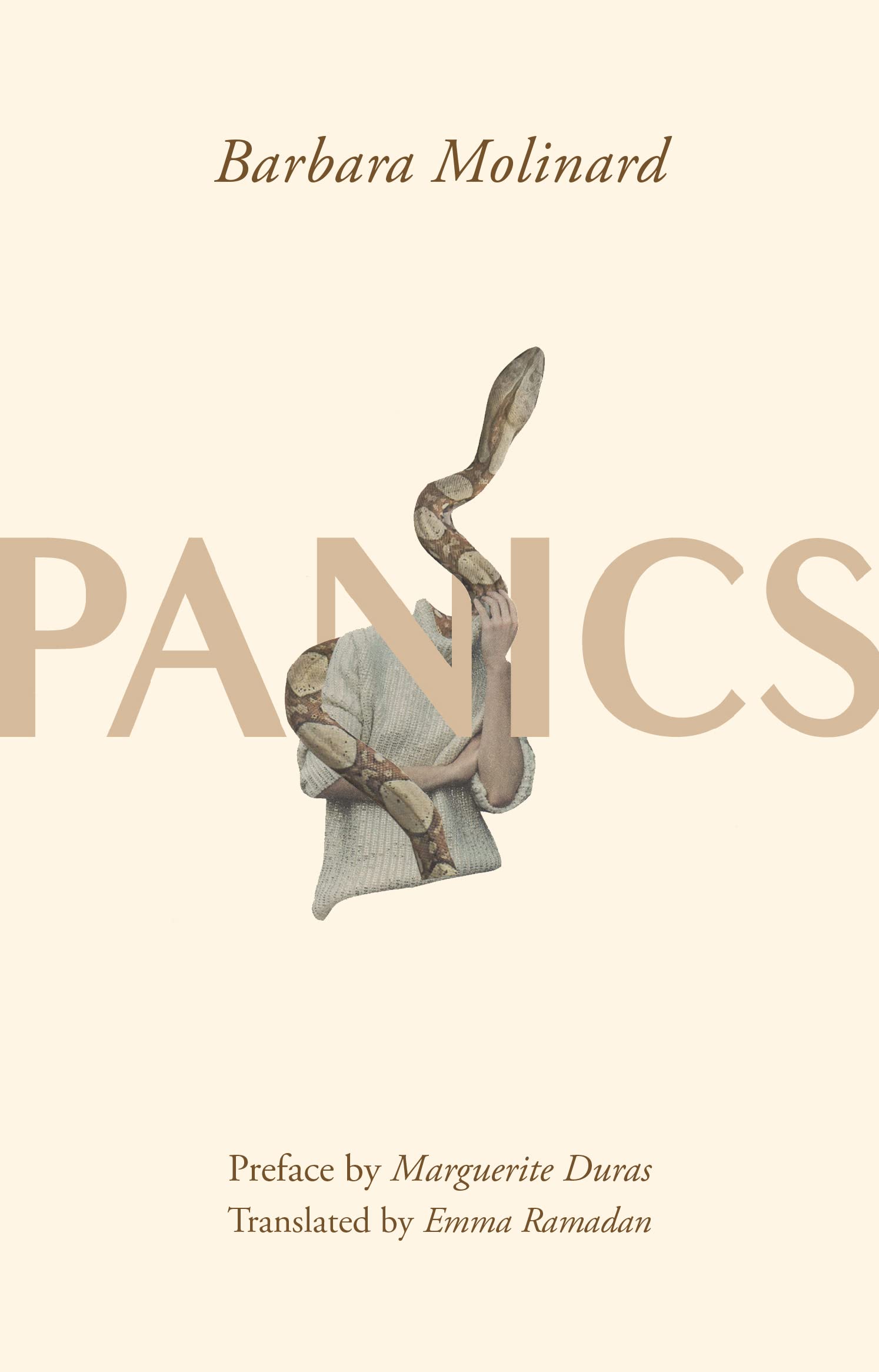
A haunting, bizarre short story collection about violence, mental illness, and the warped contradictions of the twentieth-century female experience.
A close friend and protégé of Marguerite Duras, Barbara Molinard (1921–1986) wrote and wrote feverishly, but only managed to publish one book in her the surreal, nightmarish collection Panics.
These thirteen stories beat with a frantic, off-kilter rhythm as Molinard obsesses over sickness, death, and control. A woman becomes transfixed by a boa constrictor at her local zoo, mysterious surgeons dismember their patient, and the author narrates to Duras how she was stopped from sleeping in a cemetery vault, only to be haunted by the pain of sleeping on its stone floor.
In the unsettling tradition of Franz Kafka, Djuna Barnes, Leonara Carrington, and more, Panics recovers the work of a tormented writer who often destroyed her writing as soon as she produced it, and whose insights into violence, mental illness, and bodily autonomy are simultaneously absurdist and razor-sharp.
Barbara Molinard was an apparently prolific, near-compulsive writer but as soon as she finished anything she destroyed it, even the contents of Panics (Viens) her only surviving book, were initially ripped to shreds or burnt. It was only at the urging of Molinard’s close friend Marguerite Duras that a handful of pieces were eventually rescued and published in France in 1969. Mostly very brief, and displaying the influences of writers like Beckett and Breton, these are uniformly disturbing visions of a hostile, logic-defying world recounted in precise but hallucinatory detail. Molinard’s characters are alienated and tormented, by themselves or the people around them, sometimes trapped in sinister institutions, sometimes adrift in violent dystopian settings, as in the weird fable-like “The Severed Arm.” There’s an impression of overwhelming anxiety and suffocation throughout, an obsession with death, and what Molinard called “the void.” Molinard’s fiction's accompanied by a distinctly odd preface from Marguerite Duras and an elliptical interview between Duras and Molinard, it’s a difficult book to pin down but its surreal, nightmarish landscapes made a strong impression. Translated here by Emma Ramadan.
Thanks to Edelweiss and publisher The Feminist Press for an ARC.
"The veil that masked the houses and the land has ripped open this morning. Everything around me is remarkable. My eyes fill up with beauty."
"Searching her house for the amazingly agile objects that were forever moving around, she lost an infinite amount of time."
"Sometimes I see the three gentlemen. Their sharp gazes follow me as I continue to make my way through the night. They’re buried under thousands of boxes. One of the boxes bursts into flames as I pass. I think that one’s mine."
Weird literature! We love to read it! But some weird literature consists mainly of individual sentences and paragraphs that work, but overall it doesn't have enough coherence and it disintegrates on a structural level. And that's where I land with Barbara Molinards short stories. Lovely elements, but too directionless for me.
“What readers will find here is neither invented nor dreamed. It’s a record of lived experience. Writing is a part of that. Writing is lived.” - Marguerite Duras’ Preface to Panics
I absolutely loved Barbara Molinard’s Panics. Finding a spot for it in my mind’s library, I would climb a ladder and put it between Kafka and Silvina Ocampo, with Leonora Carrington (on her less magical and fantastical days) nearby. The stories in Panic are surreal nightmares, not of another world, but of this world—in all its warped, disorienting, incongruous terror. The stories are almost dreamlike, with logic at its most absurd and almost childlike, a feeling of standing on shifting sands, something always missing or not quite right, and, finally, how the mind and body exist but can never be trusted in a reality riddled with illness, paranoia, and delusion. But there are also just beautiful moments, joy and grief hand in hand like old lovers reunited.
“It wasn’t until the rain, the wind, and the frost dismayed the passersby, who walked quickly without looking around, their heads tucked behind their coat collars, that she felt a certain harmony between the world, the weather, and herself: a harmony of graynes, a harmony of sadness.”
This is really the only surviving collection of her work, and we are lucky to even have this—thanks to Duras and Molinard’s husband saving these from Molinard’s ritualistic destruction of her own work and thanks to the translator Emma Ramadan for discovering Duras’ preface and working to get it translated and published into English (it has been republished in French this year as well).
“Frozen with terror, she couldn’t wrest her eyes from that face, crazed at the thought that her friend, he, her friend, the man she had taken for her friend, was part of the world of THE OTHERS, that hostile bizarre world of which she knew nothing except that it could not be her own.”
“The human race is flawed. The cities are flawed. The modes of transportation are all wrong: either you miss them or they don’t bring you where you want to go. A few confident people roam through this universe, never cured of their loving, their serving, their waiting.” -Duras, Preface
'Panics' was clearly a passion project for translator Emma Ramadan (who makes her case for the translation in an afterword) but I can't say I share her enthusiasm. A few of the early stories in the collection ("The Plane from Santa Rosa", "The Meeting") were mildly intriguing and disquieting but my interest waned as each little vignette covered essentially the same emotional territory, played out the same themes, always in a prose so artless and flat that it seemed almost deliberately childlike. Single page tales took me forever to finish simply because I lost interest almost immediately on starting them and kept putting the book down or falling asleep over it. Setting aside the vivid splashes of Molinard's art and the tragic facts of her briefish life, there's just not enough here to merit renewed attention to this particular author.
Denne plukket jeg tilfeldigvis opp fordi jeg kjente igjen navnet på forfatteren som har skrevet forordet, Marguerite Duras. Og for en overraskelse! Absurde og angstvekkende fortellinger som virkelig satte en støkk i meg. Samtidig er det noe svært rørende ved dem. Måtte ha noen pauser og lese historiene mellom andre bøker for å få tid til å fordøye dem.
Notorious for having destroyed most of her writing, Barbara Molinard has given us a sacred gift in PANICS. These stories are rendered with a mastery that directly conveys the preciousness of life. At the end, I found myself in a bit of panic, so to speak—how to go on having seen something so gorgeous?
Every single story in this collection is nonsensical and seems to be portraying someone in the throes of a psychotic break/mental illness crisis and not in a good way, in a voyeuristic, watch a car crash from the sidelines type way.
I couldn't get into any of the stories and actually ended up feeling sorry for Barbara Molinard in that all her brain could conjure were these disjointed, garbled tales of misery and woe.
The foreword by Marguerite Duras states that Molinard was in a bad way mentally most of the time, ripping up and destroying most of her writing. Perhaps she sensed that it was too disordered to be able to read, who knows.
Translator Emma Ramadan describes this collection of short stories -- the only Molinard ever published, as she habitually destroyed most of what she wrote -- as "little nightmares" and indeed it feels like she achieved what Nour Abi-Nakhoul more recently attempted with Supplication (my review here). Molinard certainly didn't set out to write horror or even weird fiction, but was afflicted by such severe mental illness that horror is what she lived. Her protagonists struggle against a world of nonsensical logic and distortion, like a warped figure straining against a sheet of plastic. There is never any resolution, only death or disintegration. Unique and deeply unnerving.
These kinds of stories that feel like dreams you won’t remember in the morning are really not to my taste but I find Molinard’s whole thing fascinating and strangely admirable.
It stands to reason that many writers struggled with serious mental illness, some hiding it from their writing, some perhaps embedding it into their work intentionally, or feeling that they have no choice in the matter. Barbara Molinard’s few surviving works (most of them, she destroyed) are essentially made up OF her psychological struggles.
Speaking in colloquial rather than clinical terms, what you’ll find here is paranoia, hallucination, dysmorphia, self-doubt, exhaustion, obsession. Every story is stitched out of such intrusive and upsetting experiences, every protagonist unable to function happily.
This makes the book special; you’re given a window onto something private and tender, odd and uncomfortable and—for me, at least—mercifully not super relatable. It also feels voyeuristic at times, too raw, hard to handle.
Normally I gravitate toward such fiction, for reasons I don’t want to psychoanalyze here; if I’m honest, it’s my version of escapist entertainment. So this book does the job of presenting dark ideas that are hard to categorize, something I dig. However, its back story also reminds me that Weird Fiction can’t be too fun to have to live through.
This didn’t quite hit the mark for me. Molinard succesfully creates a fevered, nightmare like athmosphere which carried the whole collection. The short-stories become very repetitive very quickly: someone is always late, time always seems to move in massive leaps, something violent happens.
My favorites from the collection were the stories with a clear (or not so clear, this is surrealism after all) storyline: ”Taxi”, ”The Sponge” and ”I’m alone and It’s Night”. ”Happiness” would’ve been a fun one, but Molinard overly explains what happens in the very last sentence, almost like she didn’t quite trust her own writing to paint the kind of picture she wanted it to.
exactly what i was expecting/hoping it would be! super bizarre & unsettling - a great spooky season read! my favorite stories were: the plane from santa rosa, the cage, and happiness.
Barbara Molinard’s Panics is a striking collection of tales aberrant and peculiar. From brief snippets to delirious interludes, the titular emotion pulses throughout the narrative with undertones of madness, paranoia, and dissolution. Each story unfolds either in bizarre worlds or in phantasms, where the familiar becomes alien and grotesque is the new normal. Except for a select few stories, Panics casts singular characters who grapple with ‘VOICE’ and/or ‘VOID’ in tandem with violence of body and mind. And the result is a circuitous, often hallucinatory, but an unforgettable exploration of death, loss, and mental-illness.
Thanks to Edelweiss and publisher The Feminist Press for an ARC.
I really wish I had liked this one more than I did. It looked experimental, full of beautiful language and insight. Maybe it's because this is a collection of short stories--not usually my preferred format in the first place, as I find myself reading through them as though they're chapters and not full stories--or maybe it's because it just didn't hit me the right way.
This one just wasn't memorable for me. Maybe in a couple years, I'll revisit Molinard.
Shocking and strange, but for the sake of it… Panics is not a book you can enjoy. The stories are dream like fragments, they don’t flow, more is left unsaid than said. Barbara Molinard destroyed almost everything she wrote, and her writing is disturbing; obsessing over death, violence and madness. I didn’t find her writing insightful, merely distasteful. Personally, not for me.
An uncomfortable, unsettling little story collection about surreally spiraling anxiety and disconnect, most interesting for its preface (by Marguerite Duras, a longtime friend of Molinard and fervent supporter of her work, about the author's self-destructive behaviors) and its translator's note (by Emma Ramadan, about her discovery of Molinard's work)
Really bizarre, surreal and imaginative stories. It’s a shame this is her only surviving work as she shredded the rest but it really is some unique art. I think my favourites are: Happiness, The Cage, The Headless Man and I’m Alone and it’s night.
If you like Gilman’s “The Yellow Wallpaper” or Hawthorne’s “Young Goodman Brown,” this one’s for you. An excellent collection of short stories, best classified as psychological horror. The author’s background makes it all the more poignant.
“The night is ink; the sky shadow. The birds have stopped singing. A blackbird on a branch dies. The black angels are no longer violent. The demon has entered during sleep. Tomorrow the sun will not rise.”
This got so good once I got through the truly funky ones at the beginning of the collection. I liked the stories that were surreal but still based in day-to-day experiences. Favorites: Taxi, Happiness, I'm Alone and It's Night (god that was disturbing).
i’ll be thinking about and rereading the stories in this collection for a long, long time. i’m completely captivated by Molinard’s writing and her story.
Last finished book before Paris, and it’s a book written by a manic, suicidal, and horny French woman which I think encapsulates the French experience pretty well