The life of an orphaned boy is shaped by the devotion of a fantastical Gull in this lovingly rendered, entirely wordless graphic novel by a contemporary comics innovator.
Joe Kessler is at the forefront of European comics. Co-founder and art director of UK’s Breakdown Press, and winner of the Angoulême International Comics Festival’s Fauve Révélation for his breakthrough comic book Windowpane , Kessler rejuvenates the form once again with his vivid and moving The Gull Yettin .
Told in striking colors and loose but confident lines, The Gull Yettin ’s story begins when a young boy awakens late one night to find his home on fire. The boy is saved by a lanky, shapeshifting Gull. Orphaned by the fire, and now adrift in a boat piloted by the Gull, the boy faces an uncertain future, one that will be both helped and hindered by his new attendant.
Without a word, Kessler builds a strange but recognizable world, using it to explore all the forms that grief, jealousy, longing, and love can take in our lives, and the compassion and cruelty that can dwell in a single heart. Filled with all the warmth and poignancy of a great folktale, The Gull Yettin proves that Kessler is pushing comics to new heights.
Joe Kessler is a cartoonist based in London. He is the author of Windowpane (2018), winner of the 2020 Angoulême Festival’s Fauve Révélation, and The Gull Yettin (2022). Kessler is also the Art Director of the English underground comics publisher Breakdown Press.
Beautiful & fun illustrations intertwined with magical elements & dark humor. Fun to read, but I think the challenge is since it doesn’t have any words, I was unable to catch some of the themes it was trying to portray. Easy to quickly flip through, but I urge whoever looks through this to really take the time to understand what each image is trying to say.
I read this with my mother, which is good, as I don’t think I would have thought quite as hard about it if I’d read it alone. It’s an odd read, and probably benefits from having someone to talk it through with. A story told without words, it follows a young g boy who is orphaned at the beginning and taken under the wing of the Gull Yettin, a shapeshifter who often takes the form of a gull. From there is a story of the ways people help and hurt each other, even with the best of intentions, and the complexity of the human heart.
It’s hard to say if I actually liked the book or not. Certainly reading it with my mother and discussing it with her was a good time, and the childishness of the drawings lends a melancholy, heartbroken feeling to the book overall. I suppose my suggestion to you is to be prepared to think on it, and draw your own conclusions.
Whew, how to even review this!? It gets 4 because of the conversation it prompted.
I was ‘reading’ this (it’s wordless) and making exclamations and my daughter was sitting there laughing at me 😁 and finally came over by me and I started over and we ‘read’ it together and then had this big discussion about it, which was fantastic. And maybe that is the beauty of this graphic novel: it makes you scratch your head and think and want someone to talk with about it.
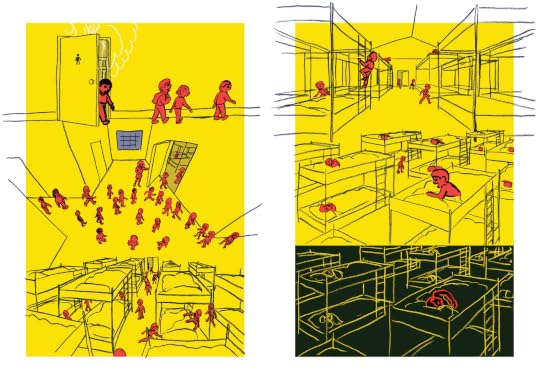
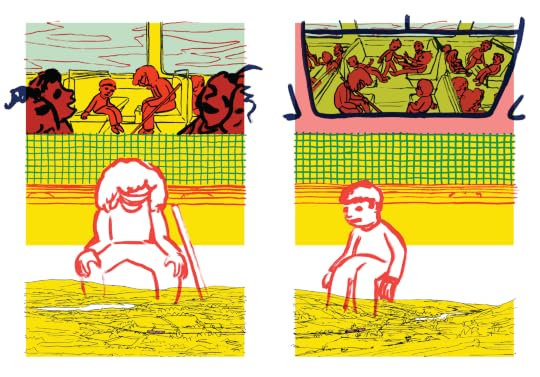
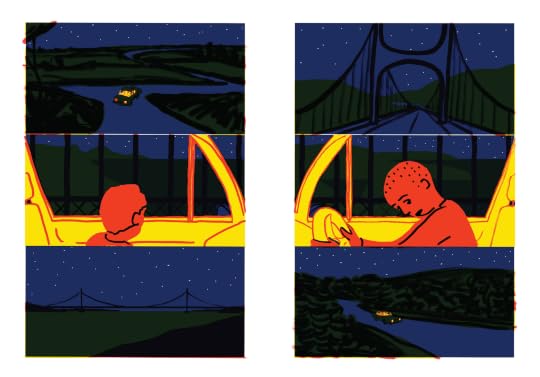
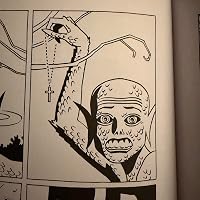
The illustrations are loose, bold lines, almost all yellow, red, green, and black. They are ‘sloppy’, but you can generally tell what is going on.
We concluded that Yettin’s desire was always to help and protect, but, maybe because of the differences in nature, was ineffective and even harmful half the time.
Joe Kessler is de wildste, meest vrije graphic novelist van dit moment. Waarlijk grensverleggend, in alle betekenissen: visueel verbluffend, verrassende kleurkeuzes, spaarzame maar heel efficiënte lijnvoering, in combinatie met een grenzeloze verbeelding. Lees zeker ook zijn WINDOWPANE dat in de prijzen viel in Angoulême in 2020.
A cult read, without any words, but a story with something for everyone. These are the kind of books that remind you almost everything an algorithm is giving you is the dead-eyed mediocrity of the center. Yet the art is all smeary— done up over afterthoughts or (perhaps) intensely dedicated focus on a primitivist storytelling style with a vibrant color palette about how dark the world can be. It's very fiery, very sad, and quite accurate. It posits a world where the boy will be taken in by a family member, by a stranger? And still be pulled by a nature-elemental back into, well, primitive longing, purpose? Fate? Whatever it is, it feels affirming. This is Joe Kessler in a high-wire act where you feel like he's in complete control. There's a real sense of trust in the creator despite the intensity of the images on the page. Not one questionable mistake in the house (save whatever started the fire, probably, yet the experience could have, probably, forced this kind of art from Joe!). Unfortunately its publishing by NYRBC is probably going to relegate it to the dustbin of "serious comics" or "academia" but you should know that this book is waiting for you: Fire Walk With Me.
I sometimes feel as if a wordless comic is the truest form of the medium. Not bogged down by the necessity to wax poetic while a silhouette stands motionless in time. I don’t mean to diminish a wordy comic (or perhaps graphic novel), but to instill a reader with a complex range of emotions through only imagery is perhaps more impressive than a well written dialogue. For instance, I am much more shocked and excited by a double page spread or excellent rendered facial expression than I am by monologues. Am I wrong? Subjective. I loved this book
Joe Kessler prezentuje tym razem dłuższą i całkowicie niemą fabułę, w której kontynuuje stylistykę znaną z "Windowpane". To ten sam eksperymentalny charakter grafik, w którym nie ma ustalonego z góry układu kadrów, a tło dla grubych konturów stanowi ograniczona paleta kolorów, czasem urozmaicona akwarelą czy flamastrami. Mieszanie tych wszystkich elementów daje momentami bardzo oryginalny efekt, choć tym razem jest to tylko pretekst dla świetnie spiętej fabuły z odpowiednią dawką surrealizmu i surowości brutalnego snu. Niezmiennie mnie ta twórczość oczarowuje i trudno mi zliczyć ile razy już "The Gull Yettin" przeczytałem. Czołówka roku
This was on the New York Times The Year in Graphic Novels (2023) list a few weeks ago - https://www.nytimes.com/2023/12/26/bo... - hadn't heard about it. Wordless graphic novel. Fantastical stuff here, couldn't tell you for the life of me what happened but it certainly looked nice.
6.5/10 A wordless comic telling an ethereal, narratively simple but emotionally complex story, in a doodle-like style. Overall, this work follows along the line of Windowpane, Kessler's previous book. The layout compositions are dominated by a clever use of contrasting colours. Pure yellows, greens and reds pop out of the page. Not so much to define light, though: these bold colours seem to define spaces, physical or metaphysical that they may be. The physical spaces are mostly houses shot from emotional angles; or, streets and rivers forming serpentines through desolate hills, the kind of environments a six years old would drawn. On a purely technical level, I honestly can't even tell if Kessler cannot draw at all, or if he can to some extent, but he purposely puts those skills away to create these super doodle-y abstract comics. Maybe it does not matter. The guy has some skills with comics storytelling. This book, like it or not, is a page turner, and that's what really matters. It should be pointed out that even the lines are in colours. Figure contours are always in some vibrant red, yellow, violet, blue, following elegant internal colouring logics.
At one point, when two characters are on a boat going down a river, Kessler goes full expressionistic painting. That was maybe the most gratuitous part of the book, for my taste. Tone it down, Joe! Towards the second half of the book the author fixates on this double spread layout with three horizontal panels per page, where every panel has the same colour scheme of the one next to it in the other page. This creates a funny counterintuitive pace of reading: you are supposed to proceed vertically (you know, first you finish the first page, then you go to the following), but your brain wants to read horizontally following the common colour scheme, skipping a page. Narratively the book is very readable, and art-wise it is fascinating to contemplate. But I still cannot shake away this feeling of pretentiousness, that I already had with Windowpane. When the art is too childish, I smell some snobbishness. You know what I mean? Maybe I am just a prejudiced man. The story of the book, well, the story is something. It turns around a kid who has lost his family, an improvised adopting mother and a magical shapeshifting bird-like creature (the Gull Yettin of the title?) who craves love but can also dispense suffering. The whole thing reads like a magical tale full of grief, pain, love, misunderstanding, revenge and redemption. What happens is clear. Why it happens, that's a whole other story. As I said at the beginning, a simple but emotionally complex little comic book.
All pictures above from this interview to the author from the Comics Journal.
Incredible work! From the first two pages, I was gripped, unable to quit reading. Kessler’s lush, crude, inventive illustrations and use of color, pushing his medium as far as it will go without losing its legibility and expressiveness, borders on genius. There’s a real cinematic quality about the way he frames and slices the action, taking the reader step by step through a soccer match, for example, or a walk back home. He also manages to tell the entire story without a single line of dialogue, not even scribbled text bubbles: everything is conveyed through meaningful sketches and clever use of color and line work. Breathtaking.
The story itself is really compelling, firmly anchored in reality and yet completely dreamlike, seamlessly weaving fantasy with emotional veracity, sudden tragedy with everyday comfort, kindness with cruelty. The narrative is compelling and believable, although it slightly loses its way towards the last third of the book, at least in my opinion. At some point, one of the characters changes appearance dramatically and I wondered if I had overlooked a metaphor underpinning the entire storyline. Again, it might be that the author wished to capture something akin to a dream, in which case this is a complete success, but still: I closed the book a little perplex, the excitement of the first two thirds fizzling out. I will keep an eye out for this author: I am totally hooked.
This really blew me away. It's an ambiguous, fantastical wordless comic that follows the travails of a young boy and a mysterious humanoid seagull-like creature called Yettin. The artwork bursts with energy and vibrant colours in a way that seems chaotic and almost childlike, but the visual storytelling is crystal clear and every page is absolutely gorgeous. The whole comic has a certain mythic or folkloric quality, with its particular blend of realistic and magical elements reminding me of “Trois fils” and “Un Père vertueux” by Ludovic Debeurme and “The Jellyfish King” by Brecht Evens – comparisons reinforced by the fact that all four of these comics focus on children fending for themselves, and they all have settings that are geographically and/or temporally ambiguous. Despite those comparisons, “The Gull Yettin” feels truly unique, exhibiting a distinct authorial voice that's left me eager to seek out more of Joe Kessler's output. Moreover, it's a rich and complex work that I've already read twice and that I'm confident will reward further revisits.
This was truly a remarkable bit of wordless storytelling. Kessler's The Gull Yettin is presented much like a dark fairytale, where a young boy is left orphaned by a house fire and is swept up in a journey with a mysterious gull-headed entity. Whether or not the companion has malintent is left quite unclear at first, and the story does a great job keeping things tense even in the absence of words. Instead, the story unfolds in a feverish, dreamlike quality, where the world feels simultaneously familiar yet starkly alien all at once. All of this is achieved with Kessler's loose, heavy linework and bold colors that often contrast in a way that feels antagonistic. And yet, the sequences seem thoughtfully laid out in a way that makes the story easy enough to follow but still presenting enough of a challenge to comprehend the inlaid symbolism. As a fan of comics that require some interpretation through the use of expressionistic formalisms, this really worked for me and is easily a contender for one of my all-time favorite wordless comics.
A 200-page+ graphic novel told without words about a young boy who is orphaned after his parents’ house burns down, rescued by Yettin, the gull—a mysterious figure who is mistakenly taken as a threat to the young boy and is brutally chased away by a woman who provides a haven for the boy. (Yettin eventually avenges the woman for the attack but at once immediately regrets the harm he has created.) The artist Joe Kessler has developed a distinct visual language for telling the story and is doing interesting things with narrative via pictures only. A fellow traveler that fans of American graphic novels may be familiar with is Dash Shaw, who also explores and pushes the realms of narrative and visual expression. The Gull Yettin makes for very nice work from an artist who bears paying attention to.
Fantastic color. An experimental art style in the modern vein of artists like Dash Shaw and Patrick Kyle. At times its beautiful and eye-catching but other times it feels sloppy and half baked. I guess that's all part of the charm.
The story is alright, a mini-odyssey as we follow a young kid (probably about 8 years old). His house burns down and a creature helps him escape on a boat. Later he meets a lady who aids him but the creature is jealous and gets a bird to peck out her eye balls! Then the kid ditches the lady on a train and ends up at a boarding school with a bunch of other kids.
Oh yes, it's also silent. No dialogue or even text on a sign. I think the closest thing is a math equation on a chalkboard. No afterward either, Joe Kessler doesn't give us a single word!
Every story has a purpose. I just can't imagine what this one's is. The art is generally hard to look at (imagine sketchy crayon modernist scribbles in bright yellow, red, and green). The story is circular, and there's a weird fu*king magical gull/person in it. And an orphan. :(
Questions I was left with when I finished the book: How/why is the fantastical humanoid gull attached to the boy? Why did he steal him away from the hospital? If he could mask as a human why didn't he do that when he was with the boy and when the woman found them? (And hurt him.) What was going on at that orphanage/school? How was the lady still riding the train alone after so many seasons passed? What was the point of this whole story?
Not sure this is quite a 5, but it is beautiful, fresh and unpredictable. It is the most Euro-avant-garde book I've seen coming out of the UK scene. There's a plot, but it isn't the point; it has a good, creepy, oppressive atmosphere, and a logic of its own. The art is really the point — there are fantastic set pieces (a spread of kids on a climbing frame, which is reminiscent of Richard McGuire's Popeye experimental comics; a journey in canoe against backdrops of abstract watercolors), and forced perspectives, mostly using a childlike and garish style. It's firmly experimental, but is very successful.
Reading 2024 Book 9: The Gull Yettin by Joe Kessler
Saw this on some “best of” lists for 2023. Scooped it up from the library.
Synopsis: The life of an orphaned boy is shaped by the devotion of a fantastical Gull in this lovingly rendered, entirely wordless graphic novel by a contemporary comics innovator.
Review: Not sure I was the target audience for this graphic novel with no words. The art was hard to follow in places, the drawings rudimentary. A bit on the weird side for me. My rating 3⭐️.
Swept me away. I'm glad I bought this one because I'll read it a lot. Abstract books can be nice like that. A lot of mystery to revisit. Although at its core the story is simple, something to ground you. I love the few reviews here that mentioned they read it with someone else and had conversations about it. A comic like this makes a really good case for shared reading since it's wordless. You can discuss what you're seeing as it happens. I didn't do that with The Gull Yettin but did with the last book I logged, Victory Parade. Good times.
Gave this one two reads as I didn't quite get it the first time round.
I'd recommend taking it slow and trying to be patient with the story, looking at each panel closely to decipher what is happening.
As for the book, I really appreciate its originality and for its art. It may look quite rough and confusing with the limited colours, but he has managed to convey a lot and to build characters personalities without words.
Anyway, i thought it was great and am giving it 5 stars due to its originality.
The Gull Yettin is a wordless, abstract, and very colorful graphic novel from British cartoonist Joe Kessler. Kessler masterfully switches between meticulous detail and rough sketches to convey mood and draw the reader through the story, which follows a boy whose family dies in a house fire. Soon after the tragedy, he's whisked away on a surreal, funny, and shocking journey by the titular gull, a shapeshifting trickster who both cares for the boy as he processes his grief and causes mayhem.
I had a different Joe Kessler book on my list of The Personal Graphic Novel Curriculum for Expanding Weird and/or Unusual Conception of What is Possible or Something. But then this book became available at my library and I read it instead. It's good. The artwork is an amalgam if different styles a couple different styles slapped together at once. It didn't always convey a coherent message to me, but it did convey something. There was an accretive effect.
I picked up this book from the library after spotting it among a display of graphic novels. The art is striking and unsettling- somewhat abstract but illustrative. I read through this wordless book first without any background, then I read the book jacket and felt a deeper understanding of the tragic, disturbing and at times even whimsical events. Overall, I give this 3.5 stars but I might have rounded up with a bit more explanation or author discussion.
"The Gull Yettin" is a visually stunning wordless graphic novel that delves into themes of grief, longing, and love. Joe Kessler's unique storytelling style shines through the vivid artwork, capturing the reader's attention from start to finish. Although it may require multiple readings to fully grasp the story, the book offers a different perspective on the graphic novel genre and is a must-read for fans of visual storytelling.
The title character of this strange graphic novel (without words) is the corporeal manifestation of an, I don't know, bird spirit? The creature takes a protective interest in a little boy leading to fantastic (and somewhat disturbing) interactions. Kessler draws with what looks like colored pencils and crayons. It's visually kind of amazing, but the meandering plot doesn't really hold together.
I'm not a big comics fan but this was one of the best comics I've ever "read." It's wordless but the images say more than many novels manage. The Gull Yettin is a strange, enigmatic, delightful story, told through stylistically eclectic art that somehow maintains an effortless sense of unity and flow.
A dreamlike Fauvist narrative that combines childlike drawings and fears with being events and actions that are deeply, deeply messed up. The juxtaposition of the art with violence that would be at home in the Brothers Grimm, but is unexpected here and now, is startling, but I imagine that’s the point.