Jump to ratings and reviews
Rate this book

The Skeleton in Armor

Rate this book
This work has been selected by scholars as being culturally important, and is part of the knowledge base of civilization as we know it. This work was reproduced from the original artifact, and remains as true to the original work as possible. Therefore, you will see the original copyright references, library stamps (as most of these works have been housed in our most important libraries around the world), and other notations in the work. This work is in the public domain in the United States of America, and possibly other nations. Within the United States, you may freely copy and distribute this work, as no entity (individual or corporate) has a copyright on the body of the work. As a reproduction of a historical artifact, this work may contain missing or blurred pages, poor pictures, errant marks, etc. Scholars believe, and we concur, that this work is important enough to be preserved, reproduced, and made generally available to the public. We appreciate your support of the preservation process, and thank you for being an important part of keeping this knowledge alive and relevant.

96 pages, Paperback

First published January 1, 1877

35 people want to read

About the author

Henry Wadsworth Longfellow

2,910 books737 followers
Extremely popular works of Henry Wadsworth Longfellow, American poet, in the United States in his lifetime, include The Song of Hiawatha in 1855 and a translation from 1865 to 1867 of Divine Comedy of Dante Alighieri.

Henry Wadsworth Longfellow educated. His originally wrote the "Paul Revere's Ride" and "Evangeline." From New England, he first completed work of the fireside.

Bowdoin College graduated Longefellow, who served as a professor, afterward studied in Europe, and later moved at Harvard. After a miscarriage, Mary Potter Longfellow, his first wife, died in 1835. He first collected Voices of the Night (1839) and Ballads and Other Poems (1841).

From teaching, Henry Wadsworth Longfellow retired in 1854 to focus on his writing in the headquarters of of George Washington in Cambridge, Massachusetts, during the Revolutionary War for the remainder.

Dress of Frances Appleton Longfellow, his second wife, caught fire; she then sustained burns and afterward died in 1861. After her death, Longfellow had difficulty writing and focused on from foreign languages.

Longfellow wrote musicality of many known lyrics and often presented stories of mythology and legend. He succeeded most overseas of his day. He imitated European styles and wrote too sentimentally for critics.

Ratings & Reviews

What do you think?
Rate this book

Friends & Following

Create a free account to discover what your friends think of this book!

Community Reviews

5 stars
13 (38%)
4 stars
12 (35%)
3 stars
7 (20%)
2 stars
2 (5%)
1 star
0 (0%)
Displaying 1 - 8 of 8 reviews
Profile Image for Liz.
828 reviews8 followers
February 15, 2020
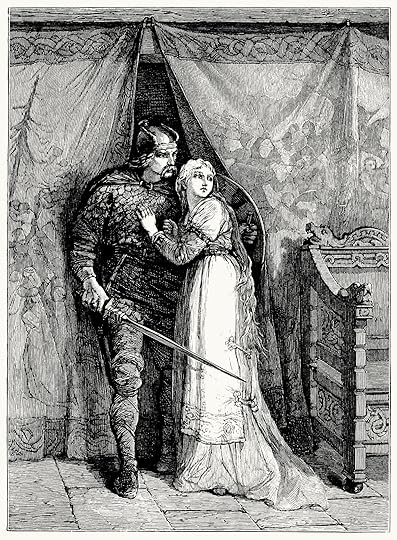
I really like the illustrations in this edition. The style is on point for the period it was published rather than historically accurate.
Profile Image for Carfig.
957 reviews
January 29, 2025
Longfellow heard the story of a skeleton wearing armor, found on the beach in Massachusetts in 1832, not far from a lone tower in Newport, Rhode Island. (As well as a 40-ton boulder, Dighton Rock, carved with strange writing.) He was able to view the skeleton and decided it was that of a seafaring voyager, namely a Viking from Norway. We get a sketch of the boy growing into manhood, falling in love, and being cast aside by his beloved's father. A deadly sea chase ensues, the young man and fair maiden survive to live some happy years in New England.

Longfellow wrote this poem in 1841, as one of his earlier works. This one is "boldly" illustrated by Paul Kennedy.

Although the skeleton was destroyed by fire in 1843 (two boys firing a canon that destroyed 20 acres, town buildings, and 200 homes!), it is believed to be Native American--Narragansett or Wampanoag) because it was buried sitting up and had a belt made up of 41 small brass tubes.
Profile Image for Zookswag.
19 reviews
November 5, 2021
Viking stole daughter
from Norse king then to New World
Where tale was ghostly told.

HWL sing-songy style. Worth a read, not a save. The backstory improves the experience.
Profile Image for Nathan.
2,255 reviews
March 15, 2022
I really liked the beat and measure of the rhyme.
Profile Image for Silverin.
269 reviews41 followers
July 20, 2013
This ballad is worth several reads, and not just for the beautiful illustrations:

<br />Should not the dove so white<br />Follow the sea-mew's flight
Should not the dove so white
Follow the sea-mew's flight


Of this work Longfellow writes:

The following Ballad was suggested to me while riding on the seashore at Newport. A year or two previous a skeleton had been dug up at Fall River, clad in broken and corroded armor; and the idea occurred to me of connecting it with the Round Tower at Newport, generally known hitherto as the Old Wind-Mill, though now claimed by the Danes as a work of their early ancestors.
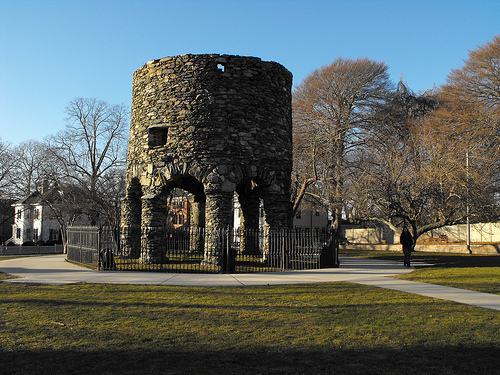


Cloud-like we saw the shore
Stretching to lee-ward;
There for my lady's bower
Built I the lofty tower,
Which, to this very hour,
Stands looking seaward.


Profile Image for Karen GoatKeeper.
Author 22 books36 followers
October 14, 2015
Longfellow brings Hiawatha and Paul Revere to mind. This poem has the same epic feel to it but is a Viking ghost wanting his story told.

The poem is easy reading with good rhythm and rhyme. It is a good story but lacks the action and splash of Beowulf.

Although printed for children, this poem is better for older children who have some idea who the Vikings were as the poem doesn't do much explaining.
Displaying 1 - 8 of 8 reviews

Can't find what you're looking for?

Get help and learn more about the design.