'It was customary, it seems, for an author to begin with excuses, explanations and snivels about their work. Which is quite peculiar since the author is usually the last person to know what their book is about...'
Right from the wickedly funny table of contents, which belongs not to this collection but an imagined one, this remarkable genre-defying volume is guaranteed to delight the reader in the mood for something original and different.
In the title story, 'The Inconceivable Idea of the Sun', a couple finds that reorganizing their home library has an unexpected consequence on their shared reality; 'The Robots of Eden' is set in a world where stories are no longer essential to be human, because civilized people have developed better technology to mediate their emotions; in 'Into the Night', an old Brahmin leans into the comforts of an ancient language when the future renders him obsolete; and 'How Not to Tell the Ramayana' is a Borgesian journey into a Ramayana retelling unlike any other.
This stellar collection of short fiction, as poignant as it is playful, blurs the distinction between what lies inside a story and what lies outside it. It demonstrates yet again why Anil Menon is one of the most formidable names in contemporary Indian writing.
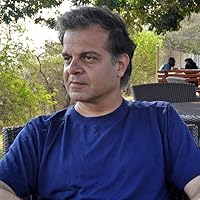
Anil Menon is a leading Indian writer of speculative fiction, as well as a computer scientist with a Ph.D. from Syracuse University, who has authored research papers and edited books on Evolutionary Algorithms; his research addressed the mathematical foundations of replicator systems, majorization, and reconstruction of probabilistic databases, in collaboration with Professors Kishan Mehrotra, Chilukuri Mohan, and Sanjay Ranka. After working for several years as a computer scientist, he has directed his creative energies towards fiction. His short stories and reviews have appeared in the anthology series Exotic Gothic, Strange Horizons, Interzone, Lady Churchill's Rosebud Wristlet, Chiaroscuro, Sybil's Garage, Apex Digest and other magazines. In 2009, Zubaan Books, India's leading feminist press, published his debut young adult novel The Beast With Nine Billion Feet. It was shortlisted for the 2010 Vodafone Crossword Book Award and 2010 Parallax prize. In 2009, in conjunction with Vandana Singh and Suchitra Mathur, he helped organize India's first in-residence, three-week speculative fiction workshop at IIT-Kanpur. Source: https://en.wikipedia.org/wiki/Anil_Menon
Let me just begin by saying that my mind was completely blown by this collection of wondrous, fantastical, and most unique short stories I've read in a while. Anil Menon's writing is all over the place (in a very good way), and you enjoy it from the very start.
I love how each story has a beating, alive, and full heart. Menon doesn’t overlook emotions in favour of craft or the story. Each story gets its due – some more than the others, but nonetheless the setting, the characters, and the way the prose moves between surrealism and reality of the situations is what makes the reader’s jaw drop and be in awe of the writing.
I absolutely loved the title story – of a couple in the process of reorganising their home library, realizes how that impacts their reality – a story so refreshing, odd, and yet hugely satisfying. There is so much going on in this collection of short stories – there are robots, there is a Ramayan retelling unlike anything I have read before, there is betrayal, there are ancient languages, there is so much technology yet sort of mixed with the old and the medieval, and extremely playful. There is philosophy, there is a lot of wit, and of course SFF shines when it has to.
Anil Menon’s writing hits you in the face – like something good – out of the blue – something that you cannot quite put your finger on and yet you cannot stop turning the pages. Overall, I just think everyone must read this book and enjoy it to its fullest. Approach it with an open mind and enjoy the ride!
If you search what’s ‘Speculative fiction’ on google, this is what the search result displays on top- “It’s a literary “super genre,” which encompasses a number of different genres of fiction, each with speculative elements that are based on conjecture and do not exist in the real world.” Is it any different than fantasy then? Yes, it is, and the main difference is what's being speculated upon- that it’s mainly the results of changing what's real or possible, not how a character would react to a certain event.
The inconceivable idea of the sun is a short story collection written based on the genre of 'speculative fiction'. It’s the first book from the author to me, so I honestly didn’t know what to expect, and when I finished the book, let’s just say I'm very impressed by Anil’s narrative skills.
First up, the book started with only rough humps in the beginning, as I didn’t know how to react to speculative stories, and that put me in a difficult position to follow through the rest of the stories. But it slowly started to seep into me, and the stories were unputdownable that I finished reading the book in just 3 days. Only at the end of the book did I see a context section for each of these stories that made me breathe a sigh of relief as I had too many unanswered questions.
Most of the stories were quite engaging from the beginning to the end, and I loved how Anil narrated his characters more than the stories. Every character had a unique story to tell, both joyful and poignant, and I loved reading most of them. Some of them were quite unfathomable to understand until I read the context page at the end, so I wished it would have been presented better if there were context at the beginning or right after the end of each of these stories. But that’s just my opinion!
Overall, I definitely enjoyed reading 'the inconceivable idea of the sun' for its inimitable narration. I would recommend it to everyone looking for some abstract conjectural telling with only advice to read it with an open mind. Personally, it was an ‘out of the box’ kind of reading for me, and I am excited to read more works from this author.
Speculative-fiction as a genre isn't something I read much of (or even knew about maybe), so this book took quite a bit of getting used to. The initial stories did not land well for me and were hard to get through, but the latter half worked quite well for me. Anil Menon definitely has a lot of creativity, imagination, and a talent for world-building, especially those where technology is a major part of the world. "How not to tell the Ramayana", "The Mind and the Body Problem", and "The Inconceivable Idea of the Sun" were stories that I especially loved.
An eclectic collection of stories and non-fiction by Anil Menon is one of my first forays into speculative fiction. The non-fiction essay on the Ramayana retellings was excellent. Among the fiction short-stories, I liked the mind-body problem and Into the night the best. The explanations at the end of the book provided the context to some of the stories.
I admit speculative fiction isn’t my instinctive go-to genre (a prejudice no doubt), but I greatly enjoyed these stories. I spaced them out to savor 2 or 3 each day. I think they are well crafted, complex, and often funny and innovatively cerebral. Quite a range too, including a meditation on storytelling itself based on the Ramayana. Menon's spec-fic elements creatively explore the human material, especially how well-meaning techno-driven tweaks to our psychosomatic selves can lead to utterly disquieting outcomes. Several stories had a sort of haunting quality that lingered in my mood later. An excellent collection.