From the Romantic period's star circle, the story of its saddest casualty--Fanny Wollstonecraft, daughter of an original feminist, sister of a literary star, and hopeful object of a poet's affection, dead of suicide at the age of nineteen. Little contemporary information was written about Fanny Wollstonecraft, whose mother Mary Wollstonecraft's scandalous life scarred Fanny's possibilities before she was even born. Deserted by her father, yet reared by Mary's husband William Godwin, Fanny barely had a chance to adjust when her mother died from giving birth to the legitimate and lovely Mary. Fanny was always considered the ungainly one, the plain one, the less intelligent one. Finally her imagination was sparked by the arrival of Percy Bysshe Shelley to the Godwin household. Her infatuation was quickly shattered when Shelley, like so many before him, chose the company of her sister instead, and though Fanny bore this rejection bravely, she was never quite the same after Mary and Shelley eloped along with her step-sister Claire--who would later track down and seduce Lord Byron.
Awash in a sea of sexual radicals, Fanny acted as personal assistant and go-between to this den of hedonists, shuttling information from one faction to the other, covering her sister's lies and creating fabrications of her own. She ultimately ended her life alone in a Welsh seaside hotel, an empty bottle of laudanum and an unsigned note by her side.
Janet Todd's meticulously researched and brilliantly told rendering of this life give fresh and fascinating insight to the Shelley-Byron world even as it draws Fanny out of the shadows of her mother's and sister's stunning careers.
Janet Todd (Jan) is a novelist, biographer, literary critic and internationally renowned scholar, known for her work on women’s writing and feminism. Her most recent books include the novel: Don't You Know There's A War On?; edition and essay: Jane Austen’s Sanditon; memoir: Radiation Diaries: Cancer, Memory and Fragments of a Life in Words; biography: Aphra Behn: A Secret Life; the novel: A Man of Genius 2016. Jane Austen and Shelley in the Garden: An Illustrated Novel, forthcoming 2021
A co-founder of the journal Women’s Writing, she has published biographies and critical work on many authors,including Jane Austen, Mary Wollstonecraft, her daughters, Mary (Shelley) and Fanny (Death And The Maidens) , and the Irish-Republican sympathiser, traveller and medical student, Lady Mount Cashell (Daughters of Ireland).
Born in Wales, Janet Todd grew up in Britain, Bermuda and Ceylon/Sri Lanka and has worked at schools and universities in Ghana, Puerto Rico, India, the US (Douglass College, Rutgers, Florida), Scotland (Glasgow, Aberdeen) and England (Cambridge, UEA). A former President of Lucy Cavendish College, Cambridge, she is now an Honorary Fellow of Newnham College.
I’m not going to lie, before picking this book up I had no idea she even existed. I’ve read numerous biographies on the Shelley/Godwin circle and Fanny is a name that has rarely, if only briefly, come up. She is the forgotten daughter of Mary Wollstonecraft, and the ignored sister of Mary Shelley.
And that’s the whole point of this work. Todd shows that whilst Shelley was gallivanting around Europe with the likes of Mary and Byron, some people unintentionally fell victim to his lifestyle choice. After leaving England with two of William Godwin’s daughters, Mary and Claire, Shelley left the third behind in a home of coldness and isolation. How Fanny so desperately wanted to go away with them to Geneva and live the same life of freedom. Chance had it that she was never able to; it’s not fair to blame Shelley for this: Godwin prevented it and Fanny herself was initially hostile to such ideas. Her personality did not collude with that of Shelley’s ethos.
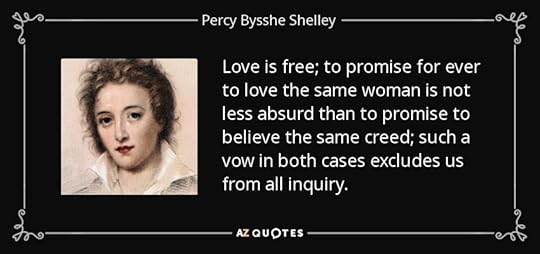
But she loved him, a fact Shelley was aware of but didn’t really consider. His doctrine was that of free-love. He did not believe in maintaining a relationship if the passion and emotions were dead; thus, he left his first wife Harriet- much to her utter dismay- when he found a woman who could make him happier. Not everyone can accept this idea. It is semi-bigamous, but at the root of things it puts the happiness of the individual before others. Romantic partners get hurt along the way, but perhaps it would be best not to elope with someone who felt this way when you didn’t. It would only lead to your own pain. But, that’s just hindsight bias- at the time both Shelley and Harriet were in love; it just didn’t last for Shelley.
Eventually Harriet and Fanny committed suicide. Todd does not directly lay the blame at Shelley’s door, though she heavily implies it. His actions did lead to their deaths, but does this make him a bad person? No. It makes him human. It was the last thing he would have wanted. He was a free spirit, but not everybody else was. His greatest flaw was not being able to see the perspective of the women he hurt. To some readers he may sound misogynistic, but this would be a deeply unfair label. Shelley was, in fact, a feminist. He championed women’s rights, he just failed to perceive that at times his actions, his involvement in his own self-interest, hurt others in the process.
This is a strong account of the women he accidently wronged.
The actual subtitle of the book is "Fanny Wollstonecraft and the Shelley Circle," which is much more descriptive of what the book is actually about. So little is left of Fanny Wollstonecraft's correspondence and, really, her memory that it would be nearly impossible to give a full accounting of her life or death. The Wollstonecraft-Godwin-Shelleys had so much scandal in their surrounding them that Fanny's death was just one more problem that had to be covered up for propriety's sake. As a consequence, her name was torn off of her suicide note, her body was never claimed, her death was denied by her family in letters for months and sometimes even years afterward, and her name was essentially removed from all of the memoirs written about her family after her death.
For me, though, the real tragedy of this story, beyond even Fanny's suicide, was the sheer numbers of people whose lives were destroyed or made otherwise severely unpleasant by the whims of one man, Percy Bysshe Shelley. He destroyed people without thought, and then later re-wrote his personal history, oftentimes even in his own mind, to make it seem as though he were blameless. Worse yet, the people around him let him get away with it because he was a "genius." It makes you ask yourself whether things have changed all that much in our current "cult of celebrity."
Good, though it was far less about Fanny than about the world of Shelley and the others who inhabited her life, which makes it less than what I was looking for, but still interesting. Also, after reading this and "Passion", I pretty much think Shelley was a complete and utter unfeeling ass.
Wat een mooi boek. Over Fanny zeg ik in mijn les dat ze vernoemd was naar Mary Wollstonecrafts vriendin Fanny Blood, dat ze ongelukkig was in het nieuw samengesteld gezin van Goodwin en dat ze heel jong (22 jaar oud) zelfmoord pleegde. Dit boek is het verhaal achter die paar zinnen. Ja, meestal gaat het over Mary Wollstonecraft en over haar dochter Mary, die 'eloped' met Shelley en Frankenstein schreef. Niet over Fanny.
Ik ben onder de indruk van de idiotie van Percy Shelley. Die mens, die zgn. geniale dichter, is compleet zot en ergert mij mateloos. Het boek gaat minder over Byron, maar dat is ook een zeer dubieuze persoonlijkheid. In het boek leren we Shelley kennen als hij 19 jaar is. Hij is geobsedeerd van vrije liefde, commune (hoewel zijn commune wel beperkt in omvang blijft) en heeft blijkbaar een voorkeur voor heel jonge meisjes (hij is zelf ook piepjong als de miserie begint). En hij maakt kinderen bij de jonge vrouwen die zijn bed delen. Zijn groot defect is blijkbaar (naast zijn karakter en temperament) dat hij Godwin grondig heeft bestudeerd en wil leven volgens de normen die uit het werk van Godwin volgen. Daarnaast heeft hij een idolatrie voor Mary Wollstonecraft en daar wordt hij ook niet echt gelukkig van. Hij is van zeer rijke huize en moet zich voortdurend bezighouden met het krijgen van voorschotten en leningen van zijn vader. Hij leeft in onmin met zijn vader omdat die het niet eens is met de ideeën en levenswijze van zijn zoon.
De vrouwen om hem heen - o.a. Mary en Fanny - kennen Mary Wollstonecrafts teksten ook zeer goed. Mary W. wordt aanbeden en het lezen en herlezen van haar werk is een geliefd tijdverdrijf. De nieuwe vrouw van Godwin is een onhebbelijk mens. Eigenaardig is de manier waarop hij haar verworven heeft. Onmiddellijk (maar echt onmiddellijk) na de dood van Mary Wollstonecraft begon hij een nieuwe vrouw te zoeken. Hij schreef daar in zijn zoektocht verschillende vrouwen voor aan. Zij was een alleenstaande moeder, die toevallig in de buurt was komen wonen. Hij vond het zo snel zoeken van een nieuwe vrouw niet abnormaal, in het kader van zijn theorie. Vrije liefde, rationaliteit, geen formaliteiten of respect voor gewoontes, atheïsme, geen romantiek ...
William Godwin is een vreselijk man. Hij is dan zo goed geweest met Mary Wollstonecraft, heeft dat prachtige boek over haar geschreven, maar de rest van zijn leven zit hij in geldnood, schrijft nooit nog iets indrukwekkends, moet altijd maar geld krijgen van Shelley en andere bereidwilligen, treedt nooit als een volwassene op, geeft geen enkele stabiliteit in zijn huishouden, wordt niet meer gewaardeerd door de intellectuele gemeenschap, wordt heel graag gezien door Mary en door Fanny. Hij vergeeft Mary nooit dat ze is weggelopen met Shelley (ze lopen trouwens ook weg omdat hij hun relatie niet aanvaardt), spreekt niet tegen haar of Shelley, verdeelt de familie in kampen, waarvan Fanny dan het slachtoffer is. Zij moet trouwens ook vaak gaan bemiddelen bij schuldeisers, ... Wankelmoedig, slap, werkloos eigenlijk. Er is geen spoor van lezingen, intellectuele contacten, universiteiten, nieuwe publicaties, ....
Wat veel indruk op mij heeft gemaakt is de miserabele impact van het werk van Mary Wollstonecraft (en zeker Godwin) op het leven van deze groep jonge mensen. Goodwin zelf gelooft zelf niet meer in zijn standpunten uit Political Justice. Tegen Shelley zegt hij erover dat ze geen onzin zijn, maar dat ze bedacht zijn voor een optimale wereld. Zij zouden valide zijn in een wereld die veel beter is dan de wereld van dat ogenblik. In de wereld zoals hij is moet je niet proberen zo te leven. Je moet de voorstellen niet oppakken als regels voor een individu in het hier en nu. Het zijn algemene voorstellen die toepasbaar zouden zijn in een beter wereld. Abstract, algemeen, universeel, niet toe te passen als individu.
Interessant: Fanny heeft een aantal gesprekken met Robert Owen (de utopisch socialist), omdat hij bij hen thuis komt om Godwin te zien. Zij is geïnteresseerd in zijn socialistische theorieën over gelijkheid, maar komt dan tot het besluit dat hij ongelijk heeft. Haar argumentatie gaat over het belang van genieën in een samenleving. Men mag een maatschappij en een opvoedingssysteem niet zo organiseren die genieën niet meer gezien worden, niet meer kunnen bloeien. Zij zegt dat op basis van haar eigen ervaring en milieu: Mary Wollstonecraft, William Goodwin, Percy Shelley zijn de genieën die zij kent en belangrijk vindt voor de mensheid. Dat is ook het cruciale punt van dit boek voor mij. Hoe de theorieën die ik zo goed ken, van de mensen die ik met zoveel belangstelling gelezen heb en doceer, in het leven van deze groep mensen spelen is pathetisch. Het revolteert mij, ik griezel ervan. En nochtans, zij zijn en blijven de belangrijke denkers van eind 18de- begin 19de eeuw. Puzzeling.
(Ik zou eens in detail moeten uitzoeken wat de relatie is tussen William Goodwins Political Justice en John Rawls A Theory of Justice uit 1971.)
Ik vertrouw Janet Todd volledig. Zij kent de protagonisten van dit boek door en door. Zij heeft de archieven gelezen, zij heeft andere boeken geschreven over Mary Wollstonecraft, zij heeft het verzameld werk van Mary Wollstonecraft uitgegeven. Ze slaagt er ook zeer goed in om nieuwe feiten te vervlechten met wat veel van haar lezers al wel zullen weten en het boek toch aantrekkelijk te maken voor lezers die buitenstaanders zijn aan deze materie. Het is een prachtig boek. Ik heb het met heel veel plezier gelezen en had het veel eerder moeten lezen.
I will rate and update thoughts after "book club" discussion. For now let me say the Wollstonecraft/Shelley circle make the Kardashian/Jenner family look tame.
I thought this book was okay and I'm glad I read it. Too bad more of the book club members did not. The discussion about the characters and their lives could have been so entertaining.
Fanny, the illegitimate daughter of Mary Wollstonecraft, was raised by her stepfather, who famously said, "Till the softer sex has produced a Bacon, a Newton, a Hume or a Shakspeare, I never will believe [in formal education for women]". What an ass!
Fanny Wollstonecraft’s suicide is not predestined. Read all about it.
“Shelley was certainly a man of Genius and great feeling—but the effects of both were perverted by some unhappy flightings of mind that led him to cause much unhappiness to his connections.” (p. xi) ~~Everina Wollstonecraft
In Death and the Maidens: Fanny Wollstonecraft and the Shelley Circle feminist author Janet Todd spends more time focusing on the finances and sexual attitude of Percy Bysshe Shelley then making Fanny Wollstonecraft a character who can be empathized with (until the ending.) The author uses narration and exposition to provide a full-length picture of Fanny’s life, beginning with the time in her mother’s life in which Fanny is conceived. Amateur psychological analysis explores Fanny Wollstonecraft’s motivation for committing suicide and leaving a note that becomes defaced, presumably by Shelley to keep scandal down for Mary, Godwin, and himself. So from the beginning the book is set up like a novel with a mystery hook. The main argument is that, despite common assumption, Fanny Wollstonecraft does not suffer from lifelong depression which gives her a suicidal disposition. That subject is written about passionately. The best documentation in the entire book involves the detailing of her suicide and how nobody came forward to claim her body.
Fanny’s great love of poetry and understanding of Shelley as a poet is stressed. However, Fanny is still basically an ordinary person in the shadow of famous literary talents. Fanny Wollstonecraft is the daughter of Mary Wollstonecraft, a feminist author who dies from complications involving the birth of Mary Godwin (later Shelley). Fanny’s stepfather is William Godwin, an author of books about philosophical anarchism. Mary—author of Frankenstein—becomes the mistress and then wife of radical thinker and poet Percy Bysshe Shelley. Even Claire Clairmont—Fanny’s stepsister with no literary talent except as a scribe of manuscripts—becomes the mother of acclaimed poet Lord Byron’s child and is quite probably mistress to Percy Bysshe Shelley. It is in this context that Fanny is used as a go-between for communication between the Shelley and Godwin households. She is taken for granted and mistreated by both sides.
The greatest strength of this book is the author’s writing skill. It is well-written grammatically. It has great clarity and is concise in word choice and structure. It is amazingly coherent and has great fluidity considering that it is a group narrative. Each chapter is focused on a specific person. All but the first two chapters are named after a single person so it makes it easy to use the table of context to know where to go back to in order to find information. The fullness of development to the point of obvious embellishment makes it closer to a novel than an ordinary biography. This would be fine if it had been what the book is marketed as. In the Preface the author uses the disclaimer “I have marshaled all the facts I can, but some links must be speculative.” For that she cites the discrepancy of the records. At times it is made clear that speculation has been made. Many more times there is lack of documentation. There is often a lack of a footnote to even say where words in quotations came from. Furthermore, on page xiv Janet Todd notes that she has employed what is considered “bad form in biographies” by drawing from poetry, fiction, novels, and philosophical works of the people in Fanny Wollstonecraft’s family circle.
Even with that shortcoming the book satisfies the argument set out by the author. Fanny Wollstonecraft did commit suicide because of life situations, not a life-long disposition to melancholy. What verifiable evidence has been provided is sufficient to the author’s cause. Death and the Maidens is so well-written that it could even be utilized as a read for pure entertainment. It is strongly recommended for those interested in learning about “one of the first families of Romanticism”, and even more enthusiastically recommended for feminists.
Written with attention to historical accuracy and care for the minute details, Janet Todd succeeds in fleshing out an enigma from the past. Reading about my long lost cousin, yes Fanny Imlay (Wollstonecraft-Godwin) is a blood relative, aloud me to see the continuing path of destruction left by Gilbert Imlay. To be fair, Gilbert and Mary Wollstonecraft were forced together under chaotic circumstances, confusing the pitch of emotions with an idealistic romance. Unfortunately, a child was produced in less than ideal conditions.
Fanny Imlay's life changed dramatically at the death of her mother. Abandoned to a step family, Fanny never could recover to find her place in the world. The actions of her stepfather and the absence of her father prescribed a course of tragedy and loneliness.
Todd does a good job of remaining objective while detailing the history and the people surrounding Fanny's life. When unable to speak directly for Fanny, Todd builds convincing inductive arguments for the likely thoughts and feelings of Mary Wollstonecraft's first daughter. Well written, very detailed, and insightful.
I highly recommend Death and the Maidens, and also say thanks to Professor Todd for writing about my cousin, who was lost to us. Fanny deserved a better life, not the emotional evisceration of feminism's first daughter.
Remembering that this was a different time and most of the players are teenagers and young adults, the attraction to the narcissistic Percy B Shelley doesn’t seem far-fetched. Young women often fall for handsome young men who know how to weave a spell in them all. The tragedy is that Fanny, the most innocent and well-intentioned person in this drama and her very existence denied; her sorrow was rewritten by friends and family in order to keep the ever thinning veneer of respectability they thought they had.
This entire review has been hidden because of spoilers.
Biography with pizazz. Too much fun to stop reading. Loaded with detail, facts, primary documents and oozing with gossipy truths about my fave Romantics! Reads like fiction.
I didn't read this because of an over fascination with Percy Shelley and the Romantics per se. I'm not really a fan of that sort of poetry or music; it all seems a little over-done to me. (I like *Frankenstein*, of course. Quite a bit, in fact. I don't think any film version has done it justice.) No, I read this book because I was fascinated by the time, and specifically by the ways it reminds us that there really is very little new in the human experience. Specifically, it was interesting to read about a group who were, for all intents and purposes, hippies a hundred and fifty years before the Sixties took place. Shelley and his harem declaimed their contempt for contemporary manners, went on at great length about how liberated they were, revered Mary's mother (author of *The Vindication of the Rights of Women*), but oozed hypocrisy as well. Mary's father argued for a new society in his youth, but later angrily demanded money from others and worried about looking respectable. Shelley's women were supposed to be brilliant and liberated, but also subservient to him and disposable. Todd does a fair job of briefly outlining how this subculture had originated in the Enlightenment and in the wake of the American and French Revolutions, and how it wore out its welcome. And also how poor Fanny, half sister to Mary Wollstonecraft Godwin Shelley, was caught up in it all and ultimately destroyed by it.
This is a look at the short life of Fanny Wollstonecraft, Mary Wollstonecraft Godwin’s first child and half-sister to Mary Shelly. Because so little is known about Fanny other than her mother’s famous writings about her childhood, “Letters from Sweden”, this book is a de facto biography of the entire Shelly-Wollstonecraft-Godwin-Clairmont clan. They led a pretty unconventional for their era in many respects. In fact, even by today’s standards, some of the ideas would still be considered quite unconventional. Poor Fanny. I wonder what her life would have been like if her mother had lived. Todd makes a good case for Fanny not having anyone in her corner for most of her existence and so she was taken for granted.
I think I might have bought this, soon after it was published now 18 years ago, based on a book review which must have been pretty compelling, because normally, I am not interested in Mary or Percy Shelly or their work. I am really glad to have read it. I found it very interesting and well presented.
When this book was suggested to me as "the Kardashians of the early 1800s" I was curious. Turns out they were optimistic, selfish, utopian-seeking, free-love practicing...etc. They were all that the description offered and I hated them. To me, they came across as debased, self-interested pleasure seekers, and although their lives were interesting I couldn't really find sympathy for them. Except Fanny and Harriet, them I sympathized with.
I read this because I'm acting in an amateur production of the play Mary Shelley playing Fanny (Wollstonecraft/Imlay/Godwin). This biography tells her story simply and effectively, especially given how little is really known about her. She appears to have been yet another bit of collateral damage in men's pursuits of their own gratification. A true tragedy. Poor Fanny.
Damn...i feel like i just read/watched a soap opera! ...and i have to admit a very love/hate relationship with them.... Having read Frankenstein and watched several of its adaptations, i was fully aware of who Mary Shelley is/was - and frankly it was her name the lured me into reading this book. This is not however Mary´s story, but the story of her older sister - Fanny Wollstonecraft. She was the daughter of the "original feminist" Mary Wollstonecraft, sister of Mary Shelley the literary star, and the deluded hopeful object of affections of the poet Percy Shelley, only to end her life at the young age of nineteen. Very little contemporary information was ever written about Fanny, whose mother Mary Wollstonecraft's scandalous life gave her daughter´s the stigma of illegitimacy and ruined any chance of a "normal" life even before Fanny was born. Deserted by her birth father, yet brought up by Mary's husband William Goodwin, Fanny barely had a chance to settle down and enjoy childhood when her mother died from giving birth to the legitimate future Mary Shelley. Fanny was always seen as the ugly duckling in the family, never taken into consideration, always subtly used and abused by Goodwin, his second wife and even her half sister. But then one day Percy Bysshe Shelley enters the Goodwin´s family life. Deeply impressed and clearly infatuated with him, she however has her romantic hopes shattered when Shelley, chooses the company of her half sister Mary (not without some seducing of her stepsister Claire in between, all while being married to another "infatuated" young lady with whom he eloped when she was 16!....busy boy....) Fanny does her best to bare this rejection bravely, but her spirit clearly breaks and she is never quite the same after Mary and Shelley elope to Switzerland, along with her step-sister Claire ( tidbit - future mistress of Lord Byron). However, even broken-hearted, Fanny acts as personal maid/secretary/assistant/messenger between to this weird group of sexual radicals maintaining communications between them and her father William Goodwin , covering her sister Mary´s lies and creating fabrications of her own, all the while keeping one tiny bit of hope that she will be deemed "good enough" and "wanted enough" to join Mary and Shelley and even the generally "detested" - at least by Fanny and Mary - Claire. Ultimately all the rejections pile and become too much for Fanny to deal with, alone, quite literally about to be "abandoned" by the only father she ever knew (she is to leave for Ireland for an extended stay with her mother´s sisters) and rejected one last time when Shelley denies her wish to live with him, Mary and Claire (all because Claire is secretly pregnant by Lord Byron and her reputation cant be ruined...more than it already has!). Fanny decided to depart everything and everyone and ultimately kills herself in a welsh seaside hotel with laudanum. in a horrible last twist of fate, her identity remains unknown and her body is never claimed by her family because no one wants an even bigger scandal. this book was clearly a labor of love and you can feel it in its meticulous research and engaging rendering of Fanny´s life,the author takes her from the mists of oblivion into which she was thrown by those she loved and never really cared enough about her in return...sad, but worth the read i would say. it also ended up providing me with a very interesting glimpse of the the Shelley-Byron universe, and left with a wish for some more research and perhaps some other readings on these characters. (even if at times i felt the need to kick the crap out of all of them for treating Fanny so badly!).
Janet Todd'S DEATH & THE MAIDENS: FANNY WOLLSTONECRAFT AND THE SHELLEY CIRCLE is an unusual scholarly biography. Joining the quiet, authoritative voice in this book is like sitting down to tea over a series of afternoons with someone willing to talk about people she knows extremely well. I've been through more than a few biographies of the second generation of English Romantic poets, from Mary Shelley herself to Hogg and Dowden to numerous 20th Century efforts. Add to these, visits to a few sites among the extensive travels and many homes of "the circle," including Field Place and its grounds, Oxford and up and down the Thames, Marlow and Bisham Wood, Este and Villa Capuccini, Venice and Fusina quay where the Shelleys with dying Clara pressed transport, Lerici to live beside the last Shelley family house, Pisa and the beach north of Vierregio, site of the PBS funeral pyre, Rome and its Protestant Cemetery and THE CENCI palazzo, over the alps to Chillon and Diodati and up to Chamonix and on along sections of Mary Shelley's HISTORY OF A SIX WEEKS TOUR, and a career of teaching the Romantics off and on. But not until coming to Todd's MAIDENS did these figures take on so much human flesh and blood. The dynamics and synergy of family life seem to have helped produce this result, along with sensible, focused examination steeped in copious reading and research. … And then there's needlessly doomed Fanny Wollstonecraft, an unknown or barely known personality to most, until now. Without sentimentality (of which the book is devoid), but with details insofar as they may be known, Todd uncovers her lonely life and gives her final journey dignity and unforgettable pathos. In fact, so indelible was the effect that, in my living room just two nights ago, I saw Fanny in the form of a distressed 19-year-old in search of shelter from domestic storms, and without words, understood her. … This is a special book that I am glad has come my way. In recommending it to those who might not be so familiar with its principals, helpful first would be short biographical overviews. That's because from the first pages and throughout, Janet Todd takes us up close and personal to Fanny and Mary Wollstonecraft, William Godwin, Mary Shelley, and Percy Shelley and the lives and deaths in their sphere. Some might consider the intimate proximity of this book to its subjects a deficit, focusing as it does on personal details to the exclusion of usual practices (social and political analyses, literary exegesis…), but for those who seek to know the lives of these people, especially the maidens, its intimate focus and voice are foremost among many assets.
This is the story of the famous Shelley/Wollstonecraft/Godwin romance/scandal, told with an emphasis on two young women who were caught between the idealistic, unrealistic and ultimately selfish theories of William Godwin and Percy Shelley on the one hand and an unforgiving social code on the other.
Poor Fanny Wollstonecraft grew up in a blended household in which she was the natural child of neither her step-father or her step-mother. Janet Margaret Todd uses the surviving written records and makes intelligent surmises to fill in the gaps, recreating the emotions and attitudes of the unhappy household on Skinner Street and the fatal last trip that Fanny took before she killed herself. "Her voice did quiver as we parted," wrote Shelley, but he never confessed the details of that last conversation. Based on the available evidence, it is very likely that Fanny was in love with Shelley. Todd also traces what may be some faint lingering remembrances of Fanny in the later novels of her half-sister Mary Godwin Shelley.
I have sometimes thought about the emotional journey made by Harriet Westbrook Shelley. She was a runaway bride at 16 and a suicide at 21. She would have started out idolizing her husband. Then she would have slowly realized that he could not handle money or make rational decisions about where to live or who to live with. Certainly once she became a mother she would have had to come down from Shelley's elevated spiritual plane and worry about practical matters. Harriet has had her defenders and detractors and her story is also told here, including what her detractors said about her final months, versus what is actually known.
I also enjoyed learning additional details about the school teacher Eliza Hitchener, who went from being idolized to detested by Shelley, and Mary Wollstonecraft's sisters Eliza and Everina.
One of the things that make this true story so fascinating to me is its applicability to the "Let's live in a commune" "free love" resurgence of the late 1960's and 70's which also ended mostly in failure and squalor.
This might not be the book you turn to for an introduction to the story of Shelley and his circle, nor, I think, is it intended to be, because its focus is to respectfully and sympathetically tell the story of Fanny and Harriet, who certainly deserve to be remembered.
What is better? Is the question this book poses. Is it better to brave the censure of others? To live a life of adventure defying convention in spite of consequences? Or is it better to conform and retain the approval of those close to you and the good opinion of society? This is the point the author raises by comparing three girls who were raised as sisters. The first was Mary. Born of the union of Mary Wollstonecraft, noted feminist writer and the radical and philosophical William Godwin, Mary was bright, ambitious and talented beyond her years, writing Frankenstein at just nineteen. Then there was Claire. Originally named Jane she changed her name chameleon-like as she changed herself to adapt and fit into any environment. What she lacked in talent she made up for in personal charm and feminine wiles. Last was Fanny. Poor forgotten Fanny, the plainest of the sisters, her face marred by the small pocks that had afflicted her in childhood and Mary Wollstonecraft's forgotten daughter by her first love who abandoned her. Poor Fanny led a hapless life continually deserted by the ones she loved the most. This is an excellent biography that tells the story of the forgotten Wollstonecraft girl and the people who knew her best in her tragically short life.
Poor, pathetic Franny. A non-fictional account of Franny Goodwin, the adopted daughter of William Goodwin and the biological daughter of Mary Wollenstonecraft. But you may perhaps he more familiar with her half sister, Mary Shelley, the author of "Frankenstein."
It's as if we only see Franny in the dull distorted reflection of a silver spoon. Her contemporaries constantly compared her (kindly, but disfavorably) to Mary --- less beautiful & with much less spark. And she is always writing letters on behalf of other people. Like a twitter account full of retweets.
While everyone is looking at Mary, Percy, Lord Bryon, and their lovers (including Todd --- for a book about Franny we spend an awful long time with all the characters around her), Franny is carrying on -- a dutiful daughter and devoted helpmate to the genius of others. The sense you are left with is that the tragedy of Franny's life is that she was forced to be dependent upon such silly, dramatic, unworthy people.
This is the little-known story of Fanny Godwin (or Fanny Wollstonecraft) the sister of Mary Wollstonecraft Shelley (wife of Percy Shelley and author of Frankenstein.) Among all of the famous intellectuals in her family, poor Fanny was just trying to get along with everyone and ended up getting the short stick in just about every way. The book seems well-researched, although since little is known about Fanny the author had to draw alot of conclusions on scanty evidence. This is a pretty quick read and quite intriguing. I enjoyed the perspective of what it's like to be on the fringes of fame.
An interesting nonfiction read about Mary Shelley's relationship with her family and the influence Percy Bysshe Shelley had on her literary creation, Frankenstein. The book was mainly an exploration of the narcissistic hedonism pursued by the Shelley's and their associates, and their philosophies that resulted in the pursuit of such behaviors. This made for a compelling story that held my interest, particularly once Lord Byron was introduced. In short, worth picking up.
Author Janet Todd brings life to a gentle soul both harassed and obscured by her more famous (and infamous) relations. While trying to reconcile warring factions of her family, Fanny Wollstonecraft (or Godwin, or Imlay) was scorned and reviled, until someone needed something from her. Her story is a sorrowful tale of a lost soul whose only peace was to be found in death.
this was a delicious book. I loved the writing and vocabulary, how the book is set up and the author's sensitive and caring interpretations of what did happen and what might have happened. She clearly defines Fanny as the only true feeling and loving human being in Fanny's world.
This was such an interesting book, it's hard to put down. It's about the torrid love triangle? square? polygon? of the Percy Shelley/ Lord Byron fellows. It is tragic and poetic, and I really enjoyed it.
Very interesting. Was nice to read this book, from the perspectives of other family members, after having read the Hoobler book, which is from the perspective of the Shelleys moreso. Depressing a bit though!
I'm not usually one for reading non-fiction, but I found this a rollicking read! Those Shelleys and Wollstonecrafts were quite an interesting bunch. I found Fanny's story really very moving. A well written and thought-provoking book.