I've been on a reading tour of the ancient near east, starting with Lindsay H. Allen's The Persian Empire about the Achaemenid empire. The Arts of Persia is a much broader work with twenty chapters covering prehistoric art, the Achaemenians, the Parthians and the Sasanians; and then zeroing in on diverse art forms including textiles, carpets, tilework and calligraphy. The illustrations are gorgeous. The chapters are somewhat uneven in style since each is penned by a different expert, but overall this is a fabulous survey.
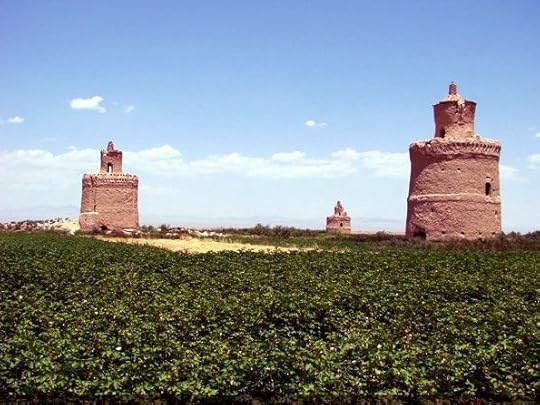
My surprise favorite chapter covered 'vernacular' architecture, including buildings like these pigeon towers that dot the agricultural landscape.
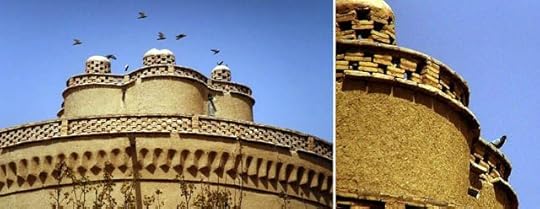
The Persians kept pigeons not as food, but for the sake of their droppings which are an excellent fertilizer. While I would not have wanted to be the one collecting the guano, the towers have their own sort of beauty and they have clever features such as decorative ledges that deter hunting snakes.
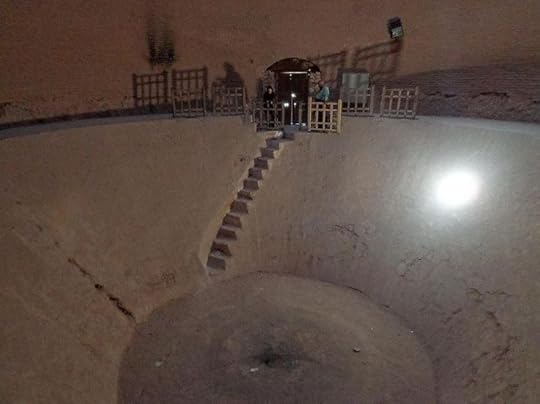
In the days before air conditioning and refrigeration people harvested ice from pond surfaces in the winter and packed it into ice houses with layers of straw. The entire center of this ice house would be filled up with ice.
In the summer months the wind towers flanking this ice house provided air conditioning that worked through evaporation.
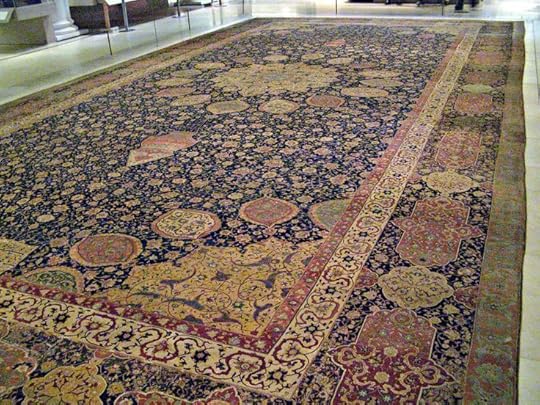
Of course there were other more sumptuous delights, such as the chapter on the ancient art of carpet-making. This is the famed Ardbadil Carpet woven by Maqusud Kashani and dated 1539-40.
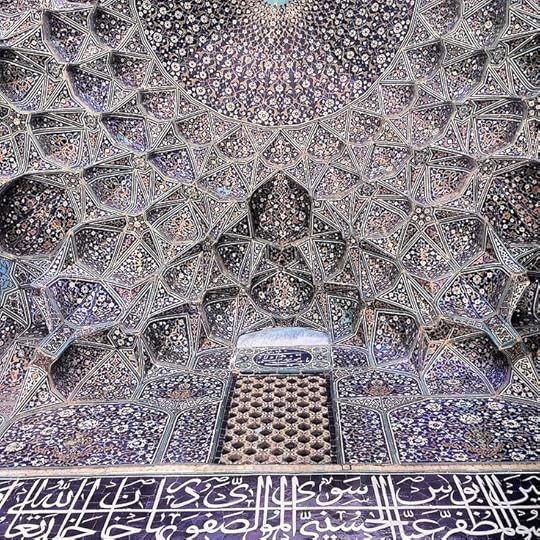
The chapters on architecture and tilework were marvelous; the Persian love of surface decoration was something close to a glorious obsession.
Many of the chapters hinted at the cross-cultural influences. The Persian empire lay athwart key trade routes between China, Russia and the west and the region's art and craftsmanship was widely appreciated, even in ancient times.
One small criticism: it would have been helpful to provide a timeline.
There are more glorious pictures and quotes in the updates section.
If you care about the arts of Persia [1] in the period before the Iranian Revolution in 1979, this is definitely a worthwhile book to read. It certainly is a massive tome, one that could knock out an unwary person who puts it on a high shelf or could double as a shield, but for all that the book is actually much less imposing than its massive size would indicate. I do not think this is a book that would be all that common for someone to read, but there are so many different types of art that the author covers in detail with vivid color photography that if you like any art over the entire course of Persia's history, there is likely going to be something here that is of interest and that is worth reading or at least looking at and pondering over. The fact that the author has an obvious degree of knowledge about Persian art history only makes this a more interesting book for its readers, even if the book weighs several pounds and is the size of a laptop computer from the 1980's.
In terms of its contents, this book contains only a bit more than 200 pages, but they happen to be large pages. Included in its contents are some twenty chapters after a foreword, maps, and glossary. The editor begins with a historical introduction into what counts as Persian art (1) before someone writes about the early art that remains from the Elamite period (2). The next three chapters cover the art of the Achaemenians, Parthians, and Sasanians respectively (2, 3, 4) as the author moves from the ancient period of prehistory and early history to the Muslim conquest of Iran. From this point the book changes tack from being a historical survey to being about different types of art. First comes architecture (6), mostly palaces and mosques, before another chapter contains very striking discussion of vernacular buildings of the Iranian plateau, including dovecotes and icehouses (7). Chapters on carpets (8), textiles (9), metalwork (10), jewelry (11), coins (12), painting (13), painting in the post-Safavid period (14), and the arts of the book follow (15). The last few chapters wrap up the art with discussions of lacquerwork (16), ceramics (17), tilework (18), glass (19), and caligraphy (20). The discussion of ceramics, and the way that Iranian pottery suffered because of its imitation of Chinese products for Western consumption, is particularly interesting. The book ends with notes and bibliographies and an index and acknowledgements for the various photographs used in the book.
Although I am by no means an expert in the art of Persia, of any kind or in any period, I found a lot to appreciate about the book. The authors are forthright and honest where information and knowledge was lacking and where it was difficult to come to conclusions. One author notes, for example, the paucity of art from the Parthian period and the narrow scope of what was ruled over by the imperial dynasty in the face of large amounts of local autonomy. Another one notes the scarcity of ancient mosques and the fact that they can most often be found in smaller and less important provincial towns rather than more important cities where mosques were torn down and rebuilt later on in a grander and more contemporary style. Another author notes the lamentable fact that vernacular buildings do not often get a lot of attention and only remain present when a use is found for them. And so it goes throughout this volume, making this volume an example where a collaborative approach to an obscure subject makes for deeply compelling and worthwhile reading.
This large coffee table sized book is a collection of essays regarding different arts in the Persian world. Printed in 1989, there is much that is now out of date here, and in some cases, some pieces that, sadly, likely no longer exist. As a beginner review of many of the different media from architecture to pottery, textiles and painting, it gives a good general introduction. However, the book is huge and many of the photographs are not. In many cases the photographs or drawings are also not labelled well, giving some confusion as to which item is being referred to in the text. Quite often, authors will discuss some minute detail in a piece, and the accompanying photo is very small, making said details impossible to see. For those already having some basis in Persian art history, this book is not likely for you, unless there are photos in here you cannot find anywhere else. Otherwise a decent introduction to the subject.