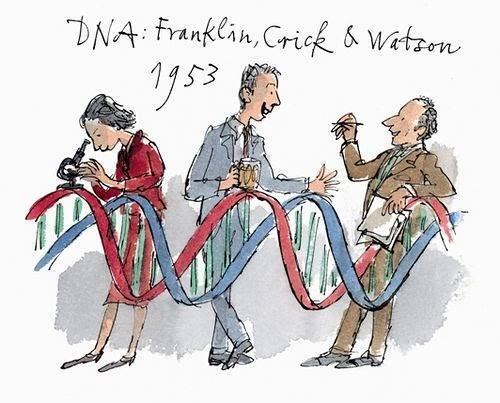
Several years ago, I read Carnegie's Maid by Marie Benedict and found myself intrigued with the author's writing style and keen attention to detail. Somehow, I lost track of her subsequent releases but recently saw that she had a new book, Her Hidden Genius, publishing in January of 2022. I was lucky enough to receive an early copy and am eager to share my thoughts on the novel.
Dr. Rosalind Franklin is most known for studying and discovering key facts and game-changing details about DNA. Not known well outside the professional circle of researchers until after her death, she was immensely dedicated to proving her theories about the building blocks of living organisms. Many books have been published on the topic, some crediting her, while others allot the discovery to the men she'd been working side-by-side with for a few decades. In this account, Benedict shows a more human side of the scientist, exploring those who treated her unfairly and stole her research.
This was an interesting topic, and while at times it focused a bit to much on the scientific details of DNA and the testing being completed through dynamic photography, it still conjures an emotional reaction. Whether it was her all-consuming desire to find the truth and beat her competitors, or it was the unfair way some of the men received credit in her laboratory, readers will find themselves with gut reactions and points of view on right and wrong. Other depictions treat the famous doctor as a difficult shrew (their words, not mine) who couldn't work with anyone. Benedict offers hints of Rosalind's inability to partner with others, but she also shows the difficulty of being a woman in a man's world (at the time) and growing up in a family who simply wanted her to stay home, marry, and procreate.
Benedict is a wonderful writer. She pulls you in, adds depth to characters, balances the true historical facts with dramatic fiction, and allows readers to decide for themselves where they end up in their beliefs. For those interested in DNA, science, experiments, et al, this will surely be a stronger reader. For me, I thoroughly enjoyed the personal relationships, the highpoints of her discoveries, and the mini-suspenseful moments of research being stolen or protected. But I also found myself tuning out every so often when the story became burdened with the technical details, mostly because I am not that intelligent in this arena nor do I have a personal interest in the scientific aspects of it (the genealogical side of DNA, yes, tho). It wasn't too much that I couldn't read the book, and without it, the story might not have had enough merit to appeal to a wider audience. All that said, it was a commanding story with memorable personalities, scenic descriptions, and a lovely educational lesson on 1940s and 1950s DNA discoveries.
I think most people will enjoy the book... but without the underlying, innate interest in DNA and science, it might fall a bit flat given that's the sole focus and precipice of the book. Near the end, it picks up when Dr. Franklin becomes ill, likely radiation poisoning / cancer from all her research. I wish we spent more time in this realm, including exploring the scientist's point of view and emotions at one's single most beloved thing being the exact reason she died so young. I'm glad I read it, and it's prompted me to add Benedict's other books higher in my TBR for 2022. I am sure others will feel very similarly.


 . I was a top reviewer on
 . Denied, then got the book mailed to me in advance and 3 additional books, too. This year, I am definitely more in ‘Go with the Flow Mentality’ By the time I finish the other Marie Benedict books I have and all the other Science books I have, it will be January. 😂 Wish me luck and wish everyone else the same. 🧬 is Interesting. Her Hidden Genius was Excellent. I highly recommend reading it. Perhaps, hit Like and maybe I have an admirer at Sourcebooks, getting my book and chocolates together right now.
  . I just realized each Mitford Sister lead such different lives. Nancy Mitford was a famous author. I just was looking into a book about Zelda Fitzgerald written by her.