Horribly disfigured by an accidental fall from a cliff, Helio Cara is shunned by his friends and decides he must reconstruct his face and his place in the world
I read Face back in 1985 when the novel was first published. I vividly recall many memorable scenes from this story based on a true event that happened in a Rio favela, where a thirty-six-year-old man fell down a long flight of cement steps and obliterated his face. Following his release after months in the hospital, he could immediately see nobody wanted anything to do with him, not his former girlfriend, his boss at the barber shop, his neighbors. Without money to pay the surgeons, all he could do was learn as much as possible about faces and surgery and then set about reconstructing his own face.
A number of passages stuck with me these past thirty years. Here they are:
Alone at night in his room at a charity hospital, our unfortunate protagonist Helio Cara catches sight of himself for the first time, bandages removed, after his accident. “In the sudden light, someone stands weaving before him on unsteady legs, something without nose or mouth, eyes dark purple splotches, sealed almost shut, particles tattooed onto the skin.”
The medical staff and students gather round Helio's bed and listen to the Head Physician. “'Never has this service seen such an injury. Mr. Cara...' and the swallowed giggles of the medical students, standing at white starched attention, suppressing the whispering of their linen, '...such an injury.'”
Helio is given a rubber mask by the medical staff. However, the rubber quickly becomes intolerable – the intense heat, the feeling of suffocation. Helio transitions to covering his face with a handkerchief. “The mask! He had forgotten it was there! Certainly he lifts the edge as it lies against his jaw. No pain. It lifts easily. Yet they had such trouble snapping it tight against his chin. He peels it upward. Can it be he has grown used to it already, like a second skin corseting his own bruised flesh?”
The women and men and children he's lived with these past years in the favela refuse to treat Helio as fully human. “Their grunts of fading recognition gave way to silence. He became as one invisible. Finally it seemed to him they no longer even see him.”
Helio confronts Lula, his girlfriend of the past. “He tries to quiet her, but she screams even louder. 'Everything, everything is spoiled now. I'm afraid to look at you. I can't stand to kiss you. I don't want to see. I can't make love to a monster.' ”
Helio goes to the restaurant where Lula works as a waitress. He doesn't find her but speaks with the boss who says the following – for me, THE most memorable line in the entire novel: “Man, it's so hot in there, the roaches have to do the samba!”
Cecile Pineda captures the pathos of a man stripped of his existential identity, a man without the most critical part of one's sense of self in the world – a face. “Would he have to accept this face like raw meat, grotesque, his own mask, but one he could never remove, stuck to him like a childhood nightmare, never to be taken off?”
The author also relates, detail by detail, the harrowing sessions when Hilio sits down with needle and thread and Procaine to reconstruct his own face. “Why, if this is so, why does his scar tissue persist? Shouldn't it be replaced by an entirely new and shining surface, one that no longer bunches in rigid ropes and knots, patterned by hard ridges that glare an angry white?”
The Face, a remarkable novel. Pick up the Wings Press edition since it includes an incisive interview with author Cecile Pineda.
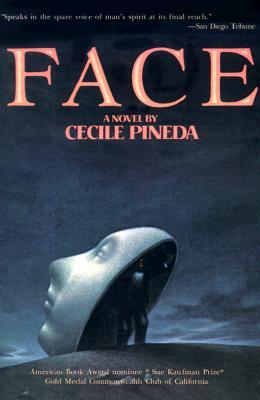
Never has the one-line GR description been less effective in conveying what a book actually feel like. Instead look at this old cover image. The artist gets it:
There it is, in all its modernist-symbolist clarity -- a story of visages, masks, and identity in bare and gleaming terms. The story streamlines into more linear, less conceptual space as it goes, unfortunately, but the final episodes dealing with reconstruction of the self/face/identity are tethered in a cold brutal physicality that makes them highly memorable.
This came to me by an odd path: after cat-sitting, my mom left this on my shelf, convinced she'd borrowed it from me in the past. She hadn't, and I'd never eve heard of this or Pineda. But this is, in fact, right at home on my shelf now.
My Classic Read for March 2019 is Cecile Pineda's Face, a book about identity.
First published in 1985, Cecile Pineda's slim and stunning novel Face was highly acclaimed and has a longevity that places it as a modern classic, an American Academy of Arts and Letters prize winner, and a finalist for the prestigious Neustadt Prize in 2013. Nobel Laureate J. M. Coetzee has called it one of the most haunting books he's ever read. Based on the true story of a man who was disfigured in an accident, we follow the fictional life of Helio Cara (a name that ironically could be taken to mean "sun or day love") a man living in a favela in Rio de Janeiro. Helio rushes, or tries to, to his dying mother's bedside but falls off a hillside (a metaphorical cliff). Surviving his accident, he is rendered faceless in that he is so disfigured that everyone rejects him and his identity, home, livelihood and all his friends, are lost to him. His situation is so dire he cannot go out and cannot bear to be seen. The light of day brings only sorrow, cruelty and rejection. Over time, Helio rebuilds himself, literally rebuilding his face, with needle and thread, and novocaine for pain.
Face remains a landmark in Latin American fiction, with Pineda being one of the first US-based Latina writers to land a contract with a major US publishing house. It is also a stunning novel about what makes us who we are, about how others see us, and how we see ourselves. What defines us? Is it what we do, the choices we make, or the face we show the world? A fascinating novel, as fresh today as it was more than thirty years ago, I cannot recommend this jewel of Hispanic literature highly enough.
The style of Pineda's novel echoes Camus', with its existential appropriation of Hemingway's sparse, action-and-surface oriented sentences. Like Camus' Meursault, Pineda's protagonist is alienated from the start from his surroundings, in this case a Brazilian shanty town. When he severely disfigures his face in a fall, his alienation becomes complete. He loses his job as a barber and is forced to scavenge in the night for food. We see him navigate a tortuous health bureaucracy and suffer anonymous attacks by people in his community. In the second half, we see him return to his mother's home, where he begins the painful and methodical process of self-surgery to reconstruct a face.
The novel excels in its opening pages, as the trauma of the fall is represented by a plotting that disorients in its shuttling from the past, future to a tenuous present. The chronology later settles itself but is later ruptured as he makes his way to his mother's home. Memories of his dead father and mother surface suddenly and in faint glimpses as the novel progresses, but I wish these fragmented memories added to something more substantial, even at the level of suggestion. It felt like the ending buried much of the potential in these fragments.
The novel excels in its affection-images, in those detailed close-ups of objects apart from the narrative that have much to suggest yet evade any easy meanings, like the sentence: "The water forms puddles in the gutter, still carrying its traces of white foam, moving slowly at first, gathering speed as it finds its way toward the storm drain in the corner." Such images of water, and at times of clouds, seem to stare at the reader with its own affect, its own faciality (to use Deleuze's term). The closely drawn-out details as the protagonist reconstructs a face are also to be commended.
'Face' is an extraordinary and haunting story on the nature of identity and social norms. Based on a true account, Pineda's work functions as an incredible social commentary on identity politics and societal relations with the labeling of bodies. Go read this. It will traumatize you, but you'll be the better for it.
Uniquely haunted little book. The hopelessness and disturbing surrealism of bureaucracy and social systems of Kafka with the hypercurated yet objective poetic narration of Camus. But I've never read anything quite like it either. Can't quite believe it's Pineda's debut (is it her only?) novel. I find the craft of it remarkable and the story itself deeply full of dread. The impartiality of it really seized me for such an intensely personal concept. It makes sense though doesn't it? Loss of a face = loss of partiality, preference, human identity. And yet the reader still knows Helio well. Identity in the unidentifiable. How magnificent is Pineda's work with words!!! Here:
He tries to picture it. But no. It will not come. Above him the fluorescent lights hum. He is in a waiting room with scores of others, waiting, seated on a plastic shell. Paradise was somewhere in an autoclave, sterile, waiting to reshape someone—himself, perhaps—into more human form.
The simplest most utilitarian words arranged to carry such marvelous flow of assonance and rhythm! And POWER. If Pineda wrote any other novels, and if they ever come to me at random like this one did, I'll hug and kiss them, I'll pay them my most complete attention, I'll pay them my most whole respect. What a masterful little book it was!
I bought this on a whim at a second-hand bookstore a year ago, finally getting around to it, and I am not thoroughly impressed. Maybe it was more novel (ha) when it came out 40 years ago, but today this felt fairly shallow. The prose is at times very enjoyable, but became pretty weighty in stretches, seemingly to hide the paper-thin plot. The ideas approached are interesting, but the narrative seems too focused on what's directly ahead of it, lacking much introspection or a wider look as to why the protagonist goes through the torment he does. Yes, having a mangled face makes you a social pariah, but Pineda seems less interested in exploring the thematic facets of this conceit than torturing her protagonist with it. At least maybe I could feel sympathy for him if it weren't for one completely unnecessary plot point that makes most of the novel feel even more pointless. A lot of good images wasted on elementary misery porn.
Felt my heart and lungs expanding with each page. This is one of the most powerful books I've ever read, and it scissors into the heart, exposes the spinal column, and remains in the mind forever integrated with sympathetic synapses. It is ahead of its time (or perhaps perfectly timely) in addressing shallowness and value, looksism and invisibility, and a metaphor for all forms of "otherness" and what it does to the spirit to be left or pushed out. It is also a beautiful, musical, and tender book -- the author is one of the kindest humans to ever inhabit this earth, so that is not surprising.
Pineda starts with the bare details of an incredible story from real life and then proceeds to flesh it out into a novel. Along the way she captures the precarious hold on life by anyone who has to work daily to maintain their place, the commonplace cruelty against anyone who is not “normal”, how quickly anger can be misplaced from those who cause it to those who are easier to abuse, and much more. The novel feels grounded in the difficulties of life, well explored and without exaggerating its pathos, as well as the successes, however partial, of those who do not resign themselves to a bitter fate.
Never have a read a book that psychologically disrupts and twists the presumptions of identity as much as this novel. The main character of this novel has struggles with his identity that are not only related to his psyche but also his own physicality as well as his physical location. The entire time I read Book 1 of this novel, I had the notion that nothing good was going to happen in regards to the main character and I felt so bad for his situation. Book 2 let's us readers see how the main character recreates his identity and we start to feel some hope for this man.
This book has stared at me for years on my shelf calling me to read it. I don’t recall where I got it but I remember that the cover grabbed my attention. Not knowing what the story was about, I started reading this complicated but hauntingly story of a man who lost his face.
The story was told poetically but confusing at the same time. Though this was a narrative, the story developed as if it were a prose. The story of Helio Cara unfolded as Helio ran out to seek his dying mother but instead fell down a cliff where his face got destroyed, changing his life permanently. These events were described as if it were a bad dream; because of this, many of the chapters sounded complicated and I was not able to fully comprehend what was going on or who the characters were the first half of the book. Consequently, I found myself withdrawing from the book a few times.
Helio’s character was a tragic one. One can’t help but feel sympathy towards him. I cannot begin to imagine having Helio’s fate. Everyone he knew turned his or her back on him. He became an outcast and an excuse for people to treat him bad. I was appalled on some of the mentality that people had about him, especially those in the clinical field. Unfortunately, Helio had little choice but try to fix himself when he could not find any help. Helio's character really grabbed my attention and was the reason why I kept reading this book. I really wanted to know how everything was going to unfold for him.
Overall, I liked the detailed attention and style that Cecile Pineda used to tell Helio's story but this creativity fell a little short for me at the first half of the book. Wanting to know Helio's fate was what had me hooked in the last half of the book.
Pineda's Face was nothing but an epiphany to me. It's very enlightening in the sense it makes you question your very existence, what you mean to yourself, and the world that surrounds you. Do the opinions of others shape who we are? Do they define us? We like to think we're above that, but reality is shaped and drawn perfectly in the inked thoughts of Helio. If anything, this book has taught me solitude and loneliness are two different things. We find both to be suffocating, but maybe that is because we don't know what to do with the liberty it simply delivers. It's defining and constructing without the cold and rasp chains that stick to your hands. No influence of authority or judgment, just you, flawlessly flying with the wind and the birds until you find another version of yourself untouched. Maybe a bit cracked but healed nonetheless.
I feel like I'm rambling a bit. but the advice of the day, do not be afraid to be alone or somewhat exiled. solitude does not equal loneliness.
and as weird and painful as it sounds it can be liberating to breathe without worrying about who might bother one for doing so.
another thing.
although I don't support Helio's actions in the slightest, I did appreciate how Pineda goes deeper within the text to make us question what our bodies mean to us and others. For instance, why is masculinity built within the violence of female bodies?
In the end, I will have to rate this as "just okay".
**Trigger warning: mention of SA
At the beginning, I was prepared and ready to feel sorry for Helio Cara, to glimpse in to his life and see him for who he really is. Just as I felt he was getting very desperate, he violently attacks and assaults his ex-fiancee? I was jarred to see that this was a scene in the book, especially because it didn't seem to be of much importance to the plot. Plus, was I supposed to be sympathetic toward Helio after this attack? I thought that perhaps Pineda could be setting the scene for Helio becoming an empty man who is haunted by loneliness, but the whole scene was glossed over, she moves away, and his ex Lula wasn't even mentioned again until the end of the novel.
I'm not sure what Pineda was trying to say, I feel strung along for several possibilities and left in the dust at all of them. I was pleased by Pineda's writing style, she has captivating prose that I find was very helpful to visualization of the atmosphere. I can certainly say that it captured poverty, hate and loneliness and laid it bare. By the end, I was nearly lost and very confused at what was happening, how things were changing, and thus I was left unsatisfied by the ending.
If I ever get the chance to read more of Cecile Pineda's work, I will certainly take it.
This entire review has been hidden because of spoilers.
An intriguing story told with in the voice of a man who has been disfigured in a landslide accident near his home in (I'm guessing) Rio or Sao Paulo. He is tormented by his poverty, government bureaucracy, and his loss of intimate love. An existential dilemma.
Pineda formed an theater company in San Francisco in the '70s and her prose has an unmistakable likeness to stage direction. "There is a bed in the corner of the room. There is a run-down table with a missing leg propped against the wall. Above the table is a small window. The window is smudged with dirt and opaque." This cadence of language is arresting. Hypnotic.
The metaphors are powerful, but Pineda seems to struggle a bit to reach a conclusion. This story is joyless allegory, and you have to be hungry for despair to enjoy this read.
Unfortunately, I did not find this novel to be extraordinary or provocative in totality. Yes, there were tragic moments here and there, but the narrative as a whole failed excite me. The trope of what is a face vis-a-vis identity was interesting to muse on, but the ruminations were quickly spoiled by excess of mundane details of his everyday life and his observations. They were distracting, uninteresting, and in my point of view, elongated the novel more than necessary. I do understand that the author was trying to recreate the history with as much detail as possible (and convey the theme of observer/observed), but honestly, get over with it already!
Face is a novel about a man after he suffers a horrific, disfiguring accident set in a undefined South American country. He is poor and, in "The Capital", lacks most means of support either familial or governmental in looking for help out of his travails. It is a very somber but meaningful and insightful rendering of how one might feel and, out of desperation, approach resolution. The characters were well drawn and interesting. I usually give more than three stars to any book I finish but, in this case, some of the situations strained my credibility. Other than that, a good read.
The face is the summation of human value. Nothing could illustrate this more than this painful, based on true events, novel. What an amazing, tragic, read.