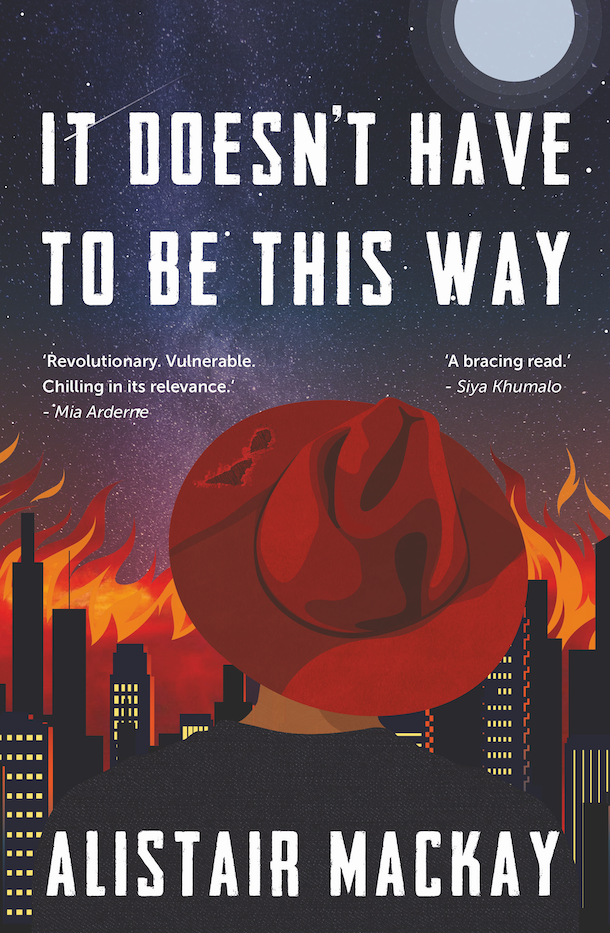
It Doesn't Have To Be This Way, the highly anticipated debut novel by South African author Alistair Mackay, tells the story of three queer friends trying to navigate an increasingly fractured, violent and unstable world ravaged by climate collapse and rampant inequality.
Within a few short years, climate collapse leaves Cape Town a vast and arid slum. Those who can afford to leave have fled to the New Temperate Zones, and to The Citadel on Signal Hill, ensconced in a climate-controlled dome behind The Wall. But at what cost? Here, residents pass their days lost in virtual reality, courtesy of a biotech implant connected to their minds, refusing to see what goes on around them. In the present day, before the Change, Luthando sees the way the world is headed and tries to avert disaster, but his activism leads to clashes with the government. As their lives begin to unravel, his life partner, Viwe, becomes embroiled in the religious end-of-days fanaticism sweeping the city. And their friend Malcolm fears that his work developing mental and emotional software is being used for sinister purposes.
It Doesn't Have to Be This Way is a profoundly moving story of resilience and tenderness, and our capacity for love in the face of fear.
Awarded as one of 100 Notable African Books of 2022
Alistair Mackay is the author of It Doesn't Have To Be This Way (2022), a story of queer love and friendship through climate breakdown, and The Child (2024), a novel about healing, resilience and love in a divided country.
Uh oh, there is a Fredric Jameson quote in the epigraph to the latest South African SF novel, that old sawhorse that “It is easier to imagine the end of the world than an end to capitalism”, I told my friend, a Professor of English at Unisa. Both of us have followed the local SF scene enthusiastically over the years. We enjoy a friendly rivalry, with myself a huge fan of Kim Stanley Robinson (KSR), whose recent ‘The Ministry for the Future’ (also about climate change) was one of Barack Obama’s favourite books of the year.
KSR’s PhD back in the day was supervised by, you guessed it, Fredric Jameson, a noted US literary critic and Marxist political theorist, who has had a major impact on the genre (another noted SF author, Adam Roberts, wrote a nuts-and-bolts introduction to Jameson.) Who is an outdated theorist, according to my friend, pointing out diplomatically that the codger is 87, which is beyond being old (and still relevant).
My friend is a lifelong fan of Ursula Le Guin, who wrote more ‘speculative’ fiction than she did traditional SF. So, whenever discussing local SF, we look at what side of the Le Guin / KSR Scale it falls under (we are very aware that we both began reading SF in a time when its Golden Age was tangible and defined.)
As soon as I heard that ‘It Doesn’t Have to be This Way’ was out, I zipped over to my local Exclusive Books … but couldn’t find it on the ‘South African fiction’ shelf. Turns out a handful of copies had been slotted into the ‘History’ section, which is an irony I am sure author Alastair Mackay will appreciate.
Mackay is lucky though to have been afforded the shelf space: I have yet to see ‘Mermaid Fillet’ by Mia Arderne (who contributes a generous cover blurb here) or even the so-so ‘Circus Days’ by Ilze Hugo appear in a local bookshop. These are local books I had to find out about via Goodreads or Scribd. (The best resources to keep tabs on local fiction remain ‘The Johannesburg Review of Books’ and the ‘Sunday Times’ online book section.)
So, whenever a book like ‘Dub Steps’ by Andrew Miller, ‘Green Lion’ by Henrietta Rose-Innes, ‘Triangulum’ by Masande Ntshanga or ‘Green Valley’ by Louis Greenberg pops out of the woodwork, I want to run around madly and hand out copies to all and sundry. Because these are fucking world-class books, people!
Not to detract from the much deserved credit and accolades bestowed on the likes of Lauren Beukes and Galgut (and local literay juggernaut Deon Meyer and rising star Irma Venter), but these writers do invariably overshadow many local literary gems. Which brings me, in a very long-winded way, to ‘It Doesn’t Have To Be This Way’, which I will abbreviate by the hashtag referenced in the book, #idhtbtw.
There have been a couple of enthusiastic comments on Goodreads where the breathless reader noted that he or she whizzed through the book in a day or two. I myself read it over a weekend. I also had to put the book down at one particular point after being emotionally eviscerated by the writing. The author himself comments on Goodreads: “Definitely quicker to read than to write.”
Ah, you can almost taste the wistfulness in that phrase. Imagine, it takes years from initial idea to end product … and then to have readers ‘whizz’ through your hard-fought-over-every word like a teleprompter. In fact, in terms of the time-based model of capitalist productivity, writing a book probably ranks as one of the Worst Jobs in the World™. Unless you’re Brandon Sanderson, but that’s another story.
The fact that I, too, ‘whizzed’ through #idhtbtw in a couple of days indicates that the book spoke to me on such a visceral level that it compelled me to keep on reading. Every word is in its exact place, and does its job to propel the reader along the narrative path. There is no fat here; that must speak to both painful hours of agonising, and hopefully some occasions of epiphany, in the writing process. The moment I mentioned where I had to put the book down is one that made me ugly-cry. And it was at that point I knew this was something truly special.
Being a long-time SF reader does mean you bring your own preconceptions to bear on any book, and I must admit this was a rocky start for me. Within a couple of pages, the reader is introduced to a slew of neologisms: The Choir, the stillness hours, the Change, the Citadel, New Temperate Zones, NewLife, the fly farm, Believers. Too much, too soon. SF writers often make the mistake of thinking that signpointing concepts, without explaining anything, is good storytelling. No, you just end up with a bad episode of Star Trek.
That hellish beginning set in the climate-ravaged dystopia of ‘Kapelitsha Island (Now)’ is desperate and brutal. It then segues into ‘Part One: The Forest (Fifteen years to go)’, a ‘reforestation festival’ in the Platbos Forest. We meet Luthando and Malcolm, two gay friends, with the latter noting “he’s going to have to come out again – as a greenie.”
Luthando meets Viwe, and so begins a brittle courtship whereby two people, recognising mutual trauma, embark on the rocky road to true love. It is such assured and delicate writing that the reader cannot help but be swept up in the blissful currents of Luthando and Viwe’s burgeoning relationship. “He smells of sandalwood and sweat, cumin and jasmine at sunset.” More than that though, the reader soon cares so deeply for these flawed characters that you suffer every step of the way when the story takes a much darker turn, as it inevitably must.
This is where the Le Guin / KSR Scale comes intp play. The remarkable achievement by Mackay in this novel is how he has fused Le Guin’s humanism with the intellectual rigour of KSR. Despite that onslaught of neologisms in the opening pages, the SF elements are largely in the background, foregrounding the all-too-human drama.
The not-too-distant-future Cape Town is split between the squalid misery of Kapelitsha and the “new private security estate” of the Citadel on Signal Hill, the last symbolic bastion of technology and capitalism against the relentless onslaught of climate change. Yes, it is the sort of polarising ‘haves / have nots’ dichotomy so beloved by KSR, and which makes my friend bristle, as the world is so many more shades of grey.
What is interesting is Mackay’s narrative decision to focus on a triangle of characters, with Luthando, Viwe and Malcolm each having a section dedicated to their point of view on their tangled inter-relationship. There are important peripheral characters like Noxolo and Viwe’s mother, but these are all framed in terms of their relationship to that main triumvirate.
Malcolm is a software designer tinkering on the virtual reality platform NewLife. Moore’s Law soon sees his pride and joy superseded by Cerebra from the US, “a biotech implant that connects to the human mind.” Indeed, Malcolm’s section is the most overtly science fictional of the book, giving us an inside look at the hi-tech cocoon of the Citadel.
The raging debate about social media algorithms inadvertently resulting in social engineering that is detrimental to our base humanity has long spilled over into the pages of SF. Mackay is deftly on top of all of the main arguments here, such as the alarming idea that if we are all uploaded to the Cloud, who cares about climate change anyway? There is this warped notion that Humanity 2.0 will be divorced from the natural realm, and all the more human because of it.
What I admire about KSR, apart from him being a social democrat in the Jamesian mould and a science geek, is that he is a noted environmentalist and nature writer. Mackay, too, has a deep affinity for the fauna and flora of the Western Cape. His love for the natural heritage of the region is a rich thread in the book that makes for some breathtaking passages that shimmer with fragile beauty.
Again, we can see how the Le Guin end of the scale is brought into play here (one of her seminal works is ‘The Word for World is Forest’.) Mackay also quotes Richard Powers in the epigraph, whose ‘The Overstory’ won the Pulitzer in 2019 (and whose recent ‘Bewilderment’ is another kind of fine humanist SF text like Mackay’s.) “Imagine how differently we’d treat plants if we could hear what they’re saying?” Luthando wonders at one point.
I do think that different readers will respond differently to the book, and in particular the three main characters. For me, I found Malcolm’s journey to be the most interesting, and devastating. But there are no easy choices or answers to be had here. Is technology still the best answer to tackle climate change on the large scale needed to prevent the eco-disaster that Mackay foresees for South Africa in only a handful of decades? (Day Zero in 2018 was a harbinger; soon we will reach a tipping point.)
Also, is trying to imagine the end of capitalism akin to imagining the end of the world? Mackay argues it is the path to a new beginning. But if we do not act decisively, and soon, it will be the road not taken.
I loved, loved, loved this book. It is topical and heartfelt, beating to a rhythm of life and love that is intoxicating to read. It is equally relentless in signposting our collective folly as a species, and the terrible price this will exact on us in the short space of a few generations.
So why are there only a handful of copies stuck accidentally into the ‘History’ shelf of my local Exclusive Books? I know marketing budgets are limited, but there has got to be a way of bringing such an important book to the attention of more readers. A book on par with some of the best SF being written in the world at present.
A book the whole world needs to read right now! Amazing (and terrifying!) stuff.
And thank you so much to Alistair for sending a copy over to the UK. Such a shame it isn’t currently published here. Any UK book editors who might happened to read this… pick up this book!
One of my few regrets from last year is not writing a review for this book, because WOW! I don’t even know where to begin 🥹 It Doesn’t Have to Be This Way takes place in what was Cape Town, but is now divided into Kapelitsha Island (a place ravaged by climate change) and The Citadel (a hi-tech cocoon where one easily forgets reality). While time oscillates between the past, and the current future we meet Luthando, an eco-activist, his partner Viwe, who often struggles to reckon with his sexuality, and Malcom (Luthando’s bestie) who works in tech.
What Mackay offers us is a terrifying but oh-so-beautiful exploration of the impact of climate change that already hits close to home - from the rapidly growing class divide, the disconnectedness that technology and media platforms provide, and the rise in religious fundamentalism and violence. I went through an array of emotions - I gasped in horror and shock; I teared up as I experienced both joy and sadness. But despite all the hardships, the novel often reminds us of the importance of empathy and kindness and what a difference it can and always will make.
A SEARING, UNPUTDOWNABLE MASTERPIECE This book confronts a possible (inevitable?) near future where the climate crisis has fundamentally changed the way we live. Despite the dark subject matter, the author has woven a landscape of characters and events that will make you laugh, cry and feel deeply. I couldn't put it down.
I had a similar sensation reading Booker-prize-winning The Promise by Damon Galgut. The story is depressing as fuck, but I was utterly captivated by the language, the narrative and the world-building.
The descriptions are so rich, you don't have to be a South African elder millennial to feel seen. But as South African elder (geriatric, even) millennial, I finally feel like this book is for me. I know these people. I am these people. This is my life. The streets are ones I've lived on and the relationships are like the complicated ones I've had.
I have a dislike for sci fi or books set in my home town. That said, I consumed this book in 36hrs reading late into the night and reaching for it first thing in the morning - un.put.downable! Topical, thoughtful, very smart … and anxiety provoking. It will make for a most excellent tv series/movie too.
Disclaimer: NB Publishers SA kindly sent me a copy of this novel in exchange for an honest review.
It Doesn't Have To Be This Way is a climate fiction novel set in Cape Town, South Africa that takes place before and after the world succumbs to climate collapse. The world has been divided into Temperate Zones, and those lucky enough to live in them are protected from the earth's harsh weather conditions.
The novel features three main characters, Luthando, Malcolm, and Viwe who are friends. All three characters are queer, and when Viwe and Luthando first met at a tree-planting festival (12 years before everything collapsed) sparks flew, and the two were even a couple for a little while. Luthando is a conservationist with the soul of a revolutionary. He's always been an extremist and worries constantly about the plight of the planet. Refusing to stop at just being a guerilla tree-planter, Luthando's life is forever altered when he ends up being jailed after a clash with the government.
Viwe is forced to wait at home as Luthando serves out his prison sentence, and even though he's been in a relationship with a man for years, he still struggles to come to terms with his sexuality. His mother, a religious fanatic, makes it difficult for him to be himself, and to be honest about who he is, and who he loves.
Malcolm works at a tech company both before and after the collapse, and before everything falls apart his company starts to work on a type of software that works directly with the human brain - a type of mental software. As Luthando and Viwe's relationship strengthens, Malcolm's role in the group borders more on the periphery, and he becomes more and more reclusive and an advocate of artificial intelligence.
The novel's point of view switches from Luthando's 12 years before the collapse, to Viwe's nine years before, and to Malcolm's a mere two years before the point of view switches to a new character named Milo who exists a few years after the world was forever altered. The narrative follows these characters through a devastating trajectory toward a world where only the truly privileged are able to live in relative comfort and safety from the planet's intense heat.
Milo lives in an unsafe zone known as Kapelisha Island (formerly Cape Town) where water is scarce, and the heat of the day is so overbearing that those living there are forced to retreat into the shade during daylight hours. When his parents go missing Milo suddenly finds himself alone, save for a caring neighbor and the still-breathing body of a Believer.
The narrative follows Luthando's fight for climate justice, Viwe's descent into religious fanaticism, and Malcolm's increasing reliance on technology that replaces everything including human emotions. The friends drift apart, but they also manage to find each other again - though not in the ways one might expect (or hope for).
Alistair Mackay's novel is about very real issues, and among those issues lie themes of friendship, loyalty, loss, betrayal, faith, and hope. In Luthando we have an example of a liberal force, in Viwe we have a character struggling with his own queerness, and in Malcolm, we find a character seduced by a technology that seems to mirror our own not-so-distant future.
It Doesn't Have To Be This Way is terrifying in its accuracy, and even more poignant is its South African setting, where corruption and crime have become commonplace, and its citizens are literally sitting in the dark as our resources in the form of load-shedding are being stripped away. With the global and ever-looming threat of A.I. (artificial intelligence) very much a real fear, this novel is topical in a way that makes it also a very scary insight into what it is like right now (and if you disagree you may just have to remove yourself from under that rock.) This terrifying and heartwarming novel is the queer dystopian novel everyone needs to read, and not just because it is a warning to all.
Absolutely phenomenal, immensely moving and chilling. This reminded me of Greenwood and the Overstory but through an unapologetic gay lense. I even found it to have hints of To Paradise. I do have one grievance though: I wished the book were 500 pages longer. -)
It took me a really long time to read this book, not because it isn't good,but because it is a bitter pill to swallow. I had to put it aside many times just to process what I had read. There was something eerily 'prophetic' about this book. Everything that happens to the world is believable and the fact that it's in the not too distant future,freaked me out. There were times when I drank water and thought of what it would be like without it. This is the impact the book had on me and I'm certain what the author wants us as readers to take away from his writing- a deep awareness!
The author is an exceptional writer. His writing style draws you in immediately and brings all his characters to life. You know that the characters are alive when you can put a book away and still think of them as if they were right in front of you, so well done!
It is obvious that the author did a lot of research to bring this book to life, from the detail of the natural environment to the technological advancements mentioned throughout. I commend him on this!
Lastly, the author addresses some important and controversial topics in beautiful ways. He addresses the marginalization and demonization of same-sex relationships, the problem with religious fanaticism and the disparities in socio-economic classes. It takes bravery to write about these things and I appreciated it and learned a lot from it!
I would have loved to read more about what was happening elsewhere in the world with regards to the environment, and I would have liked to see more 'light' moments (at times everything felt very dark)
All-in-all this was a fascinating read and I look forward to reading more novels from the author.
Oof. What a gut punch of a book to end the year on. As someone who tends to get the occasional panic attack when thinking about climate change for too long, I feel like the characters in this book display the entire gamut of emotions I myself run through when it comes to this topic: helplessness, hypocrisy, cynicism, fatalism, rage, head-in-the-sand… but is there still hope? Mackay seems to say there isn’t, but don’t you almost have to believe we can turn it around to not despair?
The story takes place in Cape Town/ South Africa, starting sometime in the present or near future and ending some 15 years later after the climate crisis has well and truly arrived. We follow Luthando, an eco activist; his partner Viwe, plagued by silent guilt over his sexuality, curtesy of his religious upbringing; and Luthando’s best friend Malcolm who is stuck in his empty but comfortable IT industry life.
I can’t help but think this novel will be preaching to the choir, both when it comes to climate change and socio-politics, which is a damn shame really because it makes good points on both topics. It’s very well written and you can clearly see the inspiration taken from older sci-fi classics: Viwe’s chapters take a pretty horrifying turn into Handmaid’s Tale territory (“teach her a lesson” chants even make an appearance), while Malcolm lives in Fahrenheit 451 style technological numbness. It doesn’t come across as a rehash though and the fact that Mackay was able to integrate such a wealth of themes into such a short book is a real feat. It could’ve actually been a lot longer if you ask me, but considering I complain about most books these days being 100-200 pages too long I’ll hold my tongue when it comes to the opposite.
I do feel like you have to suspend a certain amount of disbelief when it comes to how quickly things go from present day “welp another record breaking hot summer” to “everything is flooded, what’s not flooded is burnt, and civilisation is on the brink”, but then again, in the last few years we’ve already had to experience climate extremes I didn’t think we’d see until mid century, so who knows. Well, you know the saying: “this was the coolest summer you’ll experience for the rest of your life”… brb going to cry in a corner now, hugging my AC unit.
In a perfect world, this would be the kind of book that could change the minds of people who have a hate boner for Fridays for Future demonstrations and see “maybe you should eat less red meat” as a symbol for the downfall of Western civilisation, but until then, well recommended for everyone else.
Alistair Mackay paints a striking, unique and fascinating picture of Cape Town in the wake of global climate collapse. Perhaps what interested me most about the book was reading about what the city might look like (love a bit of speculation) and he creates a very vivid scene of a sun-ravaged south. Excellently written, engaging and straightforward, I loved the rhythm of his prose. The three characters all have a unique and engaging storyline which which weave in and out of one another.
The one place I felt the book fell a little short was in its length. Considering the theme of the book (a climate-collapse ravaged future) 250 pages doesn't quite do the detailed world he's created justice. Some key pivotal moments in the book sometimes feel too fleeting to really engage in what is happening. For example, Luthando's return from prison was sudden and a little rushed. I wanted to make more sense of it. The same goes for both Viwe's descent into his religious fanaticism and then his subsequent repentance from that. I wanted a little more. But, to be fair, I do have a penchant for sprawling, extensive novels.
Nevertheless IDHTBTW is immersive and emotional. Not least Milo's intermittent underlying narrative which drops a delightful breadcrumb trail of understanding as it goes. In conclusion, a beautifully written, and unique read. I just want more - really!
This entire review has been hidden because of spoilers.
Timely, bold, thought-provoking It Doesn’t Have to Be This Way is an intricate exploration of climate change issues- the Fourth Industrial Revolution (4IR) and queerness. It creatively unpacks how these themes relate to the complexities brought by capitalistic and religious ideologies, specifically in an African setting. It’s a well-written debut novel presenting a worst-case scenario of the effects of global warming, not only in South Africa but globally.
Undeniably we are living in VUCA times filled with volatility, uncertainty, complexity, and ambiguity, accordingly, this book is a warning! ! If individuals, government and businesses don’t wake up soon the truth will burn us like sandstorms to the eyes. When we do eventually awake to a country in flames- or floods- will we send an SOS WhatsApp message to God? Try to Google answers from our ancestors?
I absolutely devoured this book, from start to finish. It’s wonderfully written, with vibrant characters and a gripping narrative. It’s also horrifying and traumatic in its stark depiction of a dystopian future of climate crises, religious fanaticism and technological overlords.
It’s great to read more excellent South Africa literature. I thoroughly enjoyed that it was set in Cape Town, albeit one I barely recognize in the book.
I also thoroughly enjoyed the “homonormativity” of the book - the characters’ queerness is presented frankly but their queerness does not become the subject. It does not overpower the narrative, and yet it supports the overall story while bringing attention to the harm caused by homophobia in the past, present and indeed the future.
K. Sello Duiker meets Margaret Atwood in this obsessive novel that faces us with the brutal reality what we’re heading to. The cinematic precision of MacKay’s style together with his compulsive imagination makes it a fantastic yet terrifying read. Well done!
Never have I ever read eco-dystopian fiction until I met It Doesn't Have To Be This Way. What an introduction to this frightening sub-genre! And what makes it even more powerful to me is how it's set in Cape Town, a place I can't help but associate with an abundance of life and nature. As a reader who've been surrounded by mountains, fynbos, wildlife and oceans for my whole life, I can't imagine a more distressing image than Cape Town city submerged under a risen sea level, surrounded by a blackened, burnt down landscape, shacks built up against the slopes of our beloved Table Mountain, where survivors feebly cling to life in a lifeless space. An environmental apocalypse is already a frightening thought, but Alistair Mackay brought the message home. Literally.
Familiarity is key in this text. It's what grips you from start to finish and truly gets under your skin. The post-apocalyptic world Mackay has created in his book is horribly familiar to what we already know now. It mentions droughts and water crises in one part of the country, and floods in another. I found it super eery when I read about the floods in Durban (which were probably inspired by the floods in 2019) while simultanuously seeing articles, photos and videos on Facebook in real time about the latest Durban floods in 2022! The narrative is also filled with the worries we currently have about the climate, overpopulation, unemployment, homelessness. It mentions, Greta Thunberg, Covid, Day Zero, Eskom, all images we associate with crises. In It Doesn't Have To Be This Way, the story doesn't simply cut straight to a post-apocalyptic world, it actually leads you into it with these 'pre-apocalyptic' scenes that span a decade or so as we're guided into the Armageddon. And that makes the message of the novel even more profound. It's a warning: We're right now hurtling towards the end of the world as we currently know it.
But It Doesn't Have To Be This Way isn't just about an environmental apocalypse; it deals with more than just burning forests and melted ice caps. With this environmental collapse as its central theme, the novel also explores LGBT matters through its three queer main characters, as well as concerns around technology and social media use. The novel shifts between four different points of view, each focusing on one particular aspect of the end of the world: We first meet Milo, a child born into the social and environmental collapse, and through his eyes we see the destruction and horror that await us in the future. Then we jump a few decades back in time and meet Luthando, the greenie-turned-eco-terrorist. His chapters focus mainly on the pre-apocalyptic fight for nature. We also meet Viwe, Luthando's lover, whose chapters view the apocalypse through a queer lens. Finally, we explore what role technology and social media will play in the apocalypse through the narrative of Malcolm, a tech guru and close friend of Luthando and Viwe.
One thing I found all four characters have in common is how they are all in one way or another outsiders. They do not fall into what is considered 'acceptable' in their societies. Luthando fights against the government's (and the world's) reluctance to prioritize the environment, and gets branded as an eco-terrorist for his extreme, but necessary, actions. Viwe's story takes a horrible turn due to his sexual orientation, and we see how he ultimately fails to try and fit into the heteronormative society, especially as the apocalypse triggers a rise in religious pratices and beliefs. Lastly, Malcolm is the only character who essentially settles comfortably into society and in some ways 'survived' the apocalypse, but as he gets pulled more and more into an increasingly technological world, his perception changes and he willingly turns his back on what is deemed 'acceptable'. It Doesn't Have To Be This Way is about the shared, yet lonely, struggle of living in a world that tries to control and consume, especially if you refuse to be controlled or consumed.
But maybe I'm reading too much into it...?
Either way, there's a lot to mull over in this beautifully written novel. Some bits that really stood out to me are:
"It's so stupid, this idea that land can be owned. Land, which existed long before people and our ideas about ownership and rights. It doesn't belong to us. If anything, the soil owns us. It lets us move around for a bit and then it takes us back." (This particular passage ties in beautifully with the final scene of the book.)
"Infinite growth is the ideology of the cancer cell."
and in the same vein... "He thinks, not for the first time, how complicit language has been in the destruction of our planet, how we call it 'progress' to concentrate wealth among the elite, to replace most occupations with automated machines and unemployment, to destroy the wilderness and replace it with industry. 'Progress' needs to be decolonised, Luthando would say. He's right. We aren't progressing; we're metastising." (How aptly this analogy describes humanity in terms of economic and social growth, right? Human beings' desire for growth and development is actually becoming the death of us.)
"'You know, gays are probably the best thing to ever happen to this planet. We reduce overpopulation. We save the world from the toxic masculinity that got us into this mess —domination and conquest instead of nurturing, feminine qualities. We're nature's attempt to self-correct.'"
It Doesn't Have To Be This Way is not a happy, hopeful book. In fact, it actually paints a very very grim picture of our society and the road it's on. I'm reading it as a creative and artistic warning: This is what will become of us, BUT if we can decide to pull our heads out of the sand we will realize that it doesn't have to be this way.
This is a story about love, friendship and devastating climate collapse. It made me think, it made me feel, it made me picture the world differently.
Told from the present to the near future, the world is burning both literally and figuratively. When are the fire fighters coming? There aren't any. It will take everyone working together to put this fire out.
Of course, people working together to tackle the root cause of a problem isn’t exactly typical human behaviour as we know it, and everything that is "normal" is stripped away in the space of just fifteen years.
What will people turn to when everything they know has changed? Bias, fear, power struggles.
In this fractured future, the privileged are safe in the Citadel while the rest of the world falls apart around them. Technology serves as distraction, blinding them to the harsh reality that is far more terrifying than the strong winds outside and the waves crashing against former homes and office blocks outside the dome.
We experience this changing world through three queer friends and their experiences of love, activism and life-altering technology.
Luthando is an eco warrior, who believes a difference can still be made. But should he save his energy?
Viwe, Luthando’s life partner, hasn’t come to terms with his own sexuality or his strained relationship with his family and religion.
Malcolm wants to make a difference. He loves his friends, but doesn't quite know how to support them. Is technology the answer?
It Doesn’t Have to Be This Way is terrifying, relevant and brilliant. This book will make you want to embrace the people you love, and hug a tree while you’re at it.
I’m not sure I can ever venture into Cape Town’s city centre again without picturing it under water ‒ a domed safe haven perched on top of Signal Hill.
Now, if you'll excuse me, I need to go and book a weekend away in the middle of a forest while I still can.
Thank you so much Kwela Books / NB Publishers for the opportunity to read this book!
This is one of those books that might literally change the world. It’s both a stark warning and a poignant statement of hope, and I couldn’t put it down.
The way that this novel describes the impact of climate collapse on my home city is nightmarishly real, and that aspect alone would make this a gripping read. However, IDHTBTW also explores some critically important social issues with honesty and compassion, through the lives and perspectives of complex, yet accessible characters, who are relatable and real.
It’s easier than ever to look away from things like the rapidly growing wealth/class divide, the risk of disconnectedness inherent in technology and social media, and the ripple-effects of prejudice and hatred, but Alistair makes you think deeply about the human cost of indifference. This novel reminds us why empathy and kindness matter, now more than ever.
Dystopian sci-fi is my favourite genre, and IDHTBTW really ticks all the boxes for me. From the opening pages, it paints a visceral, terrifying picture of the environmental and socioeconomic effects of the impending climate crisis. At the same time, Luthando, Viwe and Malcolm’s stories illustrate the redemptive power of love and friendship so poignantly - how kindness and empathy can foster hope (and acts of great courage) even in the most dire and painful circumstances.
This is a story I can see myself coming back to over and over again - a brilliant debut novel, and a powerfully necessary story for our time.
Funny, dark, urgent, devastating and unapologetically queer - this is a compelling novel from a remarkable new voice in South African fiction!
Alistair Mackay's beautifully-crafted debut novel, It Doesn't Have to Be This Way,* is a fresh piece of speculative fiction that follows a group of queer friends, Luthando, Viwe and Malcolm, as they grapple with the devastating impact of climate collapse, a rise in violent religious fundamentalism and the alluring hedonism of digital distraction. Set over fifteen years, from the present to the near-future, in a Cape Town that has been further marred by radical inequality, the characters' struggles to survive and overcome their (and society's) demons is incredibly engrossing. Mackay's simple, striking prose and imaginative world-creation, really brings this narrative to life. This is a book that should not be missed!
* I received an advanced copy of the novel from the author in exchange for an honest review.
This is one of those books that's going to stay with me for a while. It's always fascinating to read about my hometown through fictional lenses, cos often that's where the truth actually lies.
This debut is eerily familiar, so close to "but this is happening now" and at the same time completely new and fresh.
This book is an amazing piece of work from cover to cover. Everything about it is brilliant - the story, writing style, the characters and the journey. The chapter layout makes the reading even more pleasant and easy to read. Highly recommend it.
'Uncomfortably good' is the best way to describe this book. The dystopian future it predicts felt more like a sure thing than fiction which is why it made me uncomfortable and why it's so good. You can't ignore the message of this book, it's too close to home, too real, too needed!
A very good dystopian fiction set in now-day Cape Town and in what it turns into in the immediate future. Quite scary as technologies mentioned in the novel are so recognisable and used by each one of us every day right now. The novel was published in 2022, and reading it sometimes sent chills down my spine when some events that happened between then and now were accurately predicted in the book. Climate change is real, and we need to take an action right now.
An important disclaimer, before we go further – there is nothing remotely realistic about the climate science in Alistair Mackay’s sensitively written, beautiful queer cli-fi (climate change fiction) novel It Doesn’t Have to Be This Way.
Fifteen years or so into the future, the Cape Flats have suddenly been flooded by rising oceans. Cape Town’s skyscrapers are inundated at ground level. Daytime temperatures in the city now exceed what the human body can survive, prompting its inhabitants to hide in shelters in the day and forage at night. As crops fail, protein powder made from ground-up maggots becomes prized fare.
Meanwhile, in the domed, walled, air-conditioned Citadel settlement built on Signal Hill, conditions are easier, but residents still dream of emigrating from the violence and refugees. They peruse glossy brochures advertising green woods and fields in New Washington, Antarctica.
Once, such alarming exaggeration was a staple of left-wing environmentalism, literary and activist. Today, though, dystopian scenarios such as these have largely fallen out of favour, as writers and activists absorb the findings of climate communications research. Rather than being galvanised into action by representations of catastrophe, most individuals either become paralysed with fear or suspect, correctly, they are being manipulated. As a result, at best they learn to avoid the subject of climate change. At worst, they become kneejerk opponents.
At first, this was how I took It Doesn’t Have to Be This Way. The eponymous political campaign in the novel, where three gay friends Luthando, Viwe and Malcolm leave QR codes at petrol stations, which use ubiquitous virtual reality glasses to immerse unwary drivers in burning rainforests, struck me as essentially futile. Put differently, in the novel, it does actually have to be this way – the #IDHTBTW hashtag simply comes much too late.
It Doesn’t Have to Be This Way . . . is a poignant, exaggerated horror composed of real life elements.
Neither did the novel seem to offer any political hope. In one of many powerful scenes, Luthando taunts the pilot of a drone deployed to attack peaceful protestors. The pilot gets footage of him, which is used in fake videos, and he loses his job. Later, Luthando throws a petrol bomb into a power plant and gets imprisoned but Eskom keeps burning coal.
Towards the end of Mackay’s novel, though, comes a shrewd and important, meta-fictive clue. Malcolm, a white South African software developer, has become progressively more involved in building interfaces between neurology and video gaming. From his Citadel flat, he develops a “Somno Library” allowing people to live others’ dreams. But classifications are approximate and soon people are getting inadvertently trapped in nightmares which traumatise them. These hallucinations, Malcolm reflects, are usually enjoyed only by “adrenaline junkies”, “horror addicts” and “dystopian novel readers” (my emphasis).
It Doesn’t Have to Be This Way isn’t a sober warning about climate change, then, nor, for that matter, capitalism or heterosexism. It is a dystopian novel that is first and foremost simply a bad dream, a poignant, exaggerated horror composed, like actual dreams, of real-life elements.
When I started reading the novel this way, vast metaphorical riches revealed themselves. There is, of course, the Citadel, walled off from the suffering masses, who fire rockets at its transparent dome in the hope of shattering it and forcing its residents to swelter in our changed climate. In other words, a contemporary South African gated community on steroids.
There are the swarms of drones inflicting terror on those who dare to challenge the ruling class — shades of Ayman al-Zawahiri being picked off on his balcony. Malcolm’s social media streams and games flowing directly from microchip to brain, to distract people — that, too, seemed apt hyperbole in our digital era.
Even more resonant was the homophobia. Because the novel takes place in what is evidently not just the end of the world, but an apocalypse fed by heat and fires, end-of-times religion takes hold. Groups of Believers impose a tyrannical orthodoxy hostile to women and queers.
The scene where Luthando narrowly escapes being burned alive in his flat by a gang of Christian fanatics is terrifying. Yet, it also seems only a short step away from where we are today, with the US Supreme Court overturning Roe vs Wade and religion-inspired, anti-gay pogroms in countres like Uganda, Egypt and Chechnya.
It Doesn’t Have to Be That Way is certainly an absorbing read. The prose is vivid, and often mesmerising, the characters tenderly drawn and vulnerable, the situations surreal and disturbing. It is also an important and intelligent contribution to the slender oeuvre of queer cli-fi focused on the developing world. It deserves to find a wide, supportive audience, not just of “adrenalin junkies” and “horror addicts” but of citizens concerned with social justice, environmental stewardship and the growing authoritarianism of our dystopian times.
It Doesn’t Have to Be This Way by Alistair Mackay, Kwela Books, R290