Jump to ratings and reviews
Rate this book

All Souls

Rate this book
With high black humor, a visiting Spanish lecturer bends his gaze over that most British of institutions, Oxford University. In All Souls, our narrator, a visiting Spanish lecturer, viewing Oxford through a prismatic detachment, is alternately amused, puzzled, delighted, and disgusted by its vagaries of human vanity. A bit lonely, not always able to see his charming but very married mistress, he casts about for activity; he barely has to teach. His stay of two years, he recalls, involved duties which "were practically nil" -- "Oxford is, without a doubt, one of the cities in the world where least work gets done, where simply being is far more important than doing or even acting." Yet so much goes into that simply being: friendship, opinion-mongering, one-upmanship, finicky exchanges of favors, gossip, adultery, book-collecting, back-patting, back-stabbing. Marias has a sweet tooth for eccentricity, and his novel "crackles with deliciously sly observations of Oxford mores," as James Woodall noted in the Independent. And yet further, All Souls is a story of love within "a mysterious narrative," as The New Statesman noted, within "a turmoil of choreographical stories."

210 pages, Paperback

First published January 1, 1989

246 people are currently reading
5635 people want to read

About the author

Javier Marías

140 books2,445 followers
Javier Marías was a Spanish novelist, translator, and columnist. His work has been translated into 42 languages. Born in Madrid, his father was the philosopher Julián Marías, who was briefly imprisoned and then banned from teaching for opposing Franco. Parts of his childhood were spent in the United States, where his father taught at various institutions, including Yale University and Wellesley College. His mother died when Javier was 26 years old. He was educated at the Colegio Estudio in Madrid.

Marías began writing in earnest at an early age. "The Life and Death of Marcelino Iturriaga", one of the short stories in While the Women are Sleeping (2010), was written when he was just 14. He wrote his first novel, "Los dominios del lobo" (The Dominions of the Wolf), at age 17, after running away to Paris.

Marías operated a small publishing house under the name of Reino de Redonda. He also wrote a weekly column in El País. An English version of his column "La Zona Fantasma" is published in the monthly magazine The Believer.

In 1997 Marías won the Nelly Sachs Prize.

Ratings & Reviews

What do you think?
Rate this book

Friends & Following

Create a free account to discover what your friends think of this book!

Community Reviews

5 stars
911 (18%)
4 stars
1,915 (39%)
3 stars
1,518 (31%)
2 stars
366 (7%)
1 star
125 (2%)
Displaying 1 - 30 of 560 reviews
Profile Image for Jeffrey Keeten.
Author 5 books252k followers
July 12, 2018
”I’ve been slowly wearing away at my ignorance and, as I said, I’ve always kept on learning. But that ignorance is still so vast that even today, at seventy, leading this quiet life, I still cherish the hope of being able to embrace everything and experience everything, the unknown and the known, yes, even those things I’ve known before. There’s an intense longing for the known as there is for the unknown because one just can’t accept that certain things won’t repeat themselves.”

The Spaniard, unnamed, but most assuredly based on the author Javier Marias, is teaching at Oxford for two years. Teaching might be an overstatement. He has two classes assigned to him, but his main job seems to be that of being a celebrated Spanish author who adds some panache to their list of professors. He is arm candy for the university. He increases their already prestigious name with his presence. He is single and has only a handful of acquaintances among the Oxford teaching staff, so time stretches before him with no horizon.

He has two main hobbies. Women and Books.

Is there a better place for a collector of books than the Oxford area? ”For those with a taste for them, England’s second-hand bookshop are a dusty, sequestered paradise, frequented, moreover, by the most distinguished gentlemen of the realm. The variety and abundance of these shops, the limitless wealth of their stocks, the rapidity with which those stocks are replenished, the impossibility of ever exploring every corner of them, the circumscribed but vigorous and vital market they represent, make them an endlessly surprising and rewarding territory to explore.”

I’d swear I was more related to Javier Marias than I am to anyone in my own family. To be a writer is one thing, but to be a collector of books is a whole other level of madness reserved for a select group of “gently mad” individuals. Anyone who has ever been in my basement can attest to the evidence of the extent of my disease in the teetering stacks of books as well as the shelves and shelves of books that have been properly, alphabetically filed in bookcases. If I lived in the London area, I would have to subscribe to the Thomas De Quincey method of renting houses just for my books. You move to the next house when the present house becomes too full of books.

If I ever get the chance to meet Marias, I’m sure the distinctive scent of book dust that is as heady to me as the smell of baking bread or brewing coffee will reveal his malady to me as readily as red spots on the skin reveal chickenpox to a physician.

When he isn’t book hunting, our narrator is quite possibly rendezvousing with someone else’s wife or going to the local discotheque (this is the early ‘80s) to score with one of the “fat” girls who hang out there. They are girls that aren’t really slim, trim, and pretty enough to be a mistress or a girlfriend, but are reasonably attractive enough for sex. Even with casual sex, he is preoccupied with things beyond the act itself. ”It’s far less comprehensible than the fact of placing my cock, as I very soon will, inside her vagina, for--or so one hopes--there will have been nothing else in her vagina in the last few hours whilst in her mouth there’s been chewing gum and gin and tonic and ice and cigarette smoke and peanuts and my tongue and laughter and also words that I did not listen to. (The mouth is always full, abundance itself.) Now she doesn’t drink or smoke or chew or laugh or speak, because my cock is in her mouth and that keeps it occupied, there’s no room for anything else. I don’t speak either, but I’m not occupied in doing anything, I’m thinking.”

The Fat Bottom Girls are just a temporary diversion from an ongoing adulterous affair he has going with the wife of a colleague. Clare is on again off again as her married life and her life as a mother interfere with her afternoon delights with the writer from Spain. Because she is intelligent and educated, it is no surprise that she is more complicated than the girls from the discotheque. ”’You’re a fool,’ Clare said to me. ‘Fortunately you’re not my husband. You’re a fool with the mind of a detective, and being married to that kind of fool would make life impossible. That’s why you’ll never get married. A fool with the mind of a detective is an intelligent fool, a logical fool, the worst kind, because men’s logic, far from compensating for their foolishness, only duplicates it, triplicates it, makes it dangerous.’”

Since the Spaniard is not married, Clare is taking all the risks, but he is more worried about getting caught than she is. He is the one that cocks an attentive ear for the bells of Oxford to determine if it is time for her to go. He places layers of subterfuge in their meetings that she finds to be amusingly childish. Another advantage to being single is that adultery is very cheap entertainment. Instead of the expense of hotels they can use his flat for their “dangerous liaisons.” No time or opportunity for wooing with expensive restaurants and bottles of bubbly. Eating out together is simply too dangerous. They can talk, and they can screw; anything much more than that puts everything at risk.

The revelations and the details you will have to discover for yourself when you read this book.

There is an interesting substory to the plot of this novel. This book was such a huge international hit that it actually changed Marias life in more ways than one. The poet John Gawsworth is a minor character in the book. He also happened to be the King of Redonda. When the current King of Redonda, Jon Wynne-Tyson, read this book, he abdicated the throne in favor of Javier Marias. Another reason why I need to meet Marias is that he is giving away Royal titles like Reeses Pieces at a Bingo Palace.

The following has been copied from Wikipedia:

Pedro Almodóvar (Duke of Trémula), António Lobo Antunes (Duke of Cocodrilos), John Ashbery (Duke of Convexo), Pierre Bourdieu (Duke of Desarraigo), William Boyd (Duke of Brazzaville), Michel Braudeau (Duke of Miranda), A. S. Byatt (Duchess of Morpho Eugenia), Guillermo Cabrera Infante (Duke of Tigres), Pietro Citati (Duke of Remonstranza), Francis Ford Coppola (Duke of Megalópolis), Agustín Díaz Yanes (Duke of Michelín), Roger Dobson (Duke of Bridaespuela), Frank Gehry (Duke of Nervión), Francis Haskell (Duke of Sommariva), Eduardo Mendoza (Duke of Isla Larga), Ian Michael (Duke of Bernal), Orhan Pamuk (Duke of Colores), Arturo Pérez-Reverte (Duke of Corso), Francisco Rico (Duke of Parezzo), Sir Peter Russell (Duke of Plazatoro), Fernando Savater (Duke of Caronte), W. G. Sebald (Duke of Vértigo), Jonathan Coe (Duke of Prunes), Luis Antonio de Villena (Duke of Malmundo), and Juan Villoro (Duke of Nochevieja).

In addition, Marías created a literary prize, to be judged by the dukes and duchesses. In addition to prize money, the winner receives a duchy. Winners: 2001 – John Maxwell Coetzee (Duke of Deshonra); 2002 – John H. Elliott (Duke of Simancas); 2003 – Claudio Magris (Duke of Segunda Mano); 2004 – Eric Rohmer (Duke of Olalla); 2005 – Alice Munro (Duchess of Ontario); 2006 – Ray Bradbury (Duke of Diente de León); 2007 – George Steiner (Duke of Girona); 2008 – Umberto Eco (Duke of la Isla del Día de Antes); 2009 – Marc Fumaroli (Duke of Houyhnhnms)

I adore lots of writers, but probably no writer has vaulted so quickly to my top ten favorite writers of all times list than Javier Marias. His musings about the smallest details, which all impact the larger picture in sometimes subtle, but also in critical, ways is like putting my own eyes in his head. He is a thoughtful, philosopher of literature whom I sometimes swear is a conjurer of the thoughts of others...or...at least of my thoughts. My next Marais will be Dark Back of Time where he discusses what he calls a “false novel,” the impact of All Souls on his career and life. A Highly Recommended Writer!!

Here is my review of A Heart So White also by Javier Marias.

If you wish to see more of my most recent book and movie reviews, visit http://www.jeffreykeeten.com
I also have a Facebook blogger page at:https://www.facebook.com/JeffreyKeeten or you can catch some of my reviews on http://www.shelfinflicted.com/.
Profile Image for Guille.
1,004 reviews3,272 followers
September 8, 2018
Javier Marías es un autor del que disfruto –mucho- desde hace poco tiempo, un autor que pasó sin pena ni gloria por mis lecturas de juventud, un autor para el que he tardado tiempo –mucho- en estar preparado. El valor de su literatura, ese que fui incapaz de apreciar en mis primeras lecturas, reside, al menos en lo que a mí respecta, en su música, en la cadencia con la que construye su inagotable cadena de asociaciones, en la armonía con la que hilvana el relato en torno a la confidencia, a la reflexión, al oficio de testigo de hechos y personas que merecen, por motivos personalísimos, el homenaje de su escritura.

“Todas las almas” es un paseo sin rumbo determinado por la ciudad de Oxford en el que Marías dirige nuestra mirada hacia sus gentes, hacia aquellas que conoció un profesor español que pasó dos años de su vida en esta peculiar población británica. Todo importa en su discurso repleto de digresiones, da igual que el recuerdo del que parta sean bolsas de basura, libreros de viejo, o el encuentro no concluido con una desconocida en una estación de tren, el relato tiene el magnetismo de la confesión, el regusto de aquello que en realidad no es pero que se nos antoja como lo que en los propios términos del autor se recoge en el verbo inglés “to eavesdrop”: “escuchar indiscretamente, secretamente, furtivamente, con una escucha deliberada y no casual ni indeseada”. No es, pues, la historia de unos hechos sino las confidencias sobre un pasado que vuelve revestido por el ahora que actualmente somos. Es el testimonio de la huella que pervive de aquello que nos ocurrió, de aquello de lo que fuimos testigo o de aquello que nos contaron otros.

Se recuerda desde un presente no diferente en esencia al pasado ni al futuro pues “los tiempos nunca son muy distintos, aunque lo parezca”, en el que, o bien se han materializado, o bien hemos conseguido escapar de los fantasmas juveniles que poblaron nuestro por-venir, pero en el que con total seguridad se han instalado otros que ni siquiera habíamos llegado a imaginarnos; un presente más cercano a ese momento insoportable en el que “habrá que renunciar a todo”, en el que dejaremos de fantasear con lo que ha de venir, en el que las personas en las que podemos pensar han ido desapareciendo;

“No puedo permitirme disponer de todo mi tiempo y no tener en quién pensar, porque si lo hago, sino pienso en alguien sino sólo en las cosas, si no vivo mi estancia y mi vida en el conflicto con alguien o en su previsión o anticipación, acabaré no pensando en nada, desinteresado de cuanto me rodea y también de cuanto pueda provenir de mí.”

un presente en el que se piensa y se recuerda con una sospechosa densidad de detalles en...

“nuestros hombres y en nuestras mujeres, en los que ya han sido nuestros o lo podrían ser, en los que ya conocemos y en los que nunca conoceremos, en los que fueron jóvenes y en los que lo serán, en los que han estado ya en nuestras camas y en los que nunca pasarán por ellas”

un presente construido desde el pasado pero también desde la “negra espalda del tiempo”, lo no ocurrido, lo que nos aguarda, lo que ni siquiera llegará a acontecer, el pasado como futuro y el futuro como pasado;

“miré abiertamente al rostro de Clare Bayes y, sin conocerla, la vi como alguien que pertenecía ya a mi pasado. Quiero decir como alguien que ya no era de mi presente, como alguien que nos interesó enormemente y dejó de interesarnos o que ya ha muerto, como alguien que fue o a quien un día ya antiguo condenamos a haber sido, tal vez porque ese alguien nos había condenado a nosotros a dejar de ser mucho antes.”

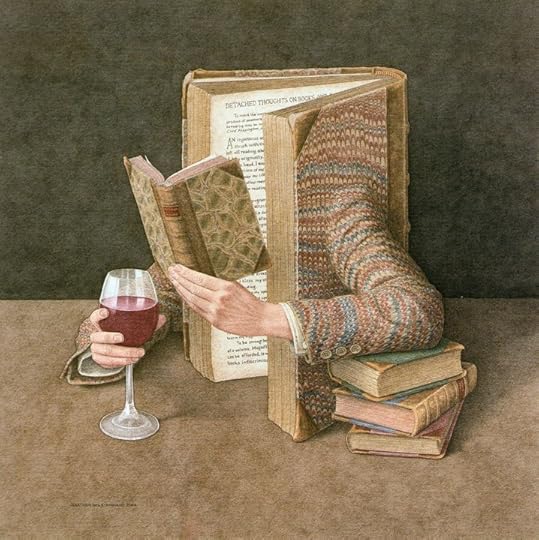
Así es el paseo al que nos invita Marías, y si todo lo dicho puede dar una impresión de pesadez, de gris y sobada trascendencia, nada más lejos de la realidad. El tono es de una elegante ligereza, de una engañosa frivolidad; el relato, repleto de ironía y humor, es una sabia mezcla de reflexión y anécdota, y en él pueden encontrarse momentos de gran comicidad como aquel en el que se describe minuciosamente y con grandes dosis de mala leche el transcurso de una “high table” o cena de gala que periódicamente organizan los colleges de Oxford.

Javier Marías se ha convertido ya en uno de esos autores que consiguen que la literatura siga siendo para mí, al igual que la vida continúa siendo para uno de sus ancianos personajes, un mundo en el que “sigo queriendo más: lo quiero todo; y lo que me hace levantarme por las mañanas sigue siendo la espera de lo que está por llegar y no se anuncia.”
Profile Image for BlackOxford.
1,095 reviews70.3k followers
September 7, 2019
The Uses of Absurdity

All Souls College is a real place. At least I think it's a real place. It might be a film set. Like most Oxford people I have never been inside it. I know it has no students, only fellows. And I know that Hillaire Belloc was refused such a fellowship, probably because of his fetishistic Catholicism. Oh, and it has a library, The Codrington, which is particularly known for is history collection. And that's it.

description

In fact, Marias's All Souls has relatively little to do with All Souls College, but with an issue contained in many of its ancient volumes. The problem of 'other minds' is a perennial flower in the philosophical garden, one of particular importance ever since that awkward Frenchman Rene Descartes threw his tuppence of fertiliser into it in the 17th century. His 'I think therefore I am' notably lacks a way to get to 'You think too, and therefore are as well.'

Philosophy has moved on from Descartes's solipsistic world, but not very far. As one of Marias's characters confides to his diary, "Life is still so medieval." We may be fairly certain that other people do think. But finding out what they think is something else. This sort of functional solipsism, virtually total uncertainty about what's actually going on in other people's heads, is what All Souls is about. It's not unlike Oxford and All Souls College really: we know it’s there but what goes on is a mystery better left alone.

This condition is fundamental to the structure of our world. From international politics to sexual politics, it dominates our lives. As Marias's unnamed protagonist sums it up: "Family resemblances notwithstanding, no man has ever known for certain that he was the father of his children. Between married couples, neither partner answers questions they don't want to answer, and so they ask each other very few." The porter at the Taylorian who lives in a different year every day, of which year no one else is entirely certain, serves as a theme for the entire book.

Other minds are mysterious, but the behaviour of others is more obvious and often just comical. Anyone who has read C. P. Snow's The Masters, or Tom Sharpe's Porterhouse Blue or even Evelyn Waugh's Brideshead Revisited knows that the manners and rituals of Oxbridge life are not just quaint remnants of outmoded tradition but also serious rules for distinguishing 'members' from others and for keeping these others permanently off-balance.

Marias's wonderful vignettes of college servants, donnish types, classes, tutorials, and dinners at high table shows another reason for the persistence of Oxford rituals: they compensate for the impenetrability of other minds by providing a definiteness to social interaction. This is why they are often so hilarious. Otherwise detestable people can be accommodated with a fluidity and ease that is probably rare even in the best of foreign embassies. Raised voices, much less fist fights rarely break out even among sworn adversaries.

There is a one word description that I think captures Marias's brilliance in coupling a philosophical problem with an essentially comedic situation: absurd. One example: The fellows of All Souls College, atheists though they may largely be, are required to attend periodic services for the repose of the eternal souls of their benefactors. Wonderfully, divinely absurd one might say. All Souls is a fiction of the absurd told with a straight face. Not a small achievement.
Profile Image for Sawsan.
1,000 reviews
June 22, 2022
رواية أوكسفورد للكاتب الأسباني خافيير مارياس عنوانها الأصلي "كل الأرواح
ذكريات وانطباعات عن المكان والشخصيات بأسلوب جميل وفكاهي
الراوي أستاذ الأدب الأسباني يحكي عن فترة إقامته في أوكسفورد لمدة سنتين
حياته الرتيبة في البيت والعمل مع روتينية وصرامة القواعد في جامعة أوكسفورد العريقة
من خلال عمله وتنقلاته وعلاقاته يتعرف على أخبار الناس ومظاهر الحياة في المدينة
شخصية الراوي فيها شيء من اللامبالاة والعبثية أحيانا وله نظرة خاصة لكل شيء ولو بسيط
حتى لسلة المهملات التي تصاحبه في عزلته المنزلية وتشهد بامتلاءها على نهاية اليوم
السرد متفاوت لكن عموما حكايات مارياس متدفقة ومختلفة
Profile Image for merixien.
671 reviews664 followers
January 16, 2023
Bu kitap üzerine daha detaylı bir yorum yazacağım aslında. Ama söylemem gereken en önemli şey, Eğer her ikisini de okumadıysanız Tüm Ruhlar'ı, Yarınki Yüzün üçlemesinden önce okuyun.

Güncelleme:

“Bir an gelip her şeyden el çekeceğini bilmek dayanılmaz bir şey, herkes için, o her şeyi oluşturan artık her neyse, bildiğimiz tek şeyi, alıştığımız tek şeyi. Ben sadece sevdiği yazarın gelecek kitabını okuyamayacağı ya da hayran olduğu aktristin gelecek filmini seyredemeyeceği, ya bir daha bira içemeyeceği ya da yeni başlayan günün çapraz bulmacasını çözemeyeceği ya da televizyonda sürüp giden diziyi izleyemeyeceği, ya da yeni başlayan sezondan şampiyonluğu hangi takımın kazanacağını bilemeyeceği için öleceğine kahırlananları anlıyorum. Gayet güzel anlıyorum. Hem yalnız her şey bundan sonra hala olabileceği, hayale bile sığmayacak haberin gelebileceği, olayların bambaşka bir mecraya sürüklenebileceği, en olağanüstü olayların keşiflerin olabileceği, dünyanın altının üstüne gelebileceği için değil. Zamanın öbür yanı, kara sırtı zamanın…”

11 Eylül 2022’deki ölümünün ardından bu satırları okumak hiç kolay olmadı. Ölüm ve zaman Marias’ın neredeyse bütün kitaplarında yer alan ve üzerine çok fazla konuştuğu temel kavramlardan ikisi elbette. Ancak Tüm Ruhlar’ın, bu eserlerin içinde bambaşka bir yeri var.

Javier Marias ülkemizde, özellikle de son yıllarda en çok okunan ve ilgi gören Avrupalı yazarların başında geliyor. Ancak Tüm Ruhlar bu ilgiden nasibini alan eserlerinden birisi değil. Halbuki kendisini İspanya sınırlarından çıkartıp uluslararası tanınır bir yazar haline getiren, hakkında çok konuşulup çok tartışılan ve hatta kendisinin de üzerine bu kadar açıklama yapma ihtiyacı duyduğu tek eseri bu kitap. Zira yayınlandığı 1989 yılından itibaren, bir otobiyografi mi yoksa tamamen kurgu mu olduğu çok fazla tartışıldı. Marias’ın okuruyla oynamayı seven yanı bu konuda da kendisini gösterdi ve “anlatıcının da Oxford’da kendisiyle aynı işi yaptığını, kendisinin yaşadığı evde yaşadığını fakat anlatıcının kendisi olmadığını” ifade ederek belirsizliği korumayı tercih etti.

Marias, bu kitabın gerçeklerle ilişkisinin boyutunu kabullenip kabullenmemek konusunda kararsız gibi görünse de bu hikayeyi anlatma ihtiyacı daha ilk sayfadan kendini ele veriyor aslında. Çünkü eğer sadık ve dikkatli bir okuruysanız fark edebileceğiniz gibi, Javier Marias’ın hemen hemen her kitabında ilk sayfa o eserin adeta şifreli bir özetidir. Genel olarak ilk cümleden konuyu size ufak bir şok yaşatarak açarken, bir yandan da hikayenin sonunun nereye gideceğini ve sizin nelerle karşılaşacağınızı çoktan anlatmıştır. Lakin siz bu şifreyi ancak son sayfayı okuduğunuzda çözebilirsiniz. Tüm Ruhlar’da ise durum biraz daha farklı. Zira ilk sayfadan anlatıcı ile kendisi arasındaki karmaşayı önünüze koyarak kitapta karşılaşacağınız olaylardan ziyade olaylarda gizli olan gerçekliğe dair bir şifre veriyor size.

Kitap İspanyol bir öğretim görevlisinin Oxford’da geçirdiği iki yılı, burada ilişkide bulunduğu insanlarla olan anılarını ve o anıların uyandırdığı düşünceleri doğrusal olmayan bir kronoloji ile, tam da bir insan geçmişi nasıl anımsarsa öyle anlatıyor. Bir açıdan Marias’ın hayranı olduğu Proust’un Kayıp Zamanın İzinde eserinden ilham aldığını hatta belki bir parça da öykündüğünü hissediyorsunuz. Zira diğer kitaplarında her daim kullandığı gizem ve merak unsuruyla okuyucuyu peşinden sürükleme tercihine Tüm Ruhlar’da rastlamıyorsunuz. Belki de kitabın ülkemizde bu kadar geri planda kalmasının sebeplerinden birisi de budur. Zira, bu sefer ne anlattığından çok, nasıl anlattığına ve hafızasında neleri yeniden keşfettiğine odaklanıyor. Diğer kitaplarından ayrılan bir başka yönü ise anlatıcının belirsizliği. Tüm Ruhlar’a kadar -hatta sonrasında da- yazdığı bütün eserlerinde anlatıcı karakterini okuyucuya oldukça detaylı tasvir ederek adeta okuyucunun gözünde cisimleşmesini sağlamışken bu sefer isim dahi vermediği, hiçbir yansıması olmayan bir ana karakterle karşımıza çıkıyor. Kitabı okurken yaşadığım en büyük şaşkınlıklardan birisinin kaynağı da buydu. Çünkü Yarınki Yüzün üçlemesini okuduysanız, Tüm Ruhlar’ı okurken ortam ve karakterler adım adım gözünüzde canlanacak ve üçlemenin öncülü olan kitabı okuduğunuzu fark edeceksiniz. Bu aydınlanma ile birlikte karakterin isimsizliği, hele de kitaplarında hiçbir detayı amaçsız eklemediğini bildiğiniz bir yazar yaptığı için daha çok ilginizi çekecektir. Zaten Marias da bir söyleşisinde, anlatıcı ile arasındaki benzerlikler bu kadar belirginken bunu bir isim ya da tasvir ile kamufle etmeyi manasız bulduğu için isimsiz bir anlatıcı tercih ettiğini açıklayarak kitabı kendi gerçekliğine biraz daha yaklaştırdı. Açıkcası kitap üzerine hiçbir şey söylememiş olsa bile, Marias’ı biraz yakından tanıyorsanız, karanlık bir dönemi hatırlama ve anlatma ihtiyacının izlerini çok kolay bir şekilde yakalayabilirsiniz. Kitaplarının temelini ister gizlemek, ister suç ortağı olmak ya da temize çıkmak, isterse de sadece anlamak için olsun, her zaman “anlatmak” üzerine kuran bir yazar olarak, bu sefer kendi “sürgün” dönemini anlatmak adına, kurguyla gerçekliği kasıtlı olarak iç içe geçirdiği bir anlatım tarzı benimsediği göze çarpıyor.

Ölüm her kitabında değindiği bir konu olsa da, Tüm Ruhlar’da ölüme ya da onun bakış açısıyla kendi rutininin dışına çıkmaya dair düşüncelerini çok daha açık ve biraz daha karamsar bir şekilde dile getiriyor. Bu karamsarlığın ve romanın kasvetli yapısının temel sebebi; her kitabında bizi sokaklarında gezdirdiği, adını anmadan geçmediği yuvasına, yani Madrid’e duyduğu aşk ve bu aşkından uzak kalıp, Oxford’da geçirdiği iki yılda yaşadığı ruhsal ve sosyal yıkım aslında. Geçmişinin, dünyanın en çok dünya olduğu çocukluk döneminin ya da kişiliğinin tanınmadığı bir yabancı olmanın yanı sıra Kıta Avrupası’ndan uzak, tarih, gelenek ve seremonilerine düşkün İngiltere yaşamının verdiği sıkışmışlığı da yoğun bir şekilde yaşıyor. Bu dönemde içinde bulunduğu ruhsal dengesizliğini belki de en iyi John Gawsworth seçimi anlatıyor. Gawsworth’e dair fotoğraflar ve anılar yalnızca kurguyla gerçek arasındaki çizgiyi muğlak bırakmakla kalmıyor. Aynı zamanda anlatıcımızın -ya da zaman zaman Marias’ın- yakaladığı bazı ufak benzerlikler ile bağ kurarak düştüğü korkuyu, İngiltere dönemindeki ruh halini ve yaşadığı kafa karışıklığını da okuruna aktarıyor.

Javier Marias’ın otobiyografi üzerine “bir kitabı kurgu olarak sunabilirsiniz ancak kurgulamak için hiçbir şey yapmamış da olabilirsiniz” minvalindeki beyanlarını ve otobiyografiyi hatırat olarak değil kurgu olarak sevdiği gerçeğini göz önüne aldığımızda, Tüm Ruhlar’ın gerçeğe ne kadar yaklaştığını belirlememiz çok zor. Hele ki isimsiz İspanyol anlatıcımız yıllar sonra Yarınki Yüzün üçlemesinde Jaime Deza’ya evrildiğinde bu kurgunun otobiyografiyle ne kadar bağı kaldığını bilmek imkansız. Yine de Tüm Ruhlar’ı okuduktan sonra, Marias’ın çoğu kitabında karşımıza çıkan Luisa ismi ve bu tekrarların müsebbibinin Oxford günlerinden kalma olduğunu düşünmeden edemiyorum. Peki bu kadar üzerine konuştuktan sonra bu kitap yazar ile tanışmak için ideal bir kitap mı diyecek olursanız, değil maalesef. Zira Tüm Ruhlar’ı sevmek Marias’ı sevmek gibi, biraz zaman ve sabır isteyen bir süreç. Eğer bir kaç kitabını okuduysanız ve kendisini erken dönem eserlerini dahi okuyacak kadar sevdiyseniz; bundan da öte belki de yıllar sonra Yarınki Yüzün’ün girişini “İnsan asla hiçbir şey anlatmamalı, bilgi de vermemeli, hikaye de aktarmamalı, hiç var olmamış, yeryüzüne ayak basmamış, dünyayı dolaşmamış ya da bu dünyadan geçmiş ama tek gözü kör kararsız unutuşa gömülerek yarı yarıya kurtulmuş varlıkları da insanlara hatırlatmamalı.” cümlesi ile yapmasına sebep olan “anlatmanın pişmanlığı”nın izlerini sürmek isterseniz bu kitabı mutlaka okuyun.

“Her şey en az bir kez anlatılmalıdır.
….zamanına göre anlatılmalıdır. Ya da aynı kapıya çıkar ki, tam zamanında anlatılmalıdır ve insan tam o anı yakalayamamışsa ya da bile isteye atlamışsa, artık bir daha dile getirilemez. O an bazen (çoğu kez) apansızın, şaşmaz biçimde ve ivedilikle ortaya çıkıverir ama bazen de ancak belli belirsiz ve aradan beş on yıl geçtikten sonra, en büyük sırlarda böyle olur.
O nedenler kimi kişiler yeniden ortaya çıkarlar.
O nedenle hep söylediklerimizden ötürü başımızı belaya sokarız. Ya da başkalarının söylediklerinden ötürü.”


Bu yazı aynı zamanda Lemur Dergi'nin Ocak 2023 sayısında yer almıştır.
Lemur Ocak'23

Profile Image for Ian "Marvin" Graye.
948 reviews2,783 followers
January 3, 2023
CRITIQUE:

A Spaniard in the Works

I suppose you could say that not a lot happens in “All Souls”, but that would only be true if you don’t count looking, thinking, loving, remembering, even being:

"Oxford is a city in syrup, where simply being is far more important than doing or even acting."

Marias uses first person narration to tell his story, and for 210 pages I was firmly ensconced in the mind of this ostensibly charming man and lover, referred to (only once) as "the Spaniard".

The closest analogies I can think of are Virginia Woolf’s "Mrs Dalloway" and Graham Greene's "The End of the Affair", although at one point I wondered about parallels with the works of Italo Calvino.

This novel deserves a place high in this class of literature.

Stream of Consciencelessness

It has almost become a cliché to refer to “stream of consciousness” in literary criticism, as if it is one easily identifiable practice. However, there is not one stream, but many, and they can be of different shapes and sizes.

If "Mrs Dalloway" was a river that flowed inexorably from planning to party over the course of 24 hours, "All Souls" moves with the same intent, but covers a longer timespan. It is a recollection of what happens at an emotional level during a two year period while the narrator teaches translation in "that inhospitable city", Oxford.

The adulterous affair failed to eventuate during the interval of "Mrs Dalloway". However, it supplies the framework for "All Souls", although it is by no means the sole focus of the novel.

Just as Woolf didn’t seem to make any moral judgement of Clarissa, Marias doesn’t condemn the Spaniard or the object of his illicit desire, Clare (note the likeness of the first names of the protagonists).

His version of stream of consciousness is less a stream of conscience than a stream of consciencelessness.

We are hot wired into the narrator's libido via the thought processing of his ego, almost in circumvention of his superego.

If You Don't Get Caught, Then Steal It All

While the affair is adulterous, only Clare Bayes breaks her marriage vows. The Spaniard is single at the time.

Marias uses the word "usufruct" to describe the relationship. This is a term of Roman law that describes the distinction between ownership and use of (or benefit from) property.

To the extent that a wife can be considered the property of a husband (which is an unfortunate condition of the metaphor), it suggests the possibility that the husband might "own" the tree that is the wife, but another man (or woman) might enjoy the fruit of the tree.

The conjugal rights of the husband are compromised by the fructal rights of the rival suitor.

This metaphor describes the relationship between the Spaniard and Clare’s husband. However, ultimately it is almost irrelevant to the principal concerns of the novel.

What matters is the internal honesty and sincerity of the relationship between the two lovers.

Somebody to Love

Clare needs the Spaniard as much as he needs her.

The Spaniard is looking for someone to love while he’s in Oxford:

"This is just a stopping-off point for me but I’ll be stopping long enough to make it worth my while finding what people call 'someone to love'."

Clare is looking for something more than what she has already via her marriage. There is never any suggestion that she will leave her husband or her son. The Spaniard must take Clare as she comes.

Thus, it is inevitable that their relationship will be defined by the period our European traveller is stationed at All Souls College.

In Clare’s eyes, the Spaniard would be a fool, if he didn’t accept his function and simply enjoy the relationship within its geographical and temporal constraints.

"All Souls" could almost be "Mrs Dalloway", reconceived from a male point of view, but with Clarissa/Clare in control.

Doing a Post-Modern Dance

The novel uses a stream of consciousness technique to some extent. However, in reality, every sentence is perfectly composed, which makes for a fast, enjoyable reading experience.

Nevertheless, Marias does play with both time and space.

There is no linear narrative. It jumps all over the place. Insofar as its focus is Clare, it follows the eye, as if Marias had taken a photograph or painted a picture of her, and his description was simply following his eye as it moved around the image.

Furtive Eavesdropping by and on the Narrator

In this respect, the mechanism of the novel depends on the narrator’s look, his view, his gaze, and what this reveals about his desire.

Marias doesn't shy away from the indiscreet, the secret, the furtive. It is all revealed.

Because the novel is a first person narrative, there is a lot of thinking (albeit relatively little "action"). Thus, one of its concerns is the relationship between thinking, looking and desire:

"[Apart from Clare herself], the more I desire women the less prepared I am to think about them, I desire them without thinking about them at all...and I don’t know if that’s indicative of anything…apart from my general state of disequilibrium."

Dislocation Dance

The novel is to some extent a fish out of water story. The Spaniard is outside his comfort zone:

"Having always been in the world (having spent my life in the world), I suddenly found myself outside it, as if I’d been transplanted into another element..."

Whereas at home he was a local, now he is a foreigner, an alien. He is an unknown quantity. He can’t be trusted and he can’t trust anybody else. Without witnesses (i.e., someone who has looked at him, observed, witnessed and authenticated him), he can have no provenance:

"I’m a foreigner about whom no one knows or cares…That’s what really troubles me, leaving the world behind and having no previous existence in this world, there being no witness here to my continuity, to the fact that I haven’t always swum in this water."

What is required to "fit in", to be "like" everybody else? Marias draws an analogy with Marco Polo staying in China for long enough to effectively become a "blue-eyed Chinaman".

Paradoxically, it’s this geographical dislocation that allows the Spaniard to be liberated from his past and from future expectations in a temporal and moral sense.

Temporal Vertigo

The Spaniard’s time in Oxford is always defined. He has only two years before he has to leave. He knows this, as does Clare. Yet it is Clare who liberates him from the constraints of time, by virtue of her carefree approach to temporal demands.

I love Marias’ description of her just lying around casually, languidly in bed:

"She would lie on my bed or her bed or on a hotel bed and smoke and talk for hours, always with her skirt still on, but pulled up to reveal her thighs, the dark upper part of her tights or just her bare skin.

"She was not circumspect in her gestures, often scorching them with the cigarette she waved around with an abandon uncommon in England (and learned perhaps in the southern lands of her childhood), a gesture accompanied by the tinkling of various bracelets adorning her forearms, bracelets she sometimes neglected to take off (it was little wonder that sometimes real sparks flew from them).

"Everything about her was expansive, excessive, excitable; she was one of those beings not made for time, for whom the very notion of time and its passing is a grievance, and one of those beings in need of a constant supply of fragments of eternity or, to put it another way, of a bottomless well of detail with which to fill time to the brim."


What could compose and relax a man more than to be propped up on a pillow next to this woman?

An Erotic Corollary to Parkinson's Law

Still, what Clare seems to do is to disregard time, so much so that she seems to expand to fill the time available.

While she is alive, time is of no concern, there is only her and what she is doing in that time.

Her response to the demands of time is to be “careless and frivolous and smiling and forgetful..."

In her arms, time and pleasure perpetuates into infinity and eternity:

"That night we were free to eternalize the contents of our time, or enjoy the illusion that we did so, and that’s why there was no hurry..."

Verbal Invention

When we first meet the Spaniard, he is flirtatious and playful and inventive, almost Nabokovian, in the way he fabricates meanings for words that don’t exist or that deserve a better meaning:

"My crazy etymologies were no more nonsensical, no less likely than the real ones...when true knowledge proves irrelevant, one is free to invent."

So, his Spanish background having become irrelevant, he is free to improvise.

This improvisation, of course, is in the nature of sexual flirtation as well.

Glimpses and Snippets and Skirts

This is when Marias’ prose becomes most enjoyable and lyrical and assonant (note the tinkles and winkles and glimpses and snippets and skirts), and most of it is directed at what the Spaniard sees and hears:

"The consequent tinkle of fine crystal."

"The whole of Oxford is fully and continuously engaged in concealing and suppressing itself whilst at the same time trying to winkle out as much information as possible about other people..."

"The tinkling of various bracelets."

"Just the glimpse of bracelet"

"Snippets of her comments"

"I was too intent on observing the wary flappings of her skirt."

Then there's his more overtly erotic observations:

"Clare’s breasts combine their two colours very subtly, like the transition from apricot to hazel."

The Spaniards eyes and ears take it all in. He processes what he sees and eroticises the "contents of our time" together. He assembles "fragments of eternity" in his mind.

Then, by virtue of turning them into literature, like Proust and Nabokov, Marias "eternalises" them for our consumption and enjoyment.

The Tale of a Blind Man Without a Seeing Eye Cock

Like most men, the Spaniard is driven by his libido, a joint venture between his eyes, his mind, his mouth, his ears and his penis.

According to his own account, his eyes are vigilant and compassionate. What he sees, he thinks about. Some of what he thinks about, he talks about. Some of what he thinks and talks about, he desires. Unless he sees, unless he thinks, unless he talks, he cannot desire:

"I can’t let myself have all this time at my disposal and not have someone to think about, because if I do that, if I think only about things rather than about another person, if I fail to live out my sojourn and my life here in conflict with another being or in expectation or anticipation of that, I’ll end up thinking about nothing, as bored by my surroundings as by any thoughts that might arise in me."

At the heart of his desire is his vision, his sight, looking, watching, observing, witnessing, gazing.

You can see the influence of Continental Philosophy on Marias’ fiction. However, he also brings a [vulgar male] sense of humor to the novel:

"When I go to bed with Clare [I miss] that my cock has no eye, no vision, no gaze that can see as it approaches or enters her vagina."

High Table Fidelity and Thoughtless Infidelity

Two libidos are at work here, and in view of Clare’s marital status, it involves an infidelity.

Marias discusses infidelity in two contexts, one general and definitional, the other personal to the three people involved.

Of fidelity and infidelity, Marias says:

"Fidelity (the name given to the constancy and exclusivity with which one particular sex organ penetrates or is penetrated by another particular sex organ, or abstains from being penetrated by or penetrating others) is mainly the product of habit, as is its so-called opposite, infidelity (the name given to inconstancy and change, and the enjoyment of more than one sex organ.)"

This discussion is almost wholly genital and masculine in orientation (for all its attempt to be reciprocal in terms of penetrating or being penetrated, I wonder how women relate to this genital analysis?).

Only a Fool Would Say That

On the other hand, Marias presents the relationship between the Spaniard and Clare (from her point of view) in terms of the relative ability of the two males in her life to deal with real physical and emotional demands, regardless of intellectual and moral considerations:

"You’re a fool. Fortunately, though, you’re not my husband. You’re a fool with the mind of a detective, and being married to that kind of fool would make life impossible.

"That’s why you will never get married. A fool with the mind of a detective is an intelligent fool, a logical fool, the worst kind, because men’s logic, far from compensating for their foolishness, only duplicates it, triplicates it, makes it dangerous.

"Ted’s brand of foolishness isn’t dangerous and that’s why I can live with him. He just takes it for granted, you don’t yet. You’re such a fool that you still believe in the possibility of not being one. You still struggle. He doesn’t."


Perhaps our ability to think, to reason, to intellectualise, particularly in the academic context of Oxford, blinds us to the reality that, as Clare continues, "we are all fools".

Save What You Can

So it is that Clare, who has the greatest ability of the protagonists to deal with the relative vagaries of space and time, is able to dictate (it must be wrong to say "rationalise"?) the basis upon which she deals with the men in her life.

While the narrator is a male, this is very much a tale where the female is in control.

However, given that the novel was written by a male, there must be a lingering question as to whether Clare is just a figment of a libidinous male’s imagination.

I can only say that, as a male, I found the novel thoughtful, intelligent, insightful, eloquent, poignant, playful, erotic and funny.


SOUNDTRACK:


The Triffids – "Save What You Can"

http://www.youtube.com/watch?v=jFzGF-...

"Time is against us, even love conspires to disgrace us
And with things being what they are ...
Yes and things being what they are

Oh my friend, we used to walk in the flames
Now somebody's taken my arms
The shadows are taller. You're missing your halo
With your face in the half-light, you look like a stranger

You made me catch my breath just then
You made me catch my breath
Is that you... is that still you?

If you cannot run, then crawl
If you can leave, then leave it all
If you don't get caught, then steal it all
Steal it all

The final time we touch
I watch as you enter the church
You turn and you wave, then you kneel and you pray
And you save of yourself what you can save

If you cannot run, then crawl
If you can leave, then leave it all
If you don't get caught, then steal it all
Steal it all

And between ourselves, and the end at hand,
Save what you can"


David McComb: "I Want To Conquer You"

http://www.youtube.com/watch?v=SoxGK_...

"We have so little time
And we have so many pains,
These days it's frightening
My dear how swiftly love wanes."


Angie Hart: "I Want To Conquer You"

http://www.youtube.com/watch?v=F5YQik...

The Triffids – "A Trick Of The Light"

http://www.youtube.com/watch?v=XgtRBL...

David McComb – "Setting You Free"

http://www.youtube.com/watch?v=00QCFF...

The Blackeyed Susans – "Ocean Of You"

http://www.youtube.com/watch?v=5L2PZT...

The Blackeyed Susans – "Every Gentle Soul" (from the album "All Souls Alive")

http://www.youtube.com/watch?v=MyZtTH...

"Every gentle soul that passes me by
I have to close my eyes
And hope their gentle smile survives
Hope that their footsteps don't follow mine
There ought to be a law
There should be a place
That they can send you to
To take my mind off your face."


The Triffids - "The Seabirds"

http://www.youtube.com/watch?v=pOWUci...

The Mutton Birds – "Anchor Me"

http://www.youtube.com/watch?v=kPIhhq...

Jefferson Airplane - "Somebody to Love" (Live 1969, with David Crosby)

http://www.youtube.com/watch?v=jUxRgU...

Simple Minds – "Theme For Great Cities"

http://www.youtube.com/watch?v=NBSotx...
Profile Image for Ana Cristina Lee.
765 reviews401 followers
October 21, 2021
Javier Marías es Javier Marías es Javier Marías es… Si te gusta su estilo, con interminables frases que no dejan cabos sueltos, que detallan hasta el más mínimo pensamiento con un estilo elegante y un uso de la lengua impecable, también te gustará este recuento de su experiencia como profesor en la Universidad de Oxford, aunque si su escritura te marea y te agobia – que puede ser – más vale que lo dejes correr.

Tengo que confesar que a mí me encanta y me dejo llevar por sus frases circulares y sus personajes recurrentes, que me hacen caer en una especie de estado hipnótico – Marías siempre igual a sí mismo pero siempre diferente.

Esta obra es particularmente agradable, quizá una buena puerta de entrada al mundo Marías, ya que es bastante breve y está llena de humor en su retrato de la vida académica de la peculiar ciudad de Oxford y sus no menos peculiares ‘dons’ o profesores, con sus togas ondeando al viento entre manadas de turistas ansiosos.

La vida en el templo del conocimiento, el cual no siempre está en manos respetuosas o sagradas, sino en poder de individuos dominados por pasiones mediocres:

A veces el saber verdadero resulta indiferente, y entonces puede inventarse.

Lo único que interesa de verdad en la ciudad de Oxford es el dinero, seguido a cierta distancia por la información, que siempre puede ser un medio de obtener dinero.

La tradición de Oxford como vivero de espías ilustrados es otro de los filones inagotables del autor, la duplicidad de las personas y la información/saber como arma. Es magnífico el retrato del viejo profesor aburrido cuyo mayor disfrute son las llamadas del MI5 para que entreviste a desertores rusos. El oxoniano es un espionaje funcionarial, de despacho polvoriento, rutinario, pero no exento de emoción en comparación con la aburridísima vida académica.

Pero es este mismo conocimiento, el ansia de saber, lo que guía los paseos ociosos del autor por una ciudad que no le es propia y donde las librerías de viejo son su refugio:

Las librerías de viejo, para el que tenga gusto por ellas, son el paraíso polvoriento y recóndito de Inglaterra, frecuentado además por los caballeros más distinguidos del reino.

En conjunto, una novela magnífica, redonda como el Reino de Redonda, cuya historia y la de su rey ocupan unas cuantas páginas.
Profile Image for Jola.
184 reviews442 followers
February 25, 2023
It will probably remain an unsolved mystery how come a brilliant, witty and besotting book which tickled me pink suddenly pivoted into murky waters of the narrator's exhausting self-analysis and soaked in a kind of limbo. Unfortunately, this is exactly what happened while I was reading All Souls (1989) by Javier Marías.

The novel is an account of a young Spanish lecturer's two-year stay in Oxford, the static city preserved in syrup. Coincidentally, last September I read English Hours , a memoir by Ferran Soldevila, a Catalan historian who worked as a Spanish language assistant at the University of Liverpool from 1926 until 1928, so I have already seen a British university through the eyes of a visiting professor from the Iberian Peninsula. Both narrators are observant, curious and have a sense of humour. Ferran Soldevila is much more interested in the surroundings while Marías's protagonist tends to be submerged in himself.

All Souls felt like a coruscating parody of a campus novel with satirical, hilarious portrayal of Oxford university’s pompousness and pretence, especially the eccentric scholars, and depiction of the narrator’s sentimental and sex education. My first reaction was pure awe and temptation to highlight almost everything in this novel. I especially loved the anecdotes regarding teaching and unforgettable fragments on obsessive book collecting which I could definitely relate to. Then out of the blue, the charm fizzled out.

I am afraid portraying female characters is not Javier Marías's forte. The cringeworthy description of the girls the narrator calls fat tarts is an example. I wish he was able to see more in women than their alluring décollettages. The thing that bothers me most though is the coldness of this book. It was a struggle to connect and engage. Despite themes like love and death, my emotional investment was scarce. Quite ironically, sometimes I found All Souls soulless.

Javier Marías's style is impeccable. No doubt he is an impressive virtuoso. Oddly, I cannot shake the feeling that he marvelled at his own prose while writing and that his exquisite style is the actual protagonist of All Souls, not necessarily the narrator. In the second half of the novel, I had the impression the monologue could go on and on and on effortlessly for hours and hundreds of pages, not caring too much if the readers are awake or still there. I had exactly the same feeling while reading Nabokov’s books. By the way, he is the narrator’s idol and the novel's premise made me think of Pnin .

It felt so eerie to read the passages on death five months after the author had passed away: I can understand someone who regrets dying simply because they won't be able to read their favourite author's next book, or see a new film starring an actress they admire, or drink another glass of beer, or do today's crossword, or continue to follow a particular television series, or because they won't know who won this year's FA Cup. I regret we will never know what Javier Marías's next book would have been like.

PS
Huge thanks to Maryana whose compelling and insightful review made me reach for this novel in a flash.


Artwork by Jonathan Wolstenholme.
Profile Image for Matthew Ted.
1,007 reviews1,035 followers
December 7, 2022
131st book of 2022. Artist for this review is English painter J.M.W. Turner (1775-1851)*.

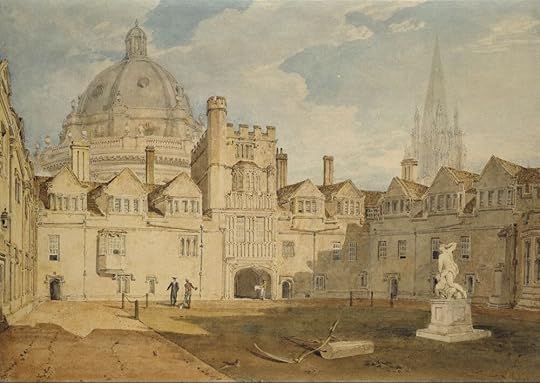
description
"High Street, Oxford" — 1810

I’m an absolute sucker for campus novels and a sucker for Oxford/Cambridge novels, so here we are with Marías's Oxford novel, All Souls. It’s a strange and oddly wonderful little book; it is almost entirely plotless (there’s a vague plot of an affair with the narrator and a woman named Clare), but otherwise the book has a smattering of things. At once it is an ode to Oxford and academia. The narrator is a Spaniard from Madrid as a visiting professor. There are ruminations on the English, their mannerisms, their habits (interesting, sometimes humorous to read as an Englishman, example: ‘As is well known, the English never look openly at anything, or they look in such a veiled, indifferent way that one can never be sure that someone is actually looking at what they appear to be looking at, such is their ability to lend an opaque glaze to the most ordinary of glances.’**) There are long digressions about numerous topics, one is an ode to English bookshops, another to homelessness, another to the English writer John Gawsworth. The narrator at one point discusses the rubbish bins and being abroad. Marías's prose is careful, intellectually compelling, sometimes light, sometimes dense. At times I wondered why Marías had chosen to write the long digressions he had written but the novel felt personal, and because of that, very humane, so I was unbothered by the relevance or the distraction from the ‘plot’, and instead enjoyed his rambling descriptions of bookshops, Oxford cobbles, and the English professors at the university around him. Not a novel I would jump to recommend to someone, but a quiet, meditative, slightly peculiar read that tickled the academic-lover in me.

description
"A View from the Inside of Brazen Nose College Quadrangle, Oxford" — 1803
_________________

*I miss the opportunity of looking at my favourite art pieces and artists when writing reviews, so it's likely I'll begin putting them in my reviews again when one comes to mind. I revel in the chance to connect the books I read to art I like. Who doesn't want to spend a moment looking at Turner?

**When my Canadian companion from here on Goodreads, Alan, came to England with one of his friends we actually joked about this very stereotype as we wandered through the Underground on our way to Soho. He made the observation that the English don’t seem to ever look you in the eye, and I joked that I had yet to look at them or know what they looked like. And indeed it was true, their eye-contact was far more assertive than my own, non-existent, apparently, English eye-contact.
Profile Image for Jonfaith.
2,145 reviews1,745 followers
October 7, 2022
Periodically I am asked if I've been to Oxford. I glibly reply, yes, I've been to both. Perhaps my first sentence is an overstatement, but i have offered my response a few times in my life and mean it. I don't consider Square Books and Rowan Oak to be tantamount to the learned city on the Isles, but the southern locale is a cultural hub. My wife and i last went to Oxford, on the Thames, a few winters ago. It was a delightful cold and wet day. Our minds were occupied with Inspector Lewis and second-hand books rather than discerning the vapor trails of Senor Marias.

I loved All Souls for its discretion. It struggles to find a pragmatic middle path in life. That said it didn't lose itself in serpentine digressions. Perhaps here, I am looking at you Your Face Tomorrow: Fever and Spear / Dance and Dream / Poison, Shadow, and Farewell

It was intriguing to note the number of observations in All Souls which resurface in YFT: the thesis on cider tax and the booksellers' distinction of Richard Francis Burton (Captain Burton for those inclined) were but a few. Alas, contrary to the novel, we didn't discover any intrigue, only wonderful Lebanese food and a knapsack stuffed w/ books from the tented stalls.
Profile Image for Nick Grammos.
277 reviews155 followers
October 30, 2024

All Souls is the third book I’ve read this year by Spanish author Javier Marias. It was written earlier than Tomorrow in the Battle… and Heart so White. He uses a characteristic style full of deeply probing sentences that search for whatever illustrative truth or impression or conclusion they can find in the lonely isolating world of the individual consciousness. That’s what I like about his work, he reminds that each mind is its own but always seeking out, or sought out by the wider world, always wanting, always interpreting those interactions, but always working it out alone. Or not working out anything. Because ultimately, we can hardly know anything. The loneliness of each consciousness becomes the theme of an isolated Spanish scholar translator on a two-year arrangement to teach at Oxford.

The theme of distance repeats in Marias novels. Solitude is the distance from the circumstance of those around him. This distance structures the interactions at high table of the visiting scholars first Oxford College dinner, a multi-course affair of long held traditions, the rituals are absurd as they are alienating. There, our narrator encounters for the first time, the woman opposite who will become his lover, the wife of a don, they engage in a distant exchange of lustful glances unable to speak because of the ritualised order of conversation demanded. At the same time, the local nobility on campus sets in motion the timing of each course. He has a gavel he bangs on the table to usher in the interminable courses with accompanying wine. Yet this local lord with the gavel is also lustfully observing the same wife of the don near him. As he gets more and more concupiscent, his gavel bangs on the table wantonly, ushering in waiters to clear half eaten courses, serving wine on wine, piling up more and more chaos until the hall is either mad with drink or hypoglycaemic from hunger. This long, drawn out chapter is interesting in another way, it gives us the outsider view of a very English scene, but also satirises the campus type novel. It’s tone is somewhere between JP Donleavy and Kingsley Amis. Marias’ skill in capturing the moment makes it feel seamlessly English, as though there is no translation issues.

Perhaps at this point, I should issue a warning that the following theory may be absurd.
I sometimes thought during this novel whether Marias and his translator have played a trick on us. I wondered if the novel was in fact written in English and translated into Spanish, not the other way around. The writing is so well done in its idiomatic, rhythmic, syntactic style that it seems to me flawlessly rendered. Or never rendered at all. Perhaps one day, somewhere in the correspondence between editor and author and translator, the great joke will be revealed.

Perhaps there’s more reasons to think this in the text. The narrator is a Spanish translator. Language is his study, there are regular educational injections about words, their usage and origins. Language is never seen as pure, complete, unadulterated, singular. Language choices alter meaning. Words themselves are unreliable, especially in English which carries vast level of nuanced meaning in so many of its words. Narrators and authors are unreliable, too when they translate the world from their perceptions to narrative. They only work in this unreliable medium. We are always confused by words and discussions; impose our own meaning on what people say; we never quite get to where we want to be. Our consciousness is not someone else’s, so misunderstandings never end. One long chapter concerns one of the narrator’s translating peers, Dewar, who is expert in Spanish and Portuguese, but also Russian which puts him in the employ of MI5 interviewing Russian artists who seek asylum. There is always a question mark when there is one translator at work. Can the information fed back to MI5 be verified, and if not is there an individualistic whimsicality or inconsistency to it that cannot be proven? Yet, no asylum seeker can enter the community without Dewar’s approval. The individual consciousness theme reemerges in a new form, the narrator cannot know everything, MI5 cannot know everything, the final version is just a version of what is possible. Simultaneous translation (I learned from my cousin who once worked in the European Commission) has methods to deal with this problem. Use two translators. But here, Marias suggests that the idea of a second translator/observer might cause further disruption to the narrative. A fun little thought. External verification is bad for art. There is only one prime mover at work on the narrative. So why not trick the reader into thinking the latest Marias is not translated by Margaret Jull Costa? After all, the very mechanisms of identifying the truth of a Russian dissident is the same set of skills applied to literature and language study, subtle uses of words, meaning, idiom, the texture of sentences, the style of speech, the consistency of character illuminated through words, always words. I enjoyed that speculation, which also came to my mind when I read A Heart so White recently.

Our narrator observes people everywhere from a distance. A woman at the station, a man follows him around the bookshops of Oxford with his 3-legged dog, he watches the gypsy flower seller, he chases copies of books by forgotten English writers of horror stories, there is a second don suspected of being M15, he befriends him, the don finally tells him his story, but is it true, can it be verified? He tries to have it verified only to eavesdrop into another don’s conversation with a likely gay lover, listening in from the front door. He watches the ritualised behaviours of country yokels and local girls at the disco, he bumps into his lover, her son and the boy’s grandfather in the Ashmolean, he shadows their movements all day. Loneliness and sitting outside a society and its structures leads to painful behaviours. Our narrator studies his garbage for weeks when he has little to do, no friends, his lover is nursing her son returned from boarding school. A single man and his garbage bin, an eternal cycle of social despair, translating garbage into meaning, like sifting through an entire language for the right words to fit the narrative.

NOTE: Marias loves to quote English literary classics in his works. The first two I read use Shakespeare's Macbeth and Richard III extensively. This one is less so, unless I missed something. Perhaps a Grand Tour in reverse? But Lawrence Stern's Sentimental Journey (through France and Italy) makes an appearance. A work Marias translated into Spanish. I know my theory that he writes in English not Spanish is far fetched. But you never know, do you?

NOTE 2: Today I picked up a copy of Marias' Dark Back of Time. It's a conversation it seems about the nature of fiction in all things like history and memoir. It starts with a discussion of this book, All Souls.
Profile Image for Vesna.
239 reviews169 followers
October 3, 2022
I meant to read Javier Marías for years by now and it's terrible that it took his sudden and shocking death to finally do it. As I was suspecting all along, he is indeed my kind of writer who can pull off the novel without a clear plot or textbook character development, who mixes meditative vignettes with the engaging "story" (not in a standard sense), who can be both serious and melancholic as well as charming and hilarious, who knows to seamlessly weave the story with slippery and meandering lines between truth and fiction, life and death, memories and delusions, knowing 'others' and oneself, ... the mysteries of life. He is original through and through.

All Souls was his own favorite work which I learned from a GR friend Kalliope who kindly watched and related it to me from his interview for Spanish TV. A long and exciting reading journey with this great Spanish writer of our times is ahead of me and for that I am thankful, Señor Marías. RIP.
Profile Image for W.D. Clarke.
Author 3 books350 followers
November 10, 2022
A first JM read for me (thanks to Kris Rabberman for kindly suggesting a starting place!), and I fell instantly in love with his sentences, his indirection, his meanders.

I won't say too much, as to describe this one really would be to spoil it, as though hardly anything happens, the way it doesn't happen unfolds in just the most delightful way possible, in that way that makes something happen in you.

So, instead I will make one claim, and then leave you with two evidentiary, epitomic quotations (if you like them at all, you will love this novel).

One Claim:
Just as Joyce's A Portrait of the Artist as a Young Man forever closes-off the hell-fire Roman Catholic sermon for all future writers in every human settlement the galaxy over, early on in this novel, Marias fully-completely puts paid to any other novelist's burnin' yearnin' to portray an Oxford High Table dinner in all its pomposity/spleandour/mendacity/ flirtatiousness/triviality/hilarity. Finis, done. Fuggedaboudit.

Two Exemplary Quotations:
1. And I enjoyed the great consolation (or perhaps even the immense pleasure) of proposing the impossible and knowing that it would be rejected: for it is precisely the recognition that it is impossible and the certainty of rejection - a rejection that the person who proposes the impossible and takes the floor first in fact expects - that allows one to hold nothing back, to be vehement and more confident in expressing one's desires than if there were the slightest risk of their being satisfied.

2. ... and I was surprised to find myself daring to say (much too early in the conversation) things I hadn't even foreseen myself saying or was even sure I wanted to say, either at the beginning or perhaps even at the end (the word "together", the word "son", the word "stepson"), but I thought, too, that my last sentences, including the very last, had been acceptable within the narrow range of possible varieties of behaviour in non-blood relationships. Now it was Clare's turn to be surprised, at least a little, although, inevitably, her surprise was only a pretence. But her pretence took the form of not being surprised, which is one way of handing back the surprise (or its pretence) to the other side.
I have since bought four more books of JM's already. If ever you find yourself that way inclined, do seek out the handsome Penguin Modern Classics Editions. They just feel right somehow.
Profile Image for Daniel Shindler.
319 reviews206 followers
February 1, 2024
“ All Souls” is the second novel I have read by Javier Marias.“ A Heart So White “ was my first experience with the author. That book was filled with intrigue and innuendo. In “All Souls,” Marias continues to enchant and tantalize. At its core, the novel is a “ ghost story” that recounts the unnamed narrator’s life at Oxford refracted through the passage of years.The permutations of time slither through the narrator’s remembrances of his academic and personal relationships, creating a spectral aura that has the reader constantly evaluating information.

Plot is not a predominant feature of the novel. The expository thread is a series of connected vignettes and musings doled out by the narrator as he ruminates on his long ago two year professorship as a Spanish scholar and translator.He is a cultural outsider in this environment. His academic training enables him to observe and evaluate contextual clues that help him to adapt to his unfamiliar milieu.Oxford, filled with departmental infighting and obfuscation, is a fertile ground for the narrator to apply his unique skills. Observational acumen and tongue in cheek wit accompany him as he seeks to decode Oxford’s academic and personal secrets.

Marias’ prose advances the narrative thread, then retreats backward, and sometimes moves sideways. Many of the narrator’s colleagues are deceased as he looks backward, tinging the reminiscences with a wraithlike aura at times.The tale becomes circular, swirling with insinuation and inference. The passage of time and the ability to both keep and decipher secrets become thematic threads running throughout the novel.

Marias has created a novel that is dominated by feeling more so than by linear logic. The reader gets caught up in the author’s unique prose that alternates between elegant tones and subtly veiled humor. Having completed the novel, the reader is tempted to ask: “ What just happened?” For me, the joy of this novel is in the attempt to answer that question long after the book has been closed.
Profile Image for Ben Winch.
Author 4 books418 followers
April 23, 2022
Strangely, I'm not exactly sure what I thought of this one. I mean, I liked it. I didn't love it though, except in places: the opening (the ancient porter who, memory ravaged, imagines himself in a different decade every morning); the hilarious 'High Table' dinner scene (in which I could almost imagine a half a boiled egg shooting from the throats of one of the Dons and lodging itself in the prominent cleavage of Claire Bayes (which I couldn't help reading as Claire Danes)); even, perhaps, the ending (kind of satisfying, kind of magical, kind of circular, feeding back into the body of the book and casting much of it in a new light). And Marias's use of language is, at times, flat out brilliant. But at times, and despite that he didn't come across (like so many 'virtuosic' writers) as a megalomaniac, I got the feeling he was skating on thin ice – a little too close to the precipice of self-caricature or just plain lack of inspiration, playing for time too transparently as he tried to conjure the next of his clause- and parenthesis-glutted sentences. An example:

I saw the child Eric, Claire's son, only once and that was when the days of his unexpected stay in Oxford were coming to an end and my emotional instability was at its height (for if you have already been deprived of something for some time or – its real duration being of little importance – have experienced it as having gone on for a long time, as perhaps being endless, the fact that an end to it is now in sight pales into insignificance beside the continuing fact of your deprivation; I mean that the mere juxtaposition of these two things is not in itself enough for you to perceive as being at an end something which, though about to end, is still not over, and what prevails is the fear that by some ill luck – by some misfortune, the opposite of what you have foreseen – that long-accumulated, patient present might yet go on forever: you experience not relief but anxiety and feel only distrust for the future.)


Now I don't know about you, but I feel as if I'd pretty much grasped what he was saying by halfway through that sentence, and that everything after 'I mean that the mere juxtaposition...' was just flash and fizzle, more about maintaining the elaborate rhythm than transmitting any meaning or illumination. To me that sentence sums up the best and worst of Javier Marias. Perhaps because I haven't read a bunch of other sentences like it recently, looking at it now I have to admit it frustrates me less than when I originally read it (and I let the book sit before writing this review for just that reason, to see if it would settle and become more satisfying, less frustrating, in retrospect). And of course there's the chance that Margaret Jull Costa's otherwise excellent translation has struggled here: that phrase 'the juxtaposition of these two things is not in itself enough for you to perceive as being at an end' is almost like some tongue-twister out of a scientific journal or owner's manual, and may well have been hell to transpose. But still, by halfway through All Souls I did start to wonder how much of this was just playing for time. By comparison, fellow Spaniard Javier Cercas uses a similar prose style in The Soldiers of Salamis, but his serpentine sentences, though at times maybe less proficiently rendered than Marias's, often left me with with a feeling I'd been kicked or struck with a whip – or bitten, to continue the serpent analogy. I winced. I gasped. He seemed to really be saying something. Now maybe it's just that my and Marias's temperaments don't knit so well, or maybe it's that I need to read more of him to put into a broader context this thin slice of his oeuvre, but for now the jury's out. I can't in all conscience say I love him like Cercas or Bolano, even though Marias may well have pioneered the style that the other two use so successfully. To be fair, I've had this sense that Marias might not be 'my people' from the first time I noticed him back in the nineties – when A Heart So White propelled him to fame. Why not? Try this:

'I have my cock in her mouth,' I thought at a certain point... 'I have my cock in her mouth or rather she has her mouth round my cock, since it is her mouth that sought it out. I have my cock in her mouth,' I thought, 'and it isn't like other times, all those other times in recent months. As I noticed the first time I kissed her, Muriel's mouth is absorbent but not as spacious or liquid as Claire's mouth. It lacks saliva and space. She has nice lips but they're a bit thin and immobile or, rather, not immobile exactly (for they're not, I'm aware of them moving) but lacking in flexibility, rigid... While I have my cock in her mouth I can see her breasts, they are large and white with very dark nipples... her breasts are soft, like new Plasticine... I used to play with Plasticine a lot... It's incomprehensible to me that I should have my cock in her mouth...'

And so on and so forth. It's a one-night stand he's describing, granted. Probably it was never going to be scintillating. But why linger on it for so long? To me, it's just more playing for time. Add that to the long essayistic paragraph which accompanies it – 'When, over a period of time, one has become used to one mouth, other mouths seem incongruous, and present one with all kinds of difficulties,' etc, etc – and I guess I have to wonder if Marias is just some kind of a boffin. Zero punk rock in that passage, that's for damn sure, which I'm aware must sound like a pretty unintelligent criticism. But maybe it goes some way to explaining why he and I may never quite gel. A high three.
Profile Image for Maryana.
69 reviews241 followers
January 26, 2023
A ghost story about a literary detective obsessed with collecting books and souls. The nameless narrator is a Spanish visiting professor at Oxford college (which is a real place, I think?). But all this academia life is so overrated: in the narrator’s opinion, it equates to pretending and showing oneself busy with preparing and giving lectures, walking through corridors wearing a black cape and looking intelligent. There is time on his hands, so why not give in to his passion of hunting literary gems, have an affair with a married woman, so there is someone to think about, and maybe engage in some intellectual conversations with his highly respected college mates?

Javier Marías doesn’t disappoint, there are philosophical reflections on life, death, memory and time, amusing digressions, witty dialogues, intriguing intertextuality and comic almodovaresque scenes. Marías’ effortless prose creates this addictive feeling of living inside the narrator’s head. Real and fictional characters - all souls - are amazingly interwoven.

I’m manufacturing and storing up future memories in order to create a little variety for myself in my old age.

Marías is so generous with absurdity here, because when true knowledge proves irrelevant, one is free to invent. There is a certain college dinner scene, where the characters have to respect a serious academic etiquette with wigs and black capes, which ends up in a hilarious farce. And it is precisely here that our narrator gains a life-changing insight. Who needs dark academia, when there is Marías academia?

That feeling of temporary vertigo or of time annihilated that is provoked by holding in one’s hands objects that still speak in muffled tones of their past.

The narrator’s obsession with rare books and elusive authors reminded me of the Critics trying to find information about an enigmatic writer in Roberto Bolaño’s 2666. Furthermore, having recently traveled through space and time with W. G. Sebald’s The Emigrants, this novel felt like a mix of Sebald and Bolaño with unmatchable Marías’ humour. The ending took me by surprise, it was unbelievably vivid and beautiful.

Since Marías himself was a visiting professor at Oxford, some critics identified him as the narrator of All Souls (how imaginative of them!). So due to many stirring reactions to this novel, Marías wrote a review in response to all those reviews - Dark Back of Time - probably my next Marías read.

It isn’t only that anything still might happen, some unimaginable piece of news, a sudden turn-around in events, the most extraordinary experiences, discoveries, the world turned upside down… The other side of time, its dark back.

Maybe I wasn’t as impressed by this novel as by Tomorrow in the Battle Think on Me (one of my favourites from last year), but it was a thought provoking reading experience and I laughed through many scenes.

All souls are still alive.

4/5

1

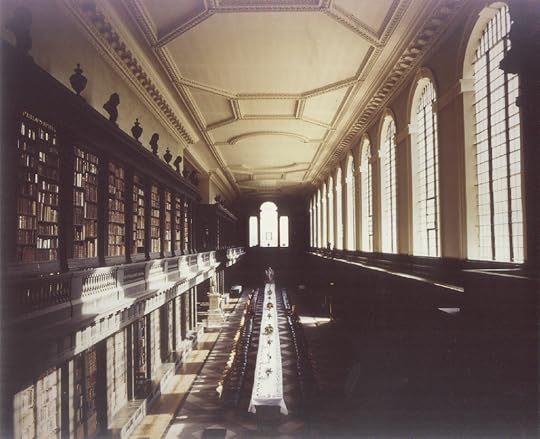
Codrington Library at All Souls College
Profile Image for Lee Klein .
911 reviews1,055 followers
June 16, 2016
Narrative voice and structure for the win. Loved the opening with the Oxford doorman suggestive of the transmigration of souls -- it introduces an almost magical hefty levity and looseness to the proceedings, which move along unexpectedly, smoothly, Sebaldianly, sort of, with language infused by Nabokov and even a sniff of the Shakespearean stylings of some Philip Roth ("in exile from the infinite" etc). Margaret Jull Costa's translation conveys all this wonderfully and I'm sure matches or maybe even improves the original Spanish. Sly, sophisticated, informed, observant, associative, digressive, yet also a little bawdy. Loved how Banville's introduction (read it after finishing the novel) didn't mention the sexy-time section with "the fat tart." The sort of open structure that lets its associations breathe. Loved the rare book hunting, the murderous booksellers (the very lightly foreboding/threatening sense throughout), the high table talk with the boring economist, all the not really all that many episodes, concluding with Clare's tragic story that may or may not relate to a forgotten writer once friends with Dylan Thomas and Lawrence Durrell. Docked a star in part because the ending seemed too set on summary. It could've done anything but just sort of seemed to return to various themes and phrases. Just started the sequel ("Dark Back of Time") and will most likely read the other two novels of his I own ("A Heart So White" and "Tomorrow in the Battle . . . ") before the fall. For ten or 12 years I've been storing up Javier Marias books for some later date that seems like it's finally arrived.
Profile Image for Carmo.
726 reviews566 followers
July 13, 2016
António Lobo Antunes, admirador convicto de Javier Marías, escreveu o prefácio deste livro e nele enumerou todas as qualidades da escrita deste autor.
Não vos maço com a minha opinião, até porque não há mais nada a dizer e, certamente, não faria melhor.

Quanto à história do livro…não há grande história. Escrito em forma de relato autobiográfico, revela-nos um pouco da vida de um professor de Espanhol colocado em Oxford por um breve período de tempo.
As personagens não são muitas nem muito aprofundadas. O que nos é dado conhecer, são pequenos acontecimentos do dia-a-dia, as interações entre colegas, as relações mais ou menos ilícitas, conflitos familiares, no fundo nada de anormal. O “mistério” está na forma tão típica do autor, de contar as coisas mais banais e fazer delas tema de reflexão.
Para um autor mais “despachado” seriam episódios para 2/3 páginas, Javier Marías fá-lo em 12 ou 13 numa linguagem elaborada, encadeada em longas frases, fazendo constantes desvios, abrindo e fechando parênteses 2 ou 3 vezes dentro do mesmo raciocínio. Nem sempre é de fácil compreensão, mas há que reconhecer-lhe a genialidade da retórica e o sentido de humor discreto e inteligente.

Não gostei de todos os capítulos (dá mais ou menos para separar a obra desta maneira), houve mesmo alguns que li na diagonal, por achar que aquela personagem não apresentava nada de relevante para a história, mas outros houve que achei divinais.
Destaco dois divertidos, mas houve outros que me tocaram por razões mais sérias.

-Um jantar na universidade com todos os salamaleques devidos à rígida etiqueta, e que seria sacrilégio não respeitar. Mas qual é a etiqueta que resiste a doses colossais de soro etílico?
Quando o maior e mais respeitável “figurão” do grupo, faz uma “figurinha”, completamente embriagado e embasbacado pelo decote de uma das professoras é o descalabro.
-Uma aventura notívaga do nosso narrador, em que passa o tempo a estabelecer comparações entre a performance e os atributos físicos da mulher que conheceu casualmente e estava disposta pra coisa, e ele, claro, macho que é macho não refuga - como dizia lá atrás, passa o tempo a fazer uma exaustiva análise racional e técnica, marcada pela distância que existe entre duas pessoas que se enrolam por valdelençois, mas sem envolvimento emocional.

Resumidamente, o livro é uma viagem ao fundo da alma de cada personagem. As minudências de cada um compõem a sua essência, o seu íntimo, a sua postura perante a vida e as suas opções: as que assumem, as que revelam a uns poucos merecedores da sua confiança, e as que calam no seu interior.

Profile Image for K.D. Absolutely.
1,820 reviews
January 20, 2013
Beautifully written. The plot is thin but Marias' prose managed to make this very engaging. I particularly liked the way he interjected the thoughts going on inside his characters' minds. I've seen this technique in many other great works the last being Hilary Mantel's Bring Up the Bodies (5 stars). However, that book has a thick and historical plot so that is its advantage. This book, All Souls has only an illicit affair on Oxford (yes, that famous school for the rich and brainy kids) hallowed ground and rooms and anywhere the lovers - the narrator and Clare - find themselves alone.

This also has a fresh approach to adultery. The doomed relationship is not dramatic as Romeo-Juliet or Anna Karenina-Alexie Vronsky. In fact, most of the time, Clare is cold and stiff in dealing with her lover and it looks like, particularly at the beginning, that she is just after sex. The setting of the story being the Oxford brought back the memories of watching Ryan O'Neal and Ali McGraw in the 1970 hit movie, Love Story (3 stars). However, the setting being that of another prestigious school, is the only similarity between the two. This book is neither mushy nor tearjerker. It is also not a soft porn or a romance.

I know that I am not making a lot of sense by describing a book by saying what it is not rather that what it is. Just take this from me: this is my first Marias book and I was in awe reading how great he intricately puts his words together. There are many good reviews already written here on Goodreads like those of my brother's and my friend Mike's. This is my first time to ride on other people's reviews but I think they both expressed perfectly what I wanted to say.

Thank you, Javier Marias, for your very nice book. Makes me what to ask myself why I am not having an extra-marital affair when it could be this "beautiful" LOL.
Profile Image for MJ Nicholls.
2,274 reviews4,848 followers
August 26, 2014
I like to take recommendations from friends, read their favourite authors, then prove them illiterate schlemiels by showing how much better Gilbert Sorrentino and Lucy Ellmann are at writing things. Then I laugh at them. Hahahaha, I go. You FOOLS! Hahahahaha. OK, no I don’t. On this occasion, Mike’s recommendation was valorous and astute.

He was absolutely right in saying Marías is the middle point between Bolaño and Sebald (or words to that effect). Combining the long unspooling sentences of the big Bolaño books, and the meandering metaphysics found in Sebald, Marías has written a unique, maddening and hilarious book at the classiest end of so-called lit-fic.

The narrator is a haughty Spanish don visiting at Oxford who gets tangled in an affair with a co-academic. OK, that sounds intolerable, but honestly, like On Beauty, it’s really quite beautiful. Marías favours laborious passages of lyrical musing and old-time wit, often straying into Henry James territory with the ponderousnessness of it all, but it’s mainly exquisite.

Here’s Mike’s review. Let him take over.
Profile Image for Becky.
440 reviews30 followers
March 25, 2011
Having spent three years in Oxford, I've been eagerly looking forward to reading All Souls since I picked it up in a second hand about a year ago. Heralded as a great Oxford novel, and witty to boot, it sounded pretty enticing.

What a disappointment it was. For Oxford, all the cliched bases are covered, but to be honest, the City really seems like a bystander. There's none of the inspiration, none of the light. Just drunk wardens, pompous gay tutors, and cheap girls in the local clubs where academics like to "rough it." The real star of this story (yawn), is yet another man (young this time, not the usual middle age), trying to find his place in life, and seeking solace in the arms of a one dimensional temptress of a lover. Troubled past, yawn, nice boobs, yawn, hotels in Reading, err, what?

I found this boring and dull and very much lacking in wit. Bah.
July 2, 2016

Welcome to the journey.

Marias spins us through time and isolation written in aquiline precise prose. The master of black comedy, his humor throughout much of the novel is tinged with a palpable sadness.

The novel opens with the narrator telling us that while at Oxford two of his colleagues died but that he is no longer the same person who taught there for two years. Entering his building each morning he passes the ninety year old porter, Will, who due to some unnamed form of dementia lives in different eras each day, shifting back and forth, seeing the people who he waves a good morning to as those of that past time, the past that has now for that day become his present. The present for our first person narrator includes an affair with the beautiful Clare that is not only limited by his two year lectureship and need to return to Madrid but also defines its character and possibilities. The novel is permeated with a sad smile at life fixed and limited in time. The presentiment of aging, ill health, death weights time as a motif through the novel absenting the present not only for the aging but some of the young as well, on their downward tread.

Oxford also is stymied rather than being the venerable institution of high discourse and the seeking of further and greater knowledge. It is a place of vapid stasis, stuck in time and space. Their lectures, "... would have been or would be conducted in the most absolute calm and tranquility, since classes were part of being, not doing or acting." The interactions of faculty were prescribed by never revealing emotions or any information about themselves. Their entertainment circles around gossip about each other, real or fictionalized. In the best of black comedy Marias tells of, high table dining, the faculty and administration are condemned to. Silently scoffing students are seated below. The meal is highly structured with each person at high table forced to talk for a specific number of minutes to the person on the right then when signaled to the person on the left. The narrator there as everywhere in this static campus feels unease and loneliness, out of sync with others who had chosen or all too willing adapted to living a confined life. "For the inhabitants of Oxford are not in the world and when they do sally forth into the world (to London, for example) that in itself is enough to have them gasping for air; their ears buzz, they lose their sense of balance, they stumble and have to come scurrying back to the town that makes their existence possible, that contains them, where they do not exist in time."

Reading this novel for me was a delight due to the fineness of his prose and darkly comedic exposition of his theme. Where I felt he stumbled was his shifts of time which were harsh and at times threw me outside of the narrative's dream. I read this in conjunction with McElroy's, Night Soul and Other Stories, as a needed occasional break. McElroy made his shifts in time jarring yet fitting into a purposefulness which rendered it as a part of the overall work. Some of Marias' shifts called attention to themselves and thus became disruptive. The ending felt forced, contrived. I am completely open that on a second reading I might see what I missed and how this fit seamlessly with his tenured preoccupations with the difficulty of living within time, space. Also as I become a better reader it may become clearer.

These were small stumbles and easily diminished by the overall polish and flow of the writing. I imagined him, a magic cloth held in hand buffing
each word, sentence, paragraph, idea to a polished gleam. I am on soon to his, Dark Back Of Time, and to rereading, All Souls when the next time is right.
Profile Image for Hakan.
829 reviews632 followers
December 27, 2020
Tüm Ruhlar, ünlü İspanyol yazar Marias’ın 1988’de yayımladığı ikinci romanıymış. Türkçe çevirisi bu yıl basıldı. Oxford Üniversitesine iki yıllık bir program için giden 30 yaşlarının ortasında Madridli ana karakterin ağzından burada yaşadıkları geriye dönük olarak anlatılıyor. Yine klasik Marias üslubuyla; yani uzun cümleler ve paragraflar kurarak, birçok yan yollara saparak, kadın-erkek ilişkileri hakkında ahkam keserek (yabana atılacak şeyler değil kesinlikle ama bu hükümler), merak unsurları yaratarak, şapkadan kıyıda köşede kalmış yazarlar çıkartarak, ilginç veya gizemli karakterler oluşturarak (ki bunlardan Toby Rylands gibileri Marias’ın sonraki romanlarında tekrar boy gösteriyor) ve tabii ki daima geçmişle hesaplaşmayı mesele edinerek. Yazarın derin gözlem gücüne bir kez daha hayran oldum. Tecrübeli çevirmenlerimizden Neyyire Gül Işık da Marias’ın hakkını vermiş.
Profile Image for Charlie Parker.
350 reviews108 followers
September 30, 2022
Todas las almas

Novela autobiográfica que se publicó en 1989, cuenta la estancia de Javier Marías como profesor en Oxford durante dos años.

Aquí aparece su relación sentimental con Clare Bayes, una mujer casada. Su relación con el profesor Toby Rylands que le habla de su pasado en el MI5, conoce a Alan Marriott y su perro de tres patas y vemos que la historia que cuenta del suceso del perro aquí es la misma que aparece en “Tu rostro mañana”. Aparecen más personajes curiosos y además hace un repaso de la vida universitaria y social de Oxford.

Luego de varios años de publicarlo, cuando escribió “Tu rostro mañana” se basó en esta historia, a la cual hace constantes alusiones. Aunque ya no sería autobiográfico, sino que pondría a Jaime Deza como narrador, pero siempre quedó esa ambigüedad en confundir narrador con el escritor mismo.

Cualquiera que lea "Tu rostro mañana", tendrá curiosidad por leer este libro que parece ser la semilla desde la cual fue creado.

El título del libro proviene de «All souls», uno de los anfitriones de las high tables o cenas programadas organizadas por uno de los colleges de Oxford (según Wikipedia)
Profile Image for Karina  Padureanu.
121 reviews97 followers
May 5, 2024
Ce imi place la Marias este felul sinuos in care scrie revenind, prin repetare, asupra acelorasi detalii, pentru a le sublinia si a da o nota de ireal situatiei. Ma mai atrage pentru ca te "loveste" cand nu te astepti, in timpul unor scene banale, cu cate o reflectie profunda care emotioneaza, urmand ca la sfarsitul cartii sa te nauceasca cu dezvaluirea unui posibil mister de necrezut, care se contureaza la convergenta unor detalii aparent nesemnificative descrise anterior.
Profile Image for Joselito Honestly and Brilliantly.
755 reviews430 followers
July 11, 2012
The plot is sparse: the narrator is a visiting Spanish lecturer in Oxford, a bachelor (good looks hinted), he mingles with the people there, those quirky dons, and--for a Spaniard like him-- experiences those strange English mannerisms and customs. He starts an affair with a pretty, but married (to a fellow professor) tutor. But this is no withering, whimpering love story. The two occasionally meet some place basically just to fuck. And mostly talk. So this is no porn. It's not in the fucking or the sucking (although Marias has thoughts while his cock is being sucked) but in the thinking.

Marias, master of asides, adorns his barest of plots with his surprisingly fresh, novel, incisive and brilliant introspective ruminations on practically everything. Carefully-crafted mini-essays about whatever comes to his or his characters' minds. Some didactic and serious, some nostalgic, some funny set pieces worthy of a laugh even during wakes or funerals (goodreads people read even there). If the reader does not control himself, he'll end up copying these and pasting them in his liked quotes here. I was able to resist this temptation only because they are so many and each of them as outstanding as the other.

Alright, so then is this just a barren skeleton of an old Christmas tree where the author hanged his varied thoughts to create a semblance of a novel? No. There is a surprising denouement waiting for the reader towards the end which, for me, completely changes the mood of the novel.

Loved it.
Profile Image for Laura.
466 reviews42 followers
December 31, 2022
The sun rose at 06.51 and set again on this short day, two days before New Year, at 16.35. The mellow moon, in its first quarter, reached its meridian at 18.26, and I finished reading All Souls. As I slowly closed the back cover, I contemplated its flawless composition. I contemplated my fondness for the deeply observant first person narrator, on the host of eccentric characters, the subtle intertextual nods to Russian literature, and on the masterful description of events, places, emotions. This was brilliant. Perfect. This is a book I could get in the habit of re-reading every year and have a different experience with each reading. As my final completed book of 2023, this was peerless.
Profile Image for Guillermo Jiménez.
486 reviews359 followers
January 26, 2018
Me he propuesto escribir sobre lo que leo, porque de alguna manera es una forma en la que me obligo a escribir. Es algo que hago, pero al mismo tiempo no. Según yo, tampoco me muevo mucho, ni viajo, y de un tiempo para acá siento que no he dejado de moverme. Y, cuando lo he hecho, he decidido que sea Marías quien me acompañe y me guíe y me de algo de paz y sosiego en el mar turbulento que siento que se me ha vuelto el mundo hoy en día.

Viajé a Bogotá con Corazón tan blanco, y elegí Todas las almas para el viaje que hicimos Rebeca y yo a varias ciudades del este americano: New York, Boston y DC; lo elijo porque sé cómo escribe, sé cómo pueden ser sus historias, cómo pueden ayudarme a sentir que me asgo a una tabla que me mantiene a flote.

Lo leo porque antes de comenzar a leer, recuerdo que entraré en un universo que aunque titubee, estará bien escrito, estará bien narrado, utilizando uno de los mejores usos del español que alguien pueda imaginar, y de paso, habrá una gran historia, y unos personajes inolvidables, y unas escenas magníficas, como esta de Cromer-Blake que yace y ve la televisión, una ópera sin sonido con “un Falstaff que vociferaba mudo”. Exquisito.

Un narrador nos lleva a recorrer su recuerdo de un par de años que pasó en Oxford como catedrático invitado. En una primera persona brutal, nos hace partícipe de sus opiniones en el momento y de las que recuerda y cómo las recuerda a su regreso a Madrid. Va y viene en el tiempo y en el recuerdo, y la narración fluye como solo pueden fluir los ríos constantes de la memoria, cabalgando a medio camino entre la ficción y la realidad, que es solo una invención más de nuestra mente.

“Todo debe ser contado una vez al menos [...] en el momento justo y a veces nunca más si ese momento justo no se supo reconocer o se dejó pasar deliberadamente”. Y nuestro narrador nos cuenta, cuenta, en el momento que adivinamos justo, no antes ni después de dónde está en ese momento, ¿por qué lo hace? Lo ignoro, ¿por qué habrá llegado al momento en su vida en que de alguna manera comprendió a quien fue su amante en esa época? ¿Porque ahora sí se reconoce en la “sensación de descenso que todos los hombres sienten más pronto o más tarde”?

Creo más bien que es lo último.

Fue un gran momento reconocerme en los paseos del narrador por las librerías de viejo, aunque él enguanta sus manos, y coincido con comprender bien “a quien lamenta morirse solo porque no podrá leer el próximo libro de su autor favorito”. ¿Cuándo leyó papá esta novela? Recuerdo que me hablara de Negra espalda del tiempo, de la tarea del escritor y los enfrentamientos con aquellos que se sienten “sus” personajes. No lo son. Recuerdo los años, los meses en que esta barata edición de bolsillo descansaba en la mesa de noche de papá, lo recuerdo porque acostumbraba tomar la siesta en su cama, en su lado, en su lugar, y ponerme los audífonos de su discman y escuchar antes de quedar dormido lo que sea que estuviera escuchando, y ver los lomos de los libros que estaba leyendo o que esperaban ser leídos.

Creo que Marías es mi Cortázar, mi Salgari, mi Conrad, quiero decir que es el autor de mi juventud aunque lo esté leyendo ya en mi edad adulta; es el escritor que me remonta a una época de vigor y de fuerza, envejecido a contratiempo, porque esa época ya fue. Las lecturas que marcaron a la generación de Marías, algo así como a Pérez-Reverte, o incluso a un Vargas Llosa (y aquí me refiero al encuentro que sostuvieron los 3 por el 50 aniversario de su editorial Alfaguara), son Salgari, Verne, entre otros. Autores que no leemos más los jóvenes. Autores que se perdieron y que solo rescatamos a través de lo que se cuele entre los textos de estos viejos.

Escribe increíblemente bien este Marías. Deseo que le reste mucho tiempo de vida escribiendo, y que lo reciente de él (que aún no leo) siga siendo tan sólido como esta novela.
Profile Image for Maral.
290 reviews70 followers
September 17, 2022
Siempre pensamos que tenemos tiempo, que habrá más libros de un autor, esperamos que publique el siguiente sin haber leído toda su obra... Y ahora me alegro de que me queden todavía muchos libros de él sin leer.
Todas las almas es un libro de párrafos subrayados, de crítica velada, de la vida de una ciudad almibarada, de la amistad entre personas que no pertenecen a un futuro planeado, es un libro sobre una relación que podría ser de amor pero no lo es, es una relación de vacíos, de necesidades.
Escrito en primera persona, como todo lo que he leído de Marias, hace que yo confunda el narrador con el autor, y poco a poco me he ido haciendo una imagen de Marias, que a ver quien me dice a mi ahora que no es real. Sus personajes peculiares, sus mujeres de faldas subidas y medias de panty, esos cigarrillos que huelen a través de las páginas en un mundo en el que fumar te arrincona, esas frases largas complicadas que dicen mucho más de lo que aparentan decir.... Marias no se corta, no es políticamente correcto. Quizás por eso crea a veces polémica, pero a mi me encanta esa libertad al escribir al opinar, aunque no coincida con la mía, me da igual... Solo quiero poder seguir leyendo libros de gente que escribe sin miramientos , con todas las letras y llamando las cosas por su nombre.
Oxford ya forma parte del mundo de Marias que he ido creando en mi.
Todas las almas, no es un libro más, ya es un libro menos.
561 reviews14 followers
October 15, 2014
Superb, probably one of the best books I have read this year. In a deliciously gossipy manner Maria's draws the reader into the ludicrously eliteist world of Oxford and the Dons. The narrator like Maras himself was a visiting lecturer at Oxford for two years and as such ruthlessly dissects the rather esoteric codes and customs of the much revered place. His description of the protocol of High Table is particularly memorable. This is an emotional novel full of fluctuating passions both hilariously funny and acutely poignant. It is overall I think a novel about death and change and the unreliable nature of memory which is mercurial and elides and conflates as one looks back from differing perspectives. Sometimes it reminded me of Robertson Davies at his best, but Maras puts a lot more emotion on the bones. Great stuff.
Displaying 1 - 30 of 560 reviews

Join the discussion

Can't find what you're looking for?

Get help and learn more about the design.