Jump to ratings and reviews
Rate this book

Erschütterung

Rate this book
Der Paläontologe Zach Wells hat sich in seiner selbstironischen Abgeklärtheit bequem eingerichtet: Idealen misstraut er, ob an der Universität, wo er, selbst Afroamerikaner, sich nicht für Gleichberechtigung einsetzt, oder zu Hause in der erkalteten Beziehung zu seiner Frau. Einziges Licht in seinem Leben ist die zwölfjährige Tochter Sarah. Als diese ihr Sehvermögen verliert und eine erschütternde Diagnose folgt, flieht Zach in die Wüste New Mexicos. Dort geht er einem mysteriösen Hilferuf nach, den er in einer Second-Hand-Jacke gefunden hatte.

288 pages, Hardcover

First published January 1, 2020

367 people are currently reading
13373 people want to read

About the author

Percival Everett

70 books8,775 followers
Percival L. Everett (born 1956) is an American writer and Distinguished Professor of English at the University of Southern California.

There might not be a more fertile mind in American fiction today than Everett’s. In 22 years, he has written 19 books, including a farcical Western, a savage satire of the publishing industry, a children’s story spoofing counting books, retellings of the Greek myths of Medea and Dionysus, and a philosophical tract narrated by a four-year-old.

The Washington Post has called Everett “one of the most adventurously experimental of modern American novelists.” And according to The Boston Globe, “He’s literature’s NASCAR champion, going flat out, narrowly avoiding one seemingly inevitable crash only to steer straight for the next.”

Everett, who teaches courses in creative writing, American studies and critical theory, says he writes about what interests him, which explains his prolific output and the range of subjects he has tackled. He also describes himself as a demanding teacher who learns from his students as much as they learn from him.

Everett’s writing has earned him the PEN USA 2006 Literary Award (for his 2005 novel, Wounded), the Academy Award for Literature of the American Academy of Arts and Letters and the Hurston/Wright Legacy Award (for his 2001 novel, Erasure), the PEN/Oakland-Josephine Miles Award for Excellence in Literature (for his 1996 story collection, Big Picture) and the New American Writing Award (for his 1990 novel, Zulus). He has served as a judge for, among others, the 1997 National Book Award for fiction and the PEN/Faulkner Award for Fiction in 1991.

Ratings & Reviews

What do you think?
Rate this book

Friends & Following

Create a free account to discover what your friends think of this book!

Community Reviews

5 stars
1,757 (28%)
4 stars
2,742 (45%)
3 stars
1,252 (20%)
2 stars
253 (4%)
1 star
61 (1%)
Displaying 1 - 30 of 1,019 reviews
Profile Image for Robin.
575 reviews3,654 followers
February 5, 2021
You know how sometimes actors rave about working with "an actor's director"? Meaning the director has a deep respect for what the actors bring, and rather than imposing his vision, is only interested in amplifying and bringing the actor's best self out?

Well, Percival Everett is "a reader's writer". I’m interested not in the authority of the artist, but the authority of the reader, he is quoted as saying.

I can't tell you how refreshing that idea is. A writer respecting the authority of the reader, rather than sanctimoniously sitting up on his self-made pedestal, saying If you don't like it, you didn't get what I, the great artist, was doing.

He understands that once art is released into the world, people will see it in a variety of ways. And these ways are valid. So on that idea, he wrote this book with three different endings. You won't know which version of the book you're reading until you get your copy, but you'll definitely have an opinion on what happened and how it was rendered. Your opinion will likely differ from your reading peers. You might find yourself saying, "hey, no, it didn't end that way!" and they respond with, "hell yes it did!" and you'd BOTH be right.

I couldn't have read this at a more perfect time, when it seems like people have less and less room for differing opinions, even in this most sacred world of art, where there should be scads of room - amphitheatres of it - for people to see what they see, and to be open to others' seeings.

The book is ridiculously clever, even down to the title, which comes from the child's game in which stories change from the teller to the recipient.

In addition to being clever, Telephone was my introduction to a fine writer - and an under-appreciated one - did you know this is his THIRTIETH book, friends? Everett pulled me in with his engaging, intelligent writing, writing that has humour and a propulsive rhythm despite its tremendously difficult subject matter. He touches on humanity and parenthood in such a sensitive way. Through Zach, his main character, we witness the universal need to save those we love, and how most times, despite our best attempts, we cannot. But that we keep trying, oh, it's the reason for living.

Of course, you might see something completely different. And that is a-okay with me.
Profile Image for Roxane.
Author 130 books168k followers
July 16, 2020
Brilliant writer. Love the cadence of the novel. The book is not quite for me because I struggled to feel a connection to the protagonist. That’s me not the book’s fault.
Profile Image for BlackOxford.
1,095 reviews70.3k followers
March 4, 2022
Cleavage

Percival’s protagonist, Zach Wells, learns the truth behind the apparently contradictory meanings of the English verb ‘to cleave’ - both ‘to attach closely’ and ‘to separate forcefully’. After all, isn’t the world, from quantum physics to human affection, paradoxical?
“I considered that word, cleave, and wondered how it could contradict itself so cleanly, wondered if the two meanings canceled each other out, leaving nothing in its wake. Cleave.”


No one ever mentions that having children is a crap shoot, a bet with the universe using dice that are loaded in unknown ways. So we ignore the infinite possibilities for genetic mutations, recessive defects, or outright deformities and trundle on as if our power of procreation were divinely sanctioned, or at least a demonstration of some sort of control over life.

But even among the religiously minded, “The Lord giveth the and the Lord taketh away.” This shibboleth, of course, is the ultimate rationalisation for the random events of human existence, including existence itself. Even the most genetically perfect child poses enormous risks to personal mental health, parental relationships, and ultimately social well-being. The Markov chain of randomness defies reason. If God exists he is “An absentee landlord at best.”

Nevertheless an unreasoned and unreasonable fundamental optimism dominates our lives. As Zach Wells says at a particularly tragic moment. “everything now felt so hard, so real, every move an effort and a mystery, yet strangely, no move seemed as if it could be wrong.” Or could it merely be that any action didn’t make any difference in the situation. Every move had an unavoidable downside. If all tactics end in failure, can any be called ‘wrong’?

And the futility of intention and hope doesn’t just apply to children. What we think of as doing good has ramifications we can’t imagine. We listen civilly and it’s taken as incipient affection. We give constructive advice which results in personal harm. We teach and it encourages psychopaths to blossom. We marry and drive our partners into depression. And all that quite apart from the accidents and natural disasters which are accepted as normal. No surprise then that Percival uses an epigraph from Kierkegaard:
“I see it all perfectly; there are two possible situations—one can either do this or that. My honest opinion and my friendly advice is this: do it or do not do it—you will regret both.”

For everything, indeed, “transit lux, umbra permanet,” the light passes, the shadow remains. I too have lost a daughter before her death, in a manner similar to Zach Wells. Despite that, it is necessary to do good because God will punish us if we do good or not. Cleavage.
Profile Image for Betsy Robinson.
Author 11 books1,228 followers
August 11, 2021
How on earth do you review a book that is as personal, as tender, and as unnamable as your own soul? Reading Percival Everett, and this new novel in particular, is like entering the territory where all life comes from. I had such a hit of this when I first began the book that I literally passed out. In yoga there are names for this. Suffice it to say that it’s when your consciousness is overwhelmed, stretched beyond its normal capacity.

Once I came to, all my subsequent reading pauses were voluntary—due to either my need to process the heartbreak of love and life and the fact that no matter how much you love, you can’t save anyone and everyone will die, or my futile attempt to keep this book going, delay its ending.

This book rips your heart out.

Per this New York Times article, there are three different versions of this book. Before reading this one, like other diehard fans, I was ready to go on a quest, campaigning a bookstore to campaign its distributor to search for the three different covers, ensuring I get a copy of the other two. But having read this one (the difference is detectable in the direction of the compass on the top right of the cover; I have the one that points northeast), I cannot imagine a more perfect book, and I don't think I want to read another version.

Three years ago, I first met Percival Everett through his last published, So Much Blue , and my brief review equally applies to Telephone.

In the interim between So Much Blue and this new book, I have read 18 of his 30 books, so I feel as if I know the man. And I love him.

Creative Capital supported this 3-book project and just published a wonderful interview with Everett. I love and, as a writer, share his respect for readers. And because of the enormity of my experience reading this book, my sense is that the book I received is very personally the one I was meant to read.

However, I would love to read reviews of the other versions and maybe have a group talk about them. I'll start a chat on the bottom of this page for anybody who is interested in that.

8/11/21 Update
This wonderful interview with Everett was just published: https://booth.butler.edu/2021/08/06/a...
Profile Image for Zoeytron.
1,036 reviews896 followers
October 13, 2022
'So often stories begin at their ends.'

This is a story of grief that has taken over a family's life.  A loss that is taking place, happening day by day, little by little.  It is a type of anguish that cannot be assuaged.  Saving one another, desperate to make a difference, to salvage something good from the sheer cruelty of it all.

Having been lucky in life, I should not have been able to relate.  But the author knew what he was doing, and I was totally caught up in the story.  Read it at a time when your heart can take it.
Profile Image for Elyse Walters.
4,010 reviews11.9k followers
April 18, 2023
“My wife and I loved our daughter, and so we were together. Had it not been for Sarah, I doubt we would have continued as a couple. We liked each other well enough, and I was a faithful and devoted husband, but I was bored, and I am fairly certain she was as well. But that was okay. I was not bored with my family. I was not bored with my child. I was not unhappy with Meg. I was not unhappy with my job, which incidentally, bored me most of the time. I was, to say it again, simply in love with my daughter, with being a father”.

Occasionally I have an experience where I could not loved a book more…
….it’s one of those times.
I COULD NOT LOVE THIS BOOK MORE!!!

Percival Everett is a genius. His writing soooo affecting …..sooo memorable……soooooo GOOD!!!!

….I read a lot of books.
….I toss a few back.
….I am ‘meh’ about a few.
….Most of the time I’m happy with the books I choose to read: most being a 4 or 5 star rating.
….Occasionally…I’ve found GOLD….better than better… than better!!!
“Telephone” is a 5+++++ rating!!!

Thank you to every reader who read this before me …. who inspired me to pick it up.
FAVORITE!!!!
This book is fantastic!!!!
HIGHLY recommend …. to everyone!!!!!


Paris…
“The sidewalk felt just like a sidewalk at home, but it was not. It was a French sidewalk covered with French grime under French feet and French air. We walked down the block and passed a few shops, around the corner, and into a patisserie we couldn’t resist. The pastries were colorful and arranged as they would never be arranged back home. Sarah loved the art of it, but still all she wanted was a plain au chocolat. I watched her bite into it, eyes closed”.

“When moments are weighted, the most insignificant details become meaningful”.

“Watching Sarah, I was confronted with the truth of life’s ephemerality, the sad and permanence of everything. These moments in Paris would not be memories she would even have a chance to look back on”.
Profile Image for Fionnuala.
886 reviews
Read
July 6, 2024
The past intersects with the present even while the present is busy intersecting with the past.

This is the story of a paleontologist who is so knowledgeable about the fragments of ancient bone he has collected from a fossilized rat midden in the mountains of New Mexico that he's not very tuned in to anything else in life—with the exception of his young daughter's welfare. Fair enough. He's not an outgoing type, and is happy to live quietly, playing chess with his daughter and accumulating notes about his beloved scraps of bone fossil which are like messages from a long ago world telling him about what things were like back then.

But our paleontologist also becomes fascinated by the obscure scraps of messages he finds in the clothes he buys on eBay and which lead him to a cache of bones from more recent times. Once he knows about those bones, he feels obliged to follow further the trace of the obscure messages using his researcher observation skills and his knowledge of chess. Eventually he finds a human-sized rat midden, and not in the least fossilized.

How does a man so unaccustomed to violence deal with the life-sized rats who guard the maidens in the midden? It's no coincidence that a chessboard knight is the piece with the most surprising moves, and our quiet paleontologist turns out to be such a knight—though he dresses in second-hand clothes.

The last quarter of this book moves very fast, in contrast to the rest (though I enjoyed the slower parts too). And not only does it move fast, it is very moving—more so than anything else of Percival Everett's I've read.

But for all its soberness, it still has some of Everett's trademark humour. When I finished it, I moved on to my fifth Everett, and now I'm already on the sixth.
I hear he has written thirty.
Profile Image for Lisa.
624 reviews229 followers
June 15, 2022
I read edition B of this novel, the one with the NW compass.

In the beginning of the novel the reader is informed:
"Some said that two hundred young women had been killed or disappeared in some twenty years. Others said it is closer to seven hundred gone. People are like that about numbers. They will say it is not seven hundred, but only three, two hundred, as if one hundred would not be truly horrible, fifty, twenty-five. No one knew who killed and kidnapped these people. Maybe drug cartels, some said. Maybe roving gangs of sexual predators. Devil worshipers. Perhaps invaders from space. Men. It was men. It was always men. Always men."

So begins one thread of this story that will lead us to a number of women from Ciudad Juarez who are enslaved laborers in New Mexico.
This thread had me off researching human trafficking and forced labor in the U.S. I am more familiar with the sex trafficking that occurs in the area where I live, mostly from eastern Europe. It boggles my mind that in 2021 there were an estimated 50,000 people working in forced labor in my country.

A second thread of the story follows the protagonist, Zach Wells, at work as a college teacher of geology handling a student's crush and a colleague's problems with publication and tenure.

How would you react if your child was diagnosed with a progressive neurological disease? The central thread of the novel: “Our daughter was dying. . . . Over time, my daughter would suffer worsening seizures, her sight would finally fail altogether, her speech and motor skills would grow progressively worse and fade, and she would suffer mental impairment; she would become demented. I would lose her before she was gone."

At first Zach escapes into his work. Then he finds a note asking for help and throws himself into discovering who is asking and what they need. Since he can't save his daughter, perhaps he can save these anonymous persons asking for help. As Sarah's disease progresses, Zach heads to New Mexico and begins scouting the small town of Bingham to find those he may be able to help.

I understand Zach's need to be doing something. I am a person of action. I struggle when there is nothing that can be done. To say that I continue to practice acceptance of what is, would be an understatement. The day after the Twin Towers fell, I found myself volunteering at the Red Cross, leaving my husband at home with our 2 daughters, then 8 and 10. After 2 days my husband gently sat me down, pointed out that the Red Cross now had enough volunteers, and that I was needed at home. I can only imagine what Meg, Zach's wife and Sarah's mother, was going through at home with Sarah and then alone for days on end.

This is a layered novel whose depths I have only begun to plumb. I'm not sure if I will search out the other 2 editions or go back and read this one again in a month or so to gain a better understanding of it; there are a lot of references and nuances, and I know I didn't get them all.

This is a well written novel with themes of grief and redemption. I have a few other of Everett's novels on my TBR and I am now even more eager to get to them.
Profile Image for switterbug (Betsey).
936 reviews1,494 followers
April 9, 2024
This story of grief and hopeful redemption was a 2020 Pulitzer Prize finalist. Well-deserved!

Everett is an angular writer, coming in sharp from all sides, but also circumspect, by not revealing all the underlying significance. Zack Wells, tenured professor and geologist/paleobiologist, is happiest playing chess with his bright, beautiful 12-year-old daughter, Sarah. Similarly, he is content contemplating an inaccessible cave in the Grand Canyon called “Naught’s Cave.” Hence, the implication of nothingness in his life. It's the old beat-up paradox that nothing is everything.

Zach and his wife, Meg, are about to find out some bad news that will cause prolonged torment and a forlorn future. Dr Wells cannot prevent the inevitable tragedy about to befall his family, so he turns to a cryptic message found in a jacket he bought online. Someone is asking for help. Can Zach save a stranger in trouble?

“…I had this palpable swath of melancholy that ran through me that I simply could not shake.” That’s a poignant thread that runs through this multilayered story, as is the potential for Zach’s melancholia to transcend---and, maybe not save him, but at least give him a purpose amid the worst horror of his life. (I know that the cover blurb and most reviews give away the forthcoming tragedy, but I urge readers to discover that for themselves.)

While Zach's heart is shattering to pieces, he has an opportunity to be a salvation for people he has only learned about from a distance. If you've read Bolaño's 2666, you'll apprehend the despairing situation in Ciudad Juárez.

Telephone combines family drama, comedy, tragedy, mystery, thriller, and adventure. Everett doesn't exactly answers all our questions; rather, he largely leaves interpretation up to the reader. There are three versions/variations of this book. THREE! Zach has three versions of his life in front of him. And if we got three readers together who each read a different rendition, oh, what a curious event that would be!

If you want to know which version you have, you can look below the ISBN number to see if it is A, B, or C. Or look at the gorgeous cover at the minor variations of the illustrated compasses (but you would need to see the three different covers online). There are also three dedications. A is "For Henry and Miles." B is "For Miles and Henry." C is just "my sons." (Mine is the B version.)

The eponymous title is from the well-known game. You whisper a message around a circle of people and then have a laugh over how much the final message was distorted from the original.

Why would Everett do this?

I'll close on some thoughtful words by the author himself: “I’m interested not in the authority of the artist, but the authority of the reader.”
Profile Image for Jenny (Reading Envy).
3,876 reviews3,709 followers
February 16, 2021
It took a few tries to get into this book and sync with it, I didn't like the main character, and thought he made the wrong assumptions about women (and couldn't tell if this was the author or the narrator.) But in the end I enjoyed reading it quite a bit, and then enjoyed the experience of thinking about it and talking about it with others since, which is an experience designed by the author. He wrote three slightly different versions so it's interesting to hear how people's views on the story and the narrator and other details are different based on the story they read, but also.on who they are and what they bring to it. In that sense there are far more than three versions. It will be interesting to see how it fares in the Tournament of Books but as this was my last read of the shortlist, I'm ready to say this is in my very small group of five-star reads.
Profile Image for Kelly (and the Book Boar).
2,819 reviews9,510 followers
October 18, 2022


Yesterday the Booker Prize winner was announced and I was actually a little bit offended (not to mention quite a bit bummed out) that Percival Everett’s The Trees had not walked away with the title. Everett is a new-to-me author whose aforementioned take on race relations via a laugh-out-loud/gory narrative left me speechless. I had no idea just how deep his backlist ran, but I knew I had to check out more of his stuff.

Then I ran across the following meme on the ‘Gram . . .


And I thought hey I already read that book! Everett only did three iterations of his tale, however, instead of ten. He also apparently never planned on divulging this information to the world, but good luck keeping a secret like that in the age of technology. And now? Methinks I have found a new favorite author.

Telephone is sort of a choose your own adventure sort of tale where nuances result in different outcomes depending on which copy you come across. A multitude of plotlines are peppered throughout – a strained marriage, an unsolicited crush, a daughter who has lost her edge at chess, a dangerous road trip, and so on.

The question here is what kind of reader are you? Are you the sort who reads for the experience or one who gets bogged down in the mire - Googling things you don’t understand (in this case because they are in a foreign language or are DNA codes or moves on a chess board). Are you a reader who needs every detail made crystal clear? Or are you one who can play a bit of “telephone” and still enjoy the experience even though you’ve missed a word or phrase here and there? Will you be satisfied with what version you received? Or will you decide to choose YOUR own adventure and track down copies of all three variations? Will Zach end up with a happier ending or do things get even worse depending on which cover you receive????

This Pulitzer finalist pretty much proves Everett writes for Everett. You get what you get and you don’t throw a fit when ordering a copy and I’ll go ahead and disclose that mine was the one that closed on an open-ending (I would love to know the alternates if you care to comment using spoiler tags and fill me in). If nothing else, Everett is a lover of language. A wordsmith of the nth degree who refuses to be tied to one genre.

Every Star.
Profile Image for Tony.
1,030 reviews1,912 followers
May 13, 2022
When my daughter was playing tournament fast-pitch softball, I would travel along as father/scorekeeper/assistant coach. The girls were good, about twelve-ish. After one tournament, when they won yet another trophy, the team and coaches and parents went to a restaurant before heading home. Everyone was in a celebratory mood. But as I played with the label on my bottle of beer, I noticed that Ashley, the second-base person, was crying. She had had a good tournament, nothing bad had happened as far as I could tell, but there she was - crying, and not a little. I asked Ashley's Mom what was wrong. She said, "She's preparing for womanhood." It was then, at that moment, that I realized I would never fully be able to understand women. And nothing since has altered that epiphany.

Zach Wells, the first-person protagonist in this latest Percival Everett novel of my reading journey doesn't understand women either. Like all Everett protagonists that I've met so far, Zach is well-intentioned and plenty smart. A college geology professor. But his marriage seems soured. He's abrupt with a female colleague, until he isn't and switches to patronizing. He rubs hard against female medical staff. He loves his daughter, though. She's twelve-ish; and she's dying.

While this is happening, he orders a shirt on eBay. He finds within a note in Spanish, simply asking for Help. (My favorite plot device, by the way.)

So, there's a lot going on.

Say you're channeling Roberto Bolano's 2666 without saying you're channeling Roberto Bolano's 2666. Well, that's what Everett did here. But he weaved it into the story with Zach's daughter; and, yes, maybe with his wife, and colleague, and hospital staff.

So, I read this as a story about a man and his connections to women. How he wants to get it right. How, often, love is not enough.

I tarried reading Everett because, I think, I was afraid of how he would handle racial issues. Now I want to read more and more Everett because of the way he handles racial issues.

I am Not Sidney Poitier was, easily, the funniest of the novels by Everett that I have read so far. This, this is my favorite. I want to send this to people I love.

Oh, and I have no idea why this is called Telephone. Well, I have an idea, but it's just a wild guess. Clue: the only person he talks to on the telephone is his wife.
Profile Image for Phyllis.
701 reviews180 followers
March 23, 2021
I'll be thinking about this book for a long, long time.

First reading, NE version "A," May 14, 2020

To me, this is one of the saddest stories I've ever read. It is about ways that parents can lose their children even while those children remain alive. But it is steady, and understated, and there is enough redemption at the end to allow the reader to believe that people can come through this sort of unbearable loss.

The heavy subject matter is in contrast with the publication gimmick that gives the novel its title. Had there not been a pandemic, it might have taken quite a while for us all to figure out this was even going on, but because we were pretty much precluded from going into actual brick-and-mortar bookstores at the time of the novel's release, Everett and his publisher Graywolf decided to give it up. Turns out there are three different versions of the book being distributed, with some degree of variation in the story and the ending. The only immediately visible difference is the direction of the top-most compass on the front cover and a letter designator following the ISBN on the back cover. The version I read has a north-east compass and an ISBN designator of "A."

Second reading, NW version "B," July 15, 2020

Oh this story is still . . . so . . . very . . . sad . . . in both of the versions I have read thus far. It moved me just as much in reading the second version as it did in the first (for me) version reading.

The variations I noticed between the NE version and the NW version begin on the first page and conclude on the last. Most are a slight turn of phrase, or a segment of a sentence, or an interlude. There are passages that are distinctly different -- the first tavern scene, the office kiss between Zach and Nichole, the conversation between Zach and Rachel in the college bar, in Paris when Sarah is found, the last scene with Sarah. The plot remained the same, but the overall tone struck me slightly differently. With only the slightest differences in the two versions, Everett conveyed to me in the NW version a different feeling in Zach; more brittle, more angst, perhaps more unmoored but perhaps more salvageable. What a master writer Percival Everett is.

Third reading, SE version "C," March 6, 2021

It took a long time, but I finally received a copy of the third version, thanks to GR reader friends. I found this version to be perhaps even sadder than the other two. Again there are mostly slight, deft differences other than a fairly dramatically different ending here. But what struck me even more is the overall feeling I had of Zach. In this version, he seemed to be trying even harder to maintain an even keel in the face of heart-wrenching tragedy, to not fall apart, and yet . . . it makes you wonder how much a man can lose and fail and get up again the next day.
Profile Image for Thomas.
1,863 reviews12k followers
March 28, 2024
I enjoyed some elements of this novel. At its core is a touching and heartbreaking story about a Black man who is losing his daughter to a degenerative disease. I thought Percival Everett included a few scenes that were emotionally resonant related to his protagonist, Zach, and Zach’s relationship with his daughter. The novel does an effective job of portraying Zach’s experience of grief in all its nonlinearity and messiness.

Unfortunately, I found the writing style a bit detached and intellectualized. Perhaps this is a function of Zach’s character – he’s a geologist-slash-paleobiologist – but I think other writers have pulled this off better, such as Yaa Gyasi in her novel Transcendent Kingdom . There were parts of the story (e.g., Zach’s relationship with his colleague Hillary, Zach’s own upbringing) that I thought merited more exploration. Still, I have Everett’s novel Erasure on hold at the library and I look forward to reading it!
Profile Image for Philip.
574 reviews847 followers
April 25, 2022
4ish stars.

The kind of book that can only truly be appreciated through discussion and inquiry. How do I interpret that, did I miss something, what's the significance?

I appreciated it in its own right just based on the perspective and voice of the main character, and the varied plot lines. But I didn't truly appreciate it until I read explanations and insights from articles and reviews after I finished reading. I realized there was a lot I didn't pick up on and a lot of the cleverness and finesse, the basic intent of the author, went way over my head.

I was vaguely aware going in that there are three slightly different versions of the novel and the first thing I thought upon finishing was "How do the other two end?!" I still can't find a straight answer on the internet. Please someone spoil me.

Posted in Mr. Philip's Library
Profile Image for Darryl Suite.
713 reviews812 followers
February 4, 2021
This was well-done. Maybe it was too well done. What an incredibly sad and heartwrenching story this is. It broke my heart and forced me to imagine what it would be like to go through what these characters had to go through. And I didn't want to face it and I hope to never experience that kind of emotional pain and helplessness in real life. I'm telling you now: if you're a parent of a small child, you're going to go through an even tougher time than I did. This book is masterful from start to finish.

It's my second Percival Everett novel and I need more. 
Profile Image for Faith.
2,229 reviews678 followers
September 19, 2023
A college professor copes with the illness of his daughter by trying to save the person who sent him a cryptic note. As usual for this author, the book was well written. The parts of the book with his daughter were heart breaking. However, there were too many writerly flourishes, like the repetition of phrases and the non-ending. It felt like he was trying too hard to impress a writer’s workshop. I’ve had a mixed reaction to his books, but I will keep reading them. I definitely recommend “The Trees”. 3.5 stars
Profile Image for Maren.
273 reviews6 followers
December 7, 2024
An "James", meinem Jahreshighlight, ist es nicht herangekommen, hatte natürlich hohe Erwartungen an diesen Autoren.
Meine Gedanken:
Das Leben eines Paläontologen gerät nach der Diagnose einer unheilbaren Erkrankung bei seiner Tochter aus dem Gleichgewicht.
Zach Wells, der Protagonist erscheint etwas spröde, aber die Grenzen seiner emotionalen und moralischen Belastbarkeit werden intensiv mit literarischem Anspruch geschildert.
Eine Art Rätsel verleiht dem Roman weitere Spannung, allerdings harmonieren die Handlungsstränge nicht immer zu 100% (Familiengeschichte, entfremdet Ehe/"Krimihandlung" mysteriöse Botschaft).

Fragen, die bleiben:
Ist Handeln in einer scheinbar unlösbaren Situation überhaupt sinnvoll?
Wie geht man mit einer Diagnose um, die ein Familienmitglied betrifft, wie verändert diese Diagnose familiäre Beziehungen?
Hat man eine Verantwortung, wenn völlig fremde Menschen um Hilfe rufen?
Kann man für Andere noch Mitgefühl empfinden/Verantwortung übernehmen, wenn gerade auch das eigene Leben aus den Fugen geraten ist?

Viel zum Nachdenken, einfache Lösungen bietet Percival Everett nicht an.

Eindringlich, schonungslos, wird noch in mir nachhallen.
Profile Image for Jonathan K (Max Outlier).
796 reviews212 followers
April 30, 2022
Uncovering a new author can go either way, though in this case it was a revelation. Everett has a knack for storytelling and how he engages the reader is award worthy

We first meet Zach Wells, a black paleobotanist as he studies bird fossils deep in a South western cave then zoom to his college classroom for a lively discussion with his students. Zach is married to Meg, a poet and professor and their 12 year old daughter Sarah holds them together. Extremely bright for her age, she loves to hike the hills above Los Angeles with Dad and beats him often when playing chess.

Noticing she has difficulty focusing, they eventually learn she has an incurable disease that will slowly kill her. Parallel to this element, Zach does his best to help a fellow professor whose tenure is on the line.

As his daughter's disease worsens, he makes a trip to New Mexico to find a woman who left a note in a used shirt he bought on Ebay and in the process discovers the reason. Worth noting, Everett takes Zach's character into a quagmire; since he's unable to do anything about his dying daughter, he goes to great lengths to help a bunch of Mexican women he's never met.

Driven by themes of grief, redemption, compassion and family, Everett shows his prowess with a well paced narrative, unique characters and a plot that's evocative and engaging. Impressive in many ways, I'll be reading everything he's written, and if that doesn't display my opinion, nothing else will.
Profile Image for Neale .
358 reviews196 followers
February 21, 2021
Shortlisted for the 2021 ToB.

Zach Wells by his own admission is dull. He admits that most people know more about nearly everything than him. Zach is a geologist/paleobiologist. Basically, he studies bones and fossils.

Intriguingly at the beginning of the novel he tells the reader,

“At the time of this writing, I do not know whether I will live much longer, and you don’t know what I’m talking about”.

He tells the reader that he is one of the many people who are not good at being happy. He cannot put his finger on the reason though. He has a wife and a daughter. A daughter that he loves more than life. He has a house and fulfilling job, loves being a father. And yet despite all of this, he still has suicidal thoughts. Suicidal thoughts that he takes good care to hide from his family.

Zach has no problem telling the reader that he loves his daughter more than his wife. He knows that she makes him a better, kinder person. He believes that it is Sarah who has kept the family together and without her, he and his wife, Meg, may have separated.

Things first start to go wrong when his daughter, Sarah, misses a move in chess. Zach and his daughter would play regularly, his daughter being the much better player, the missed move, uncharacteristic.

Then after receiving a bad mark on a test, Sarah confesses that she is not seeing well. A trip to the optometrist leaves the doctor just as baffled as them as to the problem. The doctor suggests that Sarah sees an ophthalmologist.

At the ophthalmologist's, Sarah falls into a type of seizure. A seizure that only lasts for a few seconds. Now the doctor refers Sarah to a neurologist.

Zach feels the worry about his daughter start to encroach on his mind, invading his thoughts with regularity.

“The worst feeling in the world is knowing your child is afraid, not startled or apprehensive as when about to take a test or ride a roller coaster but paralyzed by that icy cold in the pit of her stomach, confused because she suddenly believes her parents cannot make it all okay”.

He is wracked with guilt, guilt from feeling helpless to help Sarah.

When he and Meg find out that Sarah has inherited Batten disease from both parents, and that there is no cure, the guilt is magnified a thousand-fold. Sarah will spiral into dementia and death. Life becomes a nightmare for them both. What do they tell Sarah? Do they tell Sarah? They decide not to tell her and let her live whatever precious moments she has left blissfully unaware of anything.

Scattered throughout the novel like the middens he talks about, are passages describing extinct species and details, facts about them and their bones. These passages are used to show how Zach obsesses with his job to the extent that he virtually ignores the rest of the world. Politics, world news, sport. None of it matters to him. He also uses this knowledge to deal with the stress. His job and his absolute knowledge on these subjects used to mask or divert his attention from Sarah’s illness.

However, after Sarah’s diagnosis he finds he can no longer use this diversion. Thoughts of his daughter are now more than encroaching, they have taken over.

“When your child is dying, it is damn near impossible to think about anything else, to enter into distracted conversation, to enjoy a meal or a piece of music or a book. I tried to find glimpses of joy or peace or whatever word fits as I watched my daughter navigate her last chapter in ignorance of her condition”.

This paves the way for the second arc in the narrative.

Zach orders a pre-owned jacket from ebay. In the pocket he finds a note that says “help me”. As a distraction, and a desperate need to help somebody, Zach decides to track down the owner of the shirt and find out what is going on.

It is painful to read Zach’s sorrow and anguish. His feelings of complete helplessness. He is Sarah’s father he is supposed to protect her from harm, not let this unfightable, invisible disease, steal her away from him, in the cruelest of manners.

Everett uses dream sequences to great effect and the prose is excellent.

What is interesting about this novel is that Everett has written three different versions. Each version has a different ending. I read the kindle version and am eager to find out how the other versions end. 3.5 Stars.
Profile Image for Paul Secor.
649 reviews108 followers
June 6, 2020
Pain, Pain, and more pain. Then finally some redemption, if not relief.
I may have more to write once I've digested this novel more thoroughly.

As far as the three endings go, if these were normal times - I find it hard to imagine what "normal" will be anymore - I'd be spending time visiting or calling (bookstores near me aren't found in a limited area) book shops to find copies with the two covers different than the one I have. For now, I'll play the hand I've been dealt, although as a strong Percival Everett fan, I'm sure that I'll seek out the alternative endings at some point in time.
Profile Image for Doug.
2,544 reviews911 followers
July 24, 2020
[Some slightly spoiler-ish material is included in the review - proceed at your own risk!]

3.5, rounded down.

Although I had read Everett's last book (So Much Blue) and really enjoyed that, what impelled me to read this was all the hoopla over the 'gimmick' of publishing three SLIGHTLY different editions, which sounded interesting and unique - until I realized that unless I was going to track down the OTHER two versions and do a line by line comparison (something I wasn't sufficiently invested to do) - the two additional versions were totally superfluous to my singular reading experience.

As with Blue, this also has a somewhat tripartite structure - one thread of the story follows Zach Wells' travails as a college teacher of geology, with a student's crush on him and a colleague's push for tenure taking precedence. Strand two involves his daughter Sarah, who gets diagnosed with the rare and fatal Batten's disease, and how her deterioration affects his shaky marriage. The major portion of this storyline involves a trip to Paris before Sarah's disease progresses too far. The final and central thread finds Zach becoming increasingly obsessed with a small group of Mexican women he suspects have been kidnapped and forced into slave labor in New Mexico. Although each strand is intriguing in its own right, I didn't think they intersected well, or in any really meaningful way.

Although Everett's prose stylings are terrific, a couple of things bugged me - primarily the interjection of odd fragments throughout which seemed to be unnecessary filler: some of these are chess moves denoting his games with Sarah, some random Latin phrases, some factoids about fossils. Alongside the Latin, there are also a sprinkling of German and French phrases, and the final section contains a lot of untranslated Spanish - necessitating frequent trips to Google Translator, which always annoys me.

The ending also seemed a bit rushed and inconclusive (perhaps this is NOT true in the other two versions, but I read the Kindle one, which seems to be the most widely available version). And I hadn't a clue what the title meant - yes, there are phones used intermittently, but they didn't seem to take a meaningful role - until I read the NYT reveal of the three versions, and that it refers to the children's game, where facts become distorted the further they get from the originator.

One thing that DID fascinate me is that Wells and his family are not revealed to be black until a third of the way in; although knowing Everett is himself black and usually writes about race, I assumed that to be so - but it didn't seem to really 'matter' - until the final page. Ultimately, it was an interesting experiment, but I was left a mite underwhelmed.
Profile Image for Anna Carina.
682 reviews338 followers
November 4, 2024
Eins vorweg, ich bin von Everett sehr begeistert, muss ihn aber dingend lesen, um die Qualität seiner Bücher besser einschätzen zu können. Dieses Buch, wie auch "Die Bäume", habe ich als Hörbuch gehört. Insofern kann dies nur eine erste Beobachtung darstellen.

Er gehört zu den Autoren, die es schaffen, in einen süffigen Schreibstil, unterhaltend plotgetrieben, die gewisse Prise existentielle Nachdenklichkeit und Anspruch hineinzubringen.
Wir verfolgen einen Icherzähler, der seine Geschichte in der Rückschau (Vergangenheitsform) berichtet, die er hier und da, durch direkte Ansprache des Lesers und kurzen Kommentaren, im Präsens, unterbricht.

Er ist Professor an einer Universität, in deren Rolle er ua. beleuchtet wird. Dreh- und Angelpunkt ist aber die neurologische Erkrankung seiner Tochter, für die es keine Therapie gibt.
Was kann ich wissen? Sagt man dem Kind die Wahrheit? Kann ich es? Wie gehe ich damit um, nichts tun zu können? Kann ich etwas anderes tun? Fragen mit denen sich das Buch intensiv auseinander setzt.
Es gibt noch einige Nebenstränge, die die Komplexität der Kommunikation und Interaktion mit anderen Menschen verdeutlichen. Wie viel Verantwortung fällt mir zu? Thema: Aufmerksamkeit, Warnsignale, Grenzen der Empathie und Offenheit, Anerkennung, Selbstwertgefühl, ambivalentes Verhalten und daraus wieder die Frage: was ich kann ich wissen? Was ist Schein?
Everett verwebt das hervorragend miteinander und stellt uns die Besonderheit des Icherzählers zur Seite, der nämlich nicht in Betroffenheitsprosa manipulativ auf die Tränendrüse drückt, sondern, kühl, distanziert, abgeklärt und ruhig die Geschehnisse berichtet und analysiert.
Da ihm eine vorzügliche Reflexivität mitgegeben wird, erfahren wir aber, wie es in ihm aussieht.
"Kummer kennt eine Vielfalt von Reaktionen"
Er denkt nun mal bei Stress über Analogien nach und möchte seiner Tochter keine Angst machen.
Diese Eigenschaft führt in der Kommunikation und im Umgang mit seiner Ehefrau zu spannungsgeladenen Momenten. Insgesamt zeichnet Everett ausdrucksstarke Szenen der Inkommunikabilität in der Ehe.
Ein wirklich vielschichtiges Werk.

Die metaphorischen Ausdrücke sind meist recht offensichtlich.
Er spielt Schach mit seiner Tochter. Natürlich fällt dann so ein symbolischer Satz wie: du musst den Springer aufgeben, um etwas anderes zu schützen.
Eigentlich stark ist das Buch in den Lücken, den Fragen, den Möglichkeiten die mitschwingen, nachdem er imaginär aus der Szene hinausgeht. Auf der Handlungsebene schwächelt es etwas.
Insbesondere der Schluss, etwa, die letzten 20%, drängt er im Aktivitätsmodus voran. Das Buch bekommt hier eine Schieflage. Die Unterhaltungen und Dynamiken wirken extrem inszeniert und überkonstruiert. Ein ähnliches Erlebnisse hatte ich auch mit "Die Bäume".
Daher gibts dieselbe Bewertung.
Profile Image for Bill Hsu.
991 reviews221 followers
June 1, 2020
I read the paperback with the top compass pointing NE. In case you haven't heard:
https://www.goodreads.com/topic/show/...

I'm a big Percival Everett fan. I could easily have read/enjoyed this as one of Everett's impressive technical constructions (see for example Glyph, or Percival Everett by Virgil Russell). Certainly, the main narrative thread, with the little girl with Batten disease, seemed to be leading me that way. Then the crumbs began to suggest an alternate path through the labyrinth.

I'm not sure how I would react, had I read this novel (say) a year ago. But so much of it resonates with me at the moment. How we seem to be trapped in circumstances that we can't control, that are difficult for us to accept, though we're sheltered from the worst outcomes, but others are not. How our small, flawed, but well-intentioned actions may have horrific consequences. How good things may happen as a result of following through with those small actions, even if they seem at times like pissing in the wind. How accidental communities may nudge us toward these worthwhile goals.

Most of the time, we are after all playing games of "Telephone" with each other. In these difficult times, I certainly appreciate encouragement to keep pissing in the wind, in the hopes that small actions can nudge things in specific directions.

The ending was quite wonderful, though I understand the different versions end differently. Life's like that, no?
Profile Image for Matt Quann.
819 reviews450 followers
May 22, 2024
This is my third novel by Everett and, while the novels are stylistically and thematically quite different, I'm noticing what ties his work together. It's a subjective feeling that Everett plucks some chord in the recesses of my mind that resonates with recognition. Even when the experience of the character is so different to my own to be entirely foreign, there'll be a turn of phrase, a way of seeing the world, or a particular struggle that is so well put that it stops my reading in its tracks. These experiences with the ineffable are one of the great joys of reading and I'm overjoyed to return to Everett's work to find it time and again.

Telephone is a profoundly sad novel. It follows Zach Wells, a professor of palaeontology (the third prof in as many books!) whose daughter, Sarah, is diagnosed with a neurodegenerative disorder. As the novel progresses, so too does Sarah's deterioration. Though the novel remains at a slight emotional remove, the cataloguing of Sarah's small losses and their effects on Zach and his family unit are devastating. This, for me, isn't a bawl your eyes out type of novel, rather a sink into the couch and draw up the sheets over your head affair.

For me, Everett's deft combination of academia, plainspoken writing style, and terrific dialogue is a wonderful mix. Admittedly, some of the fragmentary latin and paleontological lines evaded my understanding, but to me crafted an atmosphere and simulacrum of Zach's mind. The brief runs of seemingly superfluous information shows the reader Zach's attempts at distraction from the collapse of his entire life as he knows it. They never really work to draw the reader's attention for long, nor can they distract Zach.

I know that Everett published three versions of this novel simultaneously: the changes are minor between the tellings aside from the endings which are entirely different from one another. I think it's a neat, if slightly gimmicky trick. The subplot of the entire novel centres on the US-Mexico border and the abuse of migrant workers. This thread changes from being a distraction to the main event in the final chapters of the book, making me wonder if the different endings are meant to lead the reader to different interpretations of the entire text. I was trying to draw parallels with the main thread of the novel, but I think I'd need a second reading to properly understand it all.

So, Everett continues to be an absolute treat in my life. I've got lots more of his stuff to read and eagerly look forward to all of it!
Profile Image for Christopher Febles.
Author 1 book161 followers
May 18, 2025
Zach Wells is a paleontologist who’s a little stuck in his career, maybe even a little stuck in his marriage. You might say he’s (ahem) phoning it in. But he loves his wife, Meg, and they have a brilliant daughter, Sarah. She’s the light in his life, but when she’s diagnosed with a severe brain disorder, his world comes slowly crashing down.

He can’t bear to watch Sarah slip away, so he does something unexpected. He goes on a desert crusade, a quest to help a group of people he thinks might’ve been kidnapped.

Welp. How does this guy do it? It’s like he created Zach, then watched him live for 40 years or so. And I mean, he observed his every reaction, from eating a too-hot grilled cheese, to reading Charlotte’s Web, to getting a root canal. I don’t know Everett personally, so maybe Zach is a loose version of himself. But I don’t know. Zach felt really real. True emotions, so appropriate to a particular man in a particular situation. So unique.


And look: any book with a sick kid gets me. (See: A Handful of Dust by Evelyn Waugh.) And in this case, Sarah’s my daughter’s age. Oh, man. I felt my heart cracking, twisting, turning. Oh, so sad. Ouch.

And his situations: also sad, but tough, and complicated, and a little crazy. I felt Zach’s desperation, his need to escape. Funny how he’s escaping on, of all things, a rescue mission. He seemed like a detective on autopilot, a superhero going through the motions. Moving in a great, heroic direction, without really knowing why.


Great secondary characters, too. Hillary: her research, her friendship with Zach, her inner sadness. Rachel: so complicated, so inquisitive. DeLois: great name, and a realistic but kooky sidekick, the Sancho to his Quixote. Loved how Zach floats through those relationships. And how he relates them to Sarah’s illness: oh, the power of that sadness.

Yes, I thought the ending was abrupt, but the more I consider it, the more I like it. It makes sense to me based on what I know about Zach.

Yeah, he can do no wrong, that Pulitzer winner. It’ll take a while to get through his body of work, though.
Profile Image for Cody.
984 reviews300 followers
June 27, 2024
This was genuinely painful for me to read, testament to the quality of the writing. A quasi-poststructural disjointedness furthers the dominant theme of ineffectuality against life’s currents. The illness of the daughter—the nature of which I’m realizing is an Everett preoccupation—and the year’s difference between her fictive age and my own daughter’s real life one just hit too close to home. As a parent, this is a fear that’s primal, despite our objective recognition of no special exceptionalism guaranteed to anyone just because they’ve reproduced. Anyone can die for their child—but what does the individual do to stay alive when disease denies that option to their offspring?

If you’re me, you spend your free time reading fictional tragedies like this, the better to provide grist to muse and mull over. Yep, clearly a brilliant pivot toward good times all the time. I now must go put in some hours on the John Travolta Bubble my poor spawn will henceforth be confined to forthwith.
Profile Image for Melanie.
368 reviews158 followers
July 3, 2025
Very good storytelling! The main character is crabby and curmudgeonly (he knows this about himself and is fine with it) but he managed to make me smile several times. I found out from reading GR reviews that the author had 3 versions of the book published. This was maddening to me and I wanted to know the differences! I found an old conversation on GR discussing this, messaged a very kind lady who had made a spreadsheet (several years ago) and asked if she would email a copy (if she still had it). She did and now I know! I like my version the best. I have another book by Mr. Everett waiting for me - So Much Blue. I hope I enjoy it just as much.
Profile Image for Nick Grammos.
277 reviews155 followers
October 10, 2022

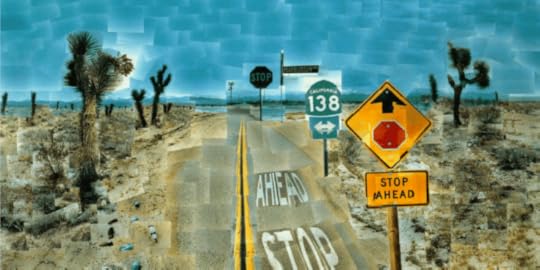
Pearblossom highway by David Hockney

My second Percival Everett book. It’s well plotted. Lots of devices tell us what’s coming. Mostly we hear the ordinary life narrated by Zach Wells, professor of Geology at a California University. How he loves his daughter, Sarah, and she’s a gorgeous pre-teen smart, likable, quirky well raised kid. But then there’s the little interludes that Everitt likes. In this case they go like this – there’s all these murdered Mexican women. Hundreds apparently. Why? We don’t know yet. They are like news stories, maybe talk in the street, maybe gossip, maybe a haunted narrative voice keeps telling Zach all about them.

Then we’re told we may get a student crush on the teacher story with young Rachel. Then what’s happening with the young academic who won’t get tenure. Zach is a nerdy, straight speaker. He tells Rachel he’s not interested and the young teacher she hasn’t published in five years and hasn’t done anything with her data collection. So she’s not going to get tenure or anything else. What’s going to happen? Where’s this heading?

Everitt likes surprise and narrators you can’t quite trust.

In this case never trust narrators when they tell you anything. Zach Wells wants to tell us he's ordinary and dull. 


Never trust a narrator when they don't tell you something, either. Zach doesn't tell us he's black. Because that would colour our perceptions of the story. He tells us when he wants us to know something about being black, not what we expect. 

Though unexceptional Zach faces what most parents dread about their kids. Imagine what that might be for a moment so I don’t have to reveal story and spoil it.

In a subplot Zach gets messages in his clothes he buys off eBay in Spanish saying “help me”. He buys more and there are more messages. He wants to know more. But at home, there are more pressing matters.

The little crush and campus relationship stories don’t go where we think they will go.

There’s texture. It’s a hot California summer. There’s maybe bears and big cats in the hills above their house when Zach go for walks with his daughter. Sarah might like to see one, but she knows to look out for their scat, she’s smart and bright and sensible. She plays chess better than her father. Megan the mother is also a teacher and a poet. We think their relationship might be in poor shape. There’s something like tension. Probably the normal tension raising children.

But as I said, there is a plot. It’s best not to know it’s coming. There’s subplots. Go along with them, the action is a good read. I don’t normally like plots nor action. But Everett isn’t into normal plots and action. They are narrative methods to keep the surface moving quickly above a deeper set of ideas. Why would Everett not tell us Zach is black? It’s obviously the author at work here. When two black students protesting about black men killed by police, they come to see him and ask him speak to other students. They also want to have their exams suspended due to the trauma of what’s happening to black lives. He tells them he won’t support that idea. He thinks they need to find the resilience to sit their exams. He’s not a soft touch. He doesn’t follow in step behind liberal values. He’s got a tough back story. Not a life from the hood story, though.

I like Zach, from him we get a deep sense of the worries and efforts of raising a child. It’s rare in literature I realised. He sounds like he’s done a great job.

I also don’t think this is a great book. Not like Erasure, which was highly charged genius. But it left me with many images of this brief period of a family life in California, the effort it takes to raise a family, be a decent human being, flow against the current, do something right in the world, even if it is grief driven. You don’t need all the psychological ducks lined up in a row to take action. You just do it to the best of your ordinary ability.
Profile Image for Lisa.
101 reviews210 followers
February 10, 2022
A smart, sometimes sad, shapeshifting book that took me by surprise with its abrupt ending.

* * *

What's that, there are THREE possible endings? How enigmatic. I landed ending C. I don't think the relationship was right for me.

* * *

It's not just the ending - there are three VERSIONS of this book? For the curious, who, like me, just need to know - the differences are detailed here. In my distraction I appear to have missed a pretty huge plot point, which I only see because it isn't shared by all three versions. Humbling. If nothing else, Percival Everett wants to check if your brain wheels are spinning right.
Displaying 1 - 30 of 1,019 reviews

Can't find what you're looking for?

Get help and learn more about the design.